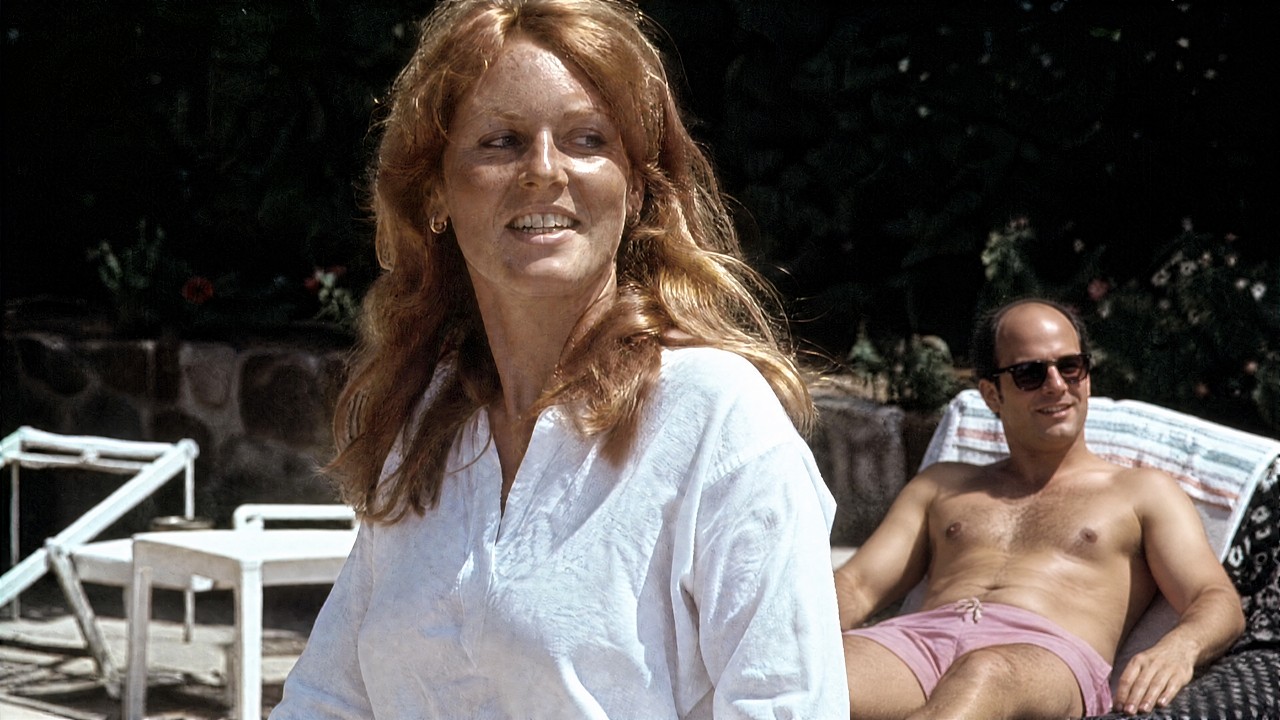
The newspapers were laid out on the breakfast table at Balmoral as they were every morning, and the Queen turned the pages without a word. On one of those pages was a photograph of her son’s wife, the Duchess of York, stretched out beside a French swimming pool while another man kissed her bare toes. Sarah Ferguson sat in that silence and understood that her place in the family was already over. No one shouted.
No one sent her away. By the end of the visit, she had gathered her two small daughters and gone. The most powerful family in Britain simply closed around the space where she had been. The question was never whether they would forgive her.
It was whether they had ever truly let her in. What happened to this woman did not end at that breakfast table. It was only beginning. The Ferguson family lived on the edge of the royal world for years before anyone thought to photograph the daughter.
They were not aristocracy and they were not new money. They were something older and quieter than either: the landed county gentry of southern England, people who measured their standing in acres and horses rather than titles, who knew the great families not as distant figures on a balcony but as the people they rode beside on a Sunday afternoon. Sarah Margaret Ferguson was born on the 15th of October 1959 at a nursing home in Marylebone in central London. Her father was Major Ronald Ferguson, a former officer of the Life Guards, a big, bluff, weathered man who had found the role that would define the rest of his life.
He became the polo manager first to Prince Philip and then to the young Prince Charles. For decades, the Ferguson name was stitched into the practical, unglamorous machinery of royal leisure. When Charles wanted to play, Ronald Ferguson arranged the ponies, the grounds, the fixtures, the men. The family did not visit the royal world as guests.
They worked at its edges, trusted, useful, and always one rung below. Ronald Ferguson himself would one day become a tabloid quarry, exposed at the end of the 1980s over his visits to a London massage parlor. His private habits spread across the same kind of front pages that would one day feast on his daughter. The Fergusons knew the taste of the modern press long before Sarah ever wore a tiara.
They understood how naked a person became once the cameras decided they were worth the chase. It was knowledge that would do Sarah no good at all in the end. She had grown up close enough to fame to know its dangers, and close enough to royalty to believe fatally that the great family on the hill would always protect its own. On both counts, she was about to be proved wrong.
Home was Dummer Down Farm in Hampshire, a working house in a green and ordinary corner of England. The childhood Sarah later described was the childhood of a certain kind of English girl of her generation and class. There were horses before there were friends. There was mud and rain and the smell of the stable.
There was boarding school and the long ache of being sent away from home young. And threaded through all of it was the sense of a family that belonged to the gentry but lived close enough to royalty to feel its pull. Then came the rupture she would speak about for the rest of her life. In 1972, when Sarah was twelve, her parents separated.
Her mother Susan fell in love with an Argentine polo player named Héctor Barrantes and left. She did not simply leave the marriage. She left the country, going to Argentina to a new life on another continent, and a twelve-year-old girl was left behind in England with a famous father and a hole in the center of her world. Those who later tried to understand the adult Sarah Ferguson, the woman who could not stop spending, who reached again and again for the wrong people and the wrong deals, returned often to that departure.
A child learns early what it feels like to be the one who is left. A child learns that love can simply pick up and move to the other side of the planet. She was not a scholar. She left school without qualifications that opened doors, took a secretarial course, and went to work.
By her early twenties she was a young woman in London, employed in public relations and publishing, sharing flats, living the busy, unremarkable life of a well-connected girl with a good name and no fortune. She was tall and strong and loud in the way the English upper classes have always quietly enjoyed in their women. Good in the saddle, good at a party, quick to laugh. She had grown up around royalty and was entirely unintimidated by it.
What she did not have was money of her own. She was, in the language of the world she had been born into, a thoroughly suitable girl. It was the Princess of Wales who decided that Sarah Ferguson should be seated next to the Queen’s second son. The two young women had known each other for years in the loose, overlapping way of the English upper class, distant cousins of a sort who moved in the same circles and had friends in common.
By the middle of the 1980s, Diana was no longer just another well-bred girl. She was the Princess of Wales, the wife of the heir to the throne, the brightest object in the entire firmament of British public life. Diana was also, by her own later account, lonely inside the palace, and she wanted an ally: someone of her own generation who understood the strangeness of the life she had married into, someone funny and warm who could sit beside her at the long, stiff royal occasions and make them bearable. She looked at Sarah Ferguson, her old acquaintance, four years older, robust and cheerful, and entirely without airs, and she saw exactly the kind of friend she needed, and perhaps she saw a match.
The reintroduction came at Royal Ascot in June of 1985. Diana arranged for Sarah to be placed in the royal party in the company of Prince Andrew. Andrew was the Queen’s second son, then twenty-five years old, a serving officer in the Royal Navy, a helicopter pilot who had flown in the Falklands conflict three years before. In the public imagination he was the dashing one, the action man, the prince who had gone to war.
He was handsome and confident, and like Sarah, fond of a joke. They were seated together, and by the accounts of everyone present, they got on at once. Two young women, barely out of girlhood, were being slotted into the most scrutinized marriages in the country, chosen in large part for their suitability, their breeding, their willingness to fit. Diana had been twenty when she married the heir to the throne.
Sarah would be twenty-six. Neither had been prepared in any real sense for the life that waited. The country, meanwhile, was gripped by a royal fever that is hard to recall now, a decade in which the young royals were treated as something between film stars and living saints. Their clothes copied, their words passed, their every appearance turned into front-page news.
Into that furnace of attention, Diana, with the kindest of intentions, was leading her cheerful, unguarded friend. She thought she was giving Sarah a gift. In a sense, she was handing her to the cameras. The courtship that followed was quick, and it was happy.
Two large, loud, athletic young people from the same world, both used to royalty, both fond of the outdoors and the good life, falling for each other in a perfectly ordinary way. Andrew was often at sea, so much of the romance carried on by letter and telephone and in snatched weekends. It moved with confidence toward the only conclusion it could have, and in March of 1986 the engagement was announced. The country was delighted.
In 1986, Sarah Ferguson was a popular choice. The press, which would later take her apart with such relish, welcomed her warmly. She was presented as a breath of fresh air, a real woman, ruddy and full-figured and full of life, a contrast to the porcelain fragility the cameras had built around Diana. She rode, she skied, she laughed with her mouth open.
She seemed in that first season like proof that the monarchy could let in someone genuine. What neither woman could see in the bright summer of 1985 was the nature of the thing Sarah was being welcomed into. From the outside, the royal family looked like the most secure family in the world, ancient, wealthy, untouchable. From the inside, it was not a family at all in the way Sarah understood the word.
It was an institution that wore the shape of a family. It had rituals that looked like warmth and obligations that looked like love, and it had a way of dealing with those who failed it that did not involve raised voices or slammed doors. It simply withdrew slowly and completely until the person who had failed found themselves standing outside in the cold, unable to say exactly when the door had closed. On a July morning in 1986, Sarah Ferguson walked into Westminster Abbey and walked out a duchess.
The date was the 23rd of July. She wore a dress of ivory silk with a long train embroidered with bees and thistles and the initial letter of the prince she was marrying, and on her red hair sat a coronet of flowers that was replaced during the service by a diamond tiara. An estimated audience of five hundred million people around the world watched the ceremony. Crowds hundreds of thousands strong filled the streets of London, lining the route from the palace to the abbey.
Her wedding dress carried a train nearly eighteen feet long, embroidered with bees and thistles and the anchors of her sailor prince. When she rose from the marriage, she was no longer Sarah Ferguson. She was Her Royal Highness, the Duchess of York. Her husband had been created Duke of York that same morning, the title traditionally given to the Sovereign’s second son.
She was twenty-six years old. She had gone in the space of a single ceremony from a young woman who worked in publishing and worried about the rent to one of the highest-ranking women in the kingdom. No private citizen rises higher in a single morning than a commoner who marries a prince. Sarah Ferguson had reached an altitude from which any fall would be measured by the same hundreds of millions of eyes that had watched her climb.
For a few short years it seemed to work. The new Duchess of York threw herself into royal duties with an energy the public found endearing. She was informal where the family was formal, warm where it was guarded, willing to be photographed laughing on a ski slope or larking about at a public event. The newspapers gave her an affectionate nickname.
She was, in the phrase of the time, the People’s Duchess, before that title was ever attached to anyone else. Then came the children. Princess Beatrice was born on the 8th of August, 1988. Princess Eugenie followed on the 23rd of March, 1990.
Whatever else would be said of Sarah Ferguson in the decades to come, no one who knew her ever seriously questioned that she loved her daughters with a fierce and uncomplicated devotion. But the structure beneath the marriage was already failing. Consider what the role of a royal duchess actually was. It came with a title, a place in the order of precedence, an expectation of grandeur, and a schedule of public duties.
It did not come with a salary Sarah controlled. It did not come with a purpose she had chosen. It did not come, crucially, with a husband who was there. Andrew was a serving naval officer, and the Navy did not adjust its deployments for the feelings of a duchess.
He was away for months at a stretch. Here is the trap laid out plainly, because everything that follows grows from it. Sarah Ferguson had been given the lifestyle and the expectations of a great lady, and almost none of the things that might have made it bearable. No independent money.
No defined work. No husband at home. A press that had crowned her and was already quietly sharpening its knives, and a family that watched her, measured her against its ancient standards, and found her increasingly wanting. She was at the peak of her rise, photographed on the palace balcony, a duchess and a mother and the most cheerful face in the family, and she had never been more alone.
The fall would not come as a single blow. It would come as a slow leak, a draining away of welcome and money and dignity over years until the morning at Balmoral when the leak became a flood. Andrew went where the Navy sent him. She stayed behind in the houses of a family that gathered on its own terms and dispersed on its own terms, holding two small children and a diary full of engagements she had not chosen.
Sarah had married into a world with its own language, its own silences, its own immovable customs, and she had married the one member of it who was least often present to translate. The other women of the family had been born to it, or had spent decades learning it. Sarah was learning it alone in public, while being scored on her performance by an unforgiving press and an even more unforgiving establishment. Into that emptiness came other people.
Some were friends. Some were advisers. Some were the kind of men who attach themselves to the rich and the famous and the unhappy: the financial managers and the well-dressed hangers-on who offer to take the difficult things off a person’s hands. Sarah had no head for money and a growing need for it, and she had time and loneliness and a name that made her interesting to exactly the wrong sort of company.
The pattern that would define her later life was set in these years. When she was unhappy, she reached outward toward people who flattered her and toward purchases that comforted her, and the reaching always seemed to cost more than she had. She also began to chafe against the institution itself. She found its coldness baffling and its rules arbitrary.
She made mistakes. She went on holidays that looked extravagant. She was photographed in places and with people that the household considered beneath the dignity of a duchess. Each misstep was noted.
Nothing was said to her face. The disapproval accumulated in the way that disapproval always accumulated in that family: quietly, completely, and without appeal. Consider the arithmetic of the marriage in those years. Andrew could be at sea for the better part of half a year.
Beatrice was born in 1988, Eugenie in 1990, two infants inside three years. The couple were building a new marital home, Sunninghill Park, near Windsor, a house with around twelve principal bedrooms and a price the newspapers loved to total up. Sarah was carrying out dozens of public engagements a year on behalf of a family that gave her little money of her own and less affection. She was by any honest measure a single mother of high rank with a vanishing husband and an audience of millions, and she was twenty-nine years old.
What broke first was not the marriage’s love but its foundation. By many accounts, the two of them remained fond of each other for the rest of their lives, which is part of what makes the story so strange. But fondness was not enough to survive the absences, the loneliness, the relentless press, and the slow freeze of a family that had decided she did not fit. By the turn of the decade, the marriage was a marriage in name.
The cracks were not yet visible to the public. The balcony appearances continued. The cheerful duchess still smiled for the cameras. But the thing was hollowing out from the inside, and the press, which had built her up, was about to discover how much more profitable it was to tear her down.
The same newspapers that had crowned her the People’s Duchess began, one headline at a time, to take her apart. It began with her body. The press that had once celebrated her as a real woman, robust and healthy, turned that same body into a daily target. Her weight became a national sport.
Cruel nicknames were coined and repeated until they stuck. Photographs were chosen for the angles that flattered her least. A person can armor herself against a single cruel headline. No one can armor herself against years of them, against opening a newspaper most mornings to find her body, her face, her judgment, her worth as a wife and a mother held up for the nation to laugh at.
Then it spread. Her clothes were ridiculed. Her holidays were totaled up and presented as evidence of extravagance. Her commercial instincts, her wish to make something of her own and to earn money in her own right, were treated as vulgar.
She wrote a series of children’s books about a small helicopter drawing on her husband’s world of flight, and even that was turned against her. The new house, Sunninghill Park, became a national joke, mocked for its style, compared unfavorably to the great historic houses of the family she had married into, given a sneering nickname that likened it to a ranch from an American television soap opera. There was a logic to the cruelty, and it was a commercial one. Britain at the start of the 1990s had the most ferociously competitive newspaper market in the world, and royal scandal was the sharpest weapon either side possessed.
A Duchess of York story, however thin, reliably moved papers off the shelf. She was not, to the industry that hunted her, a woman at all. She was a commodity, and the most valuable form of that commodity was the duchess caught out, the duchess humbled, the duchess in disgrace. By the start of the 1990s, Sarah was the subject of front pages on a near-weekly basis.
There was, in cold commercial terms, money in her humiliation. And here the story reaches forward to a darker chapter of British history, because the culture that was forming around Sarah Ferguson in these years was the same culture that would pursue her friend Diana to her death. The long lens, the hidden photographer, the willingness to print anything and total up the cost later. Sarah was one of its earliest sustained targets.
She was learning the hard way that a famous woman in 1990s Britain did not own her own image, her own body, or her own private hours; they belonged to whoever held the camera. What this did to her, beyond the obvious wounding, was to push her further toward the very behaviors the press was punishing. Lonely, mocked, short of money, and surrounded by people who profited from her, she reached harder for comfort and for escape. She spent, she traveled, she kept the wrong company.
Each act fed the next headline, and each headline deepened the unhappiness that drove the act. It was a closing spiral, and she was inside it. By the early months of 1992, the marriage and the public image were both beyond saving. The only question was how the end would come, and whether the family could manage it quietly.
They could not. 1992 was about to become the worst year in the modern history of the British monarchy, and Sarah Ferguson was about to provide one of its defining images. When the palace announced the end of the marriage in the spring of 1992, almost no one inside it argued for saving it. The announcement came on the 19th of March.
The Buckingham Palace press office confirmed that the Duke and Duchess of York were to separate. The language was careful and cold. The marriage that had begun before a television audience of hundreds of millions was ended in a few measured sentences read out to reporters. But 1992 was not a year for tidy endings.
It was the year the Queen herself would later call her annus horribilis, her horrible year. The marriage of the Prince and Princess of Wales was disintegrating in public, soon to be laid bare in a sensational book. The marriage of the Princess Royal was ending in divorce. And in November, a great fire tore through Windsor Castle itself, the ancient heart of the monarchy in flames, the state apartments gutted while the family looked on.
Toward the close of that year, the Queen rose at a public lunch and called it her annus horribilis. Among the most photographed symbols of that collapse was the unraveling Duchess of York, whose deepest humiliation was still, in the spring of that terrible year, only a few months away. Into the gap left by the failed marriage stepped a man named John Bryan. He was an American, a Texan, a financial adviser and businessman, and by the time of the separation he was managing Sarah’s affairs and had become her companion.
The press described him as her financial adviser. The reality, widely understood, was that the relationship was more than professional. Here again was the old pattern: Sarah, unhappy and short of money and surrounded by the wrong people, had drawn close to a man who promised to take the difficult things off her hands. A photographer lay hidden above a villa near Saint-Tropez, and the pictures he took would outlive the marriage, the divorce, and the man in them.
The villa was called Lou Mas de Pinol, a private house on the French Riviera, the kind of place the rich rent for the late summer when they want sun and discretion and a pool of their own. Sarah had gone there with John Bryan and with her daughters and with the small staff that traveled with a duchess, even a separated and impoverished one. In her mind, it was a private holiday, a stolen patch of warmth in a year that had given her very little. The photographer was a paparazzo named Daniel Angeli, and he was very good at his work.
He understood that the value of a photograph rose in direct proportion to its intimacy and its secrecy. A picture of the Duchess of York waving at a public engagement was worth little. A picture of the Duchess of York in a moment she believed to be entirely private, a moment of physical tenderness with a man who was not her husband, was worth a fortune. So he found his position somewhere above the villa with a clear line to the pool, settled in with a long lens, and waited.
In those unguarded hours by the pool, John Bryan kissed her and held her. And in the image that would travel around the entire planet, he bent to her bare foot and kissed and sucked her toes. It was a small, foolish, intimate thing, the kind of thing lovers do without thinking when they believe no one is watching. It was also, through Daniel Angeli’s lens, the single most damaging photograph ever taken of a member of the modern royal family until the cameras turned on Diana herself five years later.
The long lens could reach across hundreds of yards. The market for the images stretched across every continent, and the sums paid for an exclusive set of pictures like these ran into figures that could change a photographer’s life. A single set of exclusive pictures of a royal in a compromising private moment could be worth hundreds of thousands of pounds, sold and resold across the newspapers and magazines of the world. That was the prize Daniel Angeli was waiting for above the villa, and the Duchess of York, stretched out in the sun with no idea she was watched, was about to hand it to him.
Sarah did not know. She finished her holiday, gathered her children, and traveled north to Scotland, to Balmoral, to join the royal family for the annual summer gathering as fixed a part of their year as Christmas. She walked into the most royal of all royal settings, the Queen’s beloved Highland retreat, carrying no knowledge of what was already developing in a darkroom and being wired to picture desks across the world. She had taken her place at the family table, believing herself, however precariously, still inside the circle.
Balmoral was not simply a house bought by Queen Victoria and Prince Albert in the 1850s. Over more than a century it had become the place where the royal family went to be a family rather than an institution. There they walked the hills, fished the rivers, held their picnics and their private jokes, and shed for a few weeks each summer the formality that governed the rest of their year. To be invited to Balmoral was to be invited into the family’s most private self.
It was the warm center of the cold machine. The film was exposed. The pictures were sold. The presses were already running.
Somewhere in the south of France, a photographer was counting a fortune. And somewhere in the Highlands, a young woman was unpacking her bags in a castle with no idea that by the next morning her life inside the royal family would be, for all practical purposes, finished. The photographs reached Britain while Sarah was sitting at the Queen’s own breakfast table at Balmoral. They were published from the 20th of August, 1992, and a British newspaper led with them.
Within hours they were everywhere. At Balmoral, the mornings followed a fixed ritual. The newspapers were laid out, and the family read them over breakfast. On this morning, the papers carried the photographs.
Sarah was in the room. The Queen was in the room. There was no scene. That is the heart of it.
The Queen did not rage. She did not deliver a verdict or order anyone from the house. She read her newspapers and turned the pages, and the silence in that room did the work that no words could have done. Sarah described feeling the disapproval of the entire family settle over her at once, a cold weight, complete and unanswerable.
She understood sitting there that something had ended. Not the marriage, which was already over. Something larger. Her belonging.
Her place. No one shouted. No one sent her away. By her own account, she gathered her daughters and left Balmoral within a day or two, slipping out of the Highland sanctuary that had judged her in silence.
The institution had rendered its judgment in the manner it always preferred, the manner that left no fingerprints. There was no banishment to point to, no cruel decree, nothing a sympathetic public could rally against. There was only a turned page and a cooling room and a young woman who understood that she was now on the outside. Outside the walls of Balmoral, the photographs had set off a global frenzy.
Inside the breakfast room, where the only judgment that truly mattered to Sarah was being passed, there was no noise at all. The press could humiliate her. Only the family could unmake her. And it did so not with a decree but with a withdrawal so quiet that years later she could describe it only as a feeling, a coldness, a sense that the ground had gone from under her.
The consequences arrived quickly. The Duchess who had stood on the Buckingham Palace balcony would not stand there again in the old way. The invitations thinned. The great royal occasions went on without her.
The protection of the household, the soft machinery that had surrounded and supported her, began to retract. She kept her title for now, and her children always. But the thing she had married for, the sense of belonging to a family at last after the mother who left and the father who managed other men’s horses, was gone, taken not in anger but in silence over a breakfast table in Scotland. The marriage limped on in name for nearly four more years after the photographs.
The legal end came on the 30th of May, 1996. After that date, Sarah Ferguson was a divorced woman, and the royal machine moved to define exactly what a divorced royal wife was permitted to be. In 1996, the Queen issued letters patent, the formal legal mechanism by which the Sovereign defined such things, confirming that the divorced wives of royal princes would no longer hold the style of Her Royal Highness. Sarah lost the three letters, the H, the R, the H.
She was permitted to remain Sarah, Duchess of York, a courtesy title, a faded version of the rank she had held, but the Royal Highness was gone, removed by the stroke of a pen. The same fate was applied in the same year to Diana, who also lost her Royal Highness on her divorce from the Prince of Wales. The two outsider wives stripped of the same three letters in the same season. Then there was the money.
The divorce settlement Sarah received was, by the standards of the world she was leaving, remarkably small. There was a modest annual sum tied to the care of the children, in the region of a few tens of thousands of pounds a year. There was a lump sum. There was on top of that a large advance for her autobiography, which lifted the total package toward a few million pounds.
It was not nearly enough. In the very same year, on her own divorce, the Princess of Wales received a settlement reported at around seventeen million pounds, many times what Sarah was given. The difference was not really about the two women at all. It was about the children.
Diana was the mother of a future king and had to be kept in a manner that protected the dignity of the throne. Sarah was the mother of two princesses who would drift with each passing year further from the center of the line. The institution paid for what it valued, and it did not value her. Here is the trap closing, the trap that was laid the day she became a duchess.
The institution had given her the tastes, the expectations, the lifestyle, and the public profile of a great lady. Now it took away the income, the protection, the rank, and the belonging. And it left her with the name. A name cannot pay a bill, but it can be sold and it can be borrowed against, and it can attract exactly the kind of people who know how to profit from a famous woman in trouble.
She was not yet forty. She had been the People’s Duchess, had stood on the balcony, had been welcomed by a friend and frozen out by a family, photographed at her most private, and judged in silence at her most exposed. Within a few years, the most famous Duchess in the world owed more money than most people would earn in several lifetimes. By the middle of the 1990s, her debts were reported in the millions of pounds, by some accounts approaching four million while she was still inside the dying marriage.
In the years that followed, they climbed higher, reported at various points between four and five million. Her American lifestyle company, a venture meant to turn her name into an honest income, collapsed at the end of the 2000s, owing around six hundred thousand pounds in its British arm and close to a million dollars in the United States. At least one adviser inside the palace was reported to have raised the once unthinkable prospect of voluntary bankruptcy for the former wife of a prince, a first in the modern history of the family. The Queen, in one of the threads of this story that complicates any simple verdict, is reported to have quietly cleared some of those debts more than once.
The family had no use for her. The grandmother of her children would not abandon her entirely. Both things were true at once. To service the debt and fund the lifestyle she could not give up, Sarah turned her name into a business.
She became from 1997 a global ambassador for an American weight management company, a role that paid well and played painfully on the very thing the British press had tormented her about. She formed a connection with one of the most powerful figures in American broadcasting and appeared on the most watched talk programs in the world. She made a reality television series about her own struggle to rebuild herself, letting the cameras she had every reason to hate into the most private corners of her life because the cameras paid. She wrote books for adults and books for children, lent her name to products and to causes, and built on the strength of a title she no longer fully held a one-woman industry that spanned two continents.
Some of it earned real money. None of it earned enough, or earned it for long. She was forever one big deal away from solvency and forever one bad decision away from ruin. A famous woman in desperate financial trouble is the most exploitable person in the world.
She is willing to consider things a solvent person would refuse. And there is always someone watching, waiting to offer exactly the wrong opportunity at exactly the moment she is least able to say no. In the spring of 2010, that someone arrived. He presented himself as a wealthy businessman, the kind of rich and worldly man who could make a duchess’s debts disappear.
He was charming and generous and interested in what she could offer. And he was, in truth, a newspaper reporter with a hidden camera and a long history of catching exactly this kind of desperate, exploitable, famous person in exactly this kind of trap. The stranger was the creation of a journalist named Mazher Mahmood, a reporter for a Sunday newspaper who had built an entire career out of a single devastatingly effective disguise. He posed as a fabulously rich businessman from the Gulf, a sheikh with bottomless funds and a taste for deals.
Over many years he had used that disguise to draw the greedy, the foolish, and the desperate into incriminating themselves on hidden film. The press called him the fake sheikh. In 2010, he turned his attention to the Duchess of York. The bait was money.
In exchange for a large payment, Sarah would provide access to her former husband, Prince Andrew, who at that time held an official role as a trade envoy for the United Kingdom, a position that took him around the world meeting exactly the sort of wealthy businessmen the fake sheikh pretended to be. As a special representative for British trade and investment, the prince traveled the globe on the country’s behalf, opening doors to governments and tycoons, the kind of access that men of real wealth would pay handsomely to obtain. To sell a private route to such a man was not an empty boast. The figures captured on the recording are precise.
Sarah was filmed asking for five hundred thousand pounds for the access, along with a cash down payment reported at tens of thousands of dollars handed over on the spot. She was recorded saying that she had discussed the matter with Andrew, attributing to him the very sum she was naming. When the newspaper published the story and the footage, it detonated. Here was the former wife of a prince caught on camera apparently selling access to the royal family for cash to clear her own debts.
It must be said plainly: the toe-kissing photographs were a private moment stolen by a hidden camera, a humiliation done to her. This was different. No long lens caught her in an unguarded instant of human tenderness. She sat down with a man she believed to be rich and offered to sell access to her own children’s family for half a million pounds.
And she did it because she was desperate. The desperation was real. But the choice was hers. The fake sheikh did not create her desperation.
He simply found it and switched on his camera. There would be a strange and bitter coda to the affair years later. The reporter who had trapped her, Mazher Mahmood, was himself eventually jailed for perverting the course of justice in an unrelated case. Sarah, in the wake of his disgrace, was reported to be seeking substantial damages for what his deception had cost her.
But it came far too late to repair what the sting had done. The footage existed. The words were on the record. The image of the Duchess selling access for cash had joined the image of the Duchess by the French pool in the permanent gallery of her public shame.
The worst was not yet behind her. The man was Jeffrey Epstein, the American financier whose name would become a byword for the abuse of the powerless by the powerful, and whose web of connections reached into the highest rooms of British and American life, including the household Sarah had married into. Her former husband, Prince Andrew, would become one of the most prominent figures tainted by association with Epstein, the subject of allegations made by a woman named Virginia Giuffre, allegations he denied but which would in the end help to destroy what remained of his public life. Sarah’s own connection to Epstein was documented in the worst possible form, in her own words, in writing.
In correspondence that would later surface, she described Epstein in terms difficult to read now, calling him a supreme friend, a legend, the brother she had always wished for. There was money tangled up in the friendship, too: reports that Epstein had helped with her debts, that the same desperate need that drove the fake sheikh meeting had drawn her into the orbit of a man whose generosity always came with a shadow. To grasp how heavy that association would become, one has to follow what happened to Andrew. The prince’s friendship with Epstein and the allegations brought by Virginia Giuffre, who said she had been trafficked to him as a teenager, became one of the gravest scandals ever to touch the modern monarchy.
Andrew denied the allegations, but a catastrophic television interview in which he seemed to show neither judgment nor remorse destroyed what was left of his public standing, and in time he would settle Giuffre’s civil claim without any admission of liability. The man Sarah had married, the dashing naval officer who had gone to war, became a figure the institution could no longer be seen to shelter. And through all of it, Sarah remained at his side, sharing the grand house at Royal Lodge, a residence of some thirty rooms on the Windsor estate, where the divorced couple had gone on living together for the better part of three decades. The arrangement had once seemed merely eccentric.
Now, as the Epstein scandal closed around them both, it began to look like a shared sentence. Two people who had been frozen out together, clinging to the last warm room in a house that no longer wanted either of them. They had separated in 1992 and divorced in 1996, and then they had simply gone on living together. When the Epstein scandal closed around Andrew, Sarah stood by him.
She had married the man, been frozen out by his family alongside her, and she would not abandon him. The two of them, the prince who had gone to war and the girl from the polo field, ended where they had begun, bound together. Only now they were bound in scandal rather than celebration, sharing a house on the edge of the royal estate while the family that owned it decided in its silent way what to do about the pair of them. The decision, when it came, would be the most complete withdrawal yet.
The illness came first. In the summer of 2023, Sarah was diagnosed with breast cancer and underwent a mastectomy. Months later, at the start of 2024, she received a second diagnosis, a malignant melanoma, a serious skin cancer found while she was still recovering from the first. Two grave cancers inside a single year.
In Sarah’s life, it was almost a footnote, crowded out by the scandal gathering once more around her name. She fought two cancers in near silence while the storm that would finish her public life was already building on the horizon. She spoke about both publicly, urging others to be screened. Then the ground gave way entirely.
For years, the Epstein affair had been in the public mind chiefly Andrew’s disgrace, with Sarah cast as the loyal former wife standing by a fallen man. The release of fresh documents changed that story overnight. Among the material were messages in which Sarah herself addressed Epstein in warm and intimate terms, the same words again, the legend, the supreme friend, the brother she had always wished for, alongside reporting that he had helped her with money when she was desperate. There was reporting, too, of a crude remark she had once made in writing about her own daughter, a detail that did her enormous further harm.
The careful decades of rehabilitation, the charity work, the cancer campaigns, the slow and partial readmissions to the edges of royal life, were swept away in a matter of days. This time the disgrace was hers as squarely as it was his. The consequences fell on both of them together. In the autumn of 2025, Andrew was stripped of his remaining royal titles, the final stage of his removal from public life.
Then came the eviction. In the early part of 2026, the couple were required to leave Royal Lodge, and Andrew departed his home of two decades. The last physical foothold either of them had on the royal world was taken away. Sarah Ferguson had entered the royal world through a marriage celebrated before hundreds of millions and had been given a place inside the family.
Now, decades later, she was leaving it through an eviction, put out of a house on the edge of the estate, her name dragged through the worst scandal of all, her former husband stripped of the titles he had carried since their wedding day. She had been welcomed with a coronet and a tiara and a balcony. She was being removed with a notice to quit. As the summer of 2026 arrived, she was reported to be away from Britain altogether, facing fresh scrutiny over new allegations about her conduct, the Epstein fallout still spreading around her.
She was sixty-six years old. She had survived two cancers and outlived the marriage, the title, the fortune she never quite had, and most of the people who had judged her. The Queen who had turned the pages in silence at Balmoral was gone, dead in 2022, and with her went the one person inside the institution who had ever reached back to pull Sarah from the edge. There was no one left now to clear the debts or soften the verdict.
Decades later, the photograph is still the first thing the world remembers. Say the name Sarah Ferguson to almost anyone, and before the children’s books or the cancer campaigns or the long exhausting struggle to stay solvent, before the woman herself in all her complication, there rises the image of a duchess by a French pool and a man at her bare feet. Daniel Angeli’s stolen frame outlived the marriage that produced it, the divorce that followed it, the man who knelt in it, and the very camera that captured it. A single afternoon she did not know was being recorded became in the end the sum of her.
Five years after the toe-kissing photographs, the same culture of the hidden camera and the bottomless appetite for royal women’s private hours would chase her friend Diana into a tunnel in Paris and kill her. Sarah survived her own pursuit. But survival came at the cost of being permanently reduced to her worst moment. The woman spent more than thirty years trying to be more than one afternoon by a pool, and she never quite managed it, because the image would not let her go.
And beneath the photograph lies the deeper truth. Sarah Ferguson’s tragedy was that she mistook an institution for a family. She had grown up with a mother who left and a father who served, and she had married, she believed, into belonging at last, into a family grand enough and old enough to hold her forever. But the thing she married was not a family.
It was an institution wearing a family’s face. An institution does not forgive. An institution does not have a breakfast table where wrongs are shouted out and made up again. It has only its slow, silent power to withdraw, and it used that power on her with a completeness that no amount of shouting could have matched.
So return at the last to the breakfast room at Balmoral, to the morning the photographs came. Picture the laid-out newspapers and the turned page and the cold, complete silence settling over a young woman who had thought she was home. No one shouted. No one sent her away.
That was the cruelty and that was the power, all in one. They simply turned the page and let the silence do the rest. And a duchess understood that she had never truly been let in at all. The grandest doors in Britain had opened for her once before a watching world.
They closed without a sound.
