The young woman behind the counter kept glancing toward the door of the card shop, certain someone was watching her. She never saw anyone, no one ever approached her, nothing happened at all—just a feeling that would not go away. Lisa Ziegert mentioned it to the people around her, but nobody ever saw anyone hovering near Britt’s Card Shop in the small shopping plaza in Agawam, Massachusetts, so it was probably nothing. Just her imagination.
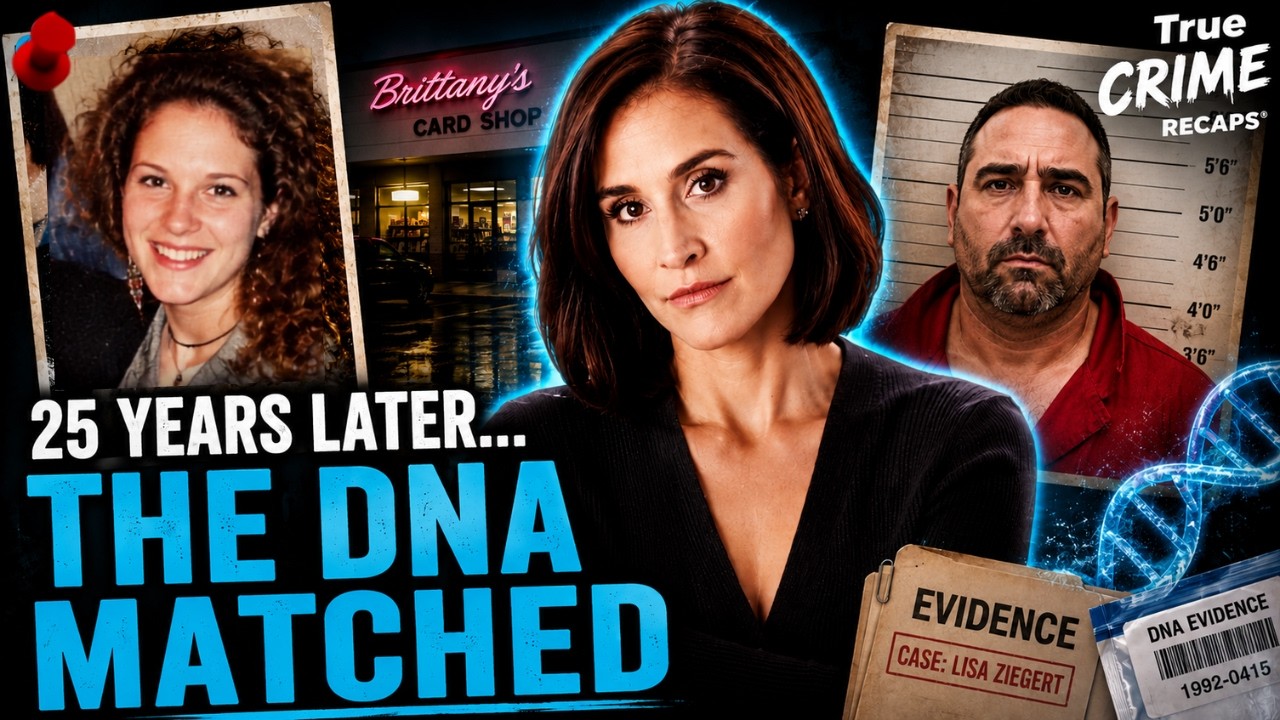
Days later, on the night of April 15, 1992, Lisa was working alone inside that same card shop. By closing time, she would be gone. Earlier that day, there was nothing unusual. Lisa was exactly where anyone would expect her to be, balancing two jobs, even three if Sunday school teaching counted.
During the day, she worked as a teacher’s aide for special needs children at the junior high school in Agawam. The card shop was extra income. She usually left the school around 4:00 or 4:30, drove straight to the shop for her shift, 5:00 to 9:00 in the evening. She had a boyfriend, she had friends, and a future moving forward exactly the way a twenty-four-year-old’s future should move.
People close to her described her as kind and dependable and easygoing. That evening, Lisa arrived for her shift at Britt’s. The plaza was busy enough. Cars came and went, customers entered and left.
Nothing stood out. Around 5:30, Lisa’s sister stopped by the shop. They talked for a while, nothing serious, just ordinary conversation between sisters. Around 6:00, her sister left.
Neither of them knew it would be the last time they saw each other. As the evening wore on, the plaza grew quiet. Stores began closing and the crowd thinned. Lisa stayed behind the counter, helping the few customers left that night.
At 8:20, she rang up what investigators would later confirm as the last recorded sale on the cash register. It was completely ordinary. The customer paid, the receipt printed, the customer left. Shortly afterwards, just before 9:00, another customer walked into the shop.
At first everything seemed normal. The lights were still on, the music still playing. But she heard something odd—a knocking sound coming from the back of the store. She stood in the shop for a minute or two, waiting for someone, but no one came out to ask if she needed help.
No one even acknowledged her presence. There was no one at the front at all. The whole thing felt awkward and uncomfortable, so she turned around and left. The next morning, the day shift arrived to open the shop and immediately knew something was wrong.
The doors were unlocked. The lights were still on. The music still played through the speakers. Lisa’s purse was behind the counter, her keys still there, but Lisa was not.
Then they noticed the back room. There were signs of a struggle—boxes crushed, bloodstains on some of the cards and balloons. Near a side door leading to the alley, there was a heel mark, as if someone had resisted desperately to stay and was taken anyway. Police were called, and within hours officers began searching for Lisa.
At first everyone wanted to believe there was an explanation. Maybe she had a medical emergency. Maybe she was injured somewhere and could not call for help. But as the hours turned into days, those explanations became harder to believe, because Lisa did not miss work, she did not stop calling her family, and she certainly did not disappear without telling anyone.
Four days later, on Easter Sunday, a man walking his dog near a wooded area made a horrifying discovery. A few miles from Britt’s Card Shop, hidden near a dirt road not clearly visible from the main road, he found the body of a young woman. It was Lisa Ziegert. She had been viciously attacked, her clothes torn, stabbed.
Whoever did it was still free. For investigators, the first question was obvious. Who could want to hurt Lisa? The problem was that no one had a bad word to say about her.
She had no enemies. She was not involved in drugs. She was not living some secret double life. That left investigators with a problem.
If this was not personal, then what was it? As the news spread, Agawam did what every small town does after a tragedy—people started talking. Rumors spread faster than facts. Everyone had a theory.
Everyone knew someone who knew someone who had heard something. Before long, one rumor rose above all the others. It centered on Lisa’s boyfriend and his roommate, a man whose family restaurant sat in the same shopping plaza as Britt’s Card Shop. That man’s father was a member of the local police department, and in the absence of any answers, some people convinced themselves the explanation had to be close to home.
Maybe jealousy. Maybe a love triangle. Maybe a hidden conflict no one knew about. And because his father was on the police force, it had to be a conspiracy—they had to be covering it up.
The rumor spread and spread, but the problem was that investigators found no evidence to support any of it. Both the boyfriend and the roommate had solid alibis. More importantly, investigators had found something on Lisa’s body that changed the entire course of the case—DNA. That might seem unremarkable today, but in 1992 DNA technology was still relatively new.
For investigators, it was both incredibly valuable and incredibly frustrating, because the DNA told them something important. The killer had left evidence behind, but the DNA did not tell them who he was. Not yet. Police compared samples from people close to Lisa, including her boyfriend and his roommate.
No match. But the rumors continued anyway. So while the public looked at familiar faces, investigators began considering a far more unsettling possibility. What if Lisa had not been targeted by someone she knew?
What if the person responsible was a stranger? Because if that were true, he could be almost anyone. Thousands of tips poured in. Some were serious, some ridiculous.
Many came from angry ex-wives, ex-girlfriends, coworkers, neighbors—people settling old scores. Investigators chased lead after lead, most going nowhere. But one caught their attention, arriving in 1993, less than a year after Lisa’s murder. It came from the lawyer of a woman going through a divorce.
She thought her husband might be connected to the case somehow—not because she had hard evidence, but because of the way he behaved every time news coverage of Lisa’s murder appeared on television. Her husband became obsessed. He would rush into the room. He wanted to hear every detail.
He followed every update. The man’s name was Gary Schara. At the time, Gary seemed perfectly ordinary. He was married.
He had a young son. He lived nearby. No criminal record. Nothing that directly stood out.
But investigators called him. At first, Gary agreed to come in and answer questions. But by the very next day, everything changed. His lawyer called the police and told them Gary would not be coming after all.
He would not answer any questions, and he would not provide a DNA sample. The lawyer claimed the accusation came from a bitter ex-wife in the middle of a fierce divorce and custody battle. Without any evidence linking Gary to the crime, investigators did what they had to do—they wrote down his name, filed it away, and moved on. Years passed, then a decade.
The case remained unsolved, but no one was ready to give up. Every so often, investigators pulled the file off the shelf and reviewed the old names and past tips. Eventually, one of those names caught their attention again—Gary Schara. This time investigators decided to try interviewing him once more.
It was now 2002. They reached out, and to their surprise, Gary agreed to meet. The conversation started normally enough, and then investigators asked for a DNA sample. Gary said no.
Not just no, but a no for a reason investigators had never heard before. According to investigators, Gary said he was afraid of cloning. Cloning. You might have heard some strange excuses in your life, but if police ask for a DNA sample in a murder investigation and your response is, “I’m worried about cloning,” you are probably not helping yourself.
But investigators could not force him, not yet. So again, Gary walked out the door, and the case went cold. Another six years passed. By 2008, investigators had narrowed the list of possible suspects further, and again they found themselves staring at the same name—Gary Schara.
For the third time, investigators brought him in for questioning. For the third time, they asked the questions. For the third time, they asked for a DNA sample. Gary refused again.
But this time, investigators tried something else. They handed him a bottle of water—not because they were deeply concerned about his hydration, but because they hoped he would touch it, leaving behind DNA or a fingerprint, anything. Gary did not take the bait. According to investigators, he barely touched anything during the interview.
Not the bottle, not the table, nothing at all. He answered questions, said he did not really know Lisa, did not remember much, and eventually left. Three interviews. Three opportunities.
Three times investigators got close, and three times they had to watch him walk away. By this point, Lisa’s murder had remained unsolved for over twenty years, and it was beginning to look like it might stay that way forever. Then a new district attorney took office, and everything changed. He did not need anyone to explain the importance of Lisa Ziegert’s case—he already knew it.
He had grown up hearing about it, just like almost everyone in western Massachusetts. For twenty-five years, Lisa’s murder had been an open wound—a case everyone remembered but no one seemed able to solve. This district attorney made clear from the start that he wanted another attempt. Fresh eyes, new technology.
Forensic science had come a long way, and the DNA found at the crime scene was still preserved. Although investigators still did not know who it belonged to, they now had tools that simply did not exist in 1992. One of those tools was DNA phenotyping. Scientists analyzed the genetic material the killer had left behind and used it to predict physical characteristics—eye color, hair color, even facial features.
It was not a precise photograph, more like a sketch based on science, but it was more than they had ever had before. Investigators released this image to the public. At first, nothing happened. No one called with that miracle tip.
No one suddenly solved the case. But something unexpected did happen. The image gave investigators a new way to look at their suspect list. Instead of asking, “Who looks suspicious?
” they began asking, “Who matches this genetic profile? ”
One by one, names fell away. The list grew smaller and smaller until investigators found themselves with a handful of men who still matched the profile, all of whom shared one thing in common—none of them would agree to provide a DNA sample. One of those names was Gary Schara.
The problem was that on paper he did not look like a likely killer. In 1992 he had worked as a manager at a popular restaurant not far from Agawam. Later, he spent years working for Enterprise Rent-A-Car. No violent criminal history, no notable arrest record, no obvious reason for investigators to focus on him.
At least not until they started reviewing some old statements, especially the one given by his ex-wife, the woman who had first raised concerns decades earlier. She remembered something that had never sat right with her. Shortly after Lisa’s murder, there were wounds on Gary’s hands. Not evidence of anything, just something else she remembered.
But then there was something even stranger—a music box. At some point, Gary gave her a music box. He said he bought it at Britt’s Card Shop—the same shop where Lisa worked. According to his ex-wife, Gary claimed a little old lady had sold it to him.
Investigators could find no record of any little old ladies ever working there. It was a small detail, but a strange lie if you had nothing to hide. Investigators suddenly began wondering whether Gary had really bought that music box from Britt’s. Why lie about something like that?
Did you meet Lisa? Did you watch her while she worked? Is that why you chose her? No one could answer those questions, but the possibility was hard to ignore.
In August 2017, investigators finally moved. A grand jury ordered eleven men from the case files to provide DNA samples. These were the eleven men who matched the DNA profile and had all refused to provide it voluntarily. Gary was clearly among them.
Investigators went out with search warrants. Gary’s apartment was not the first stop—it was the second. But when investigators arrived, he was not home. They left a message with his roommate and moved on to the next name.
The next day, something strange happened. Gary’s girlfriend walked into the police station carrying three letters. One was a will. The second was a confession.
The third was an apology to Lisa’s family. For twenty-five years, investigators had tried to find out what happened inside Britt’s Card Shop, and now they held a letter from one of the eleven men on their list, and in that letter he said he did it. In the confession, Gary described abducting Lisa from the shop. He claimed he never intended to kill her, that things got out of control.
He said he had never done it again and had regretted it ever since. Then investigators reached a deeply disturbing part of the letter. “I was never normal and never felt it,” he wrote. “Since I was young, I was fascinated with kidnapping and restraints.
I couldn’t get the thought out of my head for a long time. On that fateful day, I allowed myself to do something horrible. ”
Investigators immediately went looking for Gary, initially believing he might have killed himself, since the letters clearly pointed to that possibility. But Gary’s final cowardly act was surprisingly in character.
Although he had written what looked like a confession and a farewell, he did not actually follow through. Instead, he took a handful of over-the-counter painkillers, drove himself to the hospital, and walked in alive to have his stomach pumped. While Gary was in the hospital, investigators executed the search warrant. Inside his home, they found what they had been trying to obtain for years—his DNA.
Specifically, they got it from a toothbrush. The sample was rushed to the lab. Investigators waited, and the results came back a match. Gary Schara’s DNA matched the DNA found on Lisa Ziegert.
After twenty-five years, thousands of tips, hundreds of leads, and decades of frustration, investigators finally knew who did it. Or at least they thought they did, because incredibly, the story was not over. Despite the confession, despite the DNA, despite all the evidence, Gary pleaded not guilty. For Lisa’s family, it felt like another blow to the gut.
They had waited more than two decades for answers, and now they had to prepare for a long trial. They were forced to relive everything all over again. But in September 2019, Gary changed his plea, and for the first time in nearly three decades, Lisa’s family finally got the ending they had been waiting for. At age fifty, Gary Schara was sentenced to life in prison without the possibility of parole.
For twenty-five years, he had woken up every morning a free man. He lived holidays, birthdays, jobs, relationships—all the things he had stolen from Lisa. Now, finally, that freedom was over.
