Autumn came early and fierce to Montpelier in 1951. The maples dropped their leaves ahead of schedule, baring the countryside beneath leaden November skies. It was a season that pushed people inside, that hushed conversations and sharpened wary looks. Yet for those who lived near the old colonial estate at 1847 Elm Ridge Road, the quiet carried a burden entirely unconnected to the shifting weather.
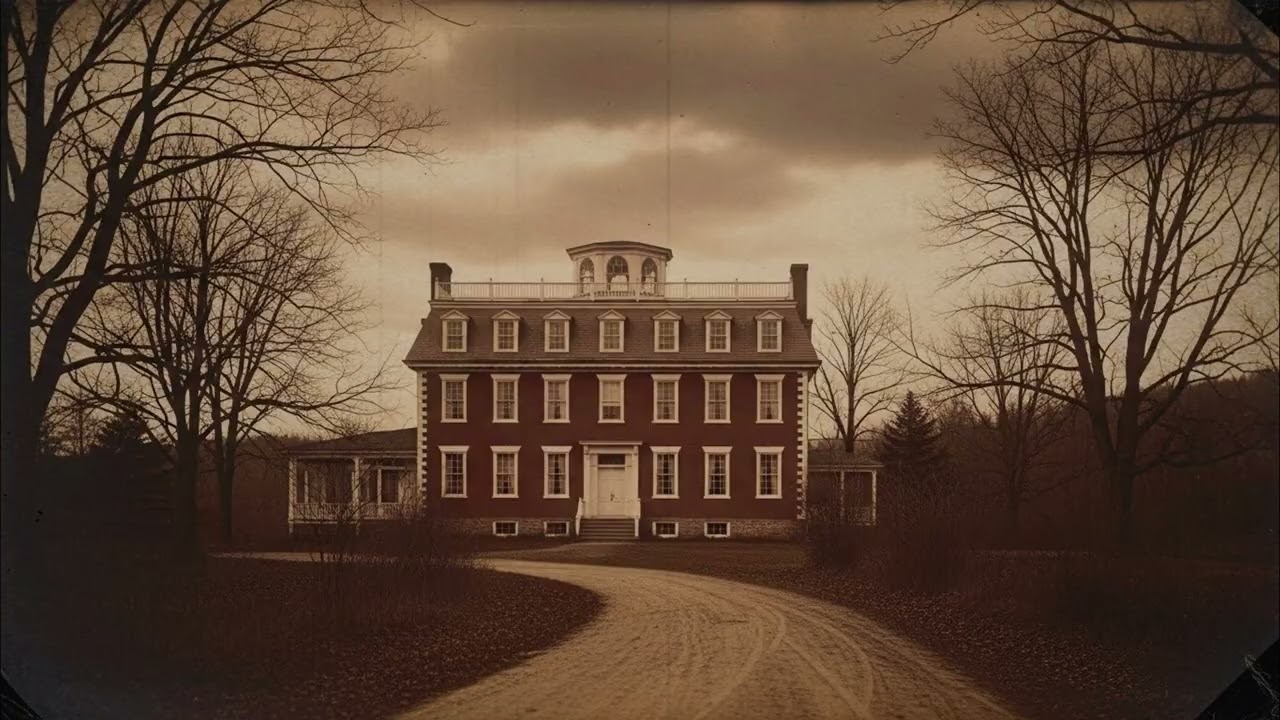
The property was Cordelia Hargreave’s, a 47-year-old widow who had come into the grand three-story Georgian manor from her late husband, Lysander Hargreave, following his death by stroke in 1949. The house occupied a forty-acre tract at the end of a curving dirt road, about three miles from the closest neighbor and seven miles from the middle of town. County records indicated the building had gone up in 1789 under Captain Jeremiah Whitmore, a Continental Army officer granted the land in payment for his service. The estate’s design embodied the restrained elegance characteristic of the Federal style: a red brick front with white wooden trim, windows set in even rows across three stories, and a noteworthy observation platform on the roof.
What distinguished the Hargreave house from other colonial estates in the area was its peculiar cellar arrangement. As the original plans on file with the county in 1790 showed, the cellar reached well past the house’s foundation, taking in what seemed to be natural limestone caves unearthed during the build. Captain Whitmore’s surviving letters, kept in the Vermont Historical Society archives, disclosed that the local indigenous people had known the cave system for generations before European settlement. In a letter to his brother written March 15, 1789, Whitmore noted that the local Abnaki had cautioned him against erecting anything over the caves, saying they were used by spirits for purposes he considered too superstitious to set down in any detail.
Still, the underground space’s practical benefits for storage and steady temperature persuaded him to fold the caves into his foundation plans. Across Montpelier, Cordelia Hargreave was recognized as a woman of refined taste and deep reserve. Born Cordelia Ashworth in Boston to a family in the textile trade, she had met Lysander while he managed a bank in Massachusetts. Their 1925 marriage was viewed as a highly favorable match, since Lysander held both substantial wealth and social standing within Vermont’s business circles.
In 1928 the couple relocated to the Elm Ridge estate, where they lived quietly and somewhat apart for more than two decades. Those acquainted with Cordelia called her clever but aloof, courteous yet never affectionate. Margaret Thornfield, postmistress in Montpelier from 1935 to 1963, recalled that Cordelia came into town twice weekly, on Tuesdays and Fridays without fail, always in the same black wool coat whatever the season, and always speaking in deliberate, guarded sentences that gave away nothing of what she thought. Her buying habits were remarkably fixed.
Week after week she purchased the same goods in the same amounts, as though keeping to an exact routine that never altered. From the outside the couple’s relationship looked amicable, though attentive neighbors occasionally remarked on a formality between them that seemed odd even for people of their era and station. Reverend Isaiah Blackthorne of the First Congregational Church, where the Hargreaves were regular worshippers, recorded in his personal diaries that across twelve years of pastoral dealings with the family he had never once seen evidence of true affection between husband and wife. Only a chilly politeness, which struck him as more disturbing than outright hostility would have been.
The reverend’s diaries, given to the church archives after his death in 1956, shed further light on the Hargreave household. In an entry dated September 12, 1947, he wrote: “During today’s pastoral visit to the Hargreave estate, I observed something troubling about their household arrangements. While Cordelia served tea with her usual precision, I noticed she set the table for four, although only Lysander and I were present for the visit. When I mentioned this, she looked momentarily confused, then quickly removed the extra place settings and explained that she had expected other guests who had not arrived.
Lysander’s reaction suggested, however, that this was not an isolated incident of simple forgetfulness. “
Following Lysander’s sudden death in March 1949, Cordelia withdrew even further from the world. She let the household staff go, retaining only Bartholomew Creed, an elderly gardener who had served the family since 1940, and started handling all her affairs by written correspondence. Her trips into town grew rarer, perhaps once a month, and always for the most necessary errands.
Bartholomew Creed gave the fullest account of life at the Hargreave estate in the stretch right after Lysander’s death. In a statement he made to the Washington County sheriff in December 1951, Cordelia had altered markedly once widowed. Where she had once kept strict routines and demanded the upkeep of house and grounds, she now passed whole days in what Creed called a state of absence, sitting for hours in the library without a book, or gazing out the front windows as though awaiting something that never arrived. Creed also observed that Cordelia had taken up strange habits concerning certain parts of the house.
She had barred him, whatever the reason, from setting foot in the cellar. Even when the pipes burst during the bitter winter of 1949-1950 and he proposed calling a plumber, she merely told him to cut off the water to that section of the house. She had also started locking particular rooms on the second floor, among them what had been Lysander’s study and the guest room at the hall’s far end. Strangest of all, perhaps, Creed noticed that Cordelia set out food beyond the sealed cellar door each evening.
Asked about it, she said they had a mouse problem, though Creed pointed out that in his eleven years tending the estate he had never once seen any trace of pests. The food, he noted, was always gone come morning, yet he had never watched any animal carry it off. What’s more, the portions looked far too generous for mice. Whole plates of cooked meals, cutlery and cloth napkins included, as though laid out for a formal dinner.
The first hint that something had gone badly wrong at the Hargreave estate surfaced on November 14, 1951. Bartholomew Creed showed up at his customary 7:30 in the morning and discovered the front door flung wide open, even though the temperature had fallen to nearly minus seven degrees overnight. The house was chilly and still. Cordelia was nowhere to be found.
Creed’s account of that morning, kept in the sheriff’s files, describes in detail the scene he came upon. At a glance, the house seemed untouched. Nothing pointed to a struggle or a break-in. Cordelia’s personal belongings sat in their usual spots.
Her jewelry, including a number of valuable pieces she had inherited from Lysander’s mother, was still sitting untouched in the bedroom drawer. Her winter coat was hanging in the closet by the front door. Her handbag, with close to three hundred dollars in cash inside, remained on the kitchen table where she customarily left it. Some things, though, bothered Creed right away.
The food he had watched Cordelia place in front of the cellar door the evening before had vanished, but the door itself, which had been securely locked for over two years, was now standing partly open. A draft drifted out of the gap, carrying what Creed called a disagreeable, sweet smell, like flowers left too long in water, blended with something damp and aged. Even more worrying was the condition of Cordelia’s bedroom. Her clothes were hung tidily in the wardrobe, but her bed gave no indication that anyone had slept in it.
The bedspread was smooth and unrumpled, the pillows set exactly in place. On the nightstand, Creed came across a cup of tea that was still tepid, and an open book turned to a page that held only an illustration of a dark hallway, with no text at all. The book was one Creed did not recognize, even after all his years running the library, and it seemed to be bound in unusually dark leather that felt oddly warm against his fingers. Most disturbing of all, Creed discovered a note in Cordelia’s handwriting, laid out conspicuously on the kitchen table.
The note, which would later be used as evidence, said only: “I have left to fulfill Lysander’s agreement. Do not seek me in the places you know. Thank you for your faithful service. The house will be cared for by its rightful inhabitants.
Cordelia.” The note bore the date November 13, 1951, but the ink was an odd dark red shade that Creed could not place. Creed spent roughly an hour going through the house, calling out Cordelia’s name, before he decided to notify the authorities. Sheriff Ezekiel Morehouse, a thirty-year veteran of law enforcement who had dealt with every major crime in Washington County since 1925, reached the property that morning at about 10:00, with Deputy Sheriff Harold Finch at his side.
The official report Sheriff Morehouse filed characterizes the first investigation as routine yet perplexing. The obvious reasons for Cordelia’s absence failed to fit the evidence. If she had gone willingly, why would she leave her coat behind in November weather? Why abandon her money?
If she had fallen victim to a crime, where were the marks of a struggle? Why had her valuables been left behind? The most baffling element of all was the note implying that someone else would look after the house, when no other residents were known to exist. The investigation team carried out a careful search of the house, starting with the living quarters and working methodically through each room.
They came across nothing out of the ordinary until they got to the cellar. The door Creed had reported as standing ajar now looked firmly shut, though neither the sheriff nor his deputy could recall anyone going anywhere near it. Stranger yet, the door now bore a new lock, plainly fitted very recently, which none of the investigators had noticed earlier that day. When they attempted to open the cellar door, they found it bolted from within by what looked like an elaborate locking mechanism, the likes of which Sheriff Morehouse had not encountered in three decades of law enforcement.
They shouted several times but got no reply. The sheriff’s report records that while they stood outside the door, they heard noises that resembled faint stirrings from below, along with something like whispering. It was hard to tell whether the sounds were human or simply the creaking of the house’s old wooden frame. Deputy Finch was dispatched to check the exterior cellar entrance, a set of double wooden doors that gave access from the garden.
He discovered these doors chained and secured with what looked like a very old padlock, heavily rusted. The chain itself had plainly been there for years, perhaps decades, since rust had welded it to the metal hinges. Yet Finch spotted something odd. For all the apparent age of the lock and chain, fresh scratches around the keyhole indicated it had been used not long ago.
Since they could not get into the cellar right away, Sheriff Morehouse chose to put off that portion of the search until he could come back with the right tools. He told Deputy Finch to stay at the property while he drove back to town for a locksmith and extra equipment. The sheriff’s brief absence would turn out to matter for reasons that only became evident afterward. Deputy Finch, left on his own to watch the house, reported hearing several distinct sounds during the two hours Morehouse was gone.
At about 12:30, he heard what seemed to be someone walking slowly across the floor directly above him, even though he could plainly see that the first floor was empty. The footsteps kept a steady rhythm, as though someone were pacing back and forth in the same room for minutes on end. At 1:15, he heard piano music drifting from the direction of the parlor, despite having personally confirmed that the parlor held no piano. The tune was easy to identify: a mournful piece that resembled a funeral hymn, performed with real skill, yet somehow dulled, as if the sound had to pass through walls or floors to reach him.
When he checked the parlor again, he found it just as empty as before, though the air in the room felt distinctly colder than elsewhere in the house. Most unnerving of all, at 2:00 Deputy Finch heard Cordelia’s voice calling his name from somewhere inside the house. The voice seemed to come from several places at once, as though she were moving through different rooms simultaneously while calling to him. When he answered and went looking for her, he found the house as empty as before.
In his supplementary report, submitted three days after the incident, Finch noted that the voice sounded exactly like Cordelia’s, but its tone carried no distress or urgency, only a calm invitation, as if she were asking him to join her for tea. The most disturbing event came at 2:45, shortly before Sheriff Morehouse returned. From his position outside the house, Deputy Finch noticed movement at the cellar windows. The cellar windows, dark all morning, now showed flickering light, as though from candles or oil lamps.
More importantly, he saw shadows crossing the lighted windows in patterns that hinted at several figures involved in some kind of organized activity. Finch walked over to the cellar windows to look more closely and found that although they were partly below ground level, they gave a clear view of the cellar space. What he saw, according to his detailed report, was a fully furnished living area, complete with carpets, furniture, and what looked like a formal dining table laid for several people. Several individuals, wearing clothes that seemed to belong to an earlier historical era, moved about the space as though going through ordinary household routines.
What stood out most was that Finch was able to identify one of those figures with absolute certainty as Cordelia Hargreave. She seemed to be overseeing the arrangement of the dining table, and she wore a dark blue dress that Finch knew well—one she had worn to church services. Her movements were natural and deliberate, with nothing about them suggesting fear or that she was being forced. At one moment she turned and looked straight at the window where Finch was watching, gave a warm smile, lifted her hand in greeting, and then went back to what she was doing.
At 3:30 Sheriff Morehouse came back with Silas Weatherbee, a locksmith from Barre who worked on antique mechanisms. Weatherbee studied the lock on the cellar door and said he had never encountered anything like it. It looked hand-forged, perhaps dating to the colonial period, and it was held by a mechanism that could be worked from either side of the door. Even stranger, the key that should have worked the lock from outside seemed to have been snapped off inside the mechanism on purpose, leaving only a thin scrap of metal wedged in place so the lock could not be opened.
Once Deputy Finch told him what he had seen at the cellar windows, Sheriff Morehouse went at once to check the account for himself. By then, though, the cellar windows were entirely dark, and nothing could be seen moving from outside. In his report the sheriff wrote that the windows seemed to have been covered from within by some dark cloth or by boards, blocking any view of the cellar. Weatherbee finally succeeded in forcing the lock, though he cautioned that the door might be damaged in the attempt.
The job took close to an hour, because the mechanism turned out to be much more intricate than its outside appearance suggested. When the cellar door at last swung open, it showed a narrow stone staircase leading down into darkness. The sweet, foul smell Creed had mentioned before was now stronger, and it made the sheriff and the deputy draw back for a moment. Sheriff Morehouse went down the stairs first, holding an electric lantern borrowed from the fire department.
What he discovered in the cellar of the Hargreave house would be investigated, debated, and argued over for decades afterward. The cellar was much larger than the house’s floor plan would have indicated, reaching into natural limestone caves that had been worked into the structure when it was built. The finished stone of the house’s foundation slowly gave way to rough cave walls that faded into darkness past where the lantern could reach. In the main section the floor was flagstone, but where the cellar joined the caves the floor was packed earth, and it showed obvious signs of regular foot traffic.
More significant than the cellar’s size was what it held. The space had plainly been set up as a living area, with furniture, carpets, and what looked like sleeping quarters. All of it, however, was buried under decades of dust and decay, which suggested the space had gone uninhabited for many years. Worn curtains hung from ropes stretched between support beams, giving the impression of separate rooms inside the larger space.
On a table rested the remnants of what had once been books, though damp and time had turned them into unreadable pulp. Even so, some areas, despite the overall look of abandonment, bore obvious traces of recent use. In the farthest corner of the cellar, where the stone floor gave way to the natural cave floor, Sheriff Morehouse found signs that someone had been living there. A sleeping area had been made up with blankets and pillows that appeared much newer than the rest of the furnishings.
Next to this makeshift bed, several objects hinted that someone had been staying in the cellar: a pair of reading glasses, a hand mirror, some pieces of clothing, and a leather-bound diary. What Sheriff Morehouse found beside the diary was the most unsettling of all. A table had been formally set on a small surface, with fine china, cutlery, and cloth napkins. On the plate were the remains of what looked like a meal recently eaten, and a wine glass held traces of a red liquid.
Close by, an oil lamp was still burning with a steady flame, throwing shifting shadows across the cave walls. The diary, which would become a key piece of evidence in the investigation, held entries going back to shortly after Lysander’s death in 1949. The earliest entries were ordinary, even dull, notes about daily life and household matters. But beginning in late 1949, the tone and substance of the entries shifted sharply.
One entry, dated December 23, 1949, reads: “The sounds from below have become more frequent and clearer. I can no longer convince myself that they are merely creaking beams or small animals. Last night I heard what was unmistakably a conversation, though I could not make out the words. This morning I found the cellar door unlocked, though I specifically remember locking it before going to bed.
Lysander never said there were others living beneath our house, but the evidence suggests he knew of their presence. ”
An entry dated January 15, 1950, states: “I have discovered the truth about the locked rooms. Lysander did not close them off to preserve memories, as he told me. He closed them off to contain something.
Yesterday I found his private papers, hidden behind a false panel in his desk. The cellar was never empty during our marriage. We were never alone in this house. There are documents from the time of the original construction describing agreements with the cave dwellers.
Captain Whitmore apparently made some kind of arrangement with them when he built the house. ”
The diary entries run on through 1950 and 1951, recording Cordelia’s growing understanding of what she called the others who lived beneath the house. By her account, the cellars reached much deeper than anyone had known, linking to a network of natural tunnels used for purposes she was only starting to grasp. A particularly troubling entry from March 17, 1951, reads: “They are waiting for me to join them.
Lysander promised them that I would, though he never told me about this arrangement. I understand now why he never allowed me to accompany him on his evening walks. He was not walking in the garden. He was visiting them below.
I know this because they have shown me the path. They are not what one would expect of people who live in caves. They are educated, refined, and possess knowledge that spans centuries. They maintain their own society, their own customs, entirely separate from the world above.
”
An entry from June 8, 1951, gives more detail about these underground inhabitants. “I have learned their history through conversations through the door. They are descendants of colonial settlers who withdrew underground during various conflicts and persecutions. Some trace their lineage to religious communities that sought isolation from mainstream society.
Others are the remnants of families who disappeared during wars or economic upheavals. They have created a stable community that has existed for generations, maintained through careful planning and occasional interaction with selected surface residents. ”
The diary shows that these interactions were formalized through agreements with certain property owners. According to Cordelia’s account, Captain Whitmore was the first to make such an arrangement, permitting the cave dwellers to continue their existence in exchange for certain considerations.
Each subsequent owner of the property was gradually initiated into the arrangement and eventually invited to participate more fully in the underground community. An entry from July 20, 1951, explains Lysander’s role. “I understand now why Lysander was so meticulous about keeping the property exactly as it was when we inherited it. He was fulfilling obligations that had been established by previous owners.
The evening meals I thought he was taking alone in the cellar were in fact communal dinners with our neighbors below. The supplies he claimed were for storage were provisions for their community. In return, they offered him knowledge and advice that proved valuable in his business dealings. The arrangement was mutually beneficial and had been maintained for over a century.
“
The final entries in the diary, dated November 13, 1951, contain detailed preparations for what Cordelia described as properly joining the community. She wrote: “Tonight I will fulfill the promise he made on my behalf. It is not a matter of coercion or desperation, but rather an opportunity to join a society that values learning, stability, and mutual support over the uncertainties of the world above. They have patiently waited for me to complete my period of mourning and settle my affairs above ground.
Now I am ready to take my place among them. “
Sheriff Morehouse’s investigation of the cellar revealed several other troubling details. In addition to the evidence of Cordelia’s recent presence, he found indications that the space had been regularly inhabited for many years. Storage areas contained preserved food, some of which appeared to have been recently consumed.
A simple kitchen area was equipped with tools and supply containers showing signs of ongoing use. Most puzzling of all, one section of the caves appeared to contain sleeping quarters for multiple individuals, complete with personal belongings suggesting different historical periods of habitation. The sheriff’s report notes that several passageways from the main cellar led deeper into the cave system. These tunnels were narrow but carefully maintained, with niches carved into the walls for oil lamps.
The passageways appeared to extend considerable distances underground, connecting rooms with various functions: storage areas, workshops, and spaces that served as communal meeting places. The exploration of one tunnel by Deputy Finch, approximately fifty yards from the main cellar, revealed something that forced the investigation team to revise their assumptions about the situation. The tunnel led to a large natural space that had been converted into what could only be described as an underground village square. In the central space, where multiple passageways converged, stone benches had been arranged.
Oil lamps in wall niches provided constant illumination. Most striking of all, the space showed clear evidence of recent use. Warm ash in a central fire pit. Personal objects on the benches and food preparation areas suggested regular gatherings of a community.
Deputy Finch also discovered that the cave system contained sections that had been modified with considerable technical skill. An advanced drainage system channeled groundwater away from the living areas. Ventilation shafts, some natural and others deliberately enlarged, provided for the circulation of fresh air throughout the underground complex. Storage rooms had been carved into solid rock and fitted with wooden shelving holding supplies ranging from preserved food to manufactured goods that appeared to have been recently obtained from surface suppliers.
Most disturbing was Finch’s discovery of what proved to be a library room. On stone shelves stood hundreds of books, many clearly antique, but others seemingly contemporary. A reading corner was furnished with comfortable furniture and sufficient lighting for extended study. Several books lay open on reading tables, suggesting they had been recently consulted.
The subjects of the visible books ranged from historical texts and religious scriptures to contemporary works on agriculture, medicine, and technology. The investigation was hampered by the fact that although the cave system showed extensive evidence of habitation, the investigators encountered no residents during their search. The spaces seemed recently vacated, as if the inhabitants had withdrawn deeper into the cave system or temporarily relocated during the surface investigation. The search team did, however, find clear evidence that they were being watched during their work.
Personal objects were moved or rearranged between their visits to different rooms. Fresh food appeared suddenly in spaces they had previously found empty. More unsettling still, they occasionally found notes addressed to them by name, written in elegant handwriting on aged paper, thanking them for their courtesy in conducting the investigation with minimal disruption to the community. The official investigation was closed after five days without determining Cordelia’s fate or locating the actual inhabitants of the cave system.
Sheriff Morehouse filed a missing person report for Cordelia and advised keeping the case open, but no new leads emerged. The house was sealed by court order pending settlement of the estate, since Cordelia had left no will and no known living relatives could be found. Bartholomew Creed, however, provided additional testimony that was included in the case files but received little attention from investigators. According to Creed, on the evening before Cordelia’s disappearance, he had stayed at the estate longer than usual to secure outdoor equipment ahead of an expected storm.
While working at the toolshed around 9:00 PM, he saw light coming from the cellar windows, which was unusual since those windows had been boarded up for as long as he could remember. More significantly, Creed reported seeing shadows moving across the lighted windows in patterns suggesting multiple figures participating in what appeared to be a formal dinner. When he approached the house to investigate, he heard sounds he described as conversation and laughter, as if several people were sharing a pleasant meal together. The conversation was too muffled to make out specific words, but the tone was clearly social and relaxed.
When he looked at the front of the house, however, Creed could see Cordelia sitting alone in the library window, apparently reading. This created an impossible situation. How could she be simultaneously alone in the library and participating in the gathering in the cellar? Creed watched for several minutes, alternating his observation between the cellar windows and the library, and confirmed that Cordelia remained visible in the library the entire time the activity in the cellar was taking place.
Creed’s statement ends with his observation that he heard music coming from the cellar that evening, specifically what sounded like a small ensemble playing pieces that were melancholic but not unpleasant. The music continued until approximately 11:00 PM, after which the cellar windows went dark again and the house assumed its usual nighttime silence. The investigation was officially closed in March 1952, with Cordelia Hargreave classified as missing under circumstances that could not be determined. The estate was eventually liquidated through the court, and the property was sold in August 1953 to the Montpelier Commercial Development Company, which planned to subdivide the land for residential construction.
The development project, however, ran into unforeseen difficulties. The surveyors brought in to chart the estate found that the underground cave network stretched far beyond what earlier examinations had shown. These limestone caverns created a vast web beneath not only the Hargreave property but also large stretches of the neighboring land. Worse for building purposes, a number of the tunnels bore signs of structural alterations that might put any construction in the area at risk.
The geological survey carried out by Dr. Araminta Thorne, of the University of Vermont’s geology department, turned up further disturbing facts about the cave system. Her report, submitted to the state in September 1953, stated that the caves clearly showed extensive human modification going back at least two hundred years. Carved corridors linked natural chambers, and several areas seemed to have been purposely dug out to form larger spaces for various community uses.
Dr. Thorne’s team also uncovered what looked like an elaborate infrastructure built to sustain long-term human habitation below ground. Such methods indicated that a great deal of time and labor had gone into making parts of the cave system entirely self-sufficient for long stretches. Most baffling of all, her survey located numerous concealed entrances to the cave system, spread across several square miles, most of them hidden by vegetation or intentionally disguised.
After receiving Dr. Thorne’s report, the development company gave up its construction plans, citing the prohibitive expense of dealing with the geological problems. The Hargreave estate then changed hands once more, sold this time to a private buyer named Percival Ashford, who bought it in 1954 as a summer home. Ashford, a retired literature professor from Dartmouth College, knew nothing of the property’s history when he acquired it.
By his own account, given years afterward to a journalist looking into the case, he had been drawn to the house’s colonial architecture and the seclusion of its remote setting. He intended to spend his retirement there writing and pursuing scholarly research. Ashford lived quietly on the estate for almost three years before anything strange occurred. His experience started in the spring of 1957, when he chose to explore the cellar storage areas while preparing to install a modern heating system.
Unlike earlier investigators, Ashford went into the cellar without any assumptions about what he might find. What he found was that the cellar had been completely cleaned and rearranged since the 1951 investigation. Every sign of previous habitation had been meticulously erased. The makeshift rooms, sleeping quarters, and storage setups described in Sheriff Morehouse’s report had vanished entirely.
The space seemed to be simply a standard colonial-era cellar with natural cave extensions, precisely what one would expect beneath an eighteenth-century house in a limestone region. Before long, though, Ashford started noticing other oddities. His food supplies appeared to run out faster than his own use could account for. Now and then he heard noises from the cellar in the evening, though checking revealed nothing out of the ordinary.
Most tellingly, he found that objects in the house were sometimes moved or slightly changed, which he first put down to his own forgetfulness. The situation grew more serious during the winter of 1957-1958. Ashford began finding proof that someone was regularly entering his house, though he could never work out how it was happening. Doors he had locked were discovered unlocked in the morning.
Windows that had been shut were found open. Food was cooked in the kitchen and left as though someone expected him to find and eat it. Instead of calling the authorities right away, Ashford chose to document these events methodically. As a scholar, he was fascinated by what seemed an intricate puzzle, and he hoped careful observation would yield a logical explanation.
He started keeping detailed records of unusual incidents, noting times, locations, and specific details of each occurrence. Ashford’s logs, later given to the Vermont Historical Society, show a pattern of escalating interaction through 1958. The incidents progressed from minor disturbances to more direct communication. By autumn, Ashford was finding notes addressed to him, written in elegant handwriting on aged paper.
These notes usually held polite questions about his health, remarks on his scholarly work, and invitations to unspecified social events. The notes showed detailed knowledge of Ashford’s daily routine, his research interests, and his personal preferences. They praised him for specific books he was reading, offered thoughtful commentary on his writing projects, and suggested sources that proved remarkably useful for his academic work. The tone was consistently respectful and intellectually engaging, though the anonymous writers clearly had extensive knowledge of both Ashford’s activities and his field of study.
The most significant incident in Ashford’s documentation took place on December 15, 1958. He was woken around 3:00 in the morning by the sound of a conversation coming from the cellar. Unlike earlier times when he had heard indistinct noises, this time he could clearly make out multiple voices engaged in an academic discussion. Ashford crept to the cellar door and listened closely.
He could distinguish at least four separate voices, two female and two male. Their conversation was plainly audible and remarkably refined, with topics ranging from classical literature to contemporary philosophy. The participants showed impressive erudition, quoting extensively from sources in multiple languages and carrying on complex theoretical discussions that would have suited university seminars. Even more intriguing, the conversation now and then mentioned Ashford’s own work, with the participants offering perceptive critiques and suggestions for his current research projects.
They discussed his writing with the familiarity of colleagues who had read his work closely, although Ashford was sure he had never shared his manuscripts with anyone in the area. What was even more troubling was that one of the female voices clearly spoke about Ashford himself, describing him as an excellent addition to our community and expressing hope that he would soon join their evening discussions, as his perspective would greatly enrich their intellectual exchange. The voice that said this carried a tone of warm invitation rather than threat, but the implications were unsettling. Ashford spent the rest of that night in front of the cellar door, listening to the conversation that went on until dawn.
The discussion covered many academic subjects, with the participants showing knowledge spanning several centuries and disciplines. At some point in the early morning hours, one of the voices addressed him directly, acknowledging his presence at the door and inviting him to join the discussion if he felt ready. When Ashford did not answer, the voice, which he believed belonged to a highly educated woman, assured him that they were patient and would wait until he was willing to take part. She explained that their community valued scholarly discourse above all other activities and that they hoped to find someone of his intellectual caliber to join their permanent staff, so to speak.
After this experience, Ashford decided to leave the property. He contacted a real estate agent the following day and arranged to put the house back on the market. He kept documenting his observations, however, during the month it took to complete the sale, giving researchers the most detailed account of the phenomena surrounding the Hargreave estate. In his final weeks on the property, Ashford witnessed several incidents that he recorded with great care.
He recorded that the cellar door, despite being fastened with several locks, would sometimes be found open when morning came. In his study he came across what looked like materials for a seminar: books left open at particular pages, papers laid out as though someone had been preparing for an academic discussion, and annotations in the margins of his own work offering scholarly commentary from angles he had never weighed. Most striking of all, Ashford reported written invitations that had been pushed beneath his bedroom door during the night. These notes, penned in the same elegant hand he had encountered previously, formally requested his presence at the evening colloquium in the cellar at 9:00 PM.
The notes gave him assurances that his participation would be received with warmth and that he would find the intellectual exchange both stimulating and worthwhile. The invitations set out in detail the subjects slated for discussion, reading lists to prepare from, and promises that the community held extensive library resources that would be placed at his disposal. The academic topics put forward were closely tied to Ashford’s own research interests, which implied the invitation had been crafted specifically to stir his scholarly curiosity. Ashford never took up these invitations, though in his last log entry he confessed that he was more and more tempted to do so.
The academic community described in the notes held out everything he had hoped for in retirement: intellectual stimulation, access to extensive research materials, and collaboration with scholars who appeared to share his passion for learning. Only the strange circumstances of their residence kept him from seriously weighing the opportunity. The property was sold in January 1959 to the Vermont State Historical Commission, which sought to preserve it as an example of Federal architecture. The commission’s plans, however, were thrown into disarray when their restoration team ran into the same unexplained phenomena that had troubled earlier residents.
The restoration team, headed by architect Harrison Whitmore, a descendant of the original builder, documented many incidents over the course of their short stay. Workers reported that tools were shifted at night, supplies vanished and turned up again in illogical places, and they felt a constant sense of being watched by unseen observers. More troubling still were the accounts from team members who worked late shifts. Several workers heard conversations and movements drifting from the cellar in the evening, and one electrician claimed to have seen a woman in the kitchen at dusk who fit historical descriptions of Cordelia Hargreave.
By his account, the woman asked him politely to take care with the wiring in the cellar, since it might disturb the people living below. The most detailed account came from master carpenter Josiah Fletcher, who was working alone in the house one evening in May 1959. In his statement to the police, he described meeting several individuals in colonial dress who examined his restoration work with evident expertise. They drew him into conversation about historical building techniques, showing impressive knowledge of eighteenth-century methods and offering suggestions that proved highly useful for preserving historical accuracy.
Fletcher reported that the individuals were courteous, highly educated, and genuinely concerned with preserving the historical integrity of the house. They voiced appreciation for the careful work and offered to share their knowledge of the building’s original construction details. When Fletcher asked how they had gotten into the house after hours, however, they explained that they had lived there far longer than any temporary residents and regarded themselves as the permanent caretakers. The state commission halted the restoration project in June 1959, citing cost overruns and planning issues.
The property was quietly sold to a private buyer who intended to tear down the house and use the land for agricultural purposes. The demolition project in the autumn of 1959 formed the final chapter in the documented history of the Hargreave case. The demolition crew, experienced in dismantling colonial structures, expected to finish the job in a few days. Instead, they ran into complications that stretched the process out by weeks and in the end left the project unfinished.
The greatest difficulty came when the crew tried to deal with the cellar and cave system. The original plans called for filling the underground spaces with concrete to prevent future settling or structural problems. When workers began exploring the cave system to work out how much material would be needed, however, they found that it was far more extensive than any earlier survey had indicated. The caves branched out in multiple directions from the house’s foundation, forming a complex that the demolition supervisor described as a small underground city.
Several passageways led to rooms large enough to hold a considerable number of people, and many of these spaces showed clear evidence of advanced long-term planning and development. Carved stone fixtures, sophisticated drainage systems, and even primitive but effective lighting systems suggested that the caves had been developed as a permanent residential community. More troubling were the personal belongings found throughout the cave system. The demolition team discovered furniture, books, clothing, and other household items scattered across multiple rooms.
Some of these belongings appeared very old, possibly dating from the colonial era, while others seemed much more recent. Several items were identified as belonging to Cordelia Hargreave, though it remained unclear how they had come to be in the deep cave chambers. The demolition project was ultimately halted when workers refused to continue after what the supervisor described as direct contact with the current residents. According to reports filed with the contractor’s insurance company, multiple crew members reported encountering people in the cave system who approached them during their work to express concerns about the demolition project.
These individuals, according to consistent reports from multiple workers, were well-dressed, articulate, and clearly highly educated. They explained that the cave system was their permanent home and asked whether the demolition work could avoid certain areas where their community was located. They offered to purchase the property at market value if the demolition could be stopped, and they provided detailed maps showing portions of the cave system that could be safely filled without affecting their living areas. The final incident that ended the demolition project occurred on October 23, 1959.
Three workers who entered the cave system to install drainage equipment reported finding a fully set dining table in one of the larger chambers, complete with burning candles, prepared food, and place settings for six people. When they returned with the supervisor to investigate, they found not only the dinner but also several individuals who stood up to greet them courteously and explain that they had prepared the meal in hopes of discussing a mutually acceptable solution to the demolition problem. The demolition company left the project the next day, leaving the main building partially demolished and the cellar and cave system intact. The property owner faced considerable unexpected costs and, unable to find another contractor willing to complete the work, eventually donated the land to the state forestry service.
In 1960 the site was absorbed into the Putney State Forest, and the surviving sections of the house along with the cellar entrances were closed off and designated as dangerous. Forestry service records refer to unstable subterranean caverns and warn hikers to stay away from the location. Not a single public document says anything at all about the property’s past or the events that caused it to be abandoned. Over the decades that followed, though, the Hargreave site drew unofficial attention from researchers, journalists, and curious onlookers, all pulled in by tales of the unresolved disappearance and unexplained occurrences.
The majority of these inquiries were short-lived and turned up little fresh material, in part because reaching the sealed cellar demanded specialized gear and authorization that was seldom given. The most exhaustive modern study was carried out in 1967 by Dr. Isidora Blackwood, a sociology professor at Middlebury College who was studying intentional communities in Vermont. Dr.
Blackwood obtained state approval to perform a restricted archaeological survey of the cave system, hoping to chart the human alterations and possibly illuminate the social structure of the underground community. Dr. Blackwood’s team devoted three weeks to mapping the cave system and cataloging the artifacts they uncovered. What they found indicated the caves had been inhabited more or less continuously from the colonial era through the 1950s, with signs of several separate phases of construction and growth.
The team cataloged what looked like family residences, shared gathering areas, workshops, and storage rooms, pointing to a sophisticated and well-ordered society. Most strikingly, Dr. Blackwood’s survey showed that parts of the cave system bore traces of ongoing occupation. Fresh provisions, clothing of recent manufacture, and other modern items suggested that somebody had been residing in the caves until at least the middle of the 1960s.
The team likewise uncovered unmistakable proof that the underground community had built elaborate arrangements for staying in touch with the world above, among them deftly concealed entrances and supply chains that let them acquire modern goods without being noticed. Dr. Blackwood’s investigation was cut short when team members reported direct contact with the cave system’s present-day residents. Team members recounted encounters with people who seemed to dwell in the caves and who questioned them about their research project.
The pivotal event took place on the survey’s final scheduled day. Two doctoral students working in one of the deeper chambers reported coming upon a space fitted out as a cozy library and gathering room, occupied by a number of individuals who appeared to be taking part in an academic seminar. By their telling, the people they met wore a blend of historical and contemporary garments and spoke with a formal, cultivated accent that betrayed extensive education. The residents the students met, they reported, were welcoming and eager to learn about the research project.
They recounted that their community had lived in the cave system for many generations, sustaining its own educational and social institutions and now and then making contact with chosen individuals from the world above. They voiced interest in Dr. Blackwood’s academic work and asked her to come and visit their community for longer talks about their social structure and history. Dr.
Blackwood went down herself to look into the students’ claims and confirmed their version of the encounter. Her final report recounts a meeting with representatives of the community who displayed striking familiarity with academic methodology and a readiness to take part in scholarly study of their society, so long as it would not endanger their privacy or safety. The archaeological survey was brought to an end by mutual consent between Dr. Blackwood and the community’s representatives.
Dr. Blackwood turned in her preliminary findings to the state but never finished the comprehensive study she had planned. Her research notes, lodged with the Vermont Historical Society, make plain her judgment that the cave community amounted to a singular kind of intentional society that had managed to preserve its independence for more than two hundred years. Dr.
Blackwood’s final report, delivered in September 1967, closes with remarks that capture her professional verdict on what she had uncovered. “The community we found beneath the Putney State Forest constitutes an extraordinary example of social organization and cultural preservation. They have created a stable, developed society that has endured major historical changes while maintaining their core values and traditions. Their willingness to engage with external researchers, combined with their clear success in maintaining their chosen way of life, suggests that this community deserves recognition as a significant anthropological phenomenon rather than being dismissed as an anomaly.
”
The state’s reaction to Dr. Blackwood’s findings was to place permanent limits on access to the cave system. The area was reclassified as a protected geological site, and entry was prohibited apart from official scientific research carried out under close state oversight. No such research has been authorized since 1967, though the restrictions seem to have stemmed more from regard for the community’s privacy than from concerns about safety.
The official record of the Hargreave case closes with Dr. Blackwood’s investigation, yet unofficial accounts and local folklore have kept spreading across the decades. Hikers in Putney State Forest now and then report hearing music or voices rising from the ground near the former Hargreave estate. Campers describe waking to find prepared food waiting at their campsites at night, always with courteous notes attached expressing the hope that the offerings would prove useful during their stay in the forest.
The most stubborn of these are the accounts from residents of Montpelier and nearby towns who every so often cross paths with individuals whose dress, manner of speech, and conduct hint that they hail from earlier historical eras. Such encounters usually involve polite inquiries about current affairs, short exchanges about local history, and offers to barter handmade wares for modern supplies or books. Margaret Thornfield, the former postmistress who had known Cordelia Hargreave, supplied one of the most detailed records of such an encounter. In 1968, at the age of 89, she reported meeting a woman she identified with certainty as Cordelia at the Montpelier farmers market.
By Thornfield’s account, Cordelia looked essentially the same as she had at their last meeting seventeen years before and kept up an agreeable conversation about local happenings and shared acquaintances as though no meaningful time had gone by. The talk, Thornfield reported, dwelled on intellectual and cultural subjects. Cordelia displayed particular curiosity about books that had lately been published, changes in higher education, and social shifts in the region. She also inquired about particular families in Montpelier, asking after people who had died or moved away during the 1950s, and seemed taken aback to hear of their absence.
Most memorably, Cordelia invited Thornfield to come to her home in the forest for tea and scholarly discussion. When Thornfield remarked that she had heard the house had been torn down, Cordelia smiled and explained that the important parts of any community are the people and their shared intellectual life, not the physical structures that temporarily house them. She assured Thornfield that she would easily find the location if she wished to accept the invitation, and that she would enjoy meeting the other members of their academic community. Thornfield never accepted the invitation, though she admitted to being curious about what such a visit might reveal.
She observed that during their exchange Cordelia appeared entirely ordinary, betraying no trace of mental disturbance or of whatever she had endured across the years she spent apart from society. Officially, the Hargreave case stays unresolved, although law enforcement has long since stopped actively pursuing it. The case files, which now rest in the Vermont State Archives, take up close to 0.1 cubic meters and hold testimony from dozens of witnesses, surveys, reports by various researchers, and hundreds of pages of documentation covering the years 1951 through 1967.
What became of Cordelia Hargreave on the night of November 13, 1951, may never be settled for certain by ordinary investigative means. The evidence points toward several readings: that she willingly joined an established community dwelling beneath her property; that she found a social alternative offering greater intellectual and personal fulfillment than her secluded life above ground; or that she met people who had built a thriving intentional society kept secret for generations. Perhaps most striking of all, the recurring accounts of encounters with Cordelia and with others resembling historical figures tied to the estate imply that what took place in the Hargreave house in 1951 was a transition rather than an ending. The cave system under the Putney State Forest seems to shelter a community running parallel to mainstream society, now and then engaging with the outside world but chiefly sustaining its own social and intellectual institutions.
The truth, as Dr. Blackwood observed in her final report, unsettles familiar assumptions about what alternative social organization might be possible. The Hargreave case implies that beneath the world we know, other forms of human community persist and develop by their own rules, holding fast to traditions and values that mainstream society has frequently discarded or forgotten. For anyone walking through the Putney State Forest today, particularly in those still hours when natural sounds travel farther and ordinary certainties feel less firm, the tale of Cordelia Hargreave stands as a reminder that Vermont’s colonial landscape may shelter communities never fully absorbed into the modern world.
The ground under our feet may hide societies in which time follows different principles, in which learning and intellectual exchange stay the foremost values, and in which those seeking alternatives to conventional life can find acceptance and purpose. And perhaps, for those who listen closely to the forest’s sounds or stay open to encounters that defy ordinary expectations, an invitation still waits. The same invitation extended in 1958 to Percival Ashford, in 1967 to Dr. Blackwood’s research team, and to Margaret Thornfield at the farmers market.
An invitation to intellectual community, to meaningful conversation, to discover what possibilities lie beyond the narrow options everyday society usually presents. The choice to explore such possibilities remains, as ever, wholly our own. Still, it may be worth reflecting that some communities, once found, offer benefits that make returning to conventional society less appealing than continuing to take part in alternatives most people do not even suspect exist.
