In February 1969, five engineers walked out of IBM’s Federal Systems Division in Huntsville, Alabama, and founded a company with little more than a thesis: that interactive computer graphics on a screen could replace the drafting tables and paper blueprints of American industry. The lead engineer, Jim Medlock, put $39,000 of his own money into the venture. They called it M&S Computing. They had no product, no customers, and no infrastructure—just the conviction that a computer could draw a bridge, rotate it in three dimensions, and remember every detail that paper could not.
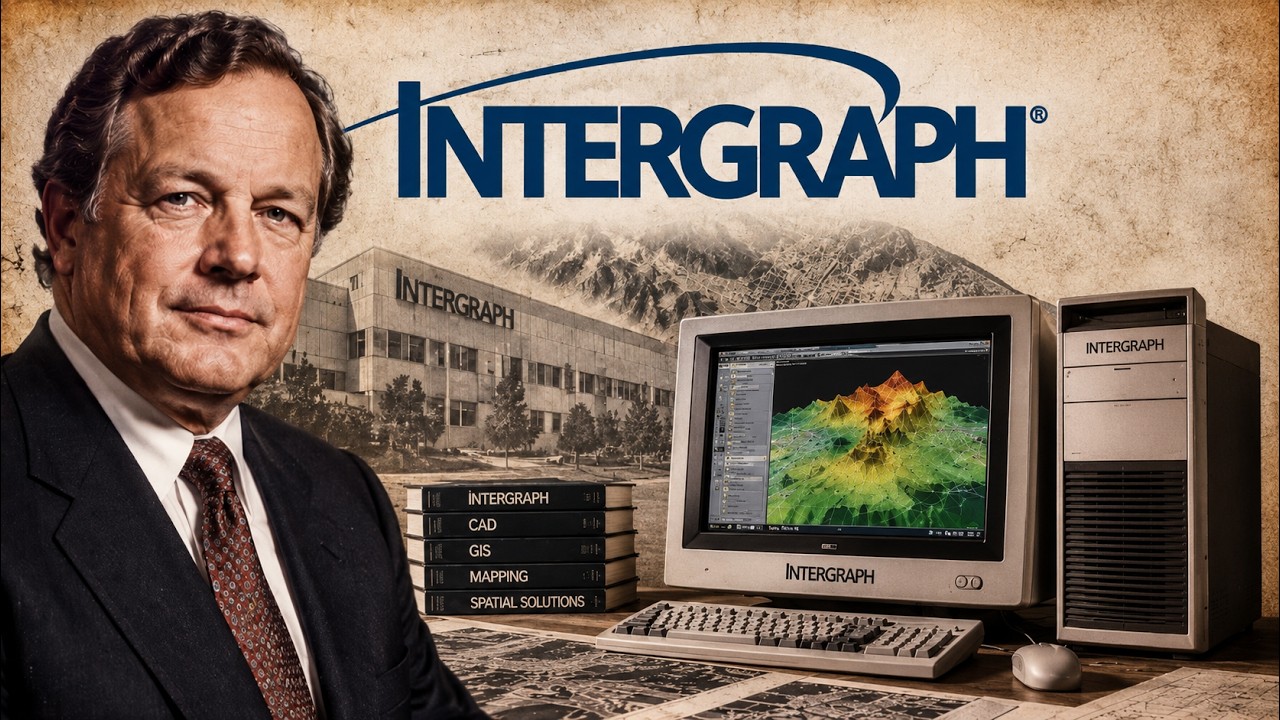
At the time, that was not a safe bet. Computers filled rooms, and graphics meant a blinking cursor on a dark display. The first year, the company lost $64,000 against Medlock’s $39,000 investment. It would be the only annual loss the company ever posted.
Within three months, a sixth engineer joined, and by the end of the year M&S had built its first interactive graphics system, running on Digital Equipment Corporation PDP-11 minicomputers with green, monochrome storage-tube displays. The system was years ahead of anything IBM was willing to sell, but the civilian market had no idea what to do with it. No one had ever bought an interactive graphics system because no one had ever seen one work outside a government lab. Then the phone rang.
In 1972, the United States Army Missile Command, headquartered at nearby Redstone Arsenal, became M&S Computing’s first major client. The Army needed interactive graphics to visualize targeting data, terrain maps, and engineering schematics. Five engineers with IBM clearances and deep knowledge of that work were sitting in a rented office down the highway. The same military infrastructure that had brought IBM to Huntsville now delivered the company its first real revenue.
By Christmas 1973, M&S had shipped three complete systems. One went to Houston, one to the Army, and one to Nashville, Tennessee, which became the first American city to digitize its roadways for computerized traffic-flow analysis. Each map cost roughly $500 to produce and sold for $80. The arithmetic made no sense as a business, but the principle was proven: a city’s entire road network could live inside a computer and answer questions no paper map ever could.
Four months later, on April 3, 1974, a tornado from the Super Outbreak destroyed the company’s building. M&S rebuilt using the insurance proceeds, expanding into a larger industrial campus on the same road. The tornado that should have ended a five-year-old startup gave it the money to build its first real headquarters. Growth followed swiftly.
From under $2 million in revenue in 1973, M&S climbed past $20 million by 1978. Electric utilities needed mapping systems for transmission lines. Oil companies needed digital models of pipeline networks. State highway departments needed to catalog thousands of miles of road.
The company migrated from the PDP-11 to Digital’s more powerful VAX platform and introduced innovations that separated it from every competitor: a dual-screen terminal that let engineers view a drawing and its underlying database at the same time, a proprietary file processor for high-speed queries, and a custom graphics processor for hidden-line removal and shading that no off-the-shelf hardware could match. In 1980, the company renamed itself Intergraph, a compression of “interactive graphics. ” The following April, it went public on NASDAQ. Revenue reached $91 million that year, climbed to $156 million in 1982, and hit $252 million in 1983 with 14.
7 percent of the North American CAD market. By 1985, the workforce had grown past 5,000 employees. Intergraph had surpassed ComputerVision, Autotrol, and Applicon to become the second-largest CAD vendor in the world, behind only IBM. The company that five engineers had started with $39,000 was outselling everyone in the industry except the corporation they had walked away from.
In 1986, Intergraph made the decision that would define its identity and eventually break it. The company introduced the InterAct and InterPro workstations built around a 32-bit RISC chip called the Clipper, designed by Fairchild Semiconductor’s advanced processor division. In October 1987, Intergraph bought that division outright, and the chip belonged to Huntsville. Intergraph also developed its own Unix variant, called CLIX, to run on the Clipper.
No other company in the CAD industry attempted what Intergraph then achieved: designing its own microprocessor, fabricating its own circuit boards, building its own monitors, writing its own operating system and application software, and delivering finished workstations to customers in its own fleet of ten tractor-trailers. In a city of 150,000 people in the Tennessee Valley, five former IBM engineers had built the most vertically integrated technology company in America. The Clipper C400, completed around 1990, was the crown of the line and a genuine landmark in processor design. It was the first microprocessor to combine super-scalar execution—issuing multiple instructions in a single clock cycle—with super-pipelining, which broke each instruction into extra stages so the clock could run faster without sacrificing throughput.
The C400 was a multi-chip module: four separate silicon dies packed into a single ceramic package, running at 50 megahertz. In the hands of an engineer designing a chemical plant or modeling a naval destroyer, it could do things no other workstation on earth could match. Beneath it sat the interactive graphics design system, IGDS, born on PDP-11 minicomputers a decade earlier. Every line in an IGDS drawing was not merely a line; it was a record in a structured database.
A drawing was not a picture. It was an information system. That idea became so thoroughly embedded in every modern CAD platform that no one remembers who proved it first. Intergraph proved it first.
The military money carried the company further than any civilian sale could. In April 1991, the United States Navy awarded Intergraph a CAD/CAM contract worth $362 million. Eighteen months later came a second contract worth $422 million. Together they pushed Intergraph past $1 billion in annual revenue.
By 1992, the company reported $1. 18 billion, ranked 315 on the Fortune 500, and employed more than 10,000 people at over 100 offices from Huntsville to London to Tokyo. For a generation of technical professionals in the Tennessee Valley, Intergraph was not merely a large employer. It was the economy.
But the same decade brought the force that would undo every proprietary workstation maker on earth: the Intel x86 processor and Microsoft Windows. Intel’s chips were slower, but they were everywhere, and every year the gap shrank. Microsoft released Windows NT in 1993 to run on Intel hardware and compete directly with the Unix workstation market. A Clipper-based Intergraph workstation cost tens of thousands of dollars.
A Windows NT machine with an Intel processor could do 80 percent of the same work at a quarter of the cost, and the remaining 20 percent was shrinking on schedule. In 1992, Jim Medlock made the call. Intergraph would abandon the Clipper. It would abandon CLIX.
The entire product line would move to Windows NT on Intel processors. The next-generation C5 was cancelled before it ever reached silicon. The engineers had even demonstrated Windows NT running natively on the C400 hardware. The port worked.
Then they killed it. The transition was a controlled demolition. In 1993, Intergraph posted an operating loss of $164. 6 million, the worst in its history.
In 1994, the loss was $72. 6 million. The company shipped more workstations and made less money on each one because a Windows NT workstation on Intel hardware was a commodity. Dell could build the same machine.
HP could build the same machine. Revenue plateaued, and the profit was gone. The money was moving from hardware margins to software licenses, and the transition was brutal. Then the relationship with Intel turned openly hostile.
In November 1997, Intergraph filed a patent-infringement lawsuit against Intel in federal court in Alabama. The claim was extraordinary: Intel’s Pentium processors and its upcoming 64-bit Itanium architecture infringed on patents derived from the Clipper—specifically the cache memory management system Intergraph’s engineers had designed for the C400 and the never-completed C5. The dead architecture still had teeth. According to Intergraph, Intel retaliated by withholding critical technical data about the Pentium III Xeon processor, starving the company of the early access it needed to design competitive workstations.
Medlock was blunt: Intel’s stonewall tactics were working against them. In September 1999, Intergraph laid off about 200 employees from its computer systems subsidiary, half the hardware division gone in one afternoon. The quarterly loss was $12. 4 million.
The company that had built its own processor was now utterly dependent on the company it was suing. The lawsuits became the most profitable product line Intergraph ever operated. In April 2002, Intel settled for $300 million. Intergraph then turned its legal department on the companies that built computers with Intel’s chips.
HP settled in January 2005 for $141 million. Gateway settled for at least $10 million. Total patent revenue from the dead Clipper architecture exceeded $400 million. The chip Intergraph had killed to make room for Intel’s processors earned more money in American courtrooms than it ever earned inside a workstation.
On July 21, 2000, Intergraph exited the hardware business entirely. The workstation and server business was sold to Silicon Graphics, a company that would file for bankruptcy within a decade. The fleet of tractor-trailers was gone. The fabrication lines were gone.
The most vertically integrated technology company in America now made nothing you could hold in your hands. What remained was software: the CAD tools, the plant design systems, the GIS platforms, the public-safety dispatch software—and $400 million in patent settlements from a chip its own engineers had designed and its own executives had killed. In November 2006, a private equity consortium led by Hellman & Friedman, Texas Pacific Group, and JMI Equity took Intergraph private for approximately $1. 3 billion.
Four years later, on July 6, 2010, Hexagon AB of Stockholm, Sweden, announced the acquisition of Intergraph for $2. 125 billion in cash. At the time of sale, Intergraph had roughly 4,000 employees and $770 million in annual revenue. The company Jim Medlock had started with $39,000 had just changed hands for more than $2 billion.
Then the name began to disappear. In 2015, Intergraph’s safety and infrastructure division became Hexagon Safety and Infrastructure. In 2017, Intergraph Government Solutions became Hexagon US Federal, and process, power, and marine became Hexagon PPM. In 2022, Hexagon PPM became Hexagon Asset Life Cycle Intelligence.
Division by division, the name was scraped off the door. In 2014, the sprawling campus in Madison, Alabama, was replaced by a $58 million hexagonal glass building overlooking a private lake. The old campus, the one the tornado had funded and ten thousand employees had filled, was demolished. The software is still running.
Intergraph Smart 3D still designs oil refineries and offshore platforms around the world. The computer-aided dispatch system still routes 911 calls in American cities. The mapping technology still processes geospatial intelligence for defense agencies. In May 2026, Hexagon spun off these software assets into an independently traded company called Octave, with roughly 7,200 employees and annual revenue near 1.
45 billion euros. The software that five engineers started writing in a Huntsville office in 1969 is now a European listed entity. The Clipper C400 processors survive only in museum archives and collector sites, engineering artifacts from an era when a company in Alabama believed it could design a processor to rival Silicon Valley. For a few years, it did.
Jim Medlock died in 2025 at the age of 91. The company he founded had already been renamed out of existence. The software he started writing was still mapping the world. When you call 911 in an American city, the dispatch system tracing the fastest route to your door is a descendant of a mapping product sold at a loss from a building in Huntsville, Alabama, that no longer exists under any of the names it has carried.
Intergraph built the machines that mapped the world. The world kept the maps and forgot the machines.






