The phone rang at half past ten on a Saturday morning in Victor, Idaho. Jay Calderwood had spent four years building the Teton Dam. Every lift of wind-blown silt, every pass of the sheep’s foot roller, ten million cubic yards of earth compacted by his crews into a 305-foot wall across the Teton River. Nobody on the project worked Saturdays unless something was wrong.
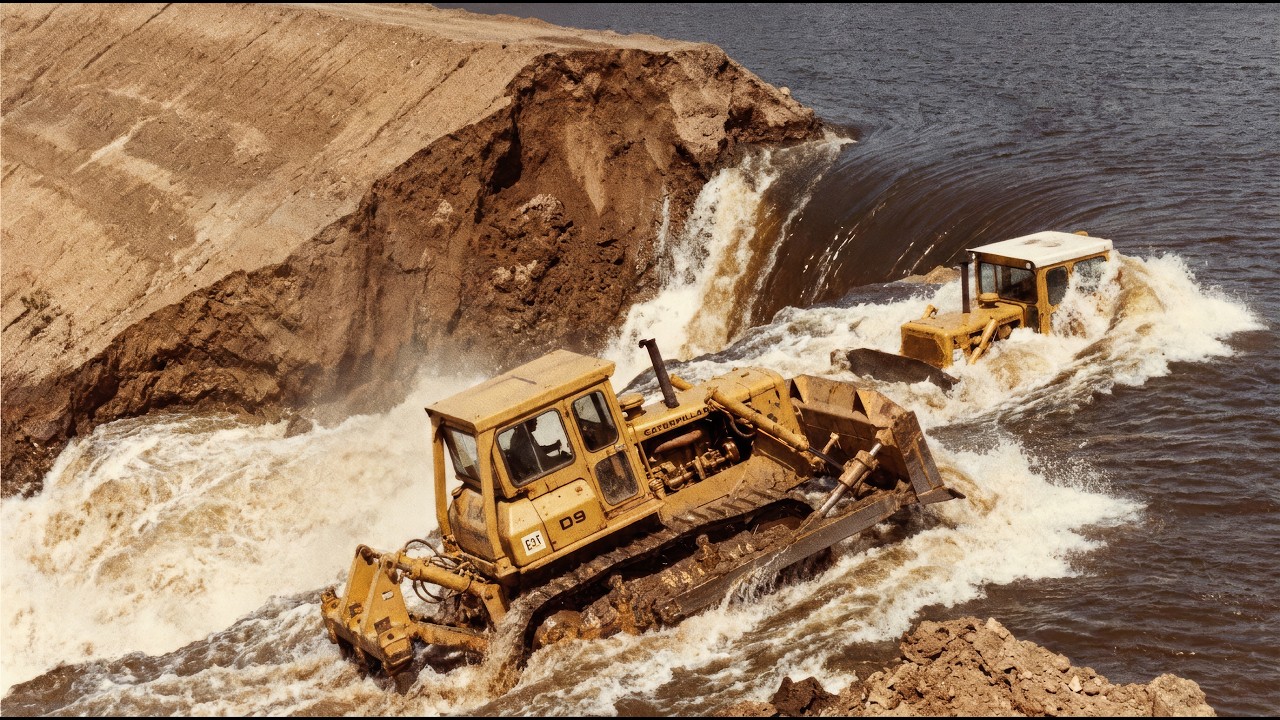
Calderwood drove forty minutes across the Teton Range to the dam site. By the time he climbed onto a Caterpillar D9 and pushed his blade toward the water, the dam was already eating itself from the inside. Within ninety minutes, eighty billion gallons would erase five towns from the map. To understand what Jay Calderwood was driving onto that Saturday morning, you have to go back sixty-four years.
The company behind the Teton Dam was not some anonymous government contractor. It was the most decorated heavy construction firm in American history. In 1905, on the New York Canal of the Boise Project in southwestern Idaho, a twenty-year-old concrete superintendent named Harry Morrison met a Danish immigrant farmer named Morris Knudsen. Morrison worked for the United States Reclamation Service.
Knudsen owned a team of horses and a single Fresno scraper, the wedge-shaped horse-drawn slip scraper invented by James Porteous of Fresno, California, in 1883. It was the tool that mechanized American earth moving, and it was the only piece of heavy equipment Morris Knudsen had to his name. Their first venture together came in 1912, a $14,000 subcontract on a pump plant at Grandview, Idaho, on the Snake River. They lost money.
Their first profitable job was Three Mile Falls Dam in Oregon two years later. They incorporated with $600 in cash, a few horses and scrapers, and a dozen wheelbarrows. What happened over the next two decades turned a two-man scraper outfit into the largest heavy construction company on the planet. On the 1925 Guernsey Dam joint venture in Wyoming, Morrison and Knudsen was among the first American contractors to run diesel trucks and gas-powered revolving shovels alongside their horse teams.
On the Deadwood Dam project in the central Idaho mountains two years later, they hauled heavy iron over passes at 7,400 feet of elevation. That job taught them how to mobilize heavy equipment into hostile, remote geography, and that institutional knowledge would carry directly from the mountains of Idaho to the canyon of the Teton River. By 1931, Morrison and Knudsen had grown enough to join the six-company consortium that won the Hoover Dam contract. It was 726 feet of concrete across Black Canyon with 20,000 workers.
The winning bid, drafted by a Morrison-Knudsen man named Frank Crowe, was $48,890,995, coming in just $24,000 below the government’s secret estimate. Crowe had worked for Reclamation his entire career. He knew exactly what the government expected to pay, and he priced it to the penny. Six companies finished Hoover two years ahead of schedule in 1935.
Morrison-Knudsen took the playbook everywhere. Bonneville Dam, Grand Coulee Dam, the San Francisco-Oakland Bay Bridge foundations. In 1941, the company was part of Contractors Pacific Naval Air Bases, building military airfields on Midway and Wake Island. When the Japanese overran Wake in late 1941, 1,200 civilian workers, many of them Morrison-Knudsen employees, were taken prisoner of war.
After the war came the Saint Lawrence Seaway locks, the DEW Line radar stations across the Arctic, Minuteman missile silos, and the Vehicle Assembly Building at Cape Kennedy, the largest building in the world by volume at the time of its completion. By 1954, Time magazine put Harry Morrison on its cover and called him the man who had done more than anyone else to change the face of the Earth. His salary at the time was $24,500 a year, while his company earned nearly six million in profit. He owned twenty-two percent of the stock.
He had no children. By the time Morrison-Knudsen signed the Teton Dam contract, the company had completed more than one hundred major dams worldwide. Harry Morrison died in 1971. Five months later, his company was awarded a $39 million contract to build an earthen dam on the Teton River in eastern Idaho for the Bureau of Reclamation.
The notice to proceed came on December 14th, 1971. Morrison-Knudsen’s partner on the job was Peter Kiewit Sons’ Company of Omaha. Site clearing began in February 1972. The dam would be a zoned earthfill structure, 305 feet tall and 3,100 feet across.
Its core was wind-deposited silt, called loess, dug from the canyon rim above the dam site. The Bureau chose this material because it was close and cheap. Better clay was available downstream, but Reclamation decided that using it would be too environmentally disruptive. That decision would prove fatal.
Morrison-Knudsen ran the job with the standard heavy fleet of a 1970s western dam project. Caterpillar D9 and D8 crawler tractors pushed and spread fill. Self-propelled motor scrapers in the 631 and 651 class hauled material from the borrow areas to the dam face. Motor graders worked each lift flat.
Sheep’s foot tamping rollers, heavy steel drums studded with rectangular feet, compacted the impervious silt core in six-inch lifts. The shells of the dam were compacted by the crawler tractors themselves, tracking back and forth across eight-inch lifts. The D9 and D8 tractors spent most of their working lives not as dozers, but as compactors. Calderwood ran two shifts, day and swing, covering roughly sixteen of twenty-four hours.
Saturdays were off. The pace was relentless. Ten million cubic yards had to be excavated, hauled, placed, and compacted in roughly thirty months of net placement, which works out to 10,000 to 13,000 cubic yards per working day. Calderwood later estimated that he oversaw a peak fleet of roughly twenty to twenty-five major pieces of iron on a given shift, not counting the water trucks that kept the silt at target moisture content.
But the real machinery battle at Teton was underground. The Teton River Canyon is carved into Huckleberry Ridge Tuff, a volcanic rock formed by a Yellowstone supervolcano eruption roughly two million years ago. As the volcanic ash cooled, it cracked. Hot gases left voids.
Earthquakes over millions of years fractured it further. When Morrison-Knudsen’s crews began excavating the foundation key trench in 1973, they discovered something the Bureau’s design had not anticipated. Caves. One measured eleven feet wide and one hundred feet long.
Inside another, the walls were covered with stalactites and stalagmites, mineral formations that proved water had been flowing through this rock for thousands of years. Some fissures in the volcanic rock measured nearly two inches wide and extended more than one hundred feet below the trench bottom. The Bureau’s solution was a grout curtain, three parallel rows of holes drilled into the rock beneath the key trench, injected with Portland cement grout under pressure to seal the fractures. The original estimate called for roughly 260,000 cubic feet of grout.
What Morrison-Knudsen’s crews actually pumped into the ground was staggering. Nearly 500,000 cubic feet of Portland cement, 82,000 cubic feet of sand, 132,000 pounds of bentonite, 418,000 pounds of calcium chloride, all of it injected into 118,000 linear feet of drilled holes, some reaching three hundred feet below the trench bottom. The grout program alone consumed months beyond the original estimate. And it was not enough.
The independent investigation later found that the grouting sequence was not followed as designed. The center row of the triple curtain was never properly closed between the two outer rows. Slush grouting of the key trench bottom was stopped at an elevation of 5,200 feet for reasons nobody has ever explained. The largest caves, the ones with the stalactites, lay beyond the grouted area entirely.
They were never sealed at all. Then came the strike on June 1st, 1974. All union personnel on the Teton Dam project walked off the job. Operating engineers, laborers, teamsters, iron workers, cement masons.
The strike lasted exactly one month, ending July 1st. That lost month compressed the rest of the 1974 construction season. And 1975 arrived with abnormally heavy snow. When placement of the impervious silt core resumed in the wet spring, Morrison-Knudsen’s crews faced a problem.
The Bureau Interior Review Group later documented what happened. The contractor spread thin dry layers of silt over wet layers and attempted to mix them in place. The Review Group concluded that the construction equipment probably could not sufficiently mix the material in place. The result was distinct wet seams, layers of differing moisture content baked into the core of the dam like a layered cake.
Water would follow them like highways. The Review Group also found that the first 7,000 cubic yards of impervious core placed after the 1973 startup received no moisture density control tests at all due to inadequate staffing on the Bureau’s side. There is one more piece of this story that makes it all worse, and it has never been told properly. Eleven years before Teton failed, the Bureau of Reclamation almost lost another dam to the exact same failure mechanism.
In September 1965, the Fontenelle Dam on the Green River in Wyoming began leaking through fractured rock in its right abutment. The project construction engineer noticed a trickle of seepage during his regular Friday inspection. By evening, the seepage was fifteen cubic feet per second. By dawn the next morning, a cavity sixty feet deep, eighty feet across, and over two hundred feet long had opened in the downstream face.
Engineers dumped 1,700 cubic yards of rock from the crest into the hole over eight days. The dam survived only because the cavity stopped short of reaching the reservoir. The Bureau investigated. Its own regional geologist wrote internally that a grout curtain failure was directly responsible for the leak.
An internal memo by an engineer named Lane concluded that fractured abutment rock deserves very conservative treatment, including consolidation grouting across the full width of the core. But the Bureau’s chief engineer at the time was a man named Bernard Bellport. Bellport wrote a journal article about Fontenelle for the International Commission on Large Dams that barely mentioned the actual failure mechanism. His public statement was that investigation had disclosed no fault in design and construction.
His conclusion blamed vague subsequent action within the abutment. The hard findings of the Lane memo and the regional geologist were buried. When Bellport’s protégés in the Denver design office began designing the Teton Dam in the late 1960s, interviews conducted years later found that many of them had heard Fontenelle had an incident. But none of them knew the specific details.
None of them knew about the piping through fractured rock. None of them knew about the Lane memo’s recommendations. The institutional memory of how a Bureau dam can almost die from foundation piping had been suppressed by the man who would later be named as responsible for the Teton Dam design. Bellport was also the director of design and construction when the Teton design was finalized.
The same man who downplayed the Fontenelle failure was the architect of the design philosophy that would be applied at Teton: a single line grout curtain with no secondary defenses, a narrow steep-walled key trench that allowed the silt to arch against the rock walls instead of settling under its own weight, and no chimney drains or filter zones, the engineered safety layers that catch eroding soil before piping spreads. The Teton Dam had one line of defense. If the grout curtain failed, there was nothing else between the reservoir and the downstream communities. And the politicians made sure nobody could stop the project.
Idaho’s congressional delegation, led by Senator Frank Church, had pushed the dam through Congress in September 1964. The authorization passed without opposition. Congressman Ralph Harding had originally championed a different dam on Burns Creek, but realized it would not fly politically. He pivoted to the Teton site and pushed the authorization through before losing his seat in 1965.
When the Department of the Interior delayed the bidding process in 1971 to conduct a seismic review of the site, which sits near the Yellowstone hotspot, Idaho’s congressional delegation pressured the Interior Department to stop the review. Bids were taken before the seismic study was complete. Construction began before the environmental lawsuit could be resolved. Congressman Leo Ryan of California later asked Bureau Commissioner Gilbert Stamm during the House hearings whether the Bureau had ever stopped a dam project after foundation excavation began.
Stamm admitted, “No, never. ” The Bureau was institutionally incapable of stopping a dam once it was started, even when its own geologists were sounding alarms. A USGS geologist named David Schleicher wrote a memo in December 1972 warning that a failure flood would make the 1962 flood look like small potatoes. His supervisors forced six months of rewrites until the language was stripped of all urgency.
By the time it reached the Bureau, it said nothing useful. Another USGS team led by Harold Prostka sent a separate memo saying “safety of the Teton Dam project is of immediate concern. ” Former Reclamation geologist Shirley Pytlak publicly predicted the reservoir would not hold water. The Bureau continued construction.
The embankment topped out in November 1975. Reservoir filling began on October 3rd of that year even though the main river outlet works tunnel was not finished. The only functioning release valve could push 850 cubic feet per second against a reservoir holding eighty billion gallons. That margin was dangerously thin when spring runoff from an abnormally heavy snowpack sent the reservoir rising at three feet per day, with peaks of 4.
3 feet per day. There was nothing the Bureau could do to slow it down. On June 3rd, 1976, two small seeps appeared downstream of the dam flowing clear water. The Bureau logged them as normal.
On June 4th, a third seep appeared. That night, from 12:30 in the morning until 7:00 in the morning on June 5th, not a single Bureau employee or Morrison-Knudsen worker was present at the dam. For six and a half hours, the largest earth dam the Bureau had ever lost was unmonitored in the dark. The General Accounting Office later pointed out that twenty-four-hour monitoring should have been standard during first filling, a lesson that should have been learned from Fontenelle eleven years earlier.
But it was not applied at Teton. Workers arrived at 7:00 in the morning to find muddy water seeping from the right abutment. Clear seepage is normal for an embankment dam. Muddy seepage means the dam’s core is being carried away from the inside.
By 8:30, the flow was estimated at twenty to thirty cubic feet per second. Bureau employee John Ringle called his colleague Pete Aberle. Aberle’s wife relayed the call to project construction engineer Robert Robison at his home in Rexburg. Robison arrived at the dam around 9:00.
He inspected the leaks. Between 9:30 and 10:00, he considered alerting downstream communities, but decided that an emergency situation was not imminent. He did not want to cause a panic. Seventy-three minutes passed between Robison’s decision not to warn and his first phone call to the county sheriffs at 10:43 in the morning.
He told Fremont County Sheriff Stegelmeier the dam might go, but it would go slowly. The sheriff later said he did not sense the urgency. By 10:15, the wet spot on the downstream face had erupted into active erosion. Brown water was cascading down the embankment in visible sheets.
The dam was now visibly dying. That is when Jay Calderwood’s phone rang in Victor. Calderwood had built dams before Teton. He had worked on the Ririe Dam on Willow Creek for the Army Corps of Engineers.
He lived in Victor in Teton Valley on the Wyoming side of the range. He drove a pickup to work across the pass every day for four years. He was forty years old. He was the general excavation foreman for Morrison-Knudsen, responsible for every cubic yard of fill that went into the dam.
His wife’s family lived in Roberts, Idaho, downstream of Sugar City. They would be flooded out that afternoon while he was on the dam crest trying to save it. By the time Calderwood arrived at the dam around 11:30, two machines had already been lost. A Caterpillar D8 and an International Harvester TD15 had been working the downstream face, trying to push fill into the expanding wet spot.
The ground beneath their tracks gave way. Both operators escaped by being hauled to higher ground with ropes. The machines did not make it out. Calderwood climbed onto one of two Caterpillar D9s parked on the crest.
His boss, excavation superintendent John Bellagante, was already there. Owen Daily, another Morrison-Knudsen operator, climbed onto the second D9. A whirlpool had formed on the upstream face of the reservoir, thirty feet across, spinning down six feet deep. Calderwood and Daily drove their D9s toward it and began pushing rip-rap, three-foot boulders from the upstream face, into the throat of the vortex.
Boulders the size of refrigerators disappeared into the spinning water. They worked for roughly twenty minutes. The diesel engines made enough noise to block out any other sound. At 11:45, Bellagante felt the dam settle beneath his boots, about five feet of vertical drop.
He later described it as a sickening sensation, as if the dam itself had exhaled. He could not shout over the engines. He waved his arm. The two D9s reversed in first gear.
Thirty feet of grade separated them from the crest, and a D9 in reverse on a slope is not a fast thing. The ground in front of them collapsed. What had been the crest of the dam simply stopped existing. Calderwood watched from thirty feet away as the gap grew to one hundred feet wide.
The diesel engines roared. The earth peeled apart. Meanwhile, at the visitor outlook above the canyon, a Rexburg radio broadcaster named Don Ellis had been watching the disaster unfold since 11:30. Nobody had asked Ellis to come to the dam.
He had driven out on his own after his son, Mitch, who was working the board at radio station KRXK, took a call from the sheriff’s office. Ellis picked up his eighteen-year-old daughter on the way. He arrived at the visitor outlook and went live on the air. At 11:55, the crest of the dam collapsed into the reservoir.
Two minutes later, the right bank third of the main wall disintegrated. Peak outflow reached 2. 3 million cubic feet per second, greater than the discharge of any river on earth except the Amazon. A wall of water fifty to seventy-five feet tall tore through the canyon at twenty-seven miles per hour.
Ellis stayed on the air for three straight hours, broadcasting live as the water spread across the Snake River Plain below him. A later study found that seventy-nine percent of downstream residents first learned about the flood from the radio. Only seven percent were warned by police. Ellis and his AM transmitter saved more lives that day than every law enforcement officer, sheriff, and Bureau official combined.
When the floodwaters killed power to the KRXK transmitter at 2:40 in the afternoon, the station went dark for days. Two miles below the dam, on a small island in the Teton River, a twenty-two-year-old sawmill worker named Daryl Wayne Grig was fishing with his twenty-one-year-old friend, David Benson. They had been there many times before. Shortly before the dam broke, a low-flying airplane circled their island.
The pilot waved at them. Grig and Benson waved back, thinking they knew him. They went back to fishing. Then the river rose six feet.
Grig looked upstream and saw a thirty-foot wall of water crashing down the canyon, carrying thousands of cottonwood trees stripped from the banks. He yelled at Benson to jump in the river. They both jumped. That was the last time Grig ever saw his friend.
Grig grabbed a cottonwood log and rode the flood for roughly three miles through churning debris. He eventually caught hold of a standing cottonwood tree and climbed it with broken ribs and a collapsed lung. He sat in that tree for four hours before friends reached him by boat. He spent ten days in the hospital.
When his friend Kevin Johnson came to the hospital to tell him about David, Grig’s mother had been sitting at his bedside for days, knowing and unable to say it. That was what friends were for in Eastern Idaho in those days. You carried the news that mothers could not carry. David Benson’s body was found two days later, a quarter mile from Grig’s tree.
Not downstream, just north. They had been that close. Benson was twenty-one years old. He was the only one of the eleven people who died that day who received no warning at all.
The flood hit the town of Wilford first. Three men from the town of Parker, Glenn Bedford, James Bedford, and Charles McCray, had driven to Wilford to help their in-laws load a pickup with belongings. Glenn’s father-in-law saw the wave coming from the east and screamed at them to leave. One of the three answered that they had time.
They stayed one minute too long. All three drowned. Nearly every home in Wilford was destroyed. Then Sugar City, where a fifteen-foot wall of water arrived around 1:00 in the afternoon.
The mayor of Sugar City had been told by his dispatcher that the dam was breaking. His response was to say, “Tell me another one. ”
Rexburg, population 9,000, flooded to eight feet by 2:30 in the afternoon. The mayor of Rexburg later told church historians that he assumed it was a hoax.
He had lived in the shadow of dams his entire life, and nothing had ever happened. Upstream of Rexburg, the flood tore apart a lumberyard and sent thousands of thirty-foot logs downstream like battering rams. Those logs struck a bulk gasoline storage tank on the north side of town. The tank ruptured.
Gasoline spread across the floodwater and ignited. Burning slicks floated through the business district, setting buildings on fire while the water was simultaneously destroying them from below. It was the only fire and water disaster in American dam failure history. Ricks College, which sits on a hill above the floodline in Rexburg, opened its doors that afternoon.
The college president told local officials that anything they needed was theirs. Over the following weeks, the campus served more than 386,000 meals to displaced families. Mormon volunteers from across the western states donated more than one million hours to the cleanup. Eighty miles downstream, the floodwater reached the American Falls Reservoir three days later.
The old American Falls Dam, built in 1927 and already scheduled for replacement, absorbed the entire Teton flood without overtopping. If American Falls had failed, the water would have continued another 123 miles into the populated Snake River corridor. Calderwood would later work on the replacement American Falls Dam, the same structure that caught the flood from the dam he tried to save. The investigation that followed brought together three of the most respected geotechnical engineers of the twentieth century: Arthur Casagrande of Harvard, the father of modern soil mechanics; Ralph Peck of the University of Illinois, the most influential student of Karl Terzaghi; and H.
Bolton Seed of UC Berkeley, a member of the California Seismic Safety Commission. It was one of the most powerful forensic panels ever assembled in the United States. Their verdict was direct. The dam failed because of piping, internal erosion of the highly erodible silt core into open joints in the fractured rock of the right abutment.
The design had relied on the grout curtain working perfectly with no second line of defense. The panel concluded that the Bureau had the necessary information available to develop an adequate defensive design. A safe dam could have been built at that site using design concepts that were known at the time. That last sentence is the most damning verdict in the history of American dam engineering.
The technology existed. The knowledge existed. The Bureau simply did not apply it. In June 1977, Interior Secretary Cecil Andrus forced Harold Arthur, the Bureau’s director of design and construction, to resign after forty-one years of federal service.
Arthur’s parting statement was bitter. He called himself a scapegoat. He said he was not involved in the design of Teton Dam, only construction. And then he named the man he said was truly responsible: Bernard P.
Bellport, his predecessor. The same Bernard Bellport who had buried the Fontenelle findings a decade earlier. Bellport had already retired. He was never held accountable.
Congressman Leo Ryan of California, who had chaired the House hearings on the failure, was shot dead on an airstrip in Guyana on November 18th, 1978, during his investigation of the People’s Temple. He never lived to see the final verdict on Teton. Morrison-Knudsen was never sued. The Idaho Department of Water Resources reviewed the contractor’s work and concluded that they built the dam to the criteria specified.
The men in the cabs were technically blameless. They built what they were told to build. The flaw was in the drawings they were handed. The federal government voluntarily paid $322 million in claims to 7,563 families over the next eleven years.
President Ford called it a moral responsibility. The dam cost $100 million to build. The federal government paid more than three times that amount to clean up the failure. Morrison-Knudsen continued building dams through the 1980s.
But in 1988, a new chief executive named William Agee steered the company into the locomotive and railcar business. By 1995, Morrison-Knudsen reported a $310 million annual loss. The board fired Agee. The company went bankrupt in 1996.
It was bought by Washington Group International, which itself was later absorbed by URS, then by AECOM in 2014. The company that Morris Knudsen started with a single Fresno scraper, the company that built Hoover Dam, the company that Time magazine called the greatest earth-moving firm in history, ceased to exist independently within twenty years of the Teton failure. The dam was never rebuilt. Today, two-thirds of the original embankment still stands in the canyon, untouched for fifty years.
The Teton River flows through the gap where the right bank third used to be. The Caterpillar D8 and the International TD-15 that were swallowed on the downstream face have never been recovered. They are somewhere under fifty years of Idaho silt and farmland, blades still pointed toward the hole they were sent to fill. In 2025, Idaho State Senator Kevin Cook introduced a resolution urging federal and state agencies to study rebuilding the Teton Dam using modern roller-compacted concrete technology.
Cook, a software engineer from Idaho Falls, told the press that the dam broke fifty years ago and that Americans did not even have microwaves in their homes back then. He said he has talked to several engineers who say they can rebuild it safely. The resolution passed both chambers of the Idaho legislature. The fiftieth anniversary of the failure falls on June 5th, 2026, and eastern Idaho communities are planning memorial events, documentary screenings, and guided tours of the formerly flooded towns across the region.
Jay Calderwood sat for an oral history interview on June 24th, 1977, one year after the disaster. He was asked whether the dam should be rebuilt. His answer was yes. He said he could vouch that the material had been put in correctly, that the Bureau made sure of it.
He said he had worked with it day after day, sweat and blood and tears and sleepless nights, and he knew there were no mistakes made. He said he definitely knew it could be built safe. Owen Daily, the man on the other D9, the man who backed up the dam alongside Calderwood in those final seconds, died of a heart attack shortly after that interview was recorded. He never told his story publicly.
He just went back to work, climbed into another machine, and did what operators do until his heart gave out. Somewhere in that canyon, beneath the rubble and the river and half a century of silence, two D9 blades are still angled toward the water. Nobody has gone down to bring them back.
