In the summer of 1987, a girl named Michelle Snow was playing in the front yard of her home in Riverside, California. A lawn dart thrown by children in a neighbor’s backyard cleared the fence. It struck her, and she lost consciousness. Three days later, she was dead.
Her father, David Snow, was not a lawyer and not a lobbyist. He was a father from Riverside who wanted to know how his daughter had been killed by a product the federal government had already classified as a banned, hazardous toy for children—and why it had taken seventeen years for anyone to actually remove it from the shelves. While gathering documents for his first trip to Washington, he found the 1970 classification. The dart that killed Michelle had already been declared a dangerous toy.
It had stayed on shelves because a company changed the aisle it sat in and called it a sporting good instead. No one invented lawn darts in a boardroom. The commercial version is generally credited to a man named Lawrence Barnett, who reportedly developed the concept in upstate New York in the 1950s. By 1970, a company called R.
B. Garst from South Glens Falls, New York, had made it a national product. Regent Sports had a competing version, the Slider Dart. Franklin Sports sold it as part of backyard game bundles.
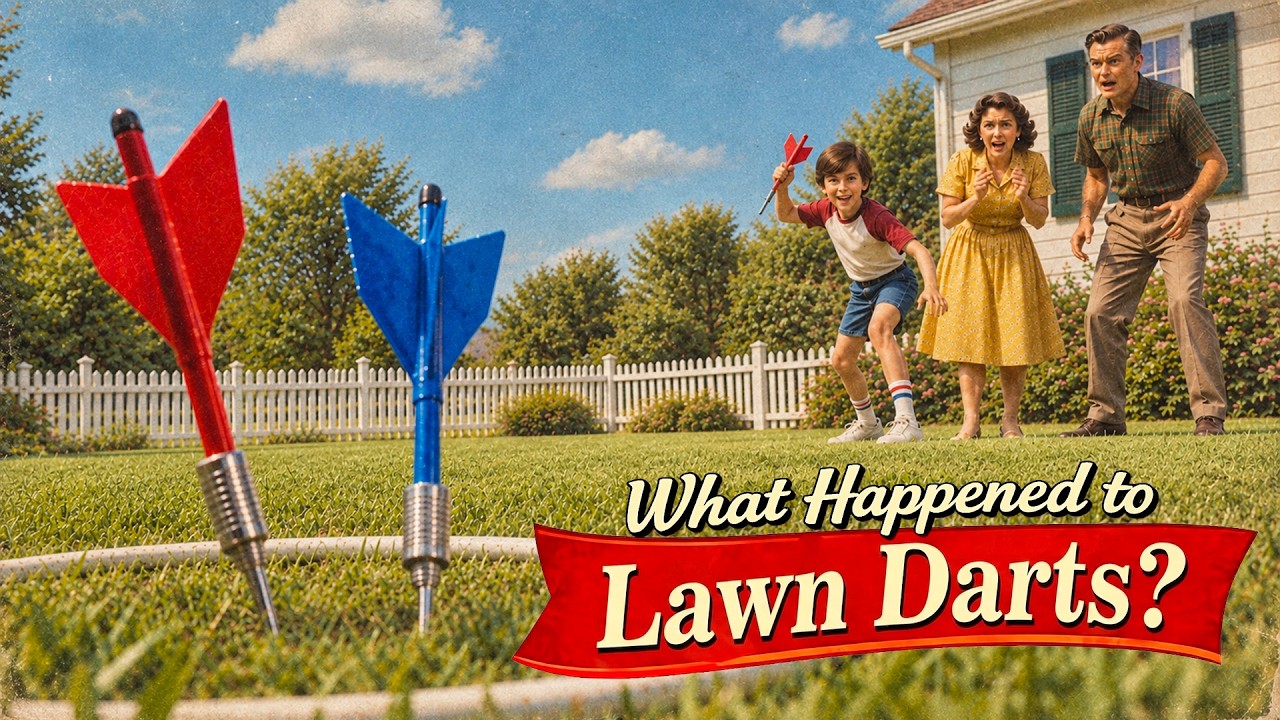
The dart was about twelve to thirteen inches long, weighed between a quarter and a half pound, with a metal tip, a slender body, and plastic fins. You threw it in an arcing motion from below toward a plastic ring lying on the grass thirty-five feet away. Two teams, four darts each, and the dart closest to the center won. What set it apart from anything else in the garage was the weight.
If you picked one up, you felt it immediately. Nobody had to tell you to be careful with it. You had to throw with a proper arc. If the throw was too flat, the head would not flip over, and the dart would slide on its side.
If it was too high, it would drift off. Master the throw, and the dart would plant itself in the ground, steel head first, with a sound that carried across the entire yard. It was real skill. Adjusting the angle of the wrist, reading the wind of the afternoon.
In the first few rounds, you would drop the dart sideways or short of the target. By the end of the summer, you knew exactly what the dart needed. There was no age advantage in the game. Adults competed at the same level as children and sometimes lost.
You could hear a game going on in the neighborhood. That faint sound of the rush through the air. A brief silence while the dart rose. Then the deep thud of impact or the hollow rattle of a close throw.
The Sears Christmas gift book that year featured them. An eight-piece set. Four red and blue darts, two rings, extra fins, and a rule sheet for about five dollars—the equivalent of forty-nine dollars today. Right next to the croquet sets and tetherball poles.
The marketing copy described them—and this precise wording matters later—as fun and skill for all ages. By the mid-1970s, lawn darts sat beside badminton and croquet in countless American backyards. The difference was that you could hear the game from two houses away. Other games did not have that.
The Fourth of July was its natural home. A cooler sweating water onto cardboard in July heat, grass withering at the edges. A father pulling the box off the garage shelf while the grill heated up. You played until the smoke drifted over and someone called you in for dinner.
But it was not only the Fourth of July, or Memorial Day, or Labor Day, but any Saturday in June with a few good hours before dusk. A bad throw could plant that steel head in the dirt next to someone’s foot. Everyone in the game knew it. That slight edge of consequence, which made you try honestly, was what made winning feel earned.
The game lasted for nearly three decades in America. Most of the people who played it had no idea the product had already been banned once. In November 1970, the Food and Drug Administration proposed classifying pointed lawn darts as banned hazardous toys for children. The makers of Garst did not change the dart.
They changed the aisle. R. B. Garst temporarily halted assembly, added warning labels to the boxes, and argued before federal regulators that this was not a children’s toy at all.
It was a sporting product for adults. The regulators accepted that, but with conditions. The packaging had to carry a prominent warning that the product was not a toy for children and could cause serious or fatal injury. The instructions had to cover safe use, keeping people and animals away from the target area, and the product could not be sold through toy stores or any department dealing primarily with children’s goods—that last condition was the one that really mattered.
A federal court upheld those conditions in January 1971. The Second Circuit described them as reasonable because the product was regularly used by children even when manufacturers described it as an adult game. It was a settlement, not a solution. The original packaging made that contradiction clear.
Boxes on shelves before 1970 described the game as an outdoor game for the whole family. The box showed parents playing alongside a young girl. The instructions stated the game was for young and old. The same company that marketed directly to families and children entered federal proceedings and claimed it was an adult sporting product.
That steel-tipped dart remained on store shelves from 1978 until early 1987 because it was in the right aisle with the right label on the side. For nearly two decades, that was enough. The rest of the industry followed R. B.
Garst’s lead. New warning labels went on the boxes. Product displays moved in the aisles. And the product kept selling.
By 1972, the newly formed Consumer Product Safety Commission inherited the case from the FDA. The 1970 order was already the status quo. Nobody revisited it. Millions of sets sold during those years.
In every Sears, Kmart, and sporting goods chain down to regional stores. The product was everywhere. The label on the side of the box was all that separated it from the aisle the FDA had tried to keep it out of. During the late 1970s and early 1980s, this arrangement mostly held.
Manufacturers put the warning labels on. Retailers stocked the product in the designated departments. Injury reports kept coming in, hundreds of cases every year. But the compliance framework existed, and the industry could point to it.
By the mid-1980s, that framework had largely collapsed. The Consumer Product Safety Commission was aware of the laxness. Staff sent letters to manufacturers asking for improvements. The industry acknowledged the problem and kept promising better results.
In June 1987, commission staff inspected products from fourteen different companies. They found labeling violations in every single case. Eight companies had no required warning on the front face at all. Eighteen of fifty-three stores were displaying lawn darts right next to toys and children’s sporting goods.
Of eighteen manufacturers and importers, seventeen had recently shipped products with incorrect labeling. In eight of the fourteen cases, the warning on the front was not merely small or badly placed. It was missing entirely. The industry continued to promise to fix it.
Inspections kept uncovering the same violations. Then a seven-year-old girl died in Riverside, California, and her father decided to go to Washington. Her name was Michelle Snow. It was April 1987.
About 670 lawn dart injuries were reported in American emergency rooms every year. More than seventy-five percent of victims were under fifteen. About half were under ten. Three children had died before Michelle.
Formal rulemaking began in October 1987. In March 1988, Snow stood before the commission. They voted against an immediate ban. Stronger warnings and better enforcement, not a ban.
By October 1988, he had been at this for eighteen months, and 1988 had moved fast. In March, Sears—the same store that had listed the Garst game in its Christmas gift book since 1970—agreed to stop all lawn dart sales after the Consumer Product Safety Commission filed a lawsuit. When a retailer that size pulls something, the rest of the industry pays attention. But the rest kept selling anyway.
In May, the commission voted two to one to develop a comprehensive ban covering any dart physically capable of penetrating the human skull. The proposed rule was placed in the Federal Register on July 29. Industry groups pushed back. The Sporting Goods Manufacturers Association argued a complete ban was disproportionate.
Better enforcement, not elimination. The same stance they had held since 1971. Some manufacturers argued that their specific dart head designs were different enough to be exempt. The Consumer Product Safety Commission did not back down.
The injury rate had not changed for nearly two decades. Compliance requests had been ignored for years. There was no reliable test distinguishing skull-penetrating darts from safer designs. The 1970 settlement had outlived its purpose.
Congress passed lawn-dart-specific legislation on October 21. Three parallel tracks had reached the same conclusion in the same month. The commission’s formal rules, the injury record, and now an independent action from Congress. The industry had been demanding better enforcement since 1971.
By October 1988, time had run out for that argument. Four days later, on October 25, 1988, eleven-year-old Amy Herron was struck by a dart in her yard, penetrating her skull. She underwent lengthy surgery. Three days after that, on October 28, the Consumer Product Safety Commission voted two to nothing.
On November 5, President Ronald Reagan signed the legislation. On December 19, 1988, the ruling took effect. Not just for new production, but for everything in the distribution chain on that date. Retailers could no longer sell remaining stock.
No commercials aired. No public announcement was made. One summer, they were in garages all across America. The next time you looked for them, they were gone.
Possession of lawn darts was never a federal crime. The federal law prohibits sale, manufacturing for sale, distribution, and importation. Possession was not listed in the ban. The Consumer Product Safety Commission recommends disposal.
Many did not do it, but perhaps it is good that this piece stays hidden in the garage. Franklin Sports launched a recall program. Five dollars for a set of four darts. Some mailed them back.
Most people kept the box. Original sets still appear at estate auctions and storage unit sales. People pay far more than five dollars for one. What replaced them on the shelves was not a true replacement.
Round-headed versions appeared. Cup-shaped ends that bounced instead of sticking. Designed for the same ring game at thirty-five feet. The weight was not enough.
They fell softly and slid. Most people played one round and put them back. Bocce and ring toss took their place. None of them made that distinctive sound.
The ban was the right call. Three children had died. Hundreds of children were going to emergency rooms every year. The industry had nearly two decades to live up to the terms it agreed to in 1971.
They did not. The arguments against the ban were about how proportionate the response was to the problem, not about whether the product was dangerous. What people remember is not the lawsuits or the final vote. They remember specific sets.
The red and yellow darts. The flat cardboard box with the hand-drawn family picture on the front. The weight in your hand. The arc you had to judge.
The sound when it settled exactly where you aimed. Before the hearings and the legislation and the December date, it was just a ring on the grass thirty-five feet away, and you were trying to master the throw. It asked you to judge the arc and place the dart where you aimed. It gave you something real to put your effort into.
Many still remember exactly how that felt. If you played back then, you already know that.
