On a small island in the Aegean, on a warm night in the spring of 1970, a maid opened a bedroom door and found the lady of the house unconscious. An empty bottle of sleeping tablets stood nearby. A doctor was flown out through the dark by helicopter, and by two in the morning, Eugenia Levanos was dead. She was forty-three years old.
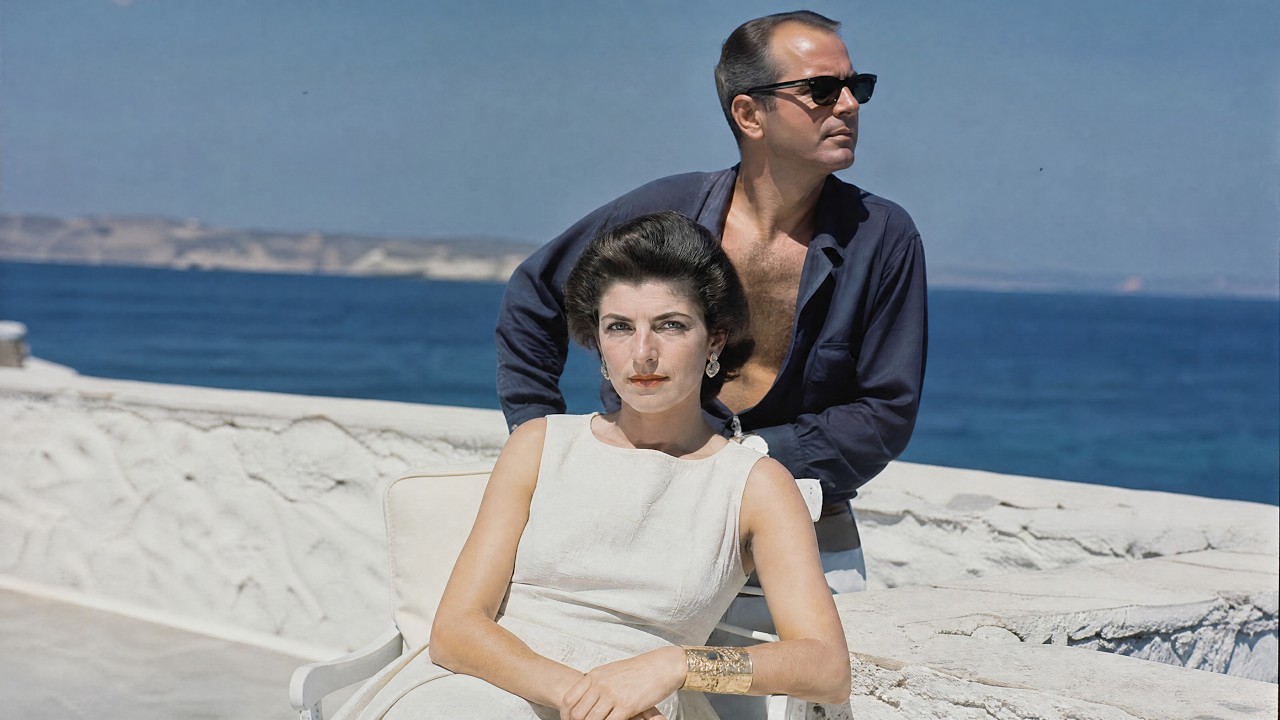
She was the wife of one of the richest men alive, the mistress of that island, the mother of his four children. Within days, her death would be examined and questioned. Within months, it would be quietly closed. Almost no one reading the headlines could have told you a single thing about the woman herself.
The world had never troubled to look at Eugenia Levanos. Now there was a body to look at. Before Eugenia Levanos was anyone’s wife, she was a rule, a piece of custom that decided her life before she could speak against it. She was born on the eleventh of August 1926 in London, the first child of Stavros Livanos and his wife Arieta.
Her father was a ship owner, and in the closed world she was born into, that word meant something very particular. It did not mean one ship or a small line of ships. It meant one of the great fleets of the Greek shipping trade, a fortune built out of the tankers and cargo vessels that carried the commerce of nations across the oceans. The Livanos name was among the oldest and most respected in that world, and it carried a weight that newer money could only envy.
Her father was a man of the older school, careful, quiet, suspicious of newspapers, the kind of rich man who believed that the safest fortunes were the ones nobody read about. Eugenia was the elder of his two daughters, and she was worth on the day she was born more than most people alive would earn in a hundred years. But she was rich in a very particular way, and that particular way is the whole of her story. The Greek shipping families of that age were a kind of aristocracy without a country.
They were a scattered handful of houses who owned between them an enormous share of the vessels that moved the world’s oil and grain. They lived between London and New York and the resorts of the Mediterranean as easily as other families moved between rooms. They educated their children at expensive schools. And above all, they married one another over and over to keep the fleets consolidated inside the same few houses.
In that world, a daughter was not only a child. She was also an alliance waiting to be arranged. The daughters of a man like Stavros Livanos were among the most valuable pieces on the whole board. Everyone in that circle understood this.
A marriage between two shipping houses was a merger. It joined fortunes and fleets and names, and it was negotiated with roughly the care and the coldness of any other large transaction. Love, where it happened, was a lucky accident laid on top of the deal. It was never the reason for the deal.
Two men came looking, and both of them would become legends of the century. One was Aristotle Onassis, the other was Stavros Niarchos. They were the two most ambitious shipping men of their generation, rivals already and fated to stay rivals for the whole of their lives. At the very start, what these two hard and driven men had in common was a single desire.
They both wanted to marry into the house of Livanos, because a Livanos daughter was the surest way into the oldest respectability that shipping money could buy. Here is the detail that tells you everything about the world Eugenia was born into. By the accounts that survive, it was Niarchos who came first. And the daughter he asked for was not Eugenia at all.
It was her younger sister, Tina, a girl he is reported to have wanted when she was only fourteen years old. Her father did not refuse him on the grounds that his daughter was a child. He deferred him on a rule, a piece of custom as old as the family itself. The elder daughter must marry first.
Eugenia had to be settled before Tina could be given away at all. So the men rearranged themselves around the rule, the way you might move chairs around a table to fit the guests you happen to have. Niarchos, told he could not yet have the younger sister, turned to the elder. That is how Eugenia Livanos, at the very start of her adult life, was matched to a man who had walked into her family’s house wanting somebody else.
To the readers of the society pages, when they noticed at all, it looked like a splendid dynastic match, two great fortunes joined. Underneath the splendor was a plainer fact. She was the elder daughter, and the elder daughter had to go first. And so she went.
Nobody wrote down what Eugenia wanted. Nobody, it seems, thought to ask. In November of 1947, she married the man who had wanted her sister, and two of the largest fortunes in the world were joined in a single afternoon. The wedding took place on the first of November 1947 in New York, about a year after Tina had married Onassis.
Look at the order of it, because the order is the whole quiet cruelty of her position. The younger sister had married first in fact, but only because the elder had been settled first in principle. Eugenia had cleared the way. Once she was matched to Niarchos, Tina was free to be pursued and won by Onassis.
And so, within the space of about a year, the two Livanos daughters were married to the two greatest rivals in world shipping. The houses of Livanos, Onassis, and Niarchos were bound into a single family, and that family would spend the next thirty years feuding across the same ocean, with the two sisters standing at the center of a war neither of them had started. The man Eugenia married was formidable. Stavros Niarchos had been born in Athens in 1909, and he had built, on the same aggressive model as his great rival, one of the largest tanker fleets in the world.
He commissioned some of the biggest supertankers ever to put to sea. He profited, as Onassis did, from the enormous tanker booms that followed the war, when the world’s hunger for oil could turn every idle ship into a fortune almost overnight. He was a hard, restless, driven man of huge appetite and iron will, and he did not lose the things he had decided to win. For a time, the marriage did exactly what such marriages were built to do.
It produced heirs. Across the years that followed, there were four children. First the sons, Philip and Spyros, then a daughter, Maria Isabella, and at last the youngest boy, Constantinos. Four children, a great fortune standing behind each parent, the alliance of two shipping houses made flesh and given names.
From the outside, it had the whole convincing shape of a strong family. Of the two Livanos sisters, Eugenia was the one who had made the solid match, the marriage that lasted, the one that worked. Tina had the glamour and the fame and the most talked-about husband alive. Eugenia had the children, the respectability, and the quiet.
In the arithmetic of the gossip columns, the younger sister was the story and the elder sister was the footnote, the sensible one, the one there was nothing to say about because nothing appeared to be wrong. She was filed under safe and forgotten. Her husband bought an island to answer a rival and made her the queen of a kingdom that existed mostly to prove a point. Stavros Niarchos bought Spetsopoula, a small island off the coast of the Peloponnese, and turned it into one of the most lavish private domains in all of Europe.
It was thousands of acres of private ground with its own harbor, its own game brought in and bred for the shooting, its own staff, and a great house in which the family lived and entertained on a scale that few royal households of the age could match. It was not in truth only a home. It was an answer. His rival Onassis had bought the island of Skorpios and made it a monument to himself, and Niarchos bought Spetsopoula and set out to make a bigger one.
The two richest rivals in world shipping each acquired a private kingdom in the same sea, partly to live in and partly so that the other would have to look across the water and see it there. Eugenia was installed as the lady of one of them. She was the wife of one of the richest men on earth, the mistress of a private island that most people could not have imagined even in a dream, the mother of four children who stood to inherit one of the great fortunes of the century. By every outward measure the century knew how to count, Eugenia Niarchos was one of the most fortunate women alive.
The two men who had married the Livanos daughters commanded fortunes that would be counted by the end of their lives not in the millions but in the thousands of millions of dollars. Niarchos alone would leave at his death an estate reported in the region of twelve billion, passed chiefly to the three sons and the daughter that Eugenia had given him. The islands, the fleets of supertankers, the great houses in a string of cities, the collections of art that would one day hang in the world’s museums—all of it belonged to the world she had married into at twenty-one. But an island is a small place, and a private kingdom has walls, and the walls are made of water.
The same wealth that gave Eugenia everything also set her down in the middle of the sea on her husband’s ground, at the center of her husband’s kingdom, inside her husband’s long and bitter war with the man across the water who had married her sister. She was not the ruler of Spetsopoula. She was its ornament and its hostess. To the world, none of this showed.
To the world, she was the fortunate one, the settled sister, the queen of a private island in a warm blue sea. Life on Spetsopoula in the years of its glory had the quality of a private world with its own weather and its own rules. There were the shooting parties for which game was bred and released across the island’s thousands of acres so that the guests could be entertained in the manner of an English country estate set down in a Greek sea. There were the boats riding at anchor in the private harbor.
There were the staff who kept the great house running, the meals that appeared, the rooms that were readied, the whole invisible machinery of extreme wealth humming quietly in the background. At the center of it, presiding, was Eugenia. But notice the exact shape of her role. She did not own the island.
She did not command it. She was its lady in the way a figurehead is the face of a ship—decorative, dignified, essential to the picture, and powerless over the course. The kingdom was her husband’s. She was its most beautiful fixture.
To understand what Eugenia’s marriage really was, you have to understand the war it was part of. Because she did not marry only a man. She married one half of the greatest rivalry in the history of shipping. Aristotle Onassis and Stavros Niarchos were the two titans of the Greek tanker fortunes.
From the moment they both married into the house of Livanos, they were locked together as brothers by marriage and enemies by nature. They competed over everything. They competed over tonnage, building ever larger tankers to outdo each other’s fleets. They competed over prestige, over who dined with which head of state, over whose name carried further in the rooms that mattered.
And they competed most visibly of all over the two private islands they each bought in the same sea—Onassis with his Skorpios and Niarchos with his Spetsopoula. Two kingdoms built partly so that each man could look across the water and be reminded of the other. Set inside that war were two sisters, and they were its connective tissue. Eugenia and Tina had not chosen the feud.
They had been married into it, one to each combatant. When the families were forced together, the two tycoons are reported to have quarreled even then. And the women who had grown up in the same house, who had shared a childhood inside the same quiet, careful fortune, now found themselves stationed on opposite sides of a rivalry that would outlast almost everything else in their lives. And it was Tina, the younger sister, whose side of that war the world watched.
While Eugenia kept to her island and her children, Tina was living out the most public marriage of the age, and it was about to break in the most public way imaginable. Onassis fell into the affair with Maria Callas that would end his marriage to Tina, and the whole world watched it happen. Tina was publicly displaced, cast aside in full view of the society that had envied her, and the humiliation of it became one of the defining scandals of the decade. Hold the two sisters side by side, because their fates rhyme in a way that is the quiet engine of this story.
Tina’s tragedy was loud. It happened in public with a famous rival and a famous husband, and the world consumed every detail of it. Eugenia’s tragedy was silent. It happened on a private island behind walls of water with no famous rival for the cameras to chase.
And so the world simply never noticed it at all. The same machine was grinding down both women at the same time. One of them it ground down in the headlines. The other it ground down in a place the headlines could not reach.
And because the world only knows how to watch the loud kind of ruin, it decided that Tina was the tragic sister and Eugenia was the lucky one. And it went on believing that right up until the night a maid opened a door. The cruelty of Eugenia’s life is that the marriage everyone called the successful one was in private as hollow as the marriage everyone called the failure. It only failed more quietly.
Stavros Niarchos was by every account that survives a hard, restless, unfaithful husband, a man of enormous appetites who treated the world as a set of things to be acquired. And a wife acquired through a rule of custom was to a man like that one more possession among many. There is the photograph and there is the person, and the distance between them is the whole story. The photograph showed the lady of a private island, the mother of four handsome children, the wife of a titan.
The person was a woman in a marriage that had never been hers to consent to, watching her husband’s attention wander where it pleased. This was not the world of the modern divorce where an unhappy wife might imagine a life of her own on the far side of it. This was the closed world of the shipping dynasties, where a woman’s whole value and position were bound up in the marriage she had been placed into, and where the families were so few and so intermarried that stepping outside meant stepping into a void. Her sister Tina would in time escape one marriage only by walking into another and then another.
That was the pattern for women of their kind. You did not leave a marriage in that world so much as you were transferred out of it. So Eugenia kept the surface intact. She was the hostess of the island, the mother of the children, the dignified wife who did not make scenes for the newspapers to print.
And the very success of that performance became another kind of trap, because a woman who keeps the surface perfect gives the world permission to assume that all is well beneath it. Tina’s misery was legible because it happened in public. Eugenia’s misery was invisible because she was too proud or too disciplined or too resigned to let it show. In 1965, the marriage the world thought was the safe one ended in the newspapers, and the replacement was less than half his age.
Niarchos did not simply part from his wife of eighteen years, the mother of his four children, the woman who had brought him the Livanos name. He parted from her and married almost at once Charlotte Ford, a young daughter of the American motor dynasty, a woman more than thirty years his junior. Read that gap again, because the gap is the humiliation. Eugenia was a woman in her late thirties who had given this man four children and two decades and the oldest respectability that shipping money could buy.
She was set aside for a bride young enough to be his own daughter, from one of the most famous fortunes in America, in a match that the newspapers of two continents wrote up as the marriage of the season. Eugenia’s entire life had been lived as a surface. She had kept the marriage’s private misery invisible precisely so that the surface would stay intact. And now the surface itself was shattered in public, in the papers, for everyone in her world to read.
The woman who had never once let the cracks show was exposed all at once, not by any failure of her own, but by her husband’s decision to trade her in. She had held the performance together for eighteen years, and then the man she had held it together for tore it up himself in front of the whole audience. A woman in Eugenia’s world, cast off in her late thirties, did not have the options an ordinary woman might have imagined. Her value had always been the alliance she embodied, and that alliance had now been dissolved by the very man it was built with.
Her sister Tina, cut loose by Onassis, had married into the English aristocracy and then in time would marry again. That was how it worked. A woman did not stand alone in that world. She moved from one powerful man’s house to the next, or she vanished from view.
In the cold ledger of the marriage market, Eugenia had simply been outbid, her respectable Greek fortune traded up for an American one attached to a bride half his age. The papers of two continents covered the new match as a triumph. Almost none of them paused over the woman being set down to make room for it. The marriage to Charlotte Ford did not last.
It began in 1965. It produced a daughter, a little girl named Elena, and by 1967 it was over, ended in divorce. And here the story does something that even the divorce had not prepared Eugenia for. Niarchos did not move on to a third young bride.
He turned around and went back to the wife he had cast aside. To the outside world, glancing at the papers, this looked like a reconciliation, a husband come to his senses, a family reassembled. The sources genuinely differ on a legal wrinkle. Some accounts describe the return as a straightforward remarriage.
Others record that under Greek law, the divorce of 1965 had never actually been recognized, so that in the eyes of Greek law, no remarriage was even necessary, and Eugenia had in a purely legal sense remained his wife throughout the whole Charlotte Ford interlude. Whichever version you choose, the human reality is exactly the same. Eugenia had been set aside so that her husband could marry a younger woman. And when he had finished with the younger woman, she was picked up again and put back in her place.
The first wife was not asked whether she would like to come back. She was simply taken back, restored to her position like a piece of furniture carried up from the cellar once the redecoration is finished. The message of that to any woman with eyes is unmistakable. You were never a person in this marriage.
You were a fixture. She had been the second choice at the start, when Niarchos came asking for her sister. She had been no choice at all in the middle, when he traded her for Charlotte Ford. And now she was a convenience at the end, taken back not out of love but out of whatever mixture of habit and calculation had made her worth reclaiming.
That is not a reconciliation. It is a reoccupation. It is in these last years, the years of the so-called reconciliation, that the sleeping tablets enter the record of her life. This was a proud, private woman who had spent more than twenty years performing contentment on a private island, keeping every crack invisible, and who had now been shown beyond any doubt that the position she had performed for could be taken from her at will and handed back to her at whim.
She lived in an age that had a ready answer for the unhappiness of wealthy women—an answer that came in a small bottle from a doctor, to be taken at night to help a person sleep through a life she had not been allowed to choose. The 1960s were the great age of the barbiturate. Drugs like Seconal, which is the one that appears in her story, were the common prescriptions of the era, handed out freely for sleeplessness and for nerves, kept in the bedside drawers of countless comfortable homes. They were not exotic and not hard to obtain.
For a woman of great fortune, with private doctors and private means, they were as available as she cared to make them, and they were dispensed in quantities that made an overdose—whether by accident in the fog of the night or by design in the depth of despair—a constant and quiet danger. Across the whole of glamour culture in those decades, from the film studios of California to the shipping villas of the Mediterranean, the same pattern repeats with a terrible regularity. A wealthy woman is unhappy for reasons that are usually structural and rarely her fault, and the answer the world offers her is not freedom or power over her own life or even simple attention. The answer is a prescription.
The barbiturate was the century’s way of managing the distress of women it had no intention of actually setting free. It let them sleep. It kept them quiet. And every so often, in a home no ordinary person could enter, it killed one of them.
Consider the shape of Eugenia’s last years. She was restored to a marriage that had discarded her. She was the lady once more of a private island in the middle of the sea, a place of astonishing beauty and almost total isolation—her husband’s ground, her husband’s kingdom, walls of water on every side. She had four children, but they were growing and gone into their own lives.
She had every material thing the age could produce, and almost nothing that a person actually needs. No real say, no real intimacy, no real door out. And she had in her bedside drawer the small bottle that the medicine of her time prescribed for exactly the kind of sleepless, nameless distress that a life like hers would produce. On the evening of the third of May 1970, the household on Spetsopoula sat down to a late dinner.
At some point that night, the husband, Stavros Niarchos, made a telephone call to Charlotte Ford in Paris to ask that their young daughter Elena come to visit the island. Within about an hour of that call, a maid went to Eugenia’s room and found her mistress unconscious. It was around eleven at night. What followed was the desperate, slow-motion emergency of a medical crisis in the most isolated place imaginable.
There was no hospital on the island. There was no quick help of any kind. A doctor had to be summoned across the water and through the dark, and he came by helicopter. By the accounts, he did not reach her until around two in the morning, some three hours after she had been found.
It was already far too late. Eugenia Livanos Niarchos was pronounced dead at about two in the morning in the early hours of the fourth of May 1970. She was forty-three years old. One contemporary report gave her age as forty-four, but she had been born in August of 1926, which makes forty-three the true figure.
Even that small confusion tells you something about how little the world actually knew the woman it was now writing about. The physical facts entered the record through the autopsy, which was carried out by the chief medical examiner, a doctor named Demetrius Kapsaskis. The finding was death from an overdose of barbiturates. Near the body was an empty bottle of Seconal, the common sleeping tablet of the age.
The toxicological account that reached the newspapers indicated that she had taken a great many of them, a figure reported at around twenty-five tablets. There was also said to be a note, described in some accounts as a message to her husband and quoted in one account with the words, “For the first time in all our life together, I have begged you to help me. ” The reports carry that note; no one can independently prove it. Let it stand as what it is, a line of terrible sadness at the edge of the record.
If the story had ended there, it would have been simply a private tragedy, and the world would have sighed and moved on. But the story did not end there. When the body was examined, those who examined it noted bruising. The accounts differ on exactly where.
A contemporary report described bruises on the throat and the abdomen. Other retellings place the bruising on the head, the throat, and the chest. Give the range rather than fixing on one version, because the exact map of the bruising was never something the public could settle. But the fact of the bruising is in the record, and it is the fact that changed everything.
Bruising on the body of a woman found dead of an overdose is the kind of detail that does not let a case simply close. An inquiry was opened. For a period, the husband was prevented from leaving the country. The quiet private death on the island became almost overnight a formal matter for the Greek courts.
Everything about the setting made the night worse than it had to be. On the mainland, in a city, a collapse found a little after eleven at night might have reached a hospital within minutes. On Spetsopoula, there was only the sea and the dark and the wait for a helicopter to cross it. Some three hours passed between the moment the maid found her and the moment the doctor finally reached the bedroom.
Whatever might have been possible in those hours was lost to distance. The isolation that had been sold to the family as the ultimate luxury became, on the last night of Eugenia’s life, the very thing that kept help away until it no longer mattered. She died where she had lived, cut off by water, waiting for someone to arrive across the dark. The inquiry that opened in the spring of 1970 is the heart of the whole matter, and it must be walked through slowly.
Niarchos gave his own account, and the record preserves it. He said that the bruising on his wife’s body had been caused by his own efforts to revive her, the desperate handling of a man trying to bring back someone he has just found unconscious. Of the death itself, he was reported to have said that all the witnesses agreed it was a simple suicide. That was his account.
It is not the job of the storyteller to endorse it or reject it, but to report that this is what he said, and to set it beside the other facts, and to let the law do what the law then did. What the law did came in two stages, and the two stages point in opposite directions. In the first stage, the public prosecutor in Piraeus, a man named Constantine Fafoutis, reviewed the findings—the overdose and the bruising and whatever inconsistencies had troubled the investigators—and he recommended that Niarchos be charged. The charge he recommended fell under the article of the Greek penal code that covers the causing of death, and it carried on paper a maximum penalty reported at eighteen years.
It was not a conviction. It was not even a trial. It was one prosecutor’s judgment that the questions were serious enough that they ought to be tested in a courtroom. Then came the second stage.
Under Greek procedure, it was not for the prosecutor alone to send a man to trial. That decision belonged to a panel of three magistrates, a penal council, whose task was to weigh the evidence and decide whether there was enough of it to justify a trial at all. In September of 1970, that panel gave its answer. It rejected the indictment.
The magistrates concluded that the medical evidence did not support a criminal charge, that the bruising was insignificant and consistent with explanations other than foul play, and that the death should be regarded as accidental. Niarchos was cleared. The bond that had kept him in the country was returned. The case was closed.
Let the plainest possible sentence carry the weight, because the plainest sentence is also the fairest one. No court ever found that anyone killed Eugenia Livanos. A prosecutor thought the questions worth a trial. A panel of magistrates, whose actual job was to decide exactly that, weighed the same evidence and disagreed, and ruled the death an accident, and cleared her husband of any crime.
To state or imply anything beyond that would be to convict a man the law itself declined to try. And yet here is the honest final truth of the inquiry, the truth that keeps the story alive. In the public imagination, the suspicion outlived the verdict. It always does in cases like this, where enormous wealth and a sudden death and a body marked with bruises come together on a private island that no ordinary person can enter.
It did not help that in the same period the inquiry was running, the Greek government of the day ratified a major expansion of Niarchos’s shipbuilding interests, a shipyard deal reported at around two hundred million dollars—a reminder of just how much power the man at the center of the questions actually held. Years later, a hostile book would press the darker reading hard, and must be treated for what it is, an advocacy, not a proof. The verdict said accident. The whisper said otherwise.
And between the verdict and the whisper, the woman herself once again disappeared. Eugenia was buried in May of 1970 in a family vault in the Bois-de-Vaux cemetery in Lausanne in Switzerland, far from the island, and the argument about how she died went on without her, as everything in her life had always gone on without her. If the inquiry had been the end, Eugenia might have faded into a footnote. What kept her story burning was what her husband did next.
In October of 1971, about seventeen months after Eugenia died, Stavros Niarchos married again. And the woman he married was Tina, her sister. The younger Livanos daughter, the one he had wanted first all those years ago when she was fourteen, and her father sent him to the elder sister instead. Onassis’s discarded wife had become at last Niarchos’s wife, and in becoming it, she became the second Livanos sister to marry the same man.
The world found the marriage deeply disturbing, and for the most obvious reason imaginable. A woman had married the man on whose island her own sister had just died, a death that was questioned and then closed. To the outside eye, it was almost incomprehensible. To the closed logic of the shipping dynasties, it was something colder and sadder, almost a return to type.
The circle of families rich enough to intermarry was so small, and the fortunes so determined to stay inside it, that the same few people simply married and remarried one another around and around. The machine that had allocated Eugenia in the first place was still running, and it had one more piece left to move. And then the machine took the second sister, too. Tina Livanos was found dead in a hotel in Paris in October of 1974 at the age of forty-five, of what was officially recorded as a lung condition and has also been widely attributed to an overdose of barbiturates, the very same shadow that had fallen over Eugenia four years before.
The sources disagree, and both readings must be given. She was buried beside her sister in the same cemetery in Lausanne. The two Livanos daughters, who had shared a childhood in one careful, quiet house, who had been handed to the two great rivals of Greek shipping, who had both in the end been the wife of Stavros Niarchos, now lay side by side in Swiss ground, dead within four years of each other, both with barbiturates somewhere in the account of their deaths. They were not even the last.
Tina’s daughter, Christina Onassis, would die in 1988 at thirty-seven, again with sedatives in the story of her end. Three women of one extended family, dead young, with the same class of drug threaded through all three deaths. It is not surprising that the word curse attached itself to the family. But the responsible telling refuses the word, because the word is a way of not looking.
A curse is supernatural, and a supernatural explanation asks nothing of the world that produced these deaths. These were wealthy, unhappy women living inside arrangements they had not chosen, in an age that answered a woman’s distress with a bottle of sedatives rather than a way out. The drug that recurs in all three deaths was the ordinary medicine of their class and their time. What looks like a curse is really a pattern, and the pattern has a name, and the name is neglect.
What survives of Eugenia in the end is mostly what survives of any woman the world declined to see. There are the four children who grew up and became figures in their own right. Her eldest son, Philip, became one of the most significant private art collectors in the world, the keeper and greatly the expander of his father’s collection. Another son, Spyros, took his place in the family’s affairs.
The daughter, Maria Isabella, and the youngest son, Constantinos, complete the four, and Constantinos died in 1999. The Niarchos name endures now chiefly as a great charitable foundation, one of the largest of its kind, which has funded among much else a vast cultural center, carrying the fortune forward into a present in which the marriage that made it and the woman who died inside it are almost entirely forgotten. The money remembers itself. The woman, the world let go.
Even in death, the sisters were kept inside the family’s orbit rather than released from it. The same fortune that had married them arranged their graves, and the same name that had valued them as alliances now carried them side by side into a Swiss cemetery far from the sea that had defined them. The money went on. It always did.
The women it had used were the part that did not survive. Let us end where we began, on a small island in the Aegean on a warm night in the spring of 1970, with a maid opening a bedroom door and finding the lady of the house unconscious, and an empty bottle standing nearby, and a helicopter beating out across the black water carrying a doctor who would arrive too late. The whole of her life was a lesson in not being looked at. She was the elder daughter, and so she was married first to clear the way for the sister two men actually wanted.
She was the respectable wife, and so her private misery was assumed to be contentment because she was too proud to let it show. She was the settled matriarch, and so when her husband traded her for a younger bride, the world watched the younger bride and not the woman being discarded. She was taken back, and the world called it reconciliation. And she died on an island, and the world argued about how—and forgot to ask who she had been.
At every single stage there was a photograph the world preferred to the person, and the person slipped further out of view behind it. Her sister at least had the fame and the flashbulbs and the famous rival. Eugenia had a private island and a quiet marriage and a silence so complete that the world only turned to look at her when there was a body to look at. She was worth a fortune, and she was invisible.
She had everything the century taught people to want, and she could not get a single one of us to see her until she was dead. We will never know now what Eugenia Livanos wanted from her one life, because no one asked her while there was still time to answer, and she was too well trained to say it unasked. We do not know whether she dreamed of a different marriage or no marriage at all or simply of being seen once plainly as herself. All of it went into the ground with her in Lausanne, unrecorded, because the world had decided long before that she was the dull sister, the safe one, the footnote.
And the world does not take notes on footnotes. That is the final theft. Not only her life arranged and discarded and reclaimed by others, but her own account of it lost, because no one thought it worth the writing down.
