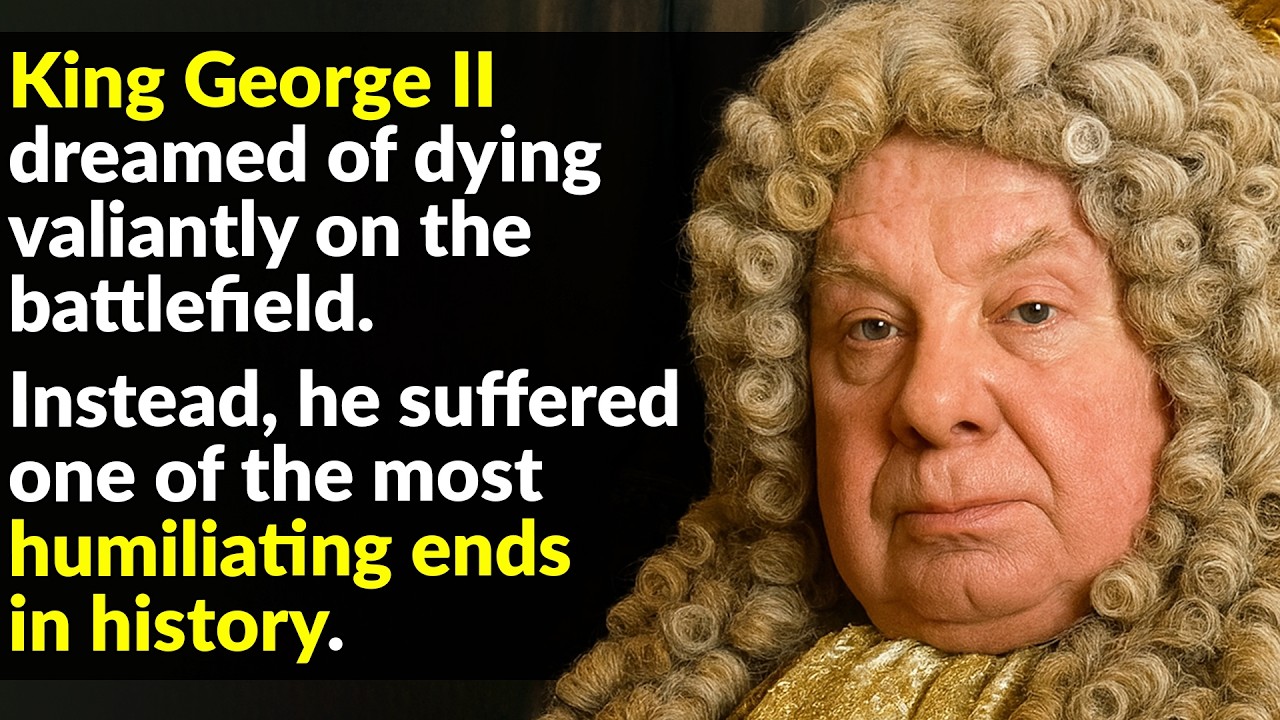
On the morning of October 25, 1760, King George II of Great Britain woke at six o’clock, as he always did. He sipped a cup of hot chocolate and sat down on the toilet. He had spent a lifetime dreaming of dying valiantly on the battlefield, of falling in the fury of a charge with his troops around him, of a death that would make the chroniclers reach for their most heroic phrases. Instead, a thoracic aortic dissection tore through him while he sat on the privy.
His valet heard a loud crash and rushed in to find the king on the floor. The attendants lifted him into his bed and sent for his daughter, Princess Amelia. By the time she arrived, George was dead. The man who ended his days in so undignified a manner had, in truth, never been British at all.
He was born in Hanover, Germany, in 1683, and his first language was French, the language of the royal court. He came into a family already disgraced. His parents, Sophia Dorothea and George Louis, were notorious philanderers of their age, each carrying on multiple affairs. But in 1692 his mother took one extramarital lover too many, and she paid a devastating price.
In a scandal that rocked Europe, the Hanoverian court dissolved the marriage and imprisoned Sophia Dorothea in a castle. The prepubescent George would never see his mother again. While his father schemed to arrange a marriage for him with Hedvig Sophia of Sweden, George hatched a secret plan of his own. He was determined to find true love, someone who would love him for his true self and not for his title.
In June 1705 he traveled to the court at Ansbach and went undercover as Monsieur de Bush. But there was one person who saw straight through his disguise. It was probably not a difficult feat, since he was a European royal whose face was plastered on paintings in every court from England to Russia. The dashing Caroline of Ansbach saw through him at once.
George fell madly in love with her, and the feeling was mutual. Love was in the air during that German summer. Just one month after they met, George and Caroline finalized every detail of their marriage contract. A month after that, they were wed.
But the marriage almost ended before it truly began. After giving birth to their first child, Caroline contracted smallpox. George could not bear the thought of losing her and stayed by her bedside through her illness. That proximity nearly killed him.
He fell ill as well, and for a moment the young couple’s prospects looked very dicey indeed. Fortunately, both survived. Apart from his love for his wife, George was passionate about fighting. He was a military strategy fanatic.
Against his father’s wishes, he took part in the Battle of Oudenarde against the French. His marriage had nearly cost him his life through smallpox, but this battle was even more dangerous. George was on the winning side, but that did not mean he had it easy. He escaped with his life only narrowly.
His unit came under heavy attack and men were falling around him. His own colonel perished in the fight. George somehow got away unscathed, but not before doing something supremely stupid. The Duke of Marlborough, who led the forces in the battle, wrote that the future King George II distinguished himself extremely, charging at the head of the Hanoverian troops.
At that time Queen Anne ruled Great Britain, but she had no heirs. It was decided that her crown would pass to her cousin George Louis, George’s father, after her death. When she died in 1714, George Louis became King George I, and his son became Prince of Wales and heir to the throne. These new titles came with their share of danger.
While standing in for his father during a royal appointment, George attended the Theatre Royal on Drury Lane. An unknown assailant attempted to do what enemy forces had not managed on a battlefield: end George’s reign before it began. The attacker managed to take out one person in the attempt, but George escaped totally unharmed. His apparent invincibility made him wildly popular in his adopted country of England.
His father, the king, took note. Whether from jealousy or mistrust, the already strained relationship between father and son took a nose dive. In a vindictive move, the king named the Duke of Newcastle as a baptismal sponsor for George’s second son, even though he knew George detested him. At the baptism, George threw out some fighting words, which the Duke unsurprisingly interpreted as a challenge to a duel.
To prevent hostilities, George’s father had to intervene. Before the duel could take place, he confined George and Caroline to their chambers. The whole baptismal setup may well have been a ploy by George’s deceptive and jealous father to sideline him. After confining his son, the king decided he did not want either of them in the royal residences and banished them from St.
James’s Palace altogether. He also separated the royal couple from their children, allowing them to visit only once a week. If George wanted to confront his father, he could not. His father was the king, and that would be treason.
Time took care of that problem. By June 1727, George’s father was dead. Then George got the last laugh. In an unprecedented move, he did not attend the funeral.
Once he became King George II, he wasted no time indulging in the regal luxuries his father had always denied him. Not only was he no longer banished from the palace, he held the keys to the whole kingdom. He decided to take an annual allowance of £800,000, about £100 million today. With his father out of the picture, George had no one left to fight with, and he missed the excitement of his military days.
He needed to go out and make some new enemies. Against the advice of his court, he began making aggressive maneuvers along the Prussian-Hanoverian border, and he made it personal. The Prussian ruler happened to be a relation. Frederick William I of Prussia was not just George’s brother-in-law, he was also his first cousin.
Frederick was just as much a fighter as George, and he was not going to back down. The saber rattling between the two cousins grew so intense that an all-out conflict seemed inevitable. To stave off total disaster, diplomats from both countries suggested the two kings settle the matter with a duel. For a man who loved a fight, George II’s response was unexpected.
He declined the offer. Part of being a good military strategist is knowing when you are beaten, and George was a good military strategist. Frederick William’s subjects called him the soldier king, and George did not like the sound of that. If George could not fight his cousin, he decided he would fight another relation: his estranged son.
While George had been feuding with his own father in England, his son Frederick had grown up in the Hanoverian court. By the time he came to England fourteen years after his parents, father and son had nothing in common except perhaps a love for blood feuds. George might have been king of Great Britain, but he was Hanoverian by birth. By 1736 the homeland called to him, and he decided to take a trip.
It was a horrible idea. Even though he intended to return, his English subjects were not impressed by their abandonment. Eager to get back before they grew too angry, George apparently did not check the weather report before sailing into the English Channel. The foolhardy king sailed directly into a giant winter storm raging on the high seas.
At home in England, things looked dire. Weeks went by without any sign of the king or his ship. Among his subjects, gossip began to swirl that George had died in the storm. But anyone who knew George knew he was not an easy man to get rid of.
One month later, the king of Great Britain miraculously emerged from the shore. This time, however, he was not entirely unscathed. The harrowing voyage had taken its toll, and he fell ill with a fever and hemorrhoids. Frederick began spreading rumors that his father was not going to make it.
Junior obviously did not know his dad. George knew his son was angling for the throne; he was, after all, no stranger to father-son feuds. When he heard Frederick was spreading rumors that he was about to die, he pulled himself out of bed and attended a social event, fever and all. Frederick was downright disappointed that his father survived.
There were other ways to send his father to an early grave, such as a broken heart. To get back at his father, Frederick banned his parents from the birth of their first grandchild. Once again, though, it was George who would have the last laugh. He pulled out an old trick his father had used on him and banished Frederick from the royal palace.
Instead of driving the family apart, George should have been keeping it together, because a heartbreaking tragedy was about to strike. His wife Caroline died after an extended battle with a strangulated bowel, and George was utterly grief-stricken. According to eyewitnesses, the belligerent king displayed a tenderness of which the world thought him before utterly incapable. With her final words, Caroline urged George to remarry.
He refused, saying, “No, I shall have mistresses. ”
George was very much the product of his parents. Despite his intense love for Caroline, he carried on numerous affairs throughout the marriage, though to be fair, he kept his wife informed about all of them. Some of those affairs might have borne fruit.
One of his longest affairs was with a Hanoverian noblewoman, Amalie von Wallmoden, and it went on for nearly thirty years. One of her two sons might actually have been George’s progeny, though he never acknowledged the child. Considering his treatment of the children he did acknowledge, that was a blessing. While George was busy ignoring the boy who might have been his son, his actual son was busy with a devious plan.
After his mother’s passing, Frederick conspired against his father by entertaining George II’s political opponents at his home. But if Frederick was planning a coup, it never came to fruition. George’s unbelievable luck continued. His scheming son Frederick died rather unexpectedly, from what historians believe to have been a pulmonary embolism.
It was not long before George wished that another of his sons would just go away: his third son, the Duke of Cumberland. His crime was negotiating a peace treaty that George did not like. According to George, his son had “ruined me and disgraced himself. ”
After more than three decades on the throne and a few close calls, the aging king became blind in one eye and suffered from hearing loss.
Then came that October morning in 1760, when he woke at six, sipped his hot chocolate, and sat down on the toilet. His dream of a valiant death on the battlefield was never fulfilled. Instead, a thoracic aortic dissection killed him on the privy. In his will, George had requested to be buried next to his wife, but unusually, he wanted the sides of their coffins removed so that their remains could mingle.
In the end, he was probably more of a lover than a fighter, if you exclude his father, his brother-in-law, his son, and his other son, and that time he charged into a bloody battle. History looks kindly on him. As one source claimed, his character would not afford subject for epic poetry, but would look well in the sober page of history.
