She was the most beloved woman in Britain, and she died owing millions. When the Queen Mother passed away in March 2002 at the age of 101, the BBC cleared its schedules, the flags dropped to half-mast, and Parliament suspended business. The tributes came in a wall of uniformity that was almost eerie in its sameness. The nation’s grandmother.
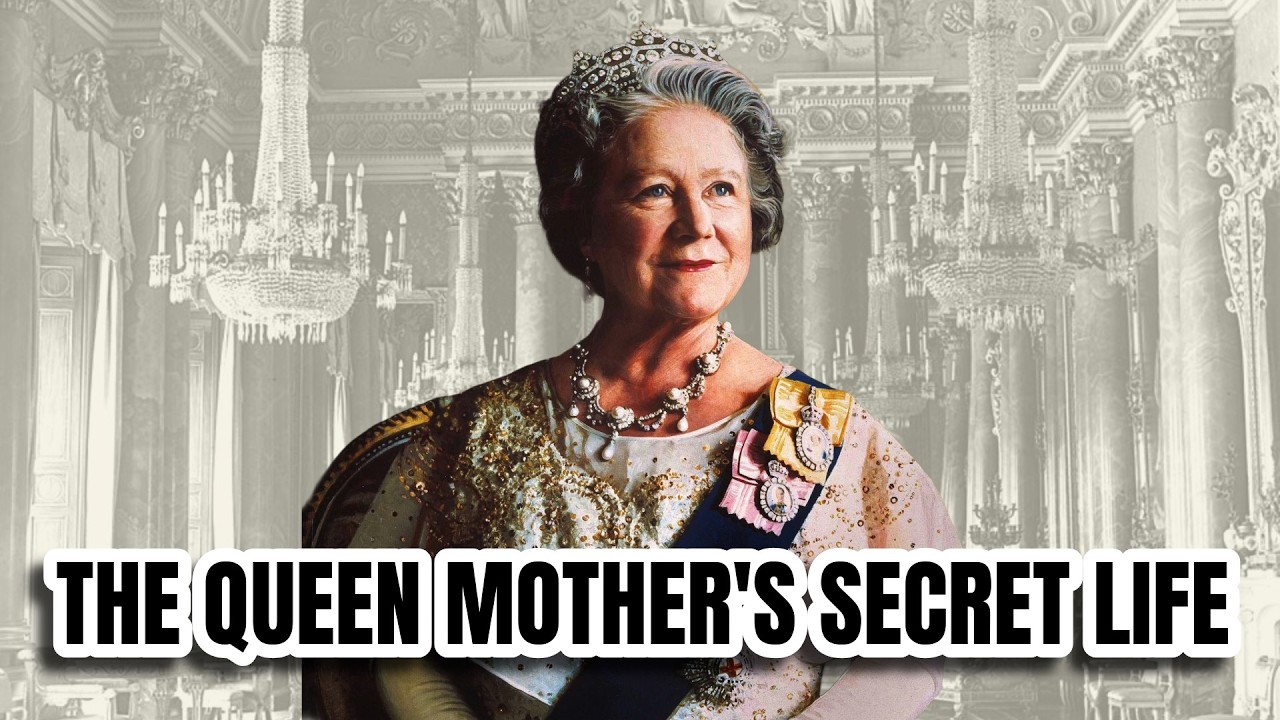
The last great Edwardian. The woman who held Britain together during the Blitz. Then her estate went to probate, and a number came out that no one wanted to discuss. She had died owing somewhere between £4 million and £7 million to her private bank, after a lifetime of spending on a scale that would have ruined any private citizen in Britain.
Buckingham Palace had no comment. The press barely covered it. For most people, it was either unknown or quickly forgotten. But the question no one really asked was how the most beloved woman in Britain, funded by the Civil List, patron of hundreds of charities, resident of four royal properties, ended up functionally insolvent.
And who, exactly, decided that the British public didn’t need to know. To understand how completely the image was constructed, you have to understand how total it was. Elizabeth Angela Marguerite Bowes-Lyon was born in 1900, the ninth of ten children of a Scottish aristocratic family. From childhood she was charming.
People who met her as a young woman consistently described a quality that was hard to pin down, an ability to make whoever she was talking to feel like the only person in the room. It wasn’t performance, or at least it didn’t read as performance. It was, by all accounts, genuine. And it would become the most politically powerful tool in the British royal arsenal for the next hundred years.
She married the Duke of York in 1923. He was not the glamorous choice. His elder brother, David, the future Edward VIII, was the one everyone wanted, charming, modern, bracingly handsome. The Duke of York was shy, prone to terrible rages, afflicted by a stammer so severe he could barely deliver a public address.
Elizabeth Bowes-Lyon transformed him. Whether she knew what she was doing or whether it was simply the effect she had on people is debatable. What isn’t debatable is the result. Then came 1936 and the abdication.
Edward VIII gave up the throne for Wallis Simpson, and suddenly the shy Duke of York was King George VI, and his wife, the woman nobody had expected to be queen, became exactly that. She was magnificent at it. That is the honest truth, and it matters to say so if the story is to land properly. You cannot understand the Queen Mother’s hold on the British imagination if you dismiss her as a fraud.
She wasn’t. She was genuinely good at being a wartime queen, genuinely committed to the role, genuinely present in the rubble of the East End when it would have been easier and safer to sit in Windsor. When the Luftwaffe began their assault on London in September 1940, the argument at court was whether to evacuate the royal family to Canada. She reportedly refused, saying in what became the most quoted line of her public career, “The children will not go without me.
I will not go without the king, and the king will never leave. ” When Buckingham Palace was bombed, hit nine times during the war, she famously said the damage made her feel she could finally look the East End in the face. Hitler, who understood the propaganda value of what she was doing, reportedly called her the most dangerous woman in Europe. That line followed her for the next sixty years.
And here is where the story becomes interesting, because that image was not accidental. It was managed. One entry in the Canadian Encyclopedia put it plainly: as a propagandist, she left even Hitler’s notorious image maker, Joseph Goebbels, trailing far behind in the wake of her fluffy, feathered gowns. That was not an insult.
It was an assessment of competence. She was brilliant at image management, which is exactly why the things that were kept off the record stayed off the record for so long. Now let’s talk about money. The Queen Mother had a household of roughly one hundred staff.
She maintained four properties: Clarence House in London, Royal Lodge in Windsor Great Park, Birkhall in Scotland, and the Castle of Mey on the far northern tip of the Scottish coast. She bought the castle in 1952, immediately after her husband died, apparently on a whim, and spent decades restoring it at enormous expense. Her wine cellar was, by all accounts, extraordinary. Her racing operation was substantial and expensive; racehorses were one of her genuine passions throughout her life.
She wore couture. She collected art. She hosted lavishly. Her official income, the Civil List allowance she received from the state, was in her later years around £640,000 a year.
By almost any measure, this was an enormous income. It was not enough. By 1999 it had become publicly known, though barely reported, that the Queen Mother held an overdraft at Coutts Bank of somewhere around £4 to 6 million. Coutts is the private bank of the royal family, and has been for centuries.
It is not a bank that sends threatening letters. It is not a bank that calls in debts. The relationship between Coutts and the Crown is less like a bank and a customer, and more like a very discreet financial arrangement between two institutions that need each other. The overdraft was, by all accounts, never seriously called in.
It sat there, growing quietly, because the alternative, pressing the Queen Mother to address her finances, would have been an institutional crisis. You don’t foreclose on the monarchy. When she died, the figure in some reports had reached £7 million. For context, in 2002 that sum was enough to buy approximately a dozen London townhouses.
Her Majesty was, on paper, insolvent. Her biographer’s account of her relationship with money was illuminating. Her treasurer, Major Sir Ralph Anstruther, held the post from 1961 to 1998, and was, by one biographer’s generous assessment, a meticulously dressed but not especially financially proficient man who had but a hazy idea of costs. This was the man whose chief job was to impose some order on her spending.
He didn’t. He couldn’t. At one dinner party, the Queen Mother reportedly turned to a guest and said, on record, “Golly, I could do with £100,000, couldn’t you? I had such an awful afternoon today with my bank manager scolding me about my overdraft.
” She said this to a dinner guest, eyes twinkling. Because here is the thing that is easy to miss. She did not appear to consider debt a particularly serious problem. It was an inconvenience.
It was something that would, presumably, be sorted out. And it was. Her estate at death was valued at somewhere between £50 and £70 million, meaning the overdraft was technically manageable. The Queen quietly inherited everything and settled it.
But that framing misses the point. The point is not whether she could theoretically have paid. The point is that for decades she operated in persistent and enormous deficit, drawing on state funds, on a household budget larger than most government departments, on a personal allowance that was reviewed upward throughout her life, and spending beyond every single one of those resources simultaneously, without anyone in public life ever being asked to account for it. Consider what made up that estate.
Her art collection, her jewels, many of which had complex royal provenance and couldn’t easily be sold, her horses, the accumulated objects of a century of aristocratic living, funded in significant part by the British taxpayer. She was, functionally, living beyond her means on the public’s account. And the palace managed it quietly for decades. Now we come to a part where anyone inclined to be defensive about the Queen Mother is going to feel uncomfortable.
That is the correct response to uncomfortable evidence. What we know, from multiple documented sources, is that the Queen Mother made racist comments in private settings. We know this not from tabloid speculation, but from the diaries and memoirs of the educated, distinguished, upper-class British men who were present when she said these things. Men who for the most part admired her and were protecting her, even as they recorded what she said.
The most explosive account came from Sir Roy Strong, director of the National Portrait Gallery and the Victoria and Albert Museum, one of the most respected figures in British cultural life. Speaking at the Hay Festival, Strong described a lunch at Ham House, a branch of the V&A, at which the Queen Mother was a guest. The Queen was in Africa at the time. The Queen Mother, seated next to Strong, leaned over mid-meal and said, “Beware the blackamoors.
” Strong’s response, by his own account, was, “I thought, I can’t put that down. It’s too awful. ” He added, “But one knows she was color prejudiced. ” He admitted he had been protective of her in his published diaries, filtering out the things that were too awful to publish.
There is more. BBC presenter Edward Stourton recorded his own experience of the Queen Mother in a book about political correctness. He had told her he was just back from a European summit. She told him, “It will never work, you know.
It will never work with all those Huns, Wops, and Dagos. ” Stourton’s assessment was unambiguous. The nation’s favorite grandmother, he wrote, was in fact a ghastly old bigot. Journalist Tanya Gold recorded that the Queen Mother had told her, discussing Africa, that the Africans did not know how to govern themselves and that it was a shame the British were no longer looking over them.
The counter-argument is usually mounted like this. She was a woman of her generation, born in 1900, raised in the Edwardian aristocracy, formed by the assumptions of the British Empire. These were widespread views. You can’t judge a person of that era by today’s standards.
Here is why that argument fails. She wasn’t just a private person with private views. She was the public face of an institution that claimed to represent the entire Commonwealth, an institution that included, by the time she made these remarks, hundreds of millions of black and Asian citizens who had shed blood for Britain, who had come to Britain to work and build and contribute, and who were being systematically failed by the country they had trusted. The gap between the public image, the gin and Dubonnet grandmother who loved everyone equally, who toured the Commonwealth with a warm smile, who was patron of charities serving every kind of person, and the private reality of a woman who used racial slurs at lunch and described African self-governance as a failure, that gap is not a minor inconsistency.
It is a fundamental dishonesty at the heart of the institution. And then there is the question of decolonization. The Queen Mother was, by many accounts, genuinely devastated by the dissolution of the British Empire. The loss of India in 1947 was not, to her, primarily a story about the violence of partition or the fourteen million people displaced or the hundreds of thousands killed.
It was a personal loss. The jewel in the crown gone. Some sources close to her inner circle suggest she found Mountbatten’s role in the handover, the rushed, catastrophically mismanaged transfer of power, not primarily troubling because of the bloodshed, but because the thing itself had happened at all. This was the private worldview of the woman Britain mourned as a universal grandmother.
Here is the detail in this story that most people don’t know. The one that, in many ways, is darker than the debt and more intimate than the racist remarks. The Queen Mother had a brother, John Bowes-Lyon. John had two daughters, Katherine, born in 1926, and Nerissa, born in 1919.
Both girls had severe intellectual disabilities. In the terminology of the era, they never learned to speak and had a mental age of around three years old. In 1941, when Katherine was fifteen and Nerissa was twenty-two, they were admitted to the Royal Earlswood Institution for Mental Defectives in Surrey. And then, for all practical purposes, they disappeared.
In 1963, Burke’s Peerage, the definitive guide to the British aristocracy, the bible of the establishment, listed Nerissa as having died in 1940 and Katherine as having died in 1961. Neither of them was dead. Nerissa died in 1986. Katherine died in 2014.
They lived for decades in the institution, largely cut off from their family, while Burke’s Peerage recorded them as deceased. In 1987, an investigative reporter discovered the truth. The story broke. The palace had no comment.
What subsequent investigation revealed was that the Queen Mother knew. A 1982 report showed she was aware of her nieces’ existence and location and had sent a check, which was used to purchase candy and toys for the residents. She was, at that time, the patron of Mencap, the leading British charity for people with learning disabilities. She sent a check.
She did not visit. She did not correct the record in Burke’s Peerage. She did not acknowledge their existence publicly. Care workers at the institution, speaking on record in a 2011 Channel 4 documentary, described something quietly devastating.
Whenever the Queen Mother appeared on television, Katherine and Nerissa would stand up and curtsy. They knew who she was. She never came. This is not ancient history.
This is not the cruelty of an earlier era before we understood disability. This is the 1980s. This is a woman receiving tens of thousands of fan letters a year, visiting hundreds of charities, described in every tribute as the embodiment of warmth and human connection, while her nieces, her brother’s children, sat in an institution in Surrey and stood up to curtsy at a television screen. The family had listed them as dead in Burke’s Peerage.
The most plausible reason, that any association between the royal bloodline and hereditary disability was, in the image management logic of the time, intolerable. How did all of this stay hidden for so long? The answer is that she was extraordinarily good at the thing she was doing, and the institutions around her were deeply motivated to protect her. Consider the persona that was constructed and maintained.
The gin and Dubonnet. The racehorses. The warm laugh. The hats.
The ability to make anyone feel, when she turned her attention to them, that they were important. These weren’t accidents. They were a coherent public character, accessible, slightly eccentric, human in a way that the more formal members of the family often weren’t. She was relatable.
She was fun. She was the grandmother Britain wanted. She maintained this character for seven decades, through the death of her husband when she was fifty-one, through her daughter’s coronation, through the painful collapse of her grandchildren’s marriages, through Diana, through all of it, she was the constant. And around her, the palace PR operation worked continuously to ensure that nothing disrupted the image.
The debts were managed privately. The bank cooperated. The Treasury turned a blind eye to the question of what, exactly, the Civil List was funding. The racist remarks were filtered out of diaries by men who admired her too much to publish them fully.
The nieces were simply not spoken of. There is a phrase for this kind of management. It is called institutional protection. It is what powerful British institutions do to the people at their center.
It happened with the church. It happened with Parliament. It happened with the BBC. And it happened, for a century, with the Queen Mother.
The difference is that in her case, it worked almost completely. She died with her reputation essentially intact, mourned as a national treasure, her funeral one of the most watched events in British television history. The files were still closed. Now, in 2026, Britain’s thirty-year rule on official documents, the rule that keeps government records sealed for three decades before they enter the public record, means that files relating to the Queen Mother’s final years, her correspondence with ministers, her involvement in matters of state policy, are only now beginning to come out.
The National Archives is steadily releasing material from the 1990s and early 2000s. We already know some things that have emerged from earlier releases. We know how deeply uncomfortable the palace was about any scrutiny of the Civil List expenditure. We know that there were conversations at the highest levels of the British establishment about how to manage the public perception of the royal finances.
We know that the question of what Coutts was doing, running a multi-million pound overdraft for a member of the royal family, effectively as an act of institutional loyalty rather than banking, was known and deliberately not discussed. What we don’t yet have is the full picture. The documents that will matter most are not the formal state papers. They are the private correspondence.
The letters between courtiers. The memos between the palace and the bank. The internal discussions about how to handle the moments when the overdraft became too large to ignore. Some of this material will have been destroyed.
Some will be withheld under exemptions. But some of it will come out. And when it does, the picture of how the Queen Mother’s image was managed and protected will become significantly clearer. There is also the question of what the biographers have been sitting on.
William Shawcross, her authorized biographer, produced a book that was, by almost all critical assessments, hagiographic, deeply admiring, protective of the subject, light on the uncomfortable material. He had access to the private papers. What he chose not to include is, in some ways, as revealing as what he did. The unauthorized accounts, from Robert Lacey, Hugo Vickers at various points, diarists like Woodrow Wyatt, and the journalists who covered her, paint a more complicated picture.
These are the sources that recorded the racist remarks, the financial dysfunction, the gap between the public warmth and the private reality. The files will likely show a woman who was genuinely charismatic and genuinely committed to her public role, who was also genuinely prejudiced by the standards of any era, who managed her finances with the blithe indifference of someone who had never in her life had to consider consequences, and who was surrounded by an institution so invested in her image that it systematically removed the evidence that might have complicated it. They will not show a monster. They will show something almost as interesting.
A system. A deliberate, coordinated, multi-generational system for managing the public’s understanding of one of the most powerful women in Britain. A system that succeeded entirely for a hundred years. And the question that leaves us with, the real question that outlasts the Queen Mother herself, is what else that system is still running on.
There is a line attributed to the journalist Christopher Hitchens, who covered the monarchy for years and had very little patience for its mystique. The function of the royal family, he argued, is not to represent the nation. It is to represent a particular idea of the nation. An idea that is carefully chosen, carefully maintained, and carefully insulated from scrutiny.
The Queen Mother was the perfect expression of that idea. Warm. Constant. Wartime.
Reassuring. The grandmother Britain needed. But the woman behind the image, the one who ran up millions in debt and let Coutts absorb it quietly, the one who made racist remarks at lunches and had them scrubbed from the diaries of the men who admired her, the one who sent a check to her hidden nieces in a sorry institution and never once went to visit, that woman was more complicated, more human, and in some ways more interesting than the myth. She died in 2002.
She was 101. The files are opening. The story isn’t over.
