At dawn on September 15, 1944, the first waves of Marines braced inside their landing craft as naval guns thundered behind them. For three days, battleships and aircraft had rained shells and bombs onto Peleliu. Columns of smoke still curled above the ridges, giving the impression that little could have survived. Major General William Rupertus, commander of the First Marine Division, remained confident.
He had told his men the island would fall in just three or four days. The Marines believed they were about to mop up scattered resistance. But as the first amphibious tractors crunched onto the coral sand, the island came alive. Hidden steel doors swung open along the ridges, and from the black mouths of caves poured an inferno of fire.
Heavy machine guns stitched the beach with deadly accuracy. 47 mm anti-tank cannons pounded the LVTs, setting them ablaze and spilling men into waist-deep water already boiling with shrapnel. In minutes, sixty landing vehicles were destroyed, their wreckage choking the shoreline. On the northern flank, Colonel Lewis “Chesty” Puller’s First Marines were pinned by fire from a rocky headland later called the Point.
Shells smashed command posts, cutting communications and leaving frontline companies blind. In the south, the Seventh Marines faced a wall of bullets so thick that men leapt into the surf, wading ashore through chest-high water while machine gun tracers skipped across the waves. Many never made it to dry land. Only the Fifth Marines in the center pushed forward, reaching the airfield by midday.
But there Colonel Kunio Nakagawa unleashed his sole armored counterattack—light tanks rolling across the runway with infantry close behind. It looked for a moment like the Americans might be driven back into the sea. Then the US Shermans came forward, their 75 mm guns roaring. Naval guns offshore and dive bombers overhead joined in.
Within minutes, the Japanese armor was reduced to burning wrecks scattered across the field. By nightfall, the Marines had secured a tenuous foothold three kilometers wide and a mile deep in the center. Yet the cost was staggering: two hundred dead and nearly a thousand wounded in a single day. Peleliu, predicted to be quick and easy, had revealed itself as a trap—a battlefield where every cave concealed death and every ridge reigned fire.
The American high command had expected nothing like this. By the summer of 1944, the Pacific War had reached a decisive turning point. The US Navy and Marine Corps had clawed their way across the Central Pacific, smashing through Japanese strongholds in the Gilberts, Marshals, and Marianas. The once seemingly invincible Imperial Navy was now on the defensive, bleeding ships and planes at a rate it could not replace.
For American commanders, the question was not if Japan would fall, but how to bring about that collapse most efficiently and at what cost. Inside the upper levels of Allied command, two powerful figures argued over the next move. General Douglas MacArthur, still burning to redeem his forced withdrawal from the Philippines in 1942, insisted on fulfilling his promise to return. In his view, recapturing the Philippines was both a moral and strategic necessity.
It would cut Japan off from vital resources in Southeast Asia and restore America’s credibility in Asia. Admiral Chester Nimitz, directing the Central Pacific Drive, pushed instead for a more direct strike at Taiwan and Okinawa. Skipping the Philippines, he argued, would save lives and shorten the path toward the Japanese homeland. President Franklin D.
Roosevelt personally intervened in this debate. During a meeting in Hawaii, he heard both sides and ultimately chose to back MacArthur’s plan. The Philippines would be retaken. And to secure that invasion, a small but heavily defended island group in the Palau chain—Peleliu and Angaur—would need to be seized first.
Control of these islands would protect the flank of MacArthur’s forces and provide additional airfields to support the advance. Yet even as the plan was finalized, doubts rippled through the American high command. Admiral William “Bull” Halsey, a man not known for caution, strongly recommended skipping Peleliu altogether. His intelligence officers reported that Japanese air power in the region had already been decimated and the island’s airfield might not be critical to the Philippines campaign.
“Why waste Marines on a coral rock? ” he warned. But his advice was dismissed. The operation was scheduled.
The landing forces already assigned. The Marines would go in regardless. While the Americans debated strategy, the Japanese prepared Peleliu to become a death trap. Colonel Kunio Nakagawa, commander of the island’s garrison, had carefully studied Japan’s earlier defeats at places like Guadalcanal, Tarawa, and Saipan.
The old doctrine of meeting the enemy at the beaches with suicidal banzai charges had proven catastrophic. Each time, waves of Japanese soldiers were cut down by naval gunfire and overwhelming US firepower. Nakagawa knew that repeating those mistakes would only ensure another rapid defeat. Instead, he adopted a new philosophy: defense in depth.
Rather than throwing his men away in futile counterattacks, Nakagawa ordered his eleven thousand soldiers to dig in and make the Americans pay for every foot of ground. Peleliu’s natural geography made this plan brutally effective. The island’s Umurbrogol Ridge was a maze of limestone outcroppings, jagged cliffs, and dense jungle. Nakagawa’s engineers transformed it into a fortress.
Hundreds of caves, many already carved by nature, were reinforced with concrete and steel. They were linked together by an extensive tunnel system that allowed defenders to move unseen from one position to another. Heavy artillery, mortars, and machine guns were placed inside these hidden strongholds, their barrels poking out from narrow firing slits that made them almost invulnerable to bombardment. If one bunker came under attack, its neighbors could cover it with overlapping fields of fire.
The defenders could vanish into the mountain, then reappear in an unexpected spot hours later. Even the beaches were carefully prepared. Though Nakagawa no longer intended to hold the shoreline at all costs, he left behind small groups of soldiers supported by mines, preset artillery shells, and camouflaged bunkers. Their task was to slow the initial landing, inflict casualties, and then withdraw into the ridges where the real fight would begin.
This was no longer a fight about honor through death charges. It was calculated attrition. Nakagawa’s men were told to survive as long as possible, to drag out the battle and bleed the Americans until they questioned whether the island was worth the cost. Each soldier was expected to kill ten Americans before being killed himself.
By September 1944, Peleliu had become one of the most formidable defensive positions in the Pacific. Unknown to the Marines preparing to land, they were about to face a new kind of war—one that turned caves into fortresses, ridges into killing grounds, and a tiny island into a nightmare. In the days after the landing, the fighting only grew more savage. Nowhere was this more evident than at the Point, a jagged outcrop dominating the landing beaches.
Whoever held it could pour fire into the Marines below. To silence it, Captain George Hunt and Company K of the First Marines were ordered forward on September 16. Two hundred men scrambled over the rocks at dawn, expecting to seize a single bunker. Instead, they found themselves inside a hornet’s nest.
With mortars lost during the landing and few heavy weapons at hand, the Marines had little more than rifles, grenades, and sheer determination. One by one, they stormed pillboxes, using smoke to blind defenders, then grenades to finish the fight. In this way, Hunt’s company knocked out half a dozen machine gun nests before finally silencing a 47 mm gun with a desperate close-range assault. By noon, against all odds, they held the Point.
But Nakagawa understood its importance. For thirty hours, he hurled wave after wave of counterattacks at the exhausted Marines. Ammunition ran low. Water was gone.
Men fought hand-to-hand in the dark, swinging rifles like clubs, stabbing with bayonets, even hurling rocks when bullets failed. One Marine later recalled, “It was like fighting demons in the night. ” By dawn, only eighteen of Hunt’s original 235 men were unhurt. Seventy-five percent were dead or wounded.
Yet they had held, and the Point was finally secured. Elsewhere, the First Marines faced the nightmare of the Umurbrogol ridges. Every advance into the limestone heights was met by crossfire from interlocking bunkers. Medics and stretcher bearers were deliberately targeted by Japanese snipers, forcing Marines to risk their lives even to evacuate the wounded.
At night, infiltrators crept into foxholes, slitting throats or tossing grenades before vanishing back into the tunnels. Sleep became impossible. Marines dug two-man positions so one could watch while the other dozed. For Puller’s regiment, Peleliu was becoming a death sentence.
Entire companies were whittled down to shadows of their former strength. By late September, the Marines had secured the airfield and southern half of the island. But the real test lay in the north—the jagged limestone ridges of the Umurbrogol, quickly nicknamed Bloody Nose Ridge. To advance meant climbing into a maze of caves and bunkers carved deep into the rock.
From these hidden layers, Colonel Nakagawa’s soldiers fired machine guns, mortars, and artillery with deadly precision, making every approach a killing ground. The Marines soon discovered the futility of frontal assaults. Whenever they stormed one cave, fire erupted from two more on the flanks. The Japanese had designed the ridge as a fortress where every position supported the next.
One after another, platoons were chewed apart for gains measured in yards. Medics became primary targets. Snipers deliberately picked them off, knowing that every wounded man required several more to carry him back. At night, infiltrators slipped through the lines, tossing grenades into foxholes or bayoneting men in their sleep.
Amid this slaughter, Captain Everett Pope led his company up what he believed was Hill 100. After a full day of climbing under fire, his men dug in on a rocky outcrop, only to realize they were beneath an even higher summit, bristling with enemy guns. Reinforcements never came. Through the night, Pope’s Marines endured wave after wave of counterattacks.
When ammunition ran out, they fought with bayonets, entrenching tools, even rocks torn from the ridge itself. By dawn, only nine Marines remained standing. Pope would later receive the Medal of Honor, but his company was effectively destroyed. This was Peleliu’s true horror.
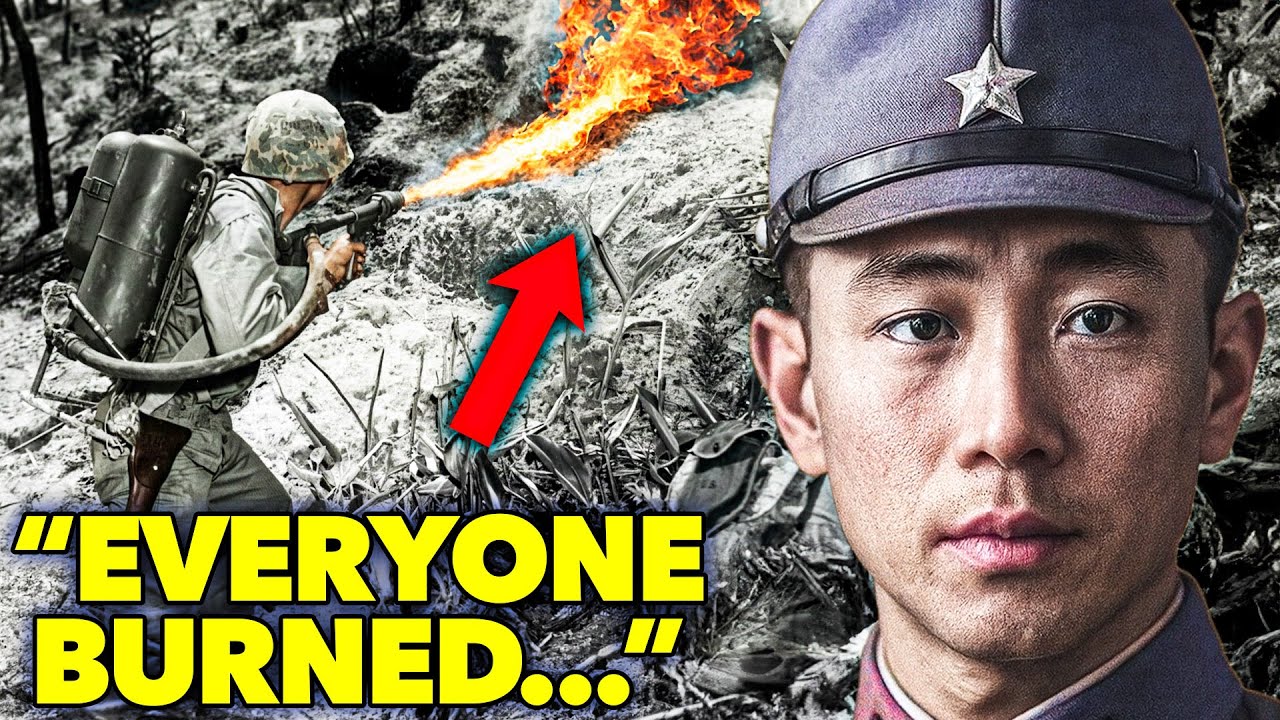
Not grand maneuvers or sweeping offensives, but grinding attrition in sweltering heat where every cave had to be blasted with flamethrowers, grenades, or satchel charges. By early October, the First Marine Regiment had been bled dry, losing over sixty percent of its strength. The proud regiment was no longer combat effective. Yet Nakagawa’s fortress still held.
The devastation forced General Roy Geiger to call in reserves. On September 23, the US Army’s 81st Infantry Division, the Wildcats, landed to relieve the battered Marines—fresh and untested in combat. They quickly realized Peleliu was no ordinary battlefield. The Wildcats’ mission was to strike into the rear of the Umurbrogol and link up with the exhausted Marines.
But the moment they advanced into the ridges, they too were swallowed by the nightmare. Japanese fire poured from hidden gunports. Mortar shells rained down from unseen positions. Every ravine was a trap.
Every slope covered by interlocking fire. In one valley, later named Death Valley, entire companies were cut down trying to cross open ground. The limestone terrain was so jagged that tanks often became useless, trapped on coral ledges or picked off by concealed artillery. Engineers struggled to keep up, blasting cave entrances with demolitions only to watch new firing points open up yards away.
The Wildcats fought with determination, but they suffered terribly. Within weeks, nearly half of the Fifth and Seventh Marines had been lost. And now the 81st Division began to see its own casualty lists grow. Still, unlike the Marines, they could rotate fresh battalions into the line, slowly grinding down the defenders.
Their task was made easier by the arrival of Marine Corsair fighter bombers operating directly from Peleliu’s airfield. Rockets and napalm seared the ridges, collapsing caves or burning out the defenders within. Even so, the Japanese showed no signs of breaking. Colonel Nakagawa had ordered his men to fight to the last, and they obeyed.
Bunkers had to be reduced one by one with satchel charges hurled into firing ports and flamethrowers blasting until nothing moved. By mid-October, the Wildcats had taken over the fight entirely as the shattered Marines were withdrawn. Yet the battle still dragged on, turning into one of the most drawn-out and costly island fights of the entire Pacific War. By that point, Peleliu had become a charnel house.
The Japanese defenders had fought with fanatical tenacity, but their fortress was slowly crumbling under relentless pressure. Flamethrowers, satchel charges, napalm, and artillery strikes gradually chewed away at their interconnected cave system. Yet even as the battlefield shrank, Colonel Kunio Nakagawa refused to surrender. His men, drilled in the doctrine of fighting to the death, clung to every position until annihilation.
The US Army’s 81st Division now bore the full burden of the campaign. Unlike the Marines, they had reserves to cycle fresh battalions into the ridges, but progress was measured in feet, not miles. Engineers blasted one cave after another, but every victory seemed to trigger another ambush from the next ridge. The jagged terrain made casualty evacuation a nightmare.
Wounded soldiers often lay exposed for hours under sniper fire before stretcher teams could reach them. Many survivors later recalled the eerie cries echoing at night—Japanese defenders taunting the Americans or shouting false commands in English to sow confusion. Inside the caves, Japanese soldiers lived like ghosts. With supplies dwindling, they rationed water by licking condensation from cave walls.
Ammunition was hoarded for close-range ambushes. Some defenders emerged only at night to scavenge American rations from the dead, disappearing back into the labyrinth before dawn. Despite starvation, they fought with lethal effectiveness until the very end. Colonel Nakagawa embodied this grim defiance.
Even as his command shrank from thousands to hundreds, he kept transmitting reports to Tokyo. His final messages were symbolic, acknowledging that the regiment’s weapons were destroyed and their flag burned to prevent capture. Facing inevitable defeat, he and his remaining officers carried out ritual suicide, leaving their men to fight on until they too fell. By late November, only scattered holdouts remained, hunted down one by one in the ridges.
The sheer cost was staggering. Of the eleven thousand Japanese defenders, over ten thousand nine hundred were killed. Barely two hundred survived, most of them non-combatants or laborers. For the US, the butcher’s bill was equally grim.
More than ten thousand Marines and soldiers were killed or wounded. One regiment of Marines had lost nearly seventy percent of its strength, making Peleliu one of the bloodiest battles in the entire Pacific theater. When Peleliu was finally declared secure on November 27, 1944, American commanders faced a sobering truth. The island had cost thousands of lives but contributed little to the larger war effort.
General MacArthur’s push into the Philippines went ahead regardless of Peleliu’s capture, and the airfield that had been the supposed prize was scarcely used. In hindsight, Admiral William Halsey’s warnings that the operation was unnecessary seemed prophetic. Thousands had been sacrificed for ground that was strategically irrelevant. For the Marines who fought there, Peleliu left scars that never healed.
Survivors spoke of it not as a battle but as an ordeal—weeks of hell under crushing heat, thirst, and constant fear. Temperatures soared past 115 degrees Fahrenheit, and many men collapsed from heat stroke as often as from enemy fire. Supplies of drinkable water remained tainted with oil for days, forcing soldiers to risk dehydration rather than drink foul liquid. The island itself became an enemy, its jagged coral cutting through boots and skin, its ridges concealing death at every turn.
News of the battle barely reached the American public at the time. Overshadowed by MacArthur’s triumphant return to the Philippines and the massive European offensives, Peleliu became the forgotten battle. Only years later, through veterans’ memoirs and historians’ work, did its brutality come to light. Marines who fought there often described it as the harshest fight of the Pacific—worse even than Tarawa or Iwo Jima, because the sacrifice seemed wasted.
Strategically, Peleliu served as a grim lesson. The Japanese had perfected their new defense-in-depth strategy, abandoning suicidal beach charges in favor of hidden fortresses designed to bleed attackers dry. The same tactics would later appear at Iwo Jima and Okinawa. But by then, American commanders understood the horrific costs such strongholds demanded.
Peleliu was their first warning, and it was written in blood. For Japan, the battle showcased both their soldiers’ ferocity and their leadership’s blindness. The garrison had been ordered to die to the last man, even though the island was already irrelevant to the broader war. The defenders’ sacrifice delayed the Americans only briefly, yet it annihilated an entire division of Japan’s best-trained troops.
In the end, Peleliu stood as a monument to wasted lives—an island drenched in blood where seventy-eight percent of one regiment’s soldiers died for nothing more than pride and flawed strategy.