A bullet-riddled brown suitcase sat in the trunk of a stolen 1934 Ford Deluxe V8 when the ambush on Highway 154 ended Bonnie Parker’s life. Inside, wrapped in waxed paper, was half a fried bologna sandwich, a napkin from the Canfield Cafe, and a cold Coca-Cola pulled that morning from an ice chest on the floorboard. Bonnie Parker knew every roadside diner between Dallas and Joplin by the smell of its coffee. Number 21 cost you 18 cents and was eaten with a pocket knife on the running board.
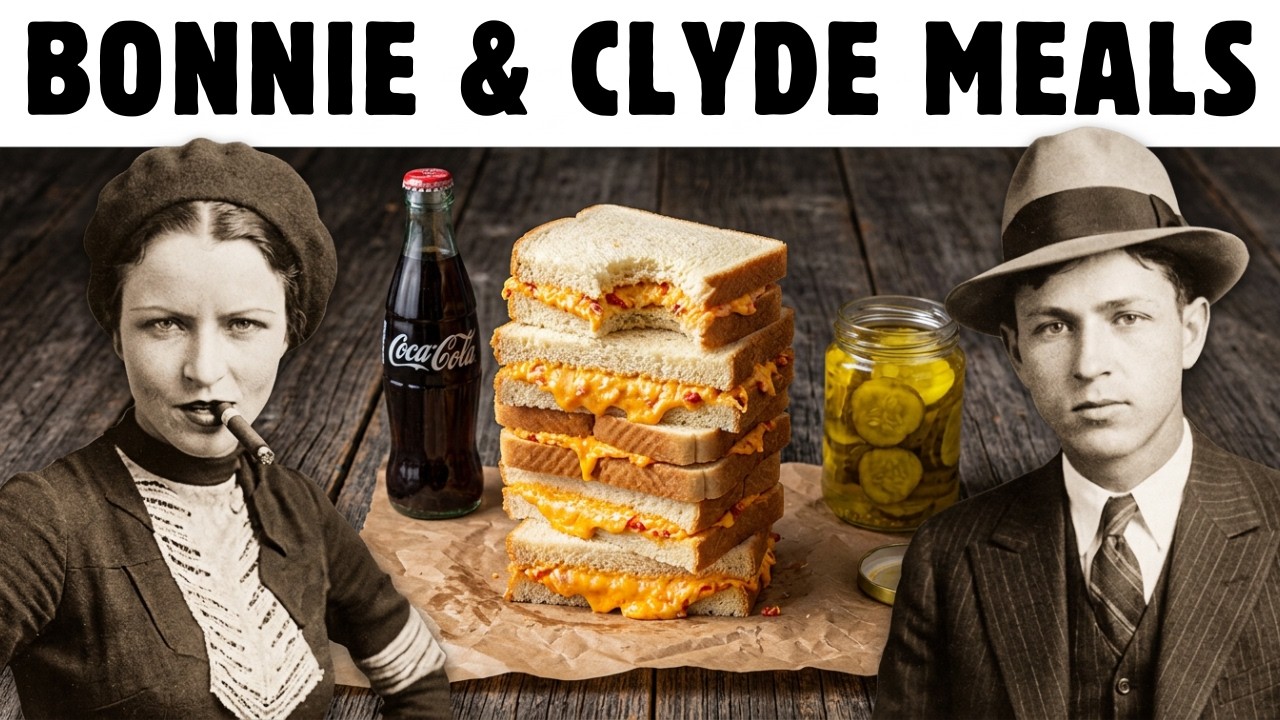
Number 13 was interrupted by a shotgun blast through a Platte City cabin door. Number one was half-chewed when the first rifle round came through the windshield. These 25 meals were not gangster feasts. They were car trunk suppers, one arm on the wheel lunches, and motor court breakfasts eaten with a Browning automatic rifle on the bed beside them.
The pecan pie came first. The Barrow family kept Clyde fed in secret. His mother Cumi would hand him wedges of pecan pie wrapped in the Dallas Morning News through the window of whatever stolen Ford he was driving that week. These meetings happened on back roads near West Dallas, sometimes in cotton fields, sometimes behind a country church.
The pie was Karo syrup, pecans from a neighbor’s tree, lard crust rolled out on a floured table. A hand reached out. A pie wrapped in newsprint landed on the seat. Clyde ate it cold, one hand on the wheel.
His sister Marie later testified that the ink stained the crust, so Clyde ate the filling and left the bottom behind. It was the closest thing to a home-cooked meal he had for 21 months on the run. October 1st, 1933. Bonnie turned 23 in a tourist cabin outside Terre Haute, Indiana.
Clyde wanted to mark the day. He sent W. D. Jones into a small bakery with a few dollars.
Jones came back with a chocolate layer cake, white buttercream, and the name Mary piped across the top. The baker had one already boxed. Clyde scraped the name off with his pocketknife and they ate the cake under a bare bulb, Bonnie in a borrowed housecoat, Clyde still wearing his holster. Blanche Barrow wrote that Bonnie cried quietly into her slice because she knew she would not see 24.
She was right. Bonnie died 7 months later, 4 months short of her next birthday. At a Texas tourist camp, the standard breakfast was side meat and grits. Side meat was salt-cured pork belly, sliced thick, fried in its own fat until the edges curled black.
The grits came from a cotton sack, boiled with a pinch of salt. The whole plate cost you 15 cents. Clyde liked his grits with the pork fat poured over the top. Bonnie took hers with sorghum molasses stirred in.
They ate with the door cracked, always facing the window, always with a loaded pistol on the table beside the coffee cup. The cook never asked where they were going. Nobody in a Texas tourist camp ever did. When you cannot risk a cafe, you cook what every Depression era farm family cooks.
Hoe cakes: cornmeal, water, salt, and a little bacon grease mixed into a thick batter. The gang fried them on the blade of a short-handled shovel held over a roadside ditch fire. W. D.
Jones wrote that Clyde could build a smokeless fire from dry grass and cottonwood sticks in under a minute. The skill came from his sharecropper father in Telico, Texas. The hoe cakes came off the shovel black on one side and pale on the other. Bonnie ate hers folded around a cold strip of bacon.
Survival meals eaten squatting next to a stolen Ford with the engine still ticking. No gangster glamour, just hunger, flour, and fire. A can of Libby’s peaches cost 18 cents in 1933. It kept in the trunk for weeks.
It opened fast with a pocketknife. Clyde carried a small fixed blade from his brother Buck and used it to punch open the lid, not to cut it. A clean cut meant a gas station clerk might remember selling the can. The gang passed the tin between them on the road, spearing peach halves out of the syrup one by one.
Blanche Barrow remembered these peach meals as the closest thing to dessert the gang had for weeks. Bonnie loved the syrup. She drank the last of it straight from the can. Clyde never ate sweets in public, a habit from his Dallas childhood.
Louisiana roadside stands in 1934 served a breakfast every southern trucker, drifter, and outlaw knew by heart. Buttermilk biscuits split open, a slice of salt-cured ham across the bottom, red eye gravy poured over the plate. Red eye gravy was strong black coffee poured into the hot skillet after the ham came out. Sharp and salty.
A plate cost 20 cents. Bonnie and Clyde ate this breakfast dozens of times in the last month of their lives. One of those cafes was Ma Canfield’s in Gibsland. Texas roadhouse chili in the early 1930s was a poor man’s supper.
Cheap cuts of beef, chili powder, cumin, whatever the cook had behind the counter. No beans ever, if the roadhouse was honest. The gang ate chili across six states. A bowl cost 10 cents.
The cook ladled it from a pot that had been on the stove since breakfast, thickening bit by bit as the day wore on. Clyde liked his chili with crumbled saltines, the way his mother made it at the family gas station in West Dallas. They ate chili the night before the Platte City shootout. Blanche wrote that Buck had two bowls.
It was his last real meal. Clyde Barrow was famously sober. That was not a matter of principle so much as survival. He needed to drive at a second’s notice.
His drink was Coca-Cola, pulled from a galvanized ice chest bolted to the floorboard of whatever Ford he was driving. The gang bought Cokes by the crate, 5 cents a bottle. The chest held 24 bottles packed in ice from roadside ice houses. Clyde drank six or seven a day.
According to the Texas Rangers report filed after the Gibsland ambush, investigators found 14 empty Coke bottles in the back of the 1934 Ford, three full ones in the ice chest, and one half-finished bottle still cold from the morning. Bonnie preferred Dr. Pepper, a Waco-made soda that reminded her of home. The couple went through an estimated 4,000 bottles during 21 months on the run.
Sobriety was total and strategic: you cannot outrun a cruiser at 85 miles an hour while drunk. That cold Coca-Cola was a tool, cheap, simple, powerful. Bottle after bottle, it worked until the morning in Gibsland when it did not. The sandwich that fueled the gang more than any other was bologna on white bread.
Piggly Wiggly sold a loaf of sliced white for 7 cents and a pound of bologna for 15 cents. That was lunch for the whole gang. Blanche would walk into a Piggly Wiggly in a small Texas town, buy the bread, the bologna, a jar of yellow mustard, and a block of hoop cheese. Supper for 2 days.
The gang ate these sandwiches in the car, on picnic blankets by rural creeks, in tourist camp cabins with the curtains drawn. Bonnie liked hers with mustard and a dill pickle. Clyde ate his plain, folded in half. Easter Sunday, April 1st, 1934.
The gang pulled off a dirt road near Grapevine, Texas to eat cold fried chicken while Bonnie waited for her mother. The chicken had been fried that morning by an aunt in Dallas, packed in a wicker basket, delivered to a relay point. Bonnie sat in a field with a drumstick in her hand. Clyde dozed in the driver’s seat.
Henry Methvin was in the back with a shotgun across his lap. Two Texas Highway Patrolmen, E. B. Wheeler and H.
D. Murphy, rode up on motorcycles. They thought the car was stranded. Methvin thought Clyde wanted him to shoot.
Methvin opened fire. Both patrolmen died on the dirt road. The chicken was still warm. The drumstick Bonnie held was found unfinished in the grass.
Fried chicken was the most eaten hot meal across the entire 21-month run. They almost always ate it cold, wrapped in waxed paper, while driving. Clyde would send Blanche or W. D.
Jones into a roadside cafe to order five pieces to go. The cook fried chicken in a cast-iron skillet with lard, salt, black pepper, sometimes cayenne. By the time the gang ate, the chicken was cold and the crust had gone soft. They ate with their fingers, tossing bones out the window.
State troopers later tracked the gang by following the trail of chicken bones and Coca-Cola bottles along backroads in Arkansas and Louisiana. A chicken dinner cost 25 cents. It fed two if you were careful. Bonnie Parker grew up eating red beans and rice at a kitchen table in Rowena, Texas, where the recipe had been handed down through three generations of Parker women.
She recreated the dish whenever the gang had a kitchen and a few hours of quiet. Red beans soaked overnight, then simmered low all day with a ham hock, bay leaf, onion, garlic, and a pinch of cayenne. The rice cooked separately in a small saucepan. Bonnie ladled the beans over the rice and ate from a chipped enamel plate with a tin spoon.
Blanche wrote in her memoir that Bonnie cooked red beans in a Joplin tourist cabin in March 1933, and again in a rented house near Fort Smith, Arkansas in October. Clyde would eat two full plates quietly, the way a man eats when the food reminds him of his mother’s kitchen. For about 25 cents, Bonnie could feed five adults a powerful meal that felt like home. That plate of red beans and rice was the one simple thing that stayed constant in a life otherwise measured in stolen cars and dead lawmen.
The afternoon of July 19th, 1933, hours before the Red Crown Tavern shootout, the gang stopped at Slim’s Castle, a Platte City service station, and stocked up on canned food. Among the cans were three tins of Vienna sausages, pink, soft, packed in chicken broth, two tins for 15 cents. Vienna sausages were a Depression-era staple, fully cooked, shelf-stable, and eaten cold straight from the can. Bonnie ate two sausages before the shootout.
Blanche served them on saltines with yellow mustard. Buck was eating his when the first shotgun blast came through the cabin door. Half the tin was still on the table when the gang fled. After Platte City, Buck Barrow was dying from a head wound.
The gang hid in the abandoned Dexfield Park near Dexter, Iowa from July 20th through July 24th, 1933. They had almost no food. Clyde drove to a nearby grocery and bought tins of King Oscar sardines, saltines, a can of coffee, and Vaseline for Buck’s wound. The gang ate sardines on crackers in the high grass above the old amusement park.
Sardines cost 10 cents a tin. Saltines were a nickel a sleeve. A beggar’s supper eaten by five fugitives hiding from a 75-man posse. Buck was captured.
He died five days later in Perry, Iowa. The final supper at Dexfield Park was cooked over a small fire in the woods south of the old park. Blanche Barrow was already half blind from shattered glass in the Platte City shootout. She managed to fry strips of bacon and boil coffee.
The gang ate bacon between folded slices of stale white bread washed down with black coffee in tin camp cups. Buck could barely swallow. Bonnie ate little. Clyde kept watch from a rise with a Browning automatic rifle across his knees.
The supper lasted maybe 20 minutes. By dawn on July 24th, the posse had found the camp. The coffee pot was still warm on the ashes when the first shots were fired. Van Camp’s pork and beans was the single most eaten canned food in Depression-era America, and the Barrow gang bought it by the case.
A large can cost 14 cents and fed two. Clyde carried a hand-operated can opener in the glove box of every Ford. The gang ate pork and beans cold straight from the can, passing a spoon between them. The beans were sweetened with molasses and tomato sauce with a small chunk of salt pork floating on top.
Bonnie fished out the pork. She ate it first. Then passed the can to Clyde. Blanche wrote that she once counted 11 empty cans in the trunk of a single stolen Ford.
Cheap hot protein eaten cold. A roadside fire drew attention. Blanche Caldwell Barrow was the cook for the Barrow gang, a role she hated but accepted. Bonnie was too small and too injured to stand over a stove for long.
Blanche carried a 10-inch cast-iron skillet in the trunk of the Ford for most of 1933. When the gang had a kitchen, she fried whatever was cheap. Pork chops with onions, fried potatoes in bacon grease, smothered chicken with flour gravy. Her husband Buck preferred pork chops.
Blanche fried them thick, salt and pepper, served with cornbread baked in the same skillet. A pork chop supper for five cost about 90 cents. Blanche wrote that she once cooked three meals a day for four days straight in the Joplin apartment before the April 13th raid. Pressed ham was cheap deli meat sliced thin from a gelatin-bound loaf at the meat counter of any small-town grocery, 12 cents for a quarter pound.
The gang ate pressed ham sandwiches on white bread with mustard and sometimes a slice of American cheese, all wrapped in waxed paper for the road. Bonnie assembled a dozen at a time in whatever tourist cabin the gang used, stacked them in a cardboard box, and tucked the box behind the driver’s seat. When a gas station attendant in Arkansas got suspicious, Clyde drove 90 miles on nothing but two pressed ham sandwiches and a cold Coca-Cola. Blanche wrote that she once made 20 sandwiches at 2:00 a.
m. in the Joplin apartment, stacked them, and slept 3 hours before the gang moved on. That pressed ham sandwich was the ration of choice for every Depression-era traveling salesman, farm laborer, and migrant picker in America. The Barrow gang just happened to eat theirs with the Dallas County Sheriff’s Office on their heels, one sandwich after another bouncing on the back seat of a stolen Ford at 70 miles an hour.
The gang rented a garage apartment at 3347 and 1/2 Oak Ridge Drive in Joplin, Missouri from March 25th through April 13th, 1933. The kitchen was small: a two-burner stove, a porcelain sink, a wooden table. Blanche kept a blue speckled enamel coffee pot on the back burner all day, every day. Coffee was brewed once in the morning with Arbuckles ground beans, boiled strong, then reheated throughout the day.
The coffee reduced and sharpened as the hours passed, bitter by evening, almost syrup by midnight. Clyde drank it black. Bonnie added a spoonful of condensed milk when they had it. On the morning of April 13th, Bonnie was in that kitchen at 4:00 a.
m. reheating coffee when she heard a car engine out front. It was the Joplin police. The morning of the Joplin raid, Bonnie Parker was cooking breakfast for five people with four eggs, a heel of bread, and some reheated coffee.
The eggs came from a farm stand, 15 cents a dozen. The bread was the end of a Piggly Wiggly loaf already going stale. Bonnie was scrambling the eggs in a cast-iron skillet with a little butter. She planned to spoon them onto torn bread, a poor woman’s meal stretched thin, the kind a Depression wife made when the paycheck had not arrived.
She never served it. The first police car pulled into the driveway at 4:05 a. m. The shootout lasted less than 5 minutes.
Two officers were killed. The gang escaped through the garage, and the skillet of scrambled eggs was left on the stove. Beyond the eggs and bread, the full breakfast spread at the Joplin hideout told the story of a gang caught off guard. On the kitchen table, Missouri detectives found a jar of strawberry jam, a stick of butter half unwrapped, five coffee cups at various levels, a sugar bowl with the spoon still sticking out, and a plate of sliced ham waiting to be fried.
There were also two boxes of breakfast cereal, Post Toasties and shredded wheat, sitting next to five bowls. Blanche had been setting the table. Buck was in the bathroom shaving. Clyde was in the bedroom cleaning a pistol.
Bonnie was at the stove. The gang had been in Joplin for 19 days. This was the biggest planned breakfast of the whole stay, but the ham never hit the skillet. The cereal never made it into a bowl.
On the evening of July 19th, 1933, Blanche Barrow walked across the gravel lot of the Red Crown Tourist Court in Platte City, Missouri into the Red Crown Tavern and ordered five fried chicken dinners to go. Each dinner was a quarter chicken fried in a cast-iron skillet with lard, served with mashed potatoes, green beans, a biscuit, and a wedge of apple pie. A dinner cost 55 cents. Blanche paid in loose change.
The waitress, Emma Mace, later told police she thought it odd. A single woman ordering five full dinners. A woman wearing tight riding jodhpurs in the middle of Missouri. That detail is what cracked the case open.
The gang ate those dinners inside cabin number 12, curtains drawn. Within 2 hours, Sheriff Holt Coffee was knocking on the door. The morning of May 23rd, 1934. Bonnie and Clyde stopped at the Rosa Canfield Cafe in Gibsland, Louisiana for coffee and donuts around 8:00 a.
m. The cafe was small: six tables, a counter with a few stools, a glass case of fresh donuts fried that morning in a cast-iron kettle out back. The donuts were simple, flour, sugar, lard, a little nutmeg, fried golden, dusted with powdered sugar. Two donuts and a coffee cost 15 cents.
Bonnie ate one donut at the counter reading a Shreveport newspaper. Clyde drank black coffee and watched the window. They did not linger. They ordered two sandwiches to go.
A BLT for Bonnie, a fried bologna for Clyde, paid with a dollar bill, walked out to the Ford parked on Highway 154. Bonnie Parker never got to eat her BLT. The sandwich was wrapped in waxed paper, tucked inside a brown paper bag from the Canfield Cafe, placed on the seat between her and Clyde when they drove out of Gibsland. The BLT was the Canfield standard.
Bacon fried crisp, iceberg lettuce, a thick slice of Louisiana tomato, mayonnaise on Texas toast. It cost 10 cents. Wrapped fresh, still warm from the skillet when the bag was handed over. But 2 hours later, the ambush on Highway 154 tore the Ford apart with 130 rounds of gunfire.
Investigators who searched the wreckage found the brown paper bag on the passenger side floorboard, scorched but intact, the BLT still inside, still wrapped. The sandwich was later returned to her mother, Emma Parker. A simple sandwich ordered for the road, never eaten. The last meal Clyde Barrow ever ate was a fried bologna sandwich from Ma Canfield, the Gibsland cook, and it was half eaten when the first bullet tore through the windshield.
Rosa Canfield fried a thick slice of bologna in a cast-iron skillet with bacon grease, laid it on two slices of white bread with yellow mustard, and wrapped it in waxed paper. The sandwich cost 10 cents. Clyde unwrapped it as he drove south on Highway 154, one hand on the wheel, the other holding the sandwich. He took two bites, maybe three.
He was chewing when he rounded the curve where six lawmen waited in the bushes with Browning automatic rifles. When Sheriff Henderson Jordan pulled Clyde from the Ford, the bologna sandwich was still in his right hand, crushed but recognizable. You can still order that same sandwich today at the Bonnie and Clyde Last Stop Cafe, built on the footprint of the original Ma Canfield Cafe. They call it Clyde’s Choice.
These 25 meals tell a story the newsreels never did. Bonnie and Clyde did not eat like gangsters. They ate like Depression Era travelers, like sharecroppers on the move, like every hungry family that crossed America on back roads in those days.
Canned beans, fried bologna, pressed ham, reheated coffee, a cold Coca-Cola pulled from an ice chest on the floorboard.
