On the morning of 21 June 1942, the garrison of the British Eighth Army on the hill overlooking the port of Tobruk in eastern Libya surrendered. The city had held out for 242 days the previous year against the same German commander who now stood outside its walls. This time, the defense collapsed in less than twenty-four hours. By nightfall, the German and Italian armored units of Panzer Army Africa had taken nearly 32,000 Allied soldiers prisoner—men from South Africa and India, British regulars, soldiers from smaller Commonwealth formations—along with stocks of fuel, food, and armored vehicles that German supply lines, stretched across a thousand miles of desert, desperately needed.
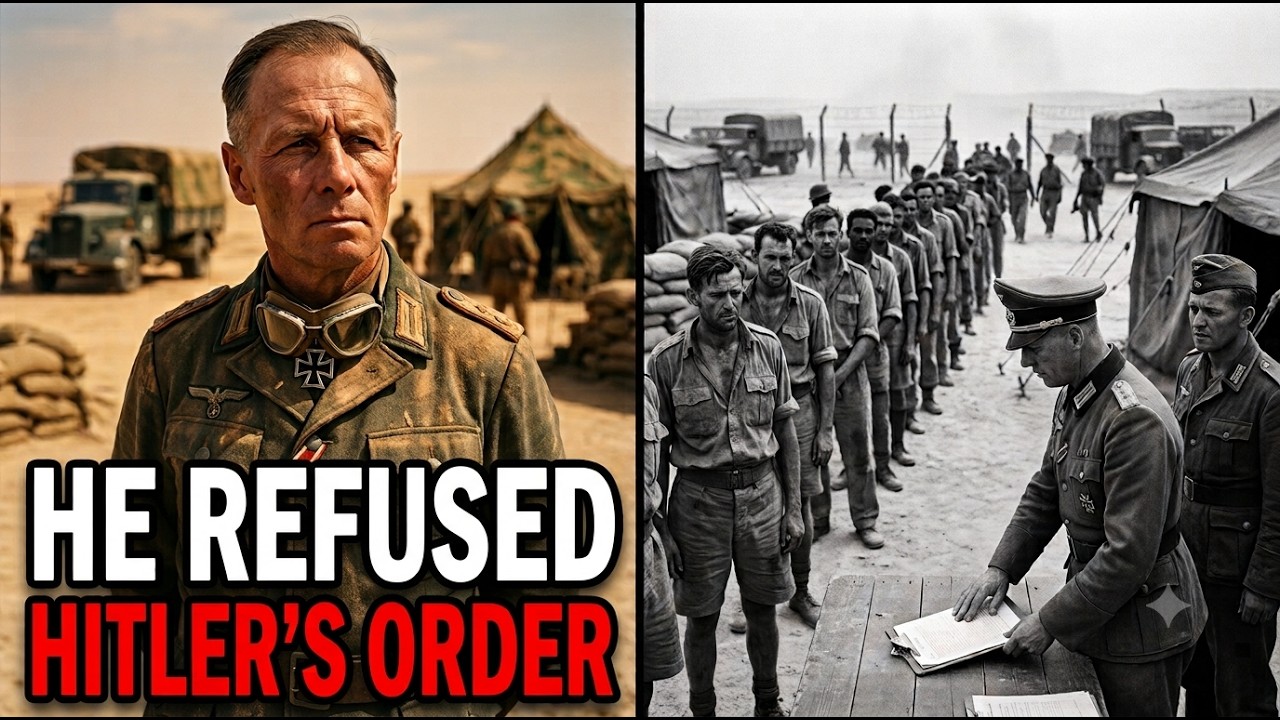
The next day, 22 June 1942, Adolf Hitler promoted the army’s commander, Erwin Rommel, to field marshal. He was fifty years old, the youngest man to hold that rank in the German armed forces. The sheer scale of the Tobruk haul created an administrative problem before it created a moral one. Thirty-two thousand prisoners had to be processed, fed, registered, and moved to the rear through transit camps in Libya before being shipped to camps in Italy, and later to Germany.
Rommel’s supply staff, working from a headquarters that was little more than trucks, tents, and a captured British command caravan, faced the same task any army faces after a mass surrender: sorting men by rank for interrogation, separating officers from enlisted men in accordance with the Geneva Convention of 1929, and registering their names for the International Red Cross. Within this processing chain, according to postwar testimony from several officers who served on Rommel’s staff, an instruction arrived through back channels—not through the normal military chain of command, but through the parallel apparatus Hitler’s regime had built alongside the army. The instruction directed that Jewish prisoners of war be identified, separated from the other prisoners, and treated differently from their fellow soldiers. This was not an isolated demand.
On the Eastern Front, the separation of Jewish Red Army prisoners, and in many documented cases their execution, had been standard practice since the first weeks of Operation Barbarossa in June 1941, carried out by the Einsatzgruppen operating behind the front lines, in a number of documented instances with the knowledge or cooperation of army units. North Africa was a different theater governed by different assumptions on both sides. The war there was fought primarily by regular formations against British Commonwealth forces, and after November 1942 American forces, under conditions that German and British commanders on the ground considered closer to the conventions of the First World War than to the war of annihilation being waged in the Soviet Union. But the ideological instructions from Berlin did not recognize that distinction.
They accompanied the army wherever it went. Rommel’s response, as recorded by his staff and later set down by his biographers in postwar accounts—including Desmond Young, who interviewed surviving officers of the Afrika Korps in the years immediately after the war—was a categorical refusal of the separation order. He gave instructions that prisoners of war falling into the hands of his army were to be treated only according to their rank and conduct under the provisions of the Geneva Convention, without regard to their religion. The Jewish prisoners of war taken by Panzer Army Africa at Tobruk and in the subsequent battles of 1942 were sent along the same path as all other prisoners.
The same transit camps in Libya, the same ships bound for Italy, the same registration with the Red Cross that enabled families in Britain, South Africa, and India to learn that their sons and husbands were alive. This was consistent with a pattern that had distinguished Rommel’s command in North Africa for more than a year. Since taking command of the newly formed German Africa Corps in February 1941, Rommel had built a reputation among his own men, and unusually among his enemies, for waging a conventional war in which both sides largely observed the rules of combat, the evacuation of the wounded, and the treatment of prisoners. British and Commonwealth accounts from the desert campaign, including postwar memoirs of officers captured by his troops, describe hospital ships and medical convoys passing under informal truce, wounded men from both armies receiving treatment in the same forward dressing stations when necessary, and captured officers—including the British colonel Desmond Young himself—being treated with a formality Young later described as “correct” rather than harsh.
Rommel had also refused on more than one earlier occasion during the campaign to pass on instructions from Berlin ordering the shooting of captured commandos and saboteurs, under what would become officially known in October 1942 as the Commando Order. That directive, elsewhere in occupied Europe, led to the summary execution of captured Allied special forces regardless of their uniform or surrender. None of this made Rommel a man outside the system he served. He held his rank, his authority, and his supply lines entirely at the pleasure of a regime whose war aims he never questioned, and he served his head of state with clear personal loyalty for most of the North African campaign.
His refusals were limited, confined to the treatment of prisoners already in his custody—decisions he could justify to his superiors as matters of military discipline and international law, not acts of political disobedience. Rommel did not challenge the broader apparatus of the regime. Where that apparatus operated beyond his direct command, he had no practical capacity to stop it, even had he wished to. That distinction—between what a field commander could control at the point of contact with his own army, and what he could not touch once the machinery of the SS and the Reich Security Main Office began to work in territory his army merely passed through—would be tested again within a year, in another country, under conditions that made the limits of his authority more visible.
By late October 1942, the military situation that had allowed Rommel this limited freedom was collapsing. On 23 October, the British Eighth Army under General Bernard Montgomery opened the Second Battle of El Alamein with a heavy artillery bombardment from more than 900 guns along a front stretching 60 kilometers from the Mediterranean coast to the Qattara Depression. Rommel, who had left the front in September on sick leave suffering from exhaustion and a liver complaint that had plagued him since the start of the campaign, returned to his command on the night of 25 October on Hitler’s personal orders. He found his army outnumbered more than two to one in tanks, dependent on fuel convoys that Allied air and naval forces in the Mediterranean were sinking faster than they could be replaced.
By 4 November, the Axis line had broken. What followed was a fighting withdrawal of nearly 2,400 kilometers west across Libya into Tunisia, lasting over the next three months with Rommel’s remaining forces, which by the end of the retreat had shrunk to a fraction of their original strength. He attempted to hold delaying positions at El Agheila and the Mareth Line while Allied pressure mounted from east and west. The western pressure was new.
On 8 November 1942, American and British forces landed in Morocco and Algeria, opening a second front behind Rommel’s army and forcing the Axis command to rush urgent reinforcements to Tunisia to prevent the collapse of the entire North African theater before the withdrawing panzer units arrived. Into the hastily prepared Tunisian bridgehead—a strip of territory perhaps 150 kilometers wide, crowded with German and Italian units, Vichy French officials of uncertain loyalty, and civilian populations caught between two advancing Allied armies and a retreating German one—finally arrived the force Rommel had kept at bay in Libya, with an authority that never passed through his headquarters at all. The special unit that reached Tunisia in late November 1942 was commanded by an officer named Walter Rauff, known as an SS Standartenführer, who had spent the previous eighteen months developing mobile gas vans for the Einsatzgruppen operating in the occupied Soviet Union. That role, by the time he arrived in North Africa, made him among the men most directly responsible for the mechanized killing of Jewish civilians anywhere in the German war effort.
Rauff’s unit, formerly known as the Tunisia Einsatz Command, was not subordinate to Rommel. It operated under the authority of the Reich Security Main Office in Berlin, loosely attached to the hastily established German military administration in Tunisia following the landings, with its chain of command running through the SS apparatus rather than through the officers of Panzer Army Africa. The Jewish population of Tunisia at that time numbered nearly 85,000. The majority were concentrated in Tunis itself, a community with roots stretching back more than two thousand years, predating the Arab and French presence in North Africa.
It had already been subject to discriminatory laws inspired by those of metropolitan France, and for a brief period under the Vichy administration that retained nominal authority after the 1940 armistice. What changed with Rauff’s arrival was the imposition of direct German enforcement. In early December 1942, orders were given to the leaders of the Jewish community in Tunis to prepare lists of able-bodied men. Over the following months, thousands of Jewish men were forcibly conscripted into labor battalions and compelled to work under German supervision, constructing fortifications, repairing roads, and clearing rubble from Allied air raids on the port and the airfields around Tunis and Bizerte.
The work was carried out under armed guard in conditions that camp records and postwar survivor testimony describe as marked by beatings, food shortages, and in a number of documented cases the execution of men who collapsed or attempted to escape. This was followed by the confiscation of Jewish property, the imposition of collective fines, and the deportation of a smaller number of prominent community members to camps in Europe during the winter. By this stage, Rommel’s headquarters had become effectively detached from the administrative center in Tunis. During December 1942 and into January 1943, Panzer Army Africa—soon to be renamed the German-Italian Panzer Army and placed under the nominal authority of a new Axis command in Tunisia headed by Lieutenant General Jürgen von Arnim—fought a defensive campaign along the Mareth Line in southern Tunisia, some 400 kilometers from the capital.
Rommel’s attention during this period was fixed on the urgent tactical problem of holding off an exhausted and hungry army against Montgomery’s advancing Eighth from the east, while a separate, more active German force under von Arnim defended its own lines against the British First Army and the newly arrived American forces from the north and west. The two commands were not unified until mid-February 1943, and even after that, the strategic disagreement between Rommel and von Arnim continued, culminating in the German attack on the Kasserine Pass from 19 to 22 February, which achieved a tactical breakthrough against inexperienced American units before stalling for lack of fuel and reinforcements. There was little room left for a field commander fighting for his army’s survival to intervene in an internal security apparatus operating under separate orders from Berlin in a city he rarely visited and did not administer. There is no documented record of Rommel issuing any order concerning Rauff’s Einsatz unit or the forced labor program in Tunisia, in either direction.
Unlike at Tobruk, where Jewish prisoners of war passed directly through his supply staff and he could act simply by directing his subordinates in how to treat them, the machinery operating in Tunisia lay outside his command. This is the crucial distinction for understanding what Rommel’s refusal in North Africa was, and what it was not. He could, and repeatedly did, refuse to carry out discriminatory or criminal orders affecting his soldiers and prisoners. This was a genuine, even exceptional example by the standards of German officers of that period, of independent judgment exercised, saving an unknown but not insignificant number of Jewish Allied soldiers from segregation and possibly worse.
Rommel could not—and did not attempt to—dismantle or obstruct the parallel SS security apparatus once it had established itself in the theater with its own institutional authority, its own reporting lines to Himmler’s Reich Security Main Office, and its own personnel from a machine over which Rommel had no command authority. These two facts sit side by side in the historical record without reducing to a single simple verdict. Serious historians of the campaign, among them David Fraser and Martin Kitchen, have generally refused to reduce the history to a pure postwar narrative promoted by West German myths, or to a blanket accusation that ignores the documented instances where Rommel used his authority to protect prisoners under his command. Rommel did not remain in North Africa to see the campaign’s end.
On 9 March 1943, worn down by the physical exhaustion that had dogged him since the previous autumn and increasingly at odds with Hitler over the strategic value of holding Tunisia, he left the theater for Rome, then Germany, ostensibly on sick leave, and never returned to Africa. Command passed to von Arnim. Two months later, on 13 May 1943, with Allied forces closing from east and west and every evacuation route across the Mediterranean cut off, the last Axis forces in Tunisia surrendered—some 275,000 German and Italian soldiers. In terms of prisoners taken, this defeat rivaled the German catastrophe at Stalingrad three months earlier, though it never received the same attention in the popular memory of the war.
The North African campaign that had begun with the arrival of the first German units in Tripoli in February 1941 was over. Rauff’s Einsatz unit dissolved in the same collapse, along with the German military administration in Tunis. Advancing Allied forces liberated the forced labor camps around Tunis in early May 1943, and the surviving Jewish population of the city, which had endured six months of direct German occupation, came under Allied administration. Rauff himself escaped the theater before the surrender, was later captured by American forces, escaped from custody in 1946, and lived for decades as a fugitive in Syria and then Chile, where he enjoyed protection in his final years through his connections within Chilean intelligence, before dying in Santiago in 1984 without ever being tried for his role in developing the gas vans or for his command in Tunisia.
Rommel’s path diverged sharply from Rauff’s over the following eighteen months, after his recall to Europe. He took command of occupation forces in northern Italy, then in January 1944 command of Army Group B, responsible for defending the French coast against an Allied invasion everyone on the German side knew was coming. In this period, according to postwar accounts from his staff and family, his personal assessment of the war’s course and of the regime he served grew increasingly stark. This evolution reached its peak after the Allied landings in Normandy on 6 June 1944 and the collapse of the German position in France over the following weeks.
It showed itself in Rommel’s direct written warnings to Hitler that the war in the west could not be won by military means, and in his informal and controversial association, still debated by historians, with the circle of officers behind the attempt to assassinate Hitler on 20 July 1944. He was not among the conspirators who planted or detonated the bomb at the Wolf’s Lair, and the extent of his knowledge remains a matter of historical dispute to this day. That changed nothing in the outcome. Rommel was implicated through the confessions of captured conspirators extracted under Gestapo interrogation.
On 14 October 1944, two generals sent from Berlin confronted him at his home in Herrlingen and offered him a choice: suicide by cyanide, with a promise that his family would be spared and that he would receive a state funeral, or a public trial before the People’s Court that would most likely end in his execution and the persecution of his wife and son. Rommel chose the cyanide. He was fifty-two years old. The German public was told he had died of wounds suffered in an earlier Allied air attack on his car.
Hitler ordered a state funeral and a day of national mourning for the man who had stopped responding to his written warnings. The historical record left by Rommel’s presence in North Africa cannot be reduced to a single clear lesson. He led an army in the service of a regime whose crimes his actions in Tunisia did nothing effectively to obstruct, once they passed beyond his direct command. Nor is the postwar myth of an unpolitical soldier untouched by the ideology of the war he fought supported by the documentary record.
He served that regime loyally for most of the campaign, accepted its honors, and turned against it only when its military defeat had become, in his professional judgment, inevitable. At the same time, the specific and repeated instances in which he used the limited authority he held over prisoners captured by his army at Tobruk and elsewhere, over the treatment of captured commandos, and over the deportation orders issued from Berlin to protect individuals from policies he refused to implement, form an integral part of the record, independently verified both by Allied prisoners who survived his captivity and by the German staff officers who served under him and later testified to what they saw. Both facts are true, and neither negates the other. The record shows neither an innocent man inside a criminal system, nor a man without guilt.
It shows the narrow, often morally insufficient space available to a field commander who chose, within the limits of his command, to draw a line—while the machinery of the system he served continued to operate largely unhindered everywhere that line did not reach. The forced labor camps in Tunisia, the 85,000 Jews of a city occupied for six months by a system that had already killed millions of their coreligionists across occupied Europe. The men who did not survive that occupation are not merely a footnote to Rommel’s story. They are the other half of it.
The half omitted from the postwar legend built around the Desert Fox, and the half that gives his narrower, better-documented refusal its true weight rather than inflating it into something it was not. Ninety kilometers south of Tunis, in the town of Zaghouan and in the labor camps around the capital, the men forced to build fortifications under Walter Rauff’s command have no monument to rival the one erected over Rommel’s grave in Herrlingen. Their names, if they survive at all, are preserved in the postwar testimonies gathered from survivors of the Tunisian occupation, and in the sparse records of a command that answered to Berlin and kept its own accounts. Both stories deserve to be remembered on the same page, in the same eighteen months—not to be compared, but because the history of that desert campaign was never only about tanks and celebrated generals.
It was also about who held the power to refuse, who exercised it in the narrow places where they could, and who never had it at all.
