In May 2026, police in Connecticut arrested a 62-year-old man named Charles Perry for a murder that had gone unsolved for four decades. The arrest closed a case that had haunted Virginia Beach since 1986, when 22-year-old Roberta “Bobby” Walls was found dead in a field behind an elementary school. For forty years, investigators held what they believed was the killer’s complete DNA profile, yet had no name to attach to it. Roberta Walls worked at the Bayside Public Library in Virginia Beach, a job that placed her at the heart of a community she knew well.
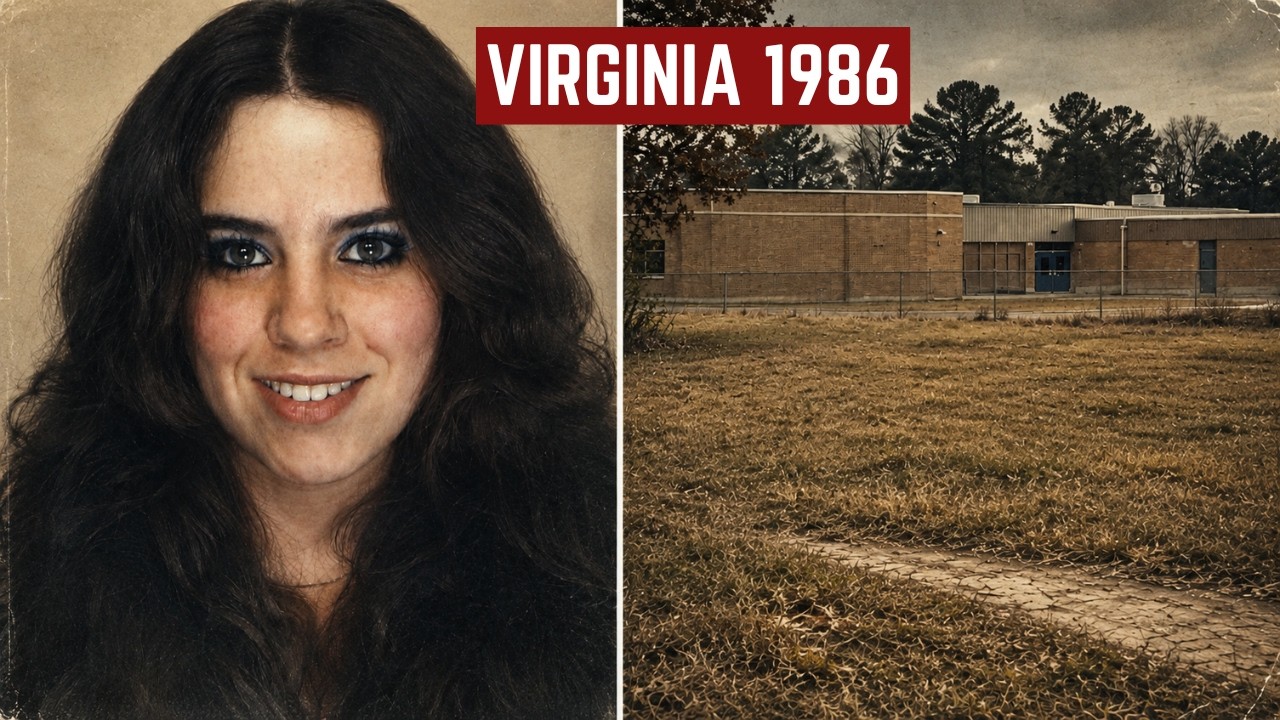
She lived in the Aragona neighborhood and spent time with friends in the Ocean View area of neighboring Norfolk. Her family knew her as a loving daughter and sister, someone they could rely on. The official case file, registered with Virginia Beach police under number 1986-065071, noted tattoos on her arm and stomach, a small administrative detail recorded while she was still simply a missing young woman. On the evening of May 14, 1986, Walls finished her shift and left the library.
She had plans to spend time with friends, nothing unusual. Around midnight, she made a brief phone call to a friend, the kind of ordinary conversation between people expecting to see each other soon. It was the last confirmed contact anyone ever had with her. At 6:30 the next morning, a passerby walking through a field in the 1000 block of Ferry Plantation Drive discovered her body, lying in the open behind what was then Old Donation Elementary School.
The location itself told investigators something immediately. The field sat almost directly across the street from where Walls had been the night before. Whatever happened to her occurred close to a place she knew well. The case file described clear evidence of violent physical assault, including sexual assault.
Her death was officially classified as homicide. From the first hours of the investigation, one thing set this case apart from other murders in Virginia Beach. There was no quarrel to trace, no jealous partner, no dispute among friends. Investigators searched for any connection between Walls and someone who might want to harm her and found nothing.
No history, no conflict, no logical name. That absence would define the case for the next forty years. Detectives preserved biological evidence from the crime scene, but in 1986, the technology to turn that evidence into a searchable DNA profile did not yet exist. The evidence was there.
The scientific tools were not. Investigators were not missing a murder weapon or a witness. What they lacked was far harder to find: an identity to attach to the evidence already sitting in their storage locker. Homicide investigations typically work outward from the victim, examining partners, coworkers, acquaintances, and anyone with potential motive.
Statistically, this is the right approach, because in most murder cases the responsible person is someone the victim knew. Virginia Beach investigators applied this logic to Walls’s case for fifteen consecutive years. They built lists from her circle of friends, tracked down acquaintances and coworkers, and tested many individuals with documented relationships to her, comparing each one directly against the crime scene evidence. Every single person was excluded.
The case revealed its fundamental contradiction: the responsible person had no connection to Walls at all. Every investigative method available in 1986 depended on a link existing between victim and perpetrator. In this case, no such link existed. In 2001, fifteen years after Walls’s death, her file was handed to the department’s newly formed cold case unit.
That same year, working with the Virginia Division of Forensic Science, investigators achieved something impossible in 1986. They developed a full male DNA profile believed to belong to Walls’s attacker, built from evidence carefully preserved since the night of the crime. The profile was entered into the national DNA bank, the system used across the country to identify convicted offenders through genetic matching. The results yielded nothing.
According to Captain Michelle Wyatt of the Virginia Beach Detective Bureau, investigators compared the DNA of more than thirty men directly against the profile over the following years. Some accounts put the number closer to forty. Every person tested was cleared. The reason the national database failed was not bad luck but a structural limitation.
The database only works if the responsible person has already been convicted of a crime serious enough to require their DNA be entered into records. No qualifying profile existed in the national system, meaning the most important evidence in the entire case remained idle, unable to do the job it was designed for. By 2017, a laboratory in northern Virginia gave investigators a tool that had not existed during the previous three decades of the case. DNA phenotyping predicted physical characteristics directly from genetic material: hair color, eye color, skin tone, even general ethnic ancestry.
The result described a white male with brown or black hair, blue or green eyes, and freckled skin, believed to be in his twenties at the time of the crime. Detective Angela Curran, working the case at the time, said publicly that the resulting image eliminated more than half the individuals on what she called the department’s suspect list. Police released the composite publicly, hoping someone would recognize the face. No one came forward.
In 2023, nearly forty years after Walls’s death, the Virginia Beach Police Department obtained grant funding through a Virginia sexual assault kit initiative. This statewide program helps departments conduct advanced forensic testing in unsolved sexual assault and homicide cases, tests that cost more than most police departments can justify within a regular annual budget. The funding opened the door to something radically different from anything investigators had tried before: forensic genetic genealogy. The technique did not require the perpetrator to have a criminal record.
It did not require a member of the public to recognize a face in a post. All it required was a relative, even a distant one, who had taken a genetic ancestry test for reasons entirely unrelated to the case. The preserved evidence was used to develop a genealogy-compatible profile, then compared within databases that allow qualified legal searches. The search did not produce Perry’s name directly.
It produced relatives, a cousin, a half-brother, someone three or four degrees out on a family tree they may not have known existed. Investigators worked backward through those family trees, matching birth records, marriage certificates, and documented geographic history, narrowing possibilities generation by generation until the branches met at one person with documented ties to the Virginia Beach area in 1986. His name was Charles Perry. According to police, Perry had been stationed in the Virginia Beach area in 1986 while serving in the United States Navy.
That kind of posting is temporary by nature, no permanent job, no long-term relationships built within the community, nothing to tie a person to a place once their service ended. When his service ended, he left. Over the following four decades, he built what appeared from the outside to be an entirely ordinary life in Newington, Connecticut. His wife of forty years, Jane Perry, told a local reporter after his arrest that the truth would come out, declining to say anything further.
Neighbors and coworkers in Newington reportedly had no indication of any connection between Perry and a decades-old case in a state two hundred miles away. Police say Perry had no prior connection to Roberta Walls. Chief Paul Neudigate stated publicly that investigators currently had no evidence linking him to any other crimes. Genealogy leads, however compelling, only identify a person of interest.
They prove nothing by themselves. Investigators sought a warrant to obtain Perry’s DNA. That sample was compared against the genetic profile developed in 2001, using the same forensic standards that apply to any suspect. According to Captain Wyatt, that direct comparison identified Charles Perry as the source of the genetic profile found at the crime scene decades earlier.
In that single moment, the gap that had remained open since 2001 was closed. On May 18, 2026, officers from the Newington Police Department arrived at Perry’s home in Connecticut and arrested him. The operation was coordinated with an active arrest warrant from the Virginia Beach Police Department. Perry was initially processed on a charge of being a fugitive from justice, a preliminary classification used to hold a wanted person in another state pending extradition proceedings.
Perry’s attorney, Robert Lacobelle, stated publicly at the time that the defense had not yet reviewed the warrant or affidavit against his client. A Virginia grand jury subsequently issued a formal indictment in the case. Bond figures reported for Perry varied widely across media outlets, ranging from two million to ten million dollars. A hearing to determine whether Perry would waive extradition to Virginia was postponed until June 17, 2026.
As of the recording of the source account, no confirmed public reports had emerged on the outcome of that hearing. Perry has been charged. He has not been convicted. Under the law, he is presumed innocent until proven guilty in a court of law.
Reaching the point of arrest required coordination among five separate agencies: the Virginia Beach Police Department, which held the original warrant; the Virginia State Police; the Office of the Virginia Attorney General; the Virginia Beach Commonwealth’s Attorney’s Office, which would oversee prosecution if the case goes to trial; and the Newington Police Department in Connecticut, whose officers carried out the arrest. Walls’s family declined to comment publicly, asking only for privacy as the case continued. This case was never limited by a lack of evidence. It was limited by the means available at each stage of the investigation and by what those means actually required to function.
The national database needed a prior conviction. The composite sketch needed recognition from the public. Genetic genealogy needed a relative and years of patient reconstruction. For forty years, the evidence never changed.
What changed was the ability of science to tell investigators whose evidence it was.
