In the autumn of 1610, the most feared man in northern Europe collapsed onto the stone floor of his own fortress. King Carl IX of Sweden, the ruthless usurper who had publicly beheaded his nation’s elite and built a police state on terror, had been struck down not by an assassin’s blade or a foreign bullet, but by a ruptured blood vessel deep inside his brain. He survived the stroke, yet woke to find half his body dead and his voice gone. The man who had manipulated theology, silenced the greatest legal minds of his generation with the swing of an axe, and roared commands across frozen battlefields could now produce only slurred, incomprehensible grunts.
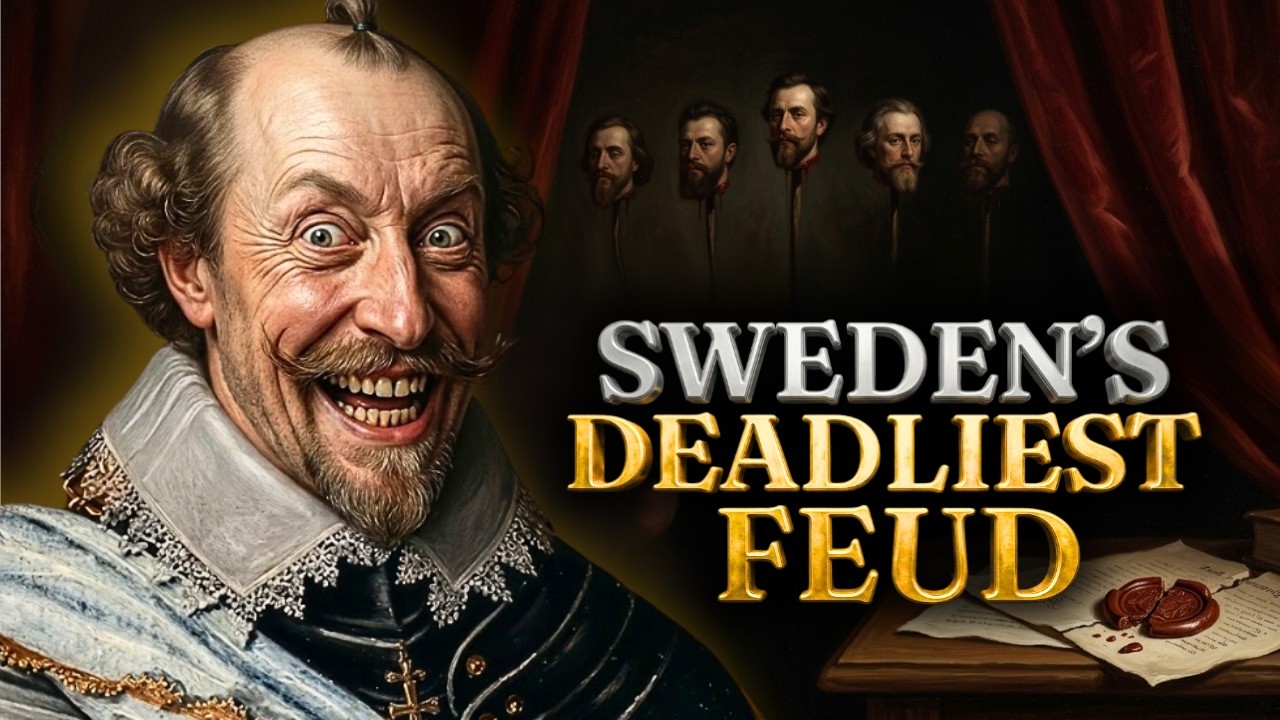
He lay paralyzed, fully conscious, and utterly silent, forced to watch his son shoulder the ruin of a kingdom he had bled dry. Born in 1550, Carl was the youngest son of Gustav Vasa, the iron-willed patriarch who had dragged Sweden out of the Kalmar Union and forged it into an independent Protestant state. Gustav treated his children not as family, but as political assets. Eric was the heir apparent, groomed for the throne.
Johan received the vast Duchy of Finland. Carl, the afterthought, was granted the Duchy of Södermanland, a respectable territory that firmly relegated him to the periphery of power. Raised with royal blood but denied royal authority, he learned early that power was never shared, only monopolized. When Gustav died in 1560, the crown passed to Eric XIV, a man of high intellect but profound psychological fragility.
His reign degenerated into paranoia and madness. Convinced the nobility was plotting against him, Eric personally participated in the slaughter of prominent nobles in their prison cells during the Sture murders of 1567. For the teenage Carl, it was a master class in how erratic violence destroys a king’s legitimacy. In 1568, Carl and his brother Johan allied, marched on Stockholm, deposed Eric, and locked him in a dungeon.
Johan III took the throne. Years later, Eric’s exhumed remains revealed lethal levels of arsenic, strongly pointing to assassination under Johan’s orders. Carl absorbed the lesson without public objection: blood does not guarantee safety, and a deposed rival must never be allowed to live. For the next two decades, Carl chose the patience of the shadow.
While Johan entangled Sweden in expensive wars with Russia and frustrated the populace with attempts to reintroduce Catholic liturgy, Carl transformed Södermanland into an autonomous fortress. He developed ironworks, modernized agriculture, and built a thriving economy that filled his personal treasury. He maintained a standing militia. He cultivated a fierce Protestant identity, not necessarily out of deep devotion, but because he recognized it as the ultimate political weapon in a country deeply suspicious of Catholic influence.
He quietly positioned himself as the moral counterweight to his brother’s policies, corresponded with dissatisfied nobles, and fed their resentment without crossing into open rebellion. When Johan III died in 1592, the crown did not pass to Carl. It passed to Johan’s son, Sigismund, a young man raised by a Catholic mother, already reigning as king of Poland. A Catholic monarch ruling from a foreign capital was about to inherit a fiercely Protestant nation.
Carl saw his nephew not as a sovereign to be served, but as the final obstacle to absolute power. He did not march on the throne. He used theology. In March 1593, while Sigismund remained in Poland, Carl convened the Uppsala Synod.
Under his manipulation, the assembly adopted the Augsburg Confession as the absolute foundation of the Swedish state and decreed that no foreign heresy, specifically Catholicism, would ever be tolerated. Carl signed first, usurping the spiritual leadership of the nation. By framing his nephew’s religion as treason, he had dismantled the king’s moral authority before he ever set foot in Sweden. When Sigismund finally arrived in 1594 for his coronation, Carl and the Protestant clergy forced him to publicly guarantee the supremacy of the Protestant Church and forbid the building of Catholic churches or the appointment of Catholic officials.
Militarily outnumbered in his own capital, Sigismund signed under duress. After a miserable stay, he returned to Poland, leaving the Privy Council and his uncle to co-rule in his absence. It was a catastrophic miscalculation. The moment Sigismund’s ships disappeared over the Baltic horizon, Carl moved to devour the power vacuum.
He convened a Riksdag in Söderköping in 1595, summoning not just nobles, but priests, burghers, and crucially, the peasantry. He stoked their fears, telling them the Catholic king was conspiring with wealthy nobles to strip them of their faith. The terrified masses bought the propaganda wholesale, and the Riksdag proclaimed Carl sole regent, sidelining the Privy Council entirely. The leading nobles, men like Erik Sparre and Gustaf Banér, realized Carl threatened not just the king but the entire social order.
They fled to Poland to join Sigismund in exile. Carl branded them traitors, seized their estates, and redirected their wealth into his military coffers. Between 1596 and 1598, he waged a war of terror, using enraged peasants to attack loyalist estates, slaughtering aristocratic families and burning manors. He was desensitizing the nation to violence, preparing the psychological ground for the purge to come.
In the summer of 1598, Sigismund assembled a mercenary army and sailed for Sweden. On September 25th, the two forces met at the Battle of Stångebro, near Linköping. Freezing rain had turned the landscape into thick mud, rendering the heavily armored Polish cavalry useless. Carl, deeply familiar with the land, launched a devastating surprise attack through heavy fog, cutting off a large contingent of the king’s army.
The fighting was intimate and savage. Sigismund, watching his forces be dismantled from a nearby hill, suffered a failure of nerve and called for a ceasefire. He surrendered the field. During the peace negotiations, Carl dictated terms like a conqueror.
The most devastating condition was the demand for the immediate surrender of the exiled Privy Council members. Sigismund, desperate to salvage his own life, handed over the men who had risked everything to support him. Gustav Banér, Sten Banér, Ture Bielke, Erik Sparre, and others were marched into Carl’s camps in chains. Days later, under cover of darkness, Sigismund broke the treaty and fled back to Poland, abandoning his crown, his loyalists, and his kingdom.
Carl knew a stolen throne is never secure as long as the men who remember the rightful king still draw breath. Throughout 1599, he purged local governments and prepared for the ultimate strike. He summoned the estates to Linköping in early 1600, near the site of his military victory. He established a tribunal of 153 judges drawn from the lower nobility, clergy, and burghers, men who knew they were there to rubber-stamp the dictator’s vengeance.
The trial was a grotesque pantomime of legal procedure. Erik Sparre attempted to defend himself using constitutional statutes, arguing correctly that the council had merely obeyed their oaths to their lawful king. Carl, acting as his own chief prosecutor, shouted down the defendants and subjected them to vicious mockery. Judges who voted for acquittal were warned they would be viewed as traitors.
The tribunal delivered the verdict Carl had drafted before the trial began: guilty of high treason, death by beheading. On March 20th, 1600, the market square of Linköping was cordoned off by armed mercenaries. A wooden scaffold stood at the center. The condemned men wore their finest velvet doublets and silk ruffs, walking with the posture of men who knew they were dying for the law, not for breaking it.
Sten Banér was the first to ascend. He knelt, placed his head upon the block, and the heavy axe fell. His brother Gustav followed, then Ture Bielke, then Erik Sparre, then Bengt Falk. In a matter of minutes, the intellectual, military, and political elite of the Swedish establishment had been decapitated.
The citizens and the members of the Riksdag were forced to watch. A suffocating, terrified silence took hold. If the duke would publicly butcher the most powerful men in the kingdom without hesitation, what hope did anyone else have? Carl did not immediately place the crown upon his own head.
He allowed four agonizing years to pass, forcing the shattered nobility and clergy to beg him to take the throne. When he finally orchestrated his own election as King Carl IX in 1604, it was not presented as a usurpation but as a restoration of order. Yet the psychology of a man who steals a throne is fundamentally broken. Having written the blueprint for rebellion, Carl spent his reign terrified that someone else would read it.
He constructed a suffocating police state, an intricate network of spies and informants that infiltrated every stratum of society. Servants were bribed to eavesdrop on their masters. Priests were pressured to report confessions. The mere accusation of sympathizing with the exiled king was a death sentence.
Public executions became bureaucratic routine. A dictator must constantly justify his power, and the most effective justification is an existential external threat. Carl plunged Sweden into catastrophic foreign wars. He launched massive campaigns into Livonia, attempting to crush Polish forces.
In 1605 at the Battle of Kirkholm, his forces suffered a humiliating annihilation. Carl barely escaped with his life. A rational leader would have sought peace, but a usurper cannot show weakness. He launched the Ingrian War, sending armies deep into Russia in an attempt to place his own son on the throne of the tsars.
To fund these disasters, he imposed crushing taxes on the peasantry he had once championed. When they could not pay in silver, he demanded their sons. Entire generations of young farmers were sent to die of dysentery, starvation, and Polish lances. If a village failed to meet its conscription quota, Carl’s soldiers hanged the local leaders.
By 1610, he aggravated the king of Denmark over trade routes, triggering the Kalmar War. Sweden now faced a three-front war against every major power in northern Europe. The stress of managing a collapsing empire triggered the stroke that shattered him in August 1610. He lingered for over a year, paralyzed and mute, while couriers reported that his armies were starving, his generals were failing, and the Danish navy was blockading the coast.
His tactical mind was still sharp, but he could not articulate a command. The burden of managing the collapsing state fell on his sixteen-year-old son, Gustavus Adolphus. Carl had stolen a crown to build an invincible dynasty, but he left his son nothing but a bankrupt treasury and a nation surrounded by wolves. On October 30th, 1611, at Nyköping Castle, the stroke finally closed around his heart.
Carl IX drew his last breath and died, a prisoner in his own paralyzed body, humiliated, exhausted, and utterly silenced. He had elevated the Vasa family’s cruelty to an industrial scale, using the apparatus of the state to commit mass political murder. But a throne secured by terror became a prison for the man who sat on it. The Linköping Bloodbath remains one of the darkest stains on Scandinavian history.
The usurper took the crown, but history collected the debt.
