In the summer of 1852, at a wharf in New Orleans, stacked with bales of cotton six tiers high and sugar barrels rolling across the planks, the steamboat Eclipse came to rest. A river pilot who had been sounding the river since before the Mexican War threw his line over the stern. The reading came back: four feet, two inches. Loaded with five hundred tons of cargo, with fuel enough for three days of steaming, she drew four feet, two inches.
The pilot had seen ocean-going brigs sit fourteen feet deep in the same harbor. He had seen Baltimore clippers draw nine feet without carrying a single pound of freight. Here was a vessel that had just come twelve thousand two hundred miles from the Gulf, on a schedule no ocean ship could match on its best day, floating in water that would have grounded most vessels before they got a mile from the dock. He recorded the draft in his logbook and made no comment.
On the rivers of the West, there was nothing to remark upon. This was what they built here. This was what the shipyards of New Albany, Indiana had been producing since 1834. Hulls that floated in water so shallow it would not drown a man who knew how to fall.
There was an old saying on the Mississippi that a good Western river steamboat could float on a heavy dew. The captains who said it were not entirely joking. The men who built the Eclipse worked in a covered timber shed in New Albany, Indiana, across the Ohio from Louisville, in a yard owned by a man named James Howard. Their names are not on the bronze plaque in the Howard Steamboat Museum, which now occupies the Howard family home at the edge of the old yard site.
They exist in the payroll records. If those records survive, they sit in archival collections that have never been systematically catalogued. The names in them are Irish names, English names, German names, and in the Civil War years and after, Black names. Men came to the yards from river towns in Indiana and Kentucky because the yards were working, the wages were better than farming, and the work, if it did not kill you, gave you a knowledge of wood and iron and a skill at building river steamboats that no other craft in the interior of the continent could match.
The problem was geography. The merchant on the Atlantic coast, the counting-house man in Philadelphia, the ship owner in Boston—when they looked at a map of the American interior in 1800, they saw a continent laced with rivers. They saw the Ohio running west from Pittsburgh through a thousand miles of country to the Mississippi. They saw the Mississippi running south from its headwaters through the entire length of the continent to the Gulf.
They saw the Missouri running west and north into the plains. They saw the Cumberland, the Tennessee, the Arkansas, the Red River. They saw what looked like a system of highways. What they did not see, because they had never traveled those rivers, was what those rivers actually were.
The rivers of the West were not like the rivers of Europe. They were not like the rivers of the Eastern Seaboard. They did not run clear over gravel beds between stable banks. They ran brown and fast over shifting sand bottoms, through channels that changed from season to season, rising twenty feet in the spring flood and shrinking to a thread of water in the summer drought, and they were full of obstructions.
Snags—trees undermined by eroding banks that had settled into the current with their roots pointing downstream and their branches pointing upstream like invisible barricades beneath the surface, capable of punching through the bottom of a wooden hull and sinking a boat in four minutes. The Mississippi at St. Louis ran in a channel that might be forty feet deep in one place, and five feet deep two hundred yards away. A pilot who knew his river in April did not necessarily know it in August.
The bottom moved, the banks moved, the obstructions appeared and disappeared. A boat propelled by crew up the Mississippi in 1800 made perhaps one mile an hour against the current, dragged by a crew of twenty men working from dawn to dusk. The trip from New Orleans to Louisville—about twelve hundred miles—took three to four months going upstream, and six weeks coming down. The Western river system was an internal trade for an entire continent that effectively flowed in only one direction.
The produce of Ohio Valley farms went down to New Orleans on flatboats, was sold there, and the men walked home or took whatever was heading north. Flatboats were not designed to return against the current. They were built to float downstream once, then be broken up for their lumber at the dock. Steam changed the equation, but not the way the first men who tried it expected.
The first steamboats in Western waters were Eastern boats built to Eastern designs by men who understood ocean ships and coastal navigation. They were wrong for the river from the start. Robert Fulton’s steamboat, the one that proved the commercial viability of steam navigation on the Hudson in 1807, was built deep and narrow, with a keel and a hull derived from sailing ship practice. When Fulton and his partner Robert Livingston obtained the government monopoly for steam navigation in Louisiana waters and sent the first steamboat to New Orleans in 1811, they built her on the same principles: deep draft, narrow hull, a low-pressure condensing engine derived from Watt’s marine engine, heavy and requiring large quantities of water for the condenser.
The New Orleans reached Natchez and could go no farther. The river above Natchez was too shallow in too many places. She spent the rest of her working life running the Natchez-to-New Orleans line, and never proved that steam navigation of the upper river was possible. Investors in New York and Philadelphia concluded that the Western rivers were not steam-navigable above a certain point, and that the interior trade would remain tied to keelboats and flatboats for the foreseeable future.
They were wrong. But it took a man from New Jersey who had grown up on the river to show them how completely they had misread the problem. Henry Miller Shreve was born in New Jersey in 1785 and moved west as a young man. By his twenties he was running keelboats on the Ohio and Mississippi, which meant he understood the Western river system not from maps or from the deck of an ocean vessel, but from years spent standing on the bow of a loaded keelboat, reading the surface of the water for bottom currents and obstruction patterns that a man who did not know how to look would miss entirely.
He knew what the Western river was. He knew what it required. When he looked at the first generation of Western steamboats, he saw at once what was wrong. The hull was too deep.
The engine was too heavy. The boilers were in the hold, putting the weight in exactly the wrong place for a flat riverboat. The entire design philosophy assumed that more depth and more weight meant better seakeeping, which was true on the ocean and absolutely wrong on the Mississippi. A deep-draft boat on the Mississippi spent most of its working life fighting the bottom.
A shallow-draft boat went over the bottom. Shreve designed the Washington in 1816 and built her at Wheeling, in what is now West Virginia. She was one hundred forty-eight feet long. She drew five feet loaded.
Her engines were not in the cargo hold. They were on the main deck. Her boilers were horizontal, not vertical. They ran at high pressure—producing more power per pound of boiler weight than the low-pressure condensing engines the Eastern builders used.
The high-pressure engine was lighter. Putting it on deck rather than in the hold raised the center of gravity, which horrified Eastern marine engineers trained to understand that a high center of gravity was dangerous at sea—but it was not a problem on a river with no significant wave action. The high center of gravity was no issue on a river where draft mattered more than stability in bad weather. It was the only logical choice.
The Washington entered service in 1817 and made a round trip between Louisville and New Orleans, proving for the first time that upper-river steam navigation was commercially viable. The trip from New Orleans to Louisville against the current took twenty-five days. The same trip by keelboat took three to four months. The commercial arithmetic was immediate and overwhelming.
Within five years, there were dozens of steamboats on the Western rivers. Within a decade, there were hundreds. And all of them were built on the principles Shreve had established: flat bottom, wide, shallow, engines on deck, high pressure, built from local timber by men who learned the trade in the small commercial shipyards of the river towns, adapted from ocean practice to conditions ocean practice had never anticipated. Now consider what this design meant in practical terms of wood and iron in the hands of the men who built it in the shipyards along the Ohio and Mississippi.
The hull of a Western river steamboat was not a simplified version of an ocean ship’s hull. It was a different structural problem built from different materials and according to different principles by craftsmen who were developing their trade as they worked. The keel of an ocean ship was a massive structural backbone, the most important piece of wood in the vessel, running the entire length of the bottom and providing the longitudinal stiffness that kept the hull from bending under load. The hull of a Western river steamboat had no keel in the ocean sense.
It had a flat bottom built of heavy planks, fastened with bolts at the edges with frames rising from it at close intervals. The frames were shallow, where an ocean ship’s frames rose upward and inward from a deep keel to form a curved cross-section that gave the hull its shape and stability. Western river steamboat hulls rose from the flat bottom almost vertically, giving the hull a rectangular cross-section that was efficient for carrying freight in shallow water but would have failed catastrophically in any kind of ocean swell. The resulting hull was a box—a carefully built, precisely bolted, copper-fastened box, but a box nonetheless.
The genius of the design was not elegance. It was honesty about what the job actually required. The job required floating in water sometimes four feet deep while carrying four hundred tons of freight. An honest box built of good wood, well-framed and well-caulked, would do that.
A beautiful curved hull derived from centuries of ocean practice could not. The wood of the Western river steamboats was not live oak. Live oak was a coastal tree. The yards of New Albany, Cincinnati, and Pittsburgh worked with what the interior forests provided.
They used white oak for the major structural elements—the bottom keelson running along the inside of the flat bottom to provide longitudinal stiffness, and the floor timbers, the heavy cross-timbers that tied the bottom structure together. They used yellow pine for planking and decking, straight-grained and resinous, resistant to the constant wetting and drying that the waterline planks of a river experienced as the river’s depth changed by feet between seasons. Some yards used poplar, because it grew abundantly along the riverbanks and was light enough to reduce the vessel’s deadweight without sacrificing the structural strength of the primary framing. The men choosing the timber for river steamboat hulls were not walking through coastal Georgia forests looking for trees that had grown with a particular curve.
They bought from interior mills and river lumberyards where the stock was straight-grained and cut to required dimensions. The art was in selecting the grade and species for each structural role. Knowing which wood would hold a bolt under the shear stress of a frame joint and which would split within the first working season. Knowing that yellow pine used for waterline planking had to come from old-growth trees with tight annual rings, or it would crack and open up in the first dry summer.
This knowledge did not exist in instruction manuals. It lived in the hands of men who had worked timber since boyhood, and understood the material the way the live-oak framers of the Hart yard understood theirs: by hand, by eye, by the accumulated weight of experience no engineering table of the era could document. The unique structural problem facing the Western river steamboat, without precedent in any earlier tradition of wooden shipbuilding, was hogging. Hogging is what happens to a long wooden hull when weight is concentrated at the ends and the middle is not adequately supported.
The bow drops, the stern drops, the middle rises, and the hull takes a curved shape when viewed from the side, arching up in the middle like a tired horse. In ocean ships, weight was distributed along the hull by cargo stowed in the hold, and the submerged shape of the hull provided support through water pressure along its length. In Western river steamboats, the heavy machinery—the boilers, the engines, the paddle wheel assemblies—was concentrated at specific points on a hull that was essentially a flat-bottomed barge with very shallow draft. The weight at the ends had to be carried by the structural stiffness of the hull itself over its entire length.
For a hull two hundred fifty feet long with only four feet of depth in the hold, the engineering problem was acute. The solution developed by Western river shipbuilders was the hog chain: iron rods one to one and a half inches in diameter running from bow to stern along the outside of the hull, supported at intervals by iron stanchions rising above the deck. The rods were tightened by turnbuckles until they were taut, pulling the bow and stern upward and preventing the ends from sagging under load. A large Western river steamboat might carry six to eight sets of hog chains running parallel on both sides and along the centerline.
These chains were not a remedial measure applied to a boat that had already begun to hog badly. They were designed into the hull from the start as a fundamental structural element, as essential as the keel itself. The ironwork for hog chains was made in the iron mills of Pittsburgh, Cincinnati, and Louisville—drawn to the required diameter, cut to lengths, threaded at the ends for the turnbuckle connections, then shipped to the yards where boiler makers and ironworkers installed them, working alongside the ship carpenters. Because the Western river steamboat was as much an iron construction as a wooden one by the time the hog chains, engine bed timbers, boiler supports, shaft housings, and paddle wheel frames were in place.
The men installing those chains were not ship carpenters. They were metalworkers who understood tensile loads and how threaded teeth engaged. The turnbuckles required retightening through the working season as the iron components settled and the wooden frame compressed behind them under load. Broad, scarred hands marked by work with wrenches and hot metal in a way that ship carpenters’ hands were not.
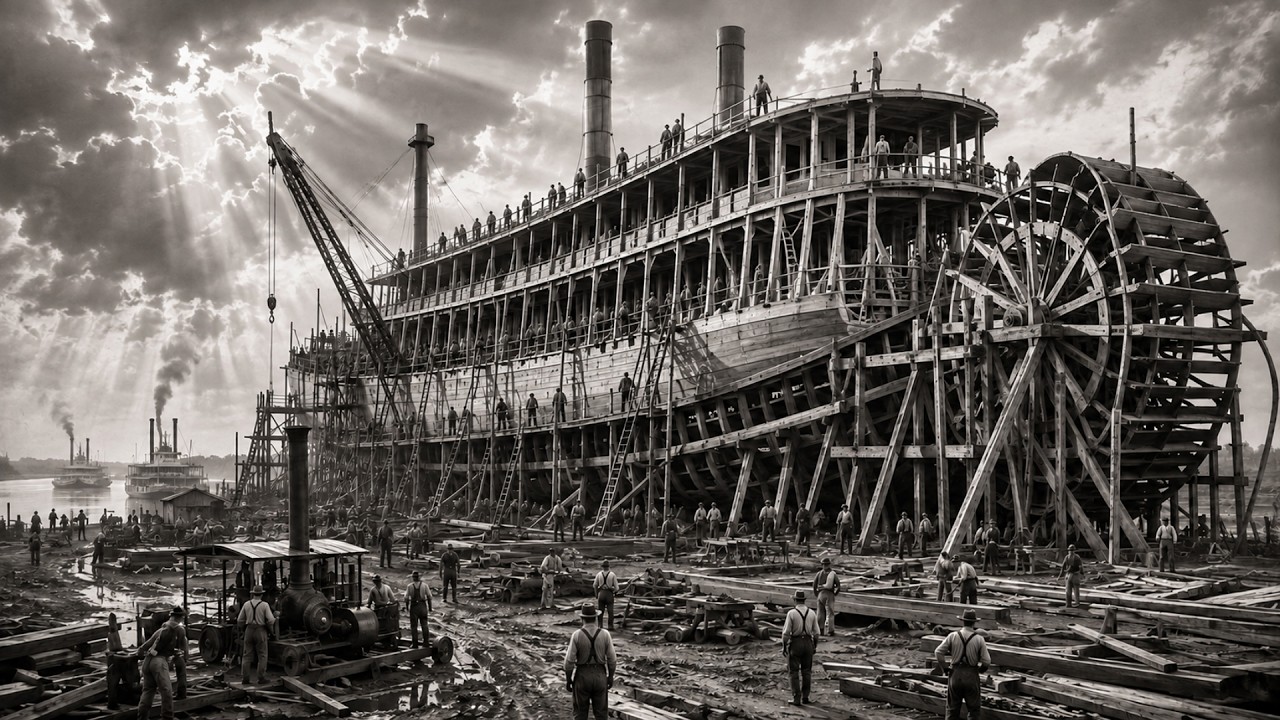
They are in the same payroll records, if the records survive, which they often do not. Think about what it meant to build a two-hundred-fifty-foot hull in the Howard yard in New Albany, Indiana, in 1852, the year the Eclipse was built. The yard sat at the river’s edge. The Ohio in front of it was a living river, with flatboats, keelboats, and the older generation of steamboats passing every day in sight of the men in the ways.
Timber arrived by wagon from mills upriver or floated down in rafts from the hill sawmills of Indiana and Ohio. The ship carpenters came to work with first light. The flat bottom of the hull was assembled first: floor timbers running transversely across the bottom from side to side, bolted to heavy longitudinal timbers running along the centerline. Each floor timber was adzed by hand to sit properly on the inclined ways.
Its bolt holes were bored by hand with an auger. The floor timber of a river steamboat was not like the huge curved frame of an ocean vessel. It was a relatively simple rectangular piece of white oak, but it was still shaped by hand, bored by hand, and fastened with iron bolts driven by sledgehammer. The men doing this work worked on their knees over wooden staging in the cold of an Indiana February morning, with a view of the Ohio through the gaps in the yard fence, their breath rising in the air above their work.
When the bottom was laid and the sides framed, the caulkers came. Caulking river boats used the same materials as ocean ships—oakum, white lead, pine tar—driven into the seams between the planking with a caulking iron and mallet. The sound of a caulking gang at work on a hull was a continuous rhythmic pounding that carried across the yard from first light to last. It was a sound the people living in the streets behind the Howard yard in New Albany heard every working day for a hundred years.
The caulkers worked fast, because the hull had to be launched, the interior fitted out, the machinery installed, and the boat had to meet a delivery date written into the contract at a price that left no room for delay. The economy of the Western river steamboat trade was built on speed of construction and short operational life. An ocean ship was built to last thirty years. A Western river steamboat was expected to last five if it was lucky.
The rivers were hard on hulls: snags, shifting sandbars, spring floods driving debris into the water at speed, the constant wetting and drying of waterline planks, the vibration of high-pressure engines running at loads that would have been considered dangerous on an ocean ship, and the sparks from wood-burning furnaces falling on wooden decks made of pine. Five years was a good life for a river steamboat, so the builders worked fast. The Eclipse took about eight months from keel-laying to delivery. Eight months to build a three-hundred-sixty-five-foot wooden ship with a full steam plant, paddle wheels, and interior fittings like a floating hotel.
The carpenters who built the passenger cabin of the Eclipse, and the grand salon running the length of the main deck, did joinery work of a quality that would not have embarrassed the best furniture makers of Cincinnati. The bedroom panels were painted and grained to imitate rosewood and mahogany. The salon ceiling was decorated with white and gold cove moldings. The upper deck was fitted with a ladies’ salon, a barbershop, and a bar.
The men who built that interior—carpenters, painters, glaziers—are not generally considered shipbuilders. They do not appear in maritime history books. They appear in the accounts of travelers who described the interior of the Eclipse in the stunned language people use when they encounter something that breaks their assumptions about what the American interior could produce. They called it a floating palace, on a river a man from Boston had been told was barely navigable.
The men who bolted those stanchions and caulked those seams and shaped those floor timbers with adzes in the New Albany yard in the winter of 1851 are not named anywhere a visitor to the Howard Steamboat Museum will ever see. The primary payroll records for the Howard yard from the early 1850s have not been found in any archive consulted. The museum holds records from later periods. The Indiana State Archives holds some fragments.
Newspaper accounts of the Eclipse’s construction mention James Howard’s name, and mention the speed of construction, and the opinions of river pilots who came to inspect the hull before delivery. They do not mention the names of the ship carpenters. They do not mention the names of the caulking masters. They do not mention the ironworkers or the joiners.
The builder’s name, the owner’s name, the captain’s name, and the record-setting construction time—those are recorded. The man boring the floor timber at five in the morning in a February shipyard is not in the newspapers. He is not on the historical marker. He is in a place that no one who saw the Eclipse at the height of her service would ever think to look.
The Eclipse set a record on the New Orleans-to-Louisville run in 1853. Four days, nine hours, and thirty minutes to cover the twelve hundred river miles against the current. That record stood for years. She was not the only vessel proving what Western river shipbuilders could deliver.
Cincinnati had yards on the Kentucky side of the Ohio at Covington and Newport, building vessels of comparable quality through the 1840s and 1850s. Pittsburgh had yards on the Allegheny and Monongahela, supplying the upper Ohio trade. Louisville had yards. St.
Louis had yards on the Missouri side. Each yard was a slightly different expression of the same inherited practice, adapted to the local timber available and the requirements of the river trade in its region. Vessels built for the Missouri River trade were built differently from lower Mississippi boats, because the Missouri was faster, shallower, and more violent, requiring a lighter hull and shallower draft. They were engineered more boldly against hogging, because the Missouri regularly operated in depths where the only thing standing between the integrity of the hull and the laws of physics was the hog chains carrying concentrated loads over a three-hundred-foot length.
The men who built the Missouri River boats were solving engineering problems that ocean ship designers never had to face. They solved them empirically, through the accumulated experience of what worked and what failed—watching the hulls they had built when they returned to the yards after a season of service, reading the condition of frames and planking to assess the stresses the river had imposed, and determining where the design needed reinforcement. The knowledge accumulated season after season, yard after yard, in the hands of men who understood their materials the way a craftsman understands the materials he has worked with all his life. Not through equations, but in the grain of the wood, in the direction of a bolt hole, in the sound of the hammer when the oakum was driven home and the seam was truly tight.
The Civil War destroyed the Western river steamboat trade in ways that have never been fully documented. The Union Army appropriated steamboats for troop transport, hospital ships, supply vessels, and the river gunboat fleet. The Howard yards at New Albany built hulls for the Union Navy under military contracts and military schedules. The men in those yards during the war years were building armed boats, headed for the contested waters of the upper Mississippi, the Tennessee, and the Cumberland, where Confederate artillery was emplaced on the bluffs.
Some of the men building those boats had sons serving on board them. This was Indiana in 1862. The river towns of the Ohio Valley were a border region in every sense of the word, and the yards building gunboats for the Union were staffed in part by men whose families were divided by the war, as border families always were. The payroll books, if we could read them systematically, would show men working through the war to build its instruments, practicing their trade, drawing their wages, then disappearing from the records as workers always do when the fighting ends.
Historians come to record who won. The Howard yard continued in operation until 1941—one hundred seven years of continuous work at the same location on the edge of the Ohio at New Albany. The family that founded the yard ran it through four generations. The boats they built changed with the trade.
Wood gave way to iron, then to steel. Steam eventually gave way to diesel. The paddle wheels Shreve had placed on the sides of the Washington moved to the stern as the river trade matured, and stern-wheelers proved more maneuverable in narrow channels and around obstructions. But the fundamental engineering principle Shreve established in 1816 held: build it shallow.
Build it light. Build it for the river it will run on, not the ocean it will never see. The Howard Steamboat Museum in New Albany occupies the Edmunds Howard house, the mansion the Howard family built on the bluff overlooking the old yard site. The museum holds tools from the yard, models of the boats it built, and photographs from the later period of the yard’s operation showing men working on hulls in ways recognizable as the same work the first ship carpenters in that yard did in 1834.
Because the tools of wooden shipbuilding did not change radically between 1834 and the end of the wooden boat era. A broadaxe is a broadaxe. A caulking iron is a caulking iron. The men in those photographs have names.
Some earned them because the tradition of captioning photographs was established by the late nineteenth century. The men in the payroll books from 1852, the men who built the Eclipse, have no photographs. Their wages are recorded in an account book kept by a bookkeeper recording what the company owed, not who those men were. Sometimes one wonders what it meant for one of those ship carpenters to walk the length of the Eclipse’s hull after her framing was complete and her planking was fastened and her seams were caulked, when she was ready for launching: a three-hundred-sixty-five-foot flat-bottomed hull drawing less than three feet of water empty.
To feel the spring of the pine planking under his boots, and to hear the solidity of a well-fastened hull the way a craftsman hears things through his feet and hands and body before he can say them. He would have known, without calculations or drawings before him, whether the frame was true, whether the caulking was sound, whether the hog chain stanchions were set at the right angle to carry the weight the machinery would impose when it was installed and the boat went to work. He would have known it the way a ship carpenter knows things: by his hands and his years, by the weight of accumulated experience of every hull he had walked before. And he would have been right.
The Eclipse worked for years on the Western rivers. She carried freight and passengers. She set records. She floated in water that Eastern boatbuilders said was too shallow for any working vessel.
She floated because the men of the Howard yard built her to float, to meet the specific requirements of a particular river system they understood in a way no marine engineer in a Philadelphia office ever needed to understand. They were right about the timber. They were right about the flat bottom. They were right about the hog chains and the high-pressure engines and the shallow draft.
They were right the way craftsmen are always right when they build honestly for the conditions that actually exist, rather than the conditions assumed to exist. And yet not one of their names is recorded on anything. On the Ohio below the Howard Steamboat Museum in New Albany, the river still runs brown and fast as it always did. The navigation channel still shifts.
The snags still form along the eroding banks. The boats on the river now are diesel towboats pushing welded steel barges, built in yards using methods the Howard ship carpenters would not recognize. But the river they navigate is the river the Western steamboat builders of New Albany and Cincinnati and Pittsburgh first made commercially viable. The interior trade of the continent—the grain, the coal, the manufactured goods moving through the Western river system to this day—travels on a route that was proven practicable by flat, shallow boats built by men who understood that the river is not an ocean, and that the right tool for the job is the one designed specifically for it, and nothing else.
The Eclipse is gone. Nearly all of them are gone. The rivers took most of them—snags, boiler explosions, fires that swept through wooden boats loaded with cotton in the time it took to evacuate the passengers. What remains is the river, and the museum on the hill above the old yard site, and the payroll books no one has fully read, and the names in them no one has spoken since the ink dried.
The men who caulked the seams and drove the bolts in the New Albany yard in the winter of 1851, and launched the Eclipse into the Ohio with her four-foot draft and her five hundred tons—their names are not recorded anywhere a person taking a river cruise on the Ohio today would think to look. They built something that changed the face of commerce across an entire continent. They are in the books, in the faded ink, waiting for someone to open them.






