She was born in Vienna in 1879, a child of the glittering Austro-Hungarian Empire, and from the moment she could speak, she was told she was destined to inspire greatness. But Alma Schindler did not want to inspire. She wanted to create. Her father, Emil Schindler, was a landscape painter who adored her from a distance and sketched her obsessively.
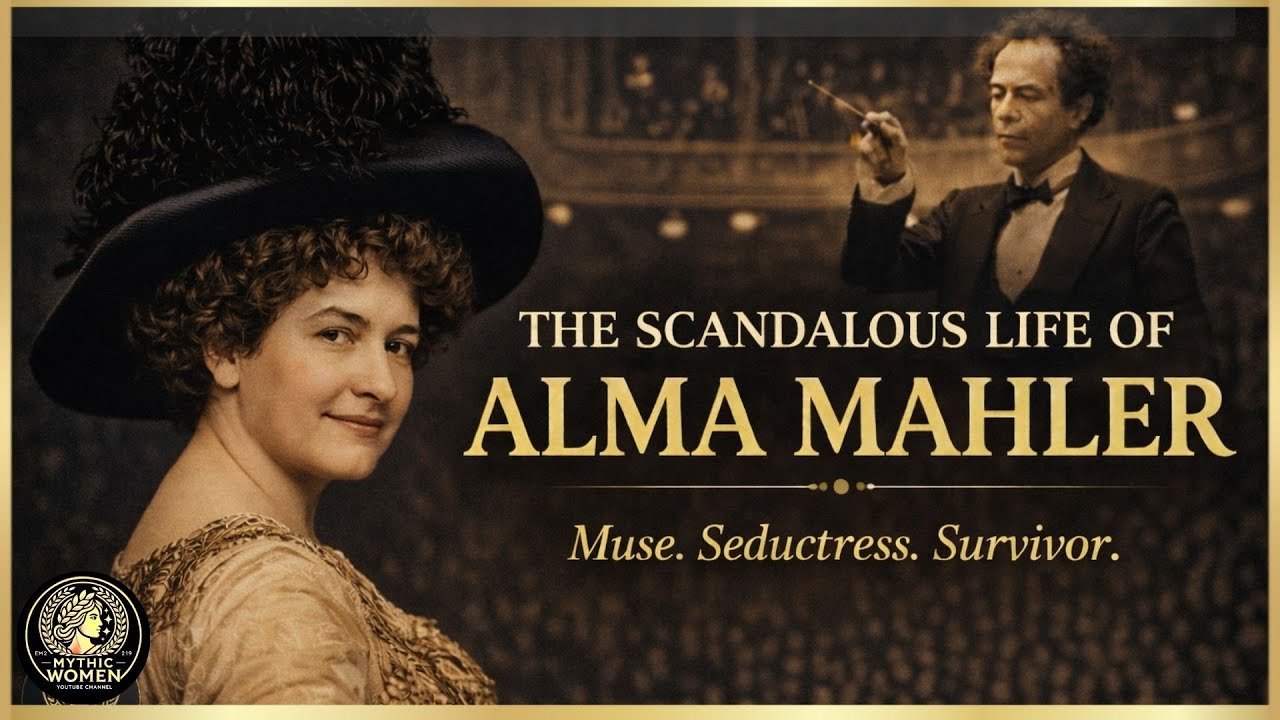
Her mother, Anna, had once been a promising singer but gave up her career for marriage. Alma learned early that in Vienna, genius was always male. She played piano before she could write properly, fell in love with Wagner at ten, dismissed Beethoven at twelve, and confronted her piano teacher, saying she did not want to play what had been written; she wanted to write what had not. She began composing seriously in her teens, studying with the blind court organist Joseph Labor, one of the few men who did not patronize her.
At fifteen, she wrote that she wanted to do something remarkable, to compose a truly good opera, something no woman had ever achieved. She kept composing in secret, but she also watched herself becoming myth. She described herself in the third person in her diaries, staging her own life. At nineteen she was known as the most beautiful girl in Vienna, and she knew it.
At salons she sparred with men twice her age about philosophy and architecture. Her first great love was Gustav Klimt, a charismatic painter who pierced a piece of bread with a toothpick and handed it to her. He kissed her in her room, asked her never to love another man, and then betrayed her in a letter to her stepfather, calling the affair a light-hearted game. She was devastated.
She stopped composing and described herself as already dead. Then she met Alexander von Zemlinsky, a composer who challenged her as no one had. He agreed to teach her counterpoint and harmony, and pushed her harder than any teacher before. You are full of ideas, he said, but it is a pity you do not take it seriously.
He told her that if she were a man, her music would already be published. They fell in love, but his letters turned furious and demanding. Their relationship soured, and just as she was pulling away, she was invited to a dinner where Gustav Mahler was present. Mahler was Vienna’s imperial director of the Hofoper, a conductor whose rehearsals could terrify orchestras.
He was twenty years her senior, intense, compulsive, and utterly compelling. At the dinner, they argued about genius and responsibility. He never asked to hear her music. Within weeks, he had proposed.
His letters came daily, demanding total devotion. He issued an ultimatum: if they were to be happy, she must be his wife, not his colleague. The role of composer, he declared, was his. She must surrender unconditionally.
She showed the letter to her mother, who was horrified. That alone made her want to accept. She persuaded herself that giving everything was the only way to be truly chosen. In December 1901, the engagement was made official.
In March 1902, they married in a modest ceremony with few witnesses. Her songs, more than a hundred of them, went into a drawer, sealed and unopened. Marriage to Mahler was total. She became his assistant, his copyist, his nurse.
She copied his scores by hand and managed his household. When she played the piano at their summer retreat, he knocked on the floor with his cane from his composing hut. She stopped playing. Their first daughter, Maria, was born in 1902.
In private, Alma wrote that she was hollow, a wrecked ship. Her own songs sat in the drawer like a coffin she carried with her. In 1907, tragedy struck twice. Their younger daughter Anna survived scarlet fever, but Maria fell ill and died, choking in the night.
Alma ran to the lake and screamed into the wind. Mahler collapsed with grief, and doctors discovered he had a heart condition, giving him perhaps four years to live. Alma believed he blamed her for Maria’s death. She blamed herself.
Shortly after, Mahler was forced to resign from the Vienna Opera, hounded by anti-Semitism and local politics. They sailed to New York, where he took up conducting again, burning through his remaining strength. At a spa in 1910, Alma met Walter Gropius, a young architect who saw her not as a muse but as a woman. They began a secret correspondence.
A letter was misdirected, Mahler opened it, and the marriage nearly collapsed. In the confrontation that followed, Mahler wept and begged her to stay. He asked to see her music. When she showed him her songs, he wept again, told her they were good, and arranged for them to be performed.
He dedicated his Eighth Symphony to her. But the reconciliation did not last. Mahler’s health failed rapidly, and he died in May 1911. Alma was not allowed at the funeral.
For nearly a decade, she had lived inside his genius. Now she was suddenly alone. She rekindled a relationship with Gropius, but it fizzled. She was pursued by admirers and disciples, including a biologist who installed a terrarium of salamanders in her apartment and threatened to shoot himself on Mahler’s grave.
Then came Oskar Kokoschka, a feverish young painter who was consumed by her. Their affair was three years of violent struggle, of love, of hell, of paradise. When she left him, he commissioned a life-sized doll in her image, dressed it in her clothes, took it to the opera, and destroyed it in a drunken fit at a party. World War I tore through Europe, and Alma married Gropius secretly in 1915.
They had a daughter, Manon, but the marriage could not survive the distance of the trenches. While Gropius was at the front, Alma fell in love with Franz Werfel, a poet and playwright whose work she had set to music years earlier. She left Gropius and devoted herself to Werfel’s career. The old empire collapsed.
Vienna starved. Alma arranged tours, managed finances, and built a new life around a new genius. But grief followed her. Manon, her youngest daughter, contracted polio in 1937 and died.
Alma did not attend the funeral, just as she had not attended Mahler’s. When Nazi Germany annexed Austria in 1938, Alma fled. Her stepfather and half-sister had joined the Nazi party. Her homes were seized, her property stolen.
She, her daughter Anna, and Werfel made a desperate crossing of the Pyrenees on foot at night, carrying nothing but small bags and manuscripts. A French border guard called them back; Alma stepped forward alone, and he stamped her papers. They reached Spain, then sailed to New York, and eventually settled in Los Angeles. Werfel enjoyed success in America, but his health failed.
In 1943, he collapsed at Alma’s feet and died a few days later. She did not cry. She did not go to the funeral. Instead, she sat at his desk and dictated his unfinished manuscript from memory, working line by line to preserve his final work.
She spent her later years curating the legacies of the men she had loved, editing memoirs, correcting anecdotes, removing enemies, softening betrayals. In a quiet brownstone on East 73rd Street, she went through old boxes and found the songs she had written in her youth, the hundred songs she had kept through war, exile, and loss. She placed one on the piano. Her fingers trembled.
She pressed down once, softly. It did not sound like Mahler. It did not sound like Werfel. It sounded like her.
She played for hours. When a young soprano asked to perform one of her songs at a recital, she agreed. The reviews were kind. One called the music delicate and strange.
Another noted that the harmony surprised with restraint. She died on December 11, 1964, at the age of 85. She was buried in Vienna beside Manon. On the funeral program, she was listed simply as Alma Mahler, composer.
The world remembers her as Mahler’s wife, Gropius’s scandal, Kokoschka’s obsession, Werfel’s muse. But beneath the myths and the men, nearly a hundred of her songs survived. Most were lost to fire and flight. A few remain.
When they are played, they sound like whispered confessions between the notes, the work of a woman who spent her life holding the stirrups of genius, but who had once dared to imagine a music entirely her own.
