In February 1676, Mary Rowlandson and her children were taken captive by Wampanoag warriors after a raid on Lancaster, Massachusetts, that left many settlers dead, including her own daughter. The raid was part of King Philip’s War, a conflict that Metacom—known to the English as King Philip—had launched against the colonies of Massachusetts and Rhode Island in 1675. For more than fifty years, his tribe had lived in peace with the English. His father, Massasoit, had been the chief who sent Squanto to help the settlers in 1621, an act remembered in the first Thanksgiving.
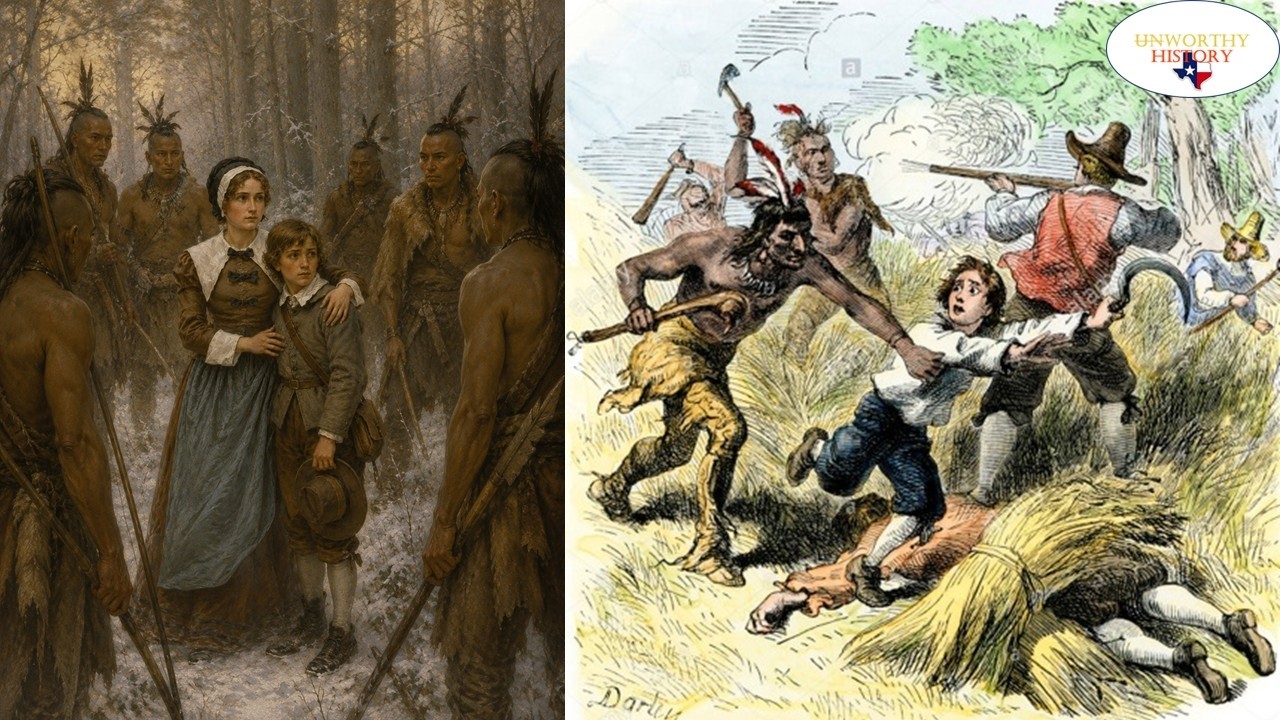
But after Massasoit’s death in 1662, his son began planning for war. Now, Mary Rowlandson was being dragged through the frozen wilderness of western Massachusetts, taken north toward the border of Vermont and New Hampshire, and forced to witness the brutality of her captors. Her account, published in 1682 as The Sovereignty and Goodness of God, became one of the most famous captivity narratives in American history. In it, she described her journey in stages, documenting each forced march and the suffering she endured.
The English army was close behind the Wampanoag, and the Indians moved with desperate speed. They selected their bravest men and sent them back to slow the pursuing soldiers while the rest fled. Everyone moved fast, carrying the old and the weak. Four men carried a heavy Indian on a litter until they reached a dense forest and could carry him no further, so they took turns bearing him on their backs.
They pressed on until they reached the Baquaug River. By Friday afternoon, the entire group had gathered at the water’s edge. Mary tried to count them but the number was too great and she was too exhausted. Her wound had lightened her load—she carried only her sewing and two quarts of parched cornmeal.
When she asked her mistress for a spoonful of the meal, the woman refused to give her any until she had tasted it herself. The Indians quickly cut dry trees and built rafts to cross the river. When Mary’s turn came, she sat on brush placed on the raft so her feet stayed dry, while others waded up to their knees in the icy water. It was bitterly cold, and she saw the hand of God in keeping her feet from wetness.
Not all crossed that night; the rest came over the following evening. On Saturday, the Indians boiled the leg of an old horse, and Mary drank the broth as soon as they thought it ready. During her first week among them, she ate almost nothing. In her second week, her stomach was so weak from hunger that she could barely swallow their filthy scraps.
By the third week, food that had once seemed revolting tasted sweet. When Saturday came and she had not yet finished sewing a pair of stockings for her mistress, she asked to rest, promising to do twice the work the next day. They told her they would smash her face. She marveled at how these heathens survived.
There were hundreds of them—sick, lame, and carrying children on their backs, mostly women loaded with all their belongings—yet they all crossed the river. On Monday, they burned their shelters and moved on. That same day, the English army reached the river and saw the smoke, but they stopped. The river held them back.
God had not given them the courage to pursue. Mary reflected that if the English had been ready for such a great mercy as victory and deliverance, God would have found a way for them to cross as He had for the Indians. On the next march, the morning was cold and a great stream lay ahead covered with ice. Some waded through it up to their knees, while Mary crossed with others at a beaver dam, keeping her feet dry.
She walked that day weeping, moving farther from home into a vast and lonely wilderness. They reached a great swamp and camped beside it for the night. From a hill overlooking the area, Mary thought she had arrived at a large Indian town, but it was only their own company. The Indians were thick as trees—a thousand axes seemed to be working at once.
Everywhere she looked, she saw Indians, and no Christian soul near. Yet she was preserved. The swamp was like a deep dungeon, and before it rose a steep hill. She thought her heart and legs would break before she reached the top.
Along the way, she saw a place where English cattle had been, which comforted her, and then an English road, which affected her so deeply she wished she could lie down and die in peace. That afternoon they reached Squakeag, where the Indians scattered through abandoned English fields, gathering whatever they could find. Some picked up scattered wheat, others found Indian corn, some found beans, and others found frozen bundles of wheat and threshed them. Mary managed to get two ears of corn, but one was stolen while her back was turned.
An Indian came carrying a basket with a horse’s liver. She asked for a piece. Surprised, he asked if she could eat it. She said she would try.
He gave her a piece, and she put it on the coals to roast, but before it was half-cooked, half of it was taken from her. She ate the rest raw, blood staining her mouth, and it tasted good. To a hungry soul, even bitter things are sweet. She found it a solemn sight to see fields of wheat and corn wasted and ruined, left as food for merciless enemies.
The next morning, they had to cross the Connecticut River to meet King Philip. Two boatloads had already crossed, and it was Mary’s turn, but as she stepped onto the boat, sudden shouts rose among the Indians. She was forced to step back, and instead of crossing, they marched four or five miles north. Some Indians ran one way, some another.
She believed English scouts had been sighted. Walking along the river at noon, the group stopped to rest and eat. While Mary sat among them, her son Joseph came to her unexpectedly. They asked each other how they fared, lamenting their change of fortune.
She asked if he wished to read. He said yes. She gave him her Bible, and he turned to the comforting verse: “I shall not die, but live, and declare the works of the Lord. ” He said, “Look here, Mother, have you read this?
”
They traveled until night, and in the morning they crossed the river to Philip’s company. When Mary was in the boat, she was astonished by the great crowd of heathens waiting on the opposite bank. When she landed, they gathered around her as she sat alone in the middle. They asked each other questions, laughing and rejoicing at their gains and victories.
Her heart began to fail, and she burst into tears—the first time she remembered weeping in front of them. Until then, she had been stupefied, unable to cry despite overwhelming grief. Now she could say as in Psalm 137: “By the rivers of Babylon, there we sat down, yea, we wept, when we remembered Zion. ” One of them asked why she was crying.
Barely able to answer, she said they would kill her. He told her no one would hurt her. Another gave her two spoonfuls of meal, and another half a pint of peas, which seemed more valuable to her than many bushels at another time. She went to see King Philip.
He invited her to sit and asked if she would smoke—a common courtesy of the time, but she had given up tobacco since her capture. She regarded smoking as a bait of Satan to waste precious time and thanked God she now had the power to resist it. Philip asked her to sew a shirt for his child, and she did, for which he paid her a shilling. She bought a piece of horseflesh with it.
He then asked her to make a cap for the child and invited her to dinner. She was given a cake the size of two fingers, made of parched, ground wheat fried in bear’s fat, and she thought she had never tasted anything so delicious. She also sewed for other Indians, earning a piece of bear meat and a quart of peas, which she boiled together and shared with her master and mistress. When she heard her son had arrived, she went to see him and found him lying on the ground.
She asked how he could sleep that way. He said he was not sleeping but praying, lying down so no one would notice. The Indians gathered their forces against Northampton. All night, one of them shouted to relay the plan, and they boiled beans and roasted corn.
They returned with horses, sheep, and other plunder. Mary begged them to take her to Albany on one of the horses and sell her for gunpowder, but instead they marched five miles along the river and crossed it. Here she sewed for a poor Indian who paid her with a knife only after she made another shirt for an unborn child. Her master demanded the knife, and she was grateful to have anything that pleased him.
During this time, her mistress’s servant returned from Narragansett country with corn, bringing news that the great chief Ninigret had been killed. Mary learned her son was a mile away and asked permission to see him. She became lost among the hills and swamps, and though she returned to find her master, who showed her the way, she was never able to cross the distance easily. When she finally reached her son, he was sick with a boil on his side.
She grieved for him, then returned, wandering and mourning, thinking of her children. Her daughter’s whereabouts were unknown—whether sick or well, alive or dead. She turned to her Bible for comfort. One day, wandering among the wigwams searching for food, a woman gave her a piece of bear meat, which she kept in her pocket all day and night for fear of having it taken, before boiling it with beans the next morning.
She had once trembled at the thought of eating bear, but now it was welcome. On a very cold day, another woman spread a skin for her to sit by the fire, gave her beans, and said she would buy her if she could. Later, when a small part of the group moved three-quarters of a mile, Mary returned to their former place for food and was kicked all the way back by an Indian sent to fetch her. That night, deer meat was roasted before her, but she was given none.
Sometimes she was treated kindly; other times, only with frowns. On a Saturday morning, she asked her master if he would sell her to her husband. He answered yes, and her spirit lifted. Her mistress, returning from a child’s burial, found Mary reading her Bible and snatched it away, throwing it out the door.
Mary retrieved it and hid it in her pocket. When they packed to leave, her load felt too heavy, and she complained. Her mistress slapped her face. Mary lifted her heart to God, hoping deliverance was near.
But to her great surprise, after they had gone a short distance, her mistress stopped and refused to go further. She turned back and said Mary must return with her. Her son refused to come and said he would return in three days. Mary’s spirit was nearly broken.
She thought death would be easier than going back. These Indians were no longer friendly. A man drew his sword and threatened to stab her if she did not leave the wigwam at night. She walked into the darkness, not knowing where to go.
One old Indian finally took her in, and his wife gave her beans and a place by a good fire. That night, she had a comfortable lodging. For about two weeks, she stayed in a thicket six miles down the river, gathering groundnuts by day and returning at night, carrying heavy loads. Her back became raw with sores.
When she asked for relief, they told her it did not matter if she lost her head as well. She had not seen her son in a while, and when she asked an Indian about him, he cruelly said his master had roasted him and that he had eaten a piece of him the size of two fingers. Mary knew these people were liars, and God strengthened her spirit. One cold night, she moved a branch blocking the fire’s heat, and a woman threw ashes in her eyes.
She thought she would go blind, but tears washed the dust away, and by morning her sight returned. Around this time, she began to despair of ever returning home. The English army had not come. Albany had not happened.
Her master had left her. She prayed and read her Bible but found little comfort. Then a captive arrived from Hadley, a man named Thomas Reed, and the Indians gathered around him, questioning him harshly. When Mary asked if they would kill him, she was told no.
Reed told her he had seen her husband in the Bay Colony, alive but deeply sorrowful, and Mary realized the Indians had lied all along—some had said he was dead, others that he had remarried. She felt great relief. Her son had been sold after his master beat him, and she did not see him again until both were freed at Portsmouth. She met a sick young Englishman, John Gilbert of Springfield, lying on the ground with a dying Indian child, starving and freezing.
She helped him to a fire, but when his master’s daughter learned of it, the Indians accused Mary of trying to escape with the young man. They threatened to strike her on the head with a hatchet and confined her to the wigwam. The situation lasted that day and half the next, until an Indian came with stockings to be resewn and asked her mistress if Mary could go with him. She said yes, and Mary regained her freedom.
She continued to suffer, reading her Bible whenever she could, clinging to the verse: “For a small moment have I forsaken thee, but with great mercies will I gather thee. ” When her mistress’s child died, the group mourned and wailed morning and evening. Mary spent many sorrowful days, often alone, thinking of her former life—her family, her church, her comfortable bed—while she now slept on the ground and ate scraps. She recalled the prodigal son and prayed, “Father, I have sinned against heaven and before thee.
”
Her captivity was not yet over, but she held onto the promise that God would gather her again. Her account, written from memory after her release, became a testament to her endurance—and to the brutal war that had torn her world apart. In the coming weeks, the Indians would move her eastward, back toward Lancaster and Boston, where her deliverance would finally come.






