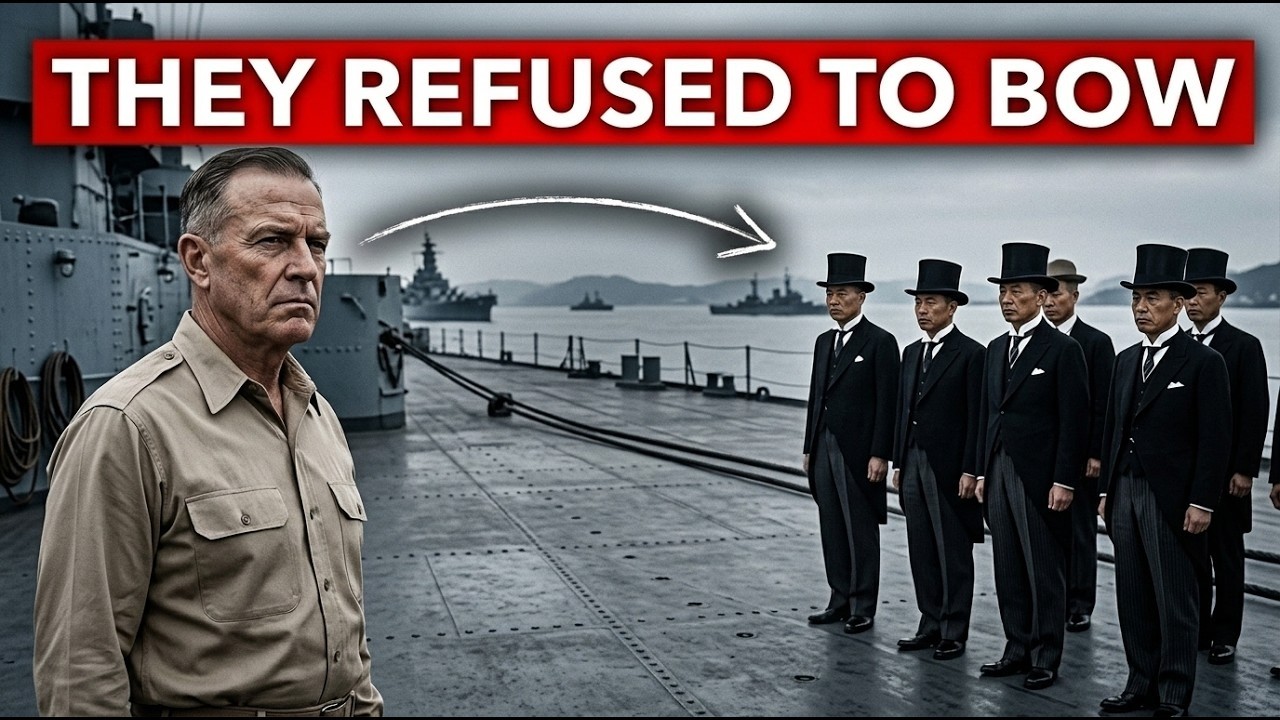
On the morning of September 2, 1945, eleven Japanese officers crossed the deck of the USS Missouri in Tokyo Bay. Their uniforms were immaculate, their ceremonial swords at their sides, their faces expressionless. They believed they had preserved their dignity. What they did not yet understand was that General Douglas MacArthur had already taken it, not through violence, but through placement, presence, and the careful arrangement of a single table.
MacArthur had fought the Japanese across four years and nine thousand miles of island, jungle, and open ocean. He understood exactly what this ceremony had to accomplish. It was not simply the signing of documents. The question that would shape every photograph and newsreel of the event was deceptively simple.
Would the Japanese officers bow? What MacArthur understood, and what the delegation did not yet realize, was that the answer did not depend on them. The officers in the first group carried ceremonial swords. Their faces, as they crossed toward the surrender table, were arranged into the absolute stillness that Japanese military culture demanded in a moment of public exposure.
For men trained in the tradition of Bushido, this was the only form of dignity available to them. They would not show grief. They would not show shame. What they might show, if MacArthur was not careful, was contempt.
This was the calculation MacArthur had spent days working through. A ceremony that looked like a simple administrative transfer of authority could, if mishandled, become something the Japanese military culture would reinterpret in its own terms. MacArthur had seen this happen before. After Germany’s defeat in the First World War, the German military establishment spent twenty years rewriting the memory of 1918, convincing an entire generation that the army had not truly been defeated but betrayed from within.
That myth weakened the Weimar Republic and carried Adolf Hitler to power. Nearly sixty million people died in the war that followed. MacArthur had no intention of providing the Japanese military with equivalent raw material. The Japanese officer class in 1945 rested on a concept of hierarchy so absolute it functioned like a physical law.
For a Japanese officer to bow his head before a superior was the visible enactment of an entire worldview. For four years, in every territory the Imperial Army occupied, the bow had moved in one direction, downward, from the conquered toward the conquerors. The ceremony on the Missouri was designed to reverse that direction permanently. Several officers had already given indications of resistance.
During the transit from the Japanese destroyer to the Missouri, American liaison officers noted that at least two maintained what was described as ostentatiously correct behavior. They were performing composure as a form of resistance, communicating that they did not regard themselves as defeated men attending their own capitulation but as samurai fulfilling an order from their emperor. General Yoshijiro Umezu, chief of the Army General Staff, was the most prominent example. Umezu had opposed the surrender in the Imperial Conference of August 9th and 10th, arguing that Japan should fight to the last man rather than accept the terms of the Potsdam Declaration.
When the emperor overruled him, Umezu accepted the Imperial will with formal compliance. He arrived on the Missouri with his back straight, his face unreadable, his sword at his side. He was there because the emperor commanded it, not because the Americans had defeated him. Foreign Minister Mamoru Shigemitsu walked with difficulty, supported by a cane, the result of a 1932 assassination attempt in Shanghai.
His physical struggle ascending the gangway was visible to everyone on deck. One American observer described the delegation’s bearing as controlled insolence, not overt defiance, but the posture of men who intended to make clear, even in defeat, that they were not prostrating themselves. MacArthur had been watching for days. He arrived on deck at 9:00 and walked to the ceremony area with his characteristic long stride.
When he spoke, his voice was flat and deliberate. Behind him stood General Jonathan Wainwright, the man who had surrendered Corregidor to the Japanese in May 1942 and spent more than three years in Japanese prisoner of war camps. Wainwright had lost nearly sixty pounds during his imprisonment. Also present was Lieutenant General Arthur Percival, who surrendered Singapore in February 1942, the greatest defeat in British military history.
He, too, had spent years as a prisoner. The men whom the Japanese military had humiliated in the early years of the war were present to witness the final signature. Shigemitsu approached the table. His artificial leg made sitting visibly difficult.
He spent what witnesses later described as an agonizing length of time examining the documents before signing. MacArthur, watching from a few feet away, said nothing for approximately a minute. Then, in a voice accounts described as sharply quiet, he told General Richard Sutherland to show Shigemitsu where to sign. The hesitation ended.
Umezu signed next, in his capacity as representative of Imperial General Headquarters. He signed without sitting down, leaning forward over the table. His posture was the most rigid and unreadable of the entire delegation. He did not look at MacArthur.
He completed his signature and straightened up. He had not bowed. But he had placed his name on an instrument of unconditional surrender, in front of hundreds of witnesses, on a ship flying the flag of the country that defeated him, with the men his army imprisoned standing behind the general who beat him. The architecture of the ceremony had already decided the question.
MacArthur had not designed a confrontation. He had designed a structure in which confrontation was unnecessary. The Japanese delegation stood on the wrong side of the table. The documents moved from the Japanese side to the Allied side and not in the other direction.
The flag above the deck was American. The ship was American. The harbor was American controlled. Every element of the physical environment communicated the same information without requiring anyone to state it aloud.
No Japanese officer performed a formal ceremonial bow toward MacArthur. There was no need. The framing was structurally impossible. The only choice available to the delegation was how they stood while it happened.
The signing took twenty-three minutes. When it was complete, MacArthur spoke again. He did not gloat. He said, “Let us pray that peace be now restored to the world and that God will preserve it always.
” The ceremony ended. The Japanese delegation was escorted from the deck. The occupation began the day the ink dried. MacArthur moved his headquarters into the Dai-Ichi Insurance Building in Tokyo, directly across from the Imperial Palace grounds.
Every morning, Japanese citizens walking past the palace could see the Supreme Commander’s building on the opposite side of the moat. The physical geography of the occupation’s authority was built into the city’s daily landscape. In the first weeks after the surrender, MacArthur made decisions that surprised many of the officers around him. He did not arrest Emperor Hirohito.
He did not put him on trial. He met with him privately at the American Embassy on September 27th, a meeting that lasted thirty-seven minutes and was photographed afterward. The photograph, MacArthur in his open-necked khaki uniform standing half a head taller than the emperor in formal morning dress, ran in every Japanese newspaper the following day. The decision was strategic.
MacArthur’s staff had assessed that the emperor’s authority was the single most stabilizing force available to an occupation government administering eighty million people with roughly four hundred thousand troops. Arresting Hirohito would have required, by the estimate of MacArthur’s G-2 section, a minimum of one million additional troops to contain the civil disorder that would follow. MacArthur kept the emperor in place but made clear through every subsequent interaction that his continued position rested on MacArthur’s decision to allow it. Umezu’s fate illustrated the longer arc of what the ceremony set in motion.
He was arrested in December 1945 and charged before the International Military Tribunal for the Far East. He was convicted of war crimes and crimes against peace in November 1948 and sentenced to life in prison. He died in Sugamo Prison in January 1949, of cancer, less than four years after standing on the Missouri with his back straight and his face correct. Shigemitsu’s trajectory was more complicated.
He too was tried and received a seven-year sentence. He was released in 1950 under parole and eventually served again as foreign minister. The tribunal saw a difference between the civilian diplomat who signed under orders and the military officer who helped plan and direct a war. Wainwright, the gaunt figure who stood behind MacArthur, was awarded the Medal of Honor shortly after the surrender.
He had spent three years and four months as a prisoner of the Japanese army, held in camps in the Philippines, Manchuria, and finally in China, where he was liberated by Soviet forces in August 1945. MacArthur placed Wainwright where he did for a reason that required no translation. At the close of the ceremony, MacArthur folded his copy of the prepared remarks and stepped back from the microphone. Then the sky filled with sound.
More than four hundred B-29 bombers and fifteen hundred carrier-based aircraft crossed Tokyo Bay in formation. The same aircraft that had burned Japanese cities now passed overhead in demonstration. The flyover had been timed to coincide with the ceremony’s conclusion. It was the final layer of architecture around the moment, the visual and auditory confirmation that the war was over and there was no ambiguity about who ended it.
The sound faded. The harbor went quiet. The Japanese officers had departed the deck. Their backs were straight.
Their faces were still. They did not bow. None of it mattered. The bow or its absence was always the smallest part of what happened that morning.
What mattered was the table, the documents, the witnesses, the harbor, the flag, and the twenty-three minutes it took to make all of it permanent.






