The 20-minute warning comes too soon. There is no time for a proper rinse, no chance to get the soap off before the attendant’s voice cuts through the steam and the shouting children and the coughing men. You emerge from the tub wetter than you entered, nominally cleaner, though cleaner is debatable. Your skin is raw and stinging.
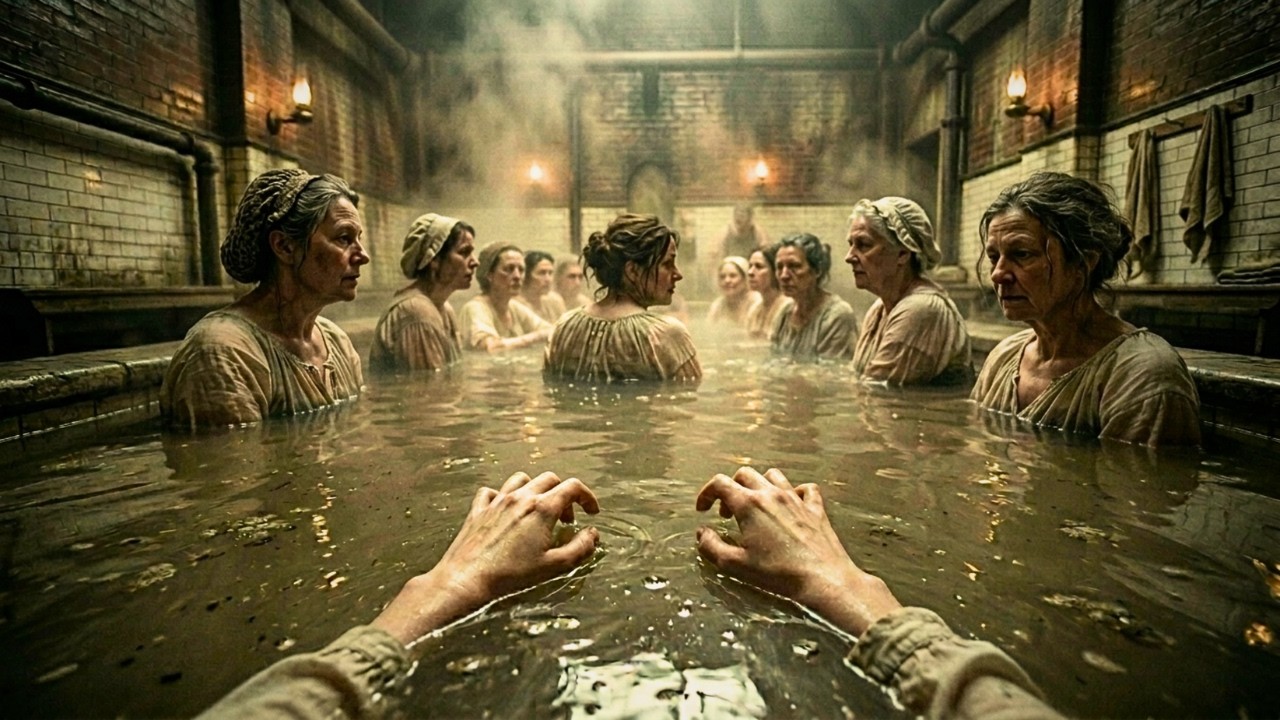
A towel is handed to you, damp and gray from dozens of bodies that have used it before yours. You dry off inadequately and pull your filthy clothes back onto your clean body, recontaminating yourself within minutes. This is as good as it gets. This is modern hygiene.
This is progress. The morning had begun the way every morning begins, in a room shared with seven other people, waking up already smelling terrible. Not a little musty. Terrible.
Genuinely offensive levels of body odor that would clear a modern elevator. You have been wearing the same undergarments for six days straight because changing them means exposing your skin to air cold enough that frost has formed on the inside of the window. The inside. You have made the rational calculation that freezing to death is worse than stewing in your own filth for another day.
Your mouth tastes like something died in it, which makes sense, because you haven’t cleaned your teeth in weeks. Toothbrushes exist in 1870, mass-produced since the 1780s, but they cost about as much as a day’s wages, so you don’t own one. Instead, your teeth are coated in a film of accumulated breakfast remnants, dinner debris, and general bacterial civilization that has been establishing colonies on your molars for the better part of a month. The chamber pot in the corner is half full from last night’s contributions from multiple family members, adding its own aromatic quality to a room that already mingles the smell of seven unwashed bodies with coal smoke seeping through the floorboards and whatever your neighbor cooked last night that involved cabbage.
Your face and hands are grimy. Not modern grimy, the kind that suggests you should wash up. Victorian grimy. London burns about 3.
5 million tons of coal annually, and a substantial percentage of that ends up as particulate matter floating through the air and settling on every exposed surface, including you. While you slept, soot drifted through the poorly sealed window and coated your skin with a fine layer of industrial progress. Your hands have ground-in dirt under the fingernails, in the creases of your knuckles, embedded in your palm lines like a fortune-telling that promises your future involves more dirt. Your washing station consists of a single ceramic basin filled with water that has been sitting there since yesterday.
The water is gray. Not clear with a slight tint. Gray. Because yesterday you washed your face and hands in it, and so did three other people.
Nobody bothered to change it, because that would require going downstairs to the communal pump, waiting in line with twenty neighbors, hauling a heavy bucket back up three flights of stairs. Who has that kind of energy before breakfast? You splash the questionable water on your face. It’s cold enough to make you gasp.
A full body wash is out of the question. It’s February, there’s no heat in the room, and attempting to wash your torso would result in pneumonia, or at minimum a miserable day of being cold and damp under your clothes. Your hair hasn’t been washed in three weeks. It’s greasy enough to slick back without any product.
Women of means use flour or starch as dry shampoo, brushing it through to absorb excess oil, but you can’t afford to waste flour on your hair when you could eat it instead. So your hair stays greasy, and you run your fingers through it, which accomplishes nothing except spreading the grease around more evenly. Getting dressed means putting on the same clothes you wore yesterday, and the day before, and the day before that. Your outer garments have never been fully washed, because washing them would damage the fabric, and you can’t afford to replace them.
The wealthy rotate between multiple outfits and send them out for professional cleaning. You have one outfit, maybe two if you’re a clerk trying to maintain respectability. If you are one of those clerks, you own a detachable collar that can be washed separately from the shirt, a brilliant innovation that lets you maintain the appearance of cleanliness without actually being clean. The collar is the only part of your ensemble that sees regular washing.
Everything else accumulates layers of sweat, street grime, coal dust, and the general patina of poverty. The statistics explain the reality. The average working-class person in Victorian London bathes fully maybe once a week in winter, often less. Not because Victorians were uniquely disgusting, but because bathing requires resources you don’t have.
Hot water requires fuel. Soap costs money. Time spent bathing is time not spent working. Privacy requires space that doesn’t exist when eight people share two rooms.
By morning you’re already breathing coal smoke from fires that started up around dawn. The air quality in your room is comparable to standing directly behind a modern diesel truck. This is just morning. This is baseline.
You step outside and the smell hits you like a physical wall. Not a metaphor. The stench has actual presence, actual weight, and if you’re not used to it, you will gag. Fortunately or unfortunately, you are used to it, so you accept that breathing through your mouth is the strategy for the next twenty minutes.
The street surface is not paved with anything resembling modern asphalt. It’s a mixture of mud, horse manure, human waste, rotting food scraps, and whatever else has been thrown out of windows or washed down from higher ground. London has approximately 300,000 horses in 1870, producing over 1,000 tons of manure daily. Much of it sits in the streets until rain washes it into the gutters, or until someone shovels it up for sale as fertilizer, or until it becomes part of the street’s general composition.
A crossing sweeper stands on the corner, a child maybe eight years old with a broom bigger than he is, clearing a path through the filth for anyone willing to pay him a halfpenny. The paths he clears are temporary. Within an hour the traffic redistributes the muck, and he’ll have to sweep again. This is his job.
This is how he contributes to his family’s survival. Beneath the streets are approximately 200,000 cesspools, brick-lined pits where human waste accumulates until someone pays to have them emptied. Many are overflowing. Many are leaking into basements and foundations.
Many are cracked and seeping directly into the groundwater that supplies the neighborhood pumps. You can smell them even when you can’t see them. The night soil men worked last night, working between 2:00 a. m.
and 5:00 a. m. , descending into literal pits of human waste armed with shovels and buckets, breathing toxic fumes that kill several of them every year. They worked, but they can’t get everywhere.
The demand exceeds the supply. From an upper window someone shouts a warning that sounds like “Gardy loo! ” and dumps a chamber pot into the street. It’s technically illegal.
It happens constantly anyway, because the alternative is walking down three flights of stairs to a cesspool that’s probably already overflowing. You step aside quickly enough to avoid the splash radius. You’ve had practice. The Thames is two blocks away, and you can smell it from here.
In 1858, twelve years ago, the smell got so bad that Parliament tried to relocate. They called it the Great Stink. The Thames had become an open sewer, and the summer heat turned it into a toxic soup so potent that lawmakers couldn’t function. It’s better now, marginally, because engineer Joseph Bazalgette has been building a modern sewer system since 1865, but it’s 1870 and the system isn’t complete and your neighborhood isn’t connected yet.
The Thames still receives a substantial portion of London’s waste while also serving as a water source for parts of the city. There’s a dead dog in the gutter. It’s been there for three days. Eventually someone will move it, probably children who collect animal carcasses for whatever bits can be sold.
Until then it’s part of the landscape. You pass a woman collecting dog feces with a bucket and small shovel. She’s a pure finder, and she’ll sell what she collects to tanneries that use it in the leather-making process. Dog feces contains enzymes useful for treating leather, valuable enough that people make a living collecting it from the streets.
The economics of poverty create professions that shouldn’t need to exist. If you’re near any factories, and you probably are, because London is industrializing rapidly, you can add chemical runoff to the mix. Dye works, tanneries, slaughterhouses, all of them dumping waste directly into the streets or the nearest water source. Environmental regulations won’t be invented for another century.
Two blocks into your walk and your clothes are already splattered with street muck. You’ve stepped in something unidentifiable at least twice. The hem of your skirt or the cuffs of your trousers collect filth like it’s their job, which in a sense it is, because outer garments are designed to be durable precisely because they’ll be exposed to these conditions daily. Everyone around you is dirty.
Everyone smells. It’s so normalized that you don’t notice individuals, just the cumulative effect of hundreds of unwashed bodies moving through streets lined with waste. You’re on your way to the bathhouse, desperate for the chance to be clean, or at least cleaner. Your skin itches under your clothes.
Your scalp feels greasy and tight. You smell yourself every time you move and your clothing shifts. This is just the commute. The bathhouse comes into view, an imposing brick building that’s supposed to represent modern progress and public health reform.
Liverpool opened Britain’s first public washhouse in 1842, nearly thirty years ago, and by 1870 this is what civilization looks like for the working class. A building where you can pay to get wet in communal facilities. There’s already a queue outside, thirty to forty people waiting their turn, and you can see steam venting from somewhere inside, confirming that hot water exists in theory. The queue is mostly men coming off factory shifts, a few women with children in tow, and a couple of people who look like lower middle class fallen on hard times, unable to afford private bathing facilities anymore.
The class system is on full display even here. Two types of baths are available. First class costs tuppence and gets you hot water, a private tub, and slightly more time. Second class costs a penny, gives you tepid water at best, communal facilities, and exactly twenty minutes before you’re expected to clear out for the next person.
You’re second class all the way, because tuppence is double the cost and you’re not made of money. The smell from inside is already detectable from the queue. Carbolic acid mixed with damp bodies, mildew, chlorine attempting to mask worse things, and the distinctive smell of too many people in too small a space with inadequate ventilation. It’s not a pleasant smell, but it’s different from the street smell, which makes it almost refreshing by comparison.
A board outside lists the rules. Twenty-minute time limit strictly enforced. No loitering. Proper behavior expected.
The penalties aren’t specified, but you can assume they involve being banned from the facility, which would be socially catastrophic, because where else are you going to bathe? Children run around in the queue waiting for their parents. They’ll bathe in the same water after their parents are done, because paying for separate baths for children makes no economic sense when you can just have them use the already-paid-for water. Family economy dictates that resources get maximized, even if those resources are bathwater that’s been used by two adults already.
A man exits the building looking marginally cleaner than when he went in, his skin visibly red and irritated. The carbolic soap they use inside is harsh enough to strip away several layers of skin along with the dirt. It burns. Everyone knows it burns.
You use it anyway, because the alternative is staying filthy. The economic calculation running through your head is constant. One penny represents about 1/72 of your weekly wage if you’re a laborer. Significant money.
But it’s Saturday, and Saturday is bath day, and the social pressure not to be the person who doesn’t bathe is considerable. Being dirty is normal. Being the dirtiest person in a room of dirty people marks you as destitute. The woman ahead of you in line is complaining to her neighbor about last week’s bath.
She caught lice from the communal tub and is still dealing with the infestation. Her neighbor nods sympathetically, because this is a known risk. Not everyone knows the bathhouse can be a disease vector. You go anyway, because the alternative is not bathing at all.
Your alternatives are limited and unpleasant. You don’t have a bathtub at home. Even if you had space for one, you couldn’t afford to heat enough water to fill it. River bathing is illegal and dangerous, the Thames being the toxic soup already described.
Just staying dirty is theoretically an option, but it’s socially unacceptable and probably increases your chances of disease. The bathhouse serves over a thousand people weekly, all of them using the same facilities. The water is changed regularly, which is defined extremely loosely. It might mean once every fifty people.
It might mean once daily, depending on how busy they are and how conscientious the staff feels. Your turn is approaching. You can see people disappearing through the entrance and emerging twenty minutes later looking damp and red-skinned. The combination of dread and relief is overwhelming.
You desperately want to be clean. You’re absolutely dreading what you’re about to experience to achieve that goal. You hand over your penny at the desk, and the attendant barely looks up. She’s seen thousands of people exactly like you, and your individual existence doesn’t register.
She points toward a corridor, and you follow the sound of echoing voices and running water through a hallway with damp walls and peeling paint. The steam is thick enough that visibility drops to about ten feet. The changing area has no privacy. Hooks on the walls, benches, that’s it.
Strangers strip down inches away from you. You remove your clothes and pile them on a bench, hoping nobody steals them, because there are no lockers, no security, just communal trust and the knowledge that everyone else’s clothes are equally worthless. Theft happens, but what are you going to do about it? The bathing room is large and communal, with multiple cast iron tubs, not enough of them for the number of people who need to bathe.
Some facilities have open communal pools. You’re getting a tub, but you’re sharing it with strangers, because efficiency demands maximum throughput of human bodies per gallon of water. The water in your assigned tub is gray-brown and opaque. You cannot see the bottom.
You have no idea how many people have used this water today, but based on the color and the floating particulate matter, the number is not small. The temperature is lukewarm. The hot water ran out three hours ago, and nobody’s bothered to refresh it, because heating water costs money. You lower yourself into water that’s been in contact with dozens of unwashed bodies, and you try very hard not to think about what you’re sitting in.
Naked strangers are within arm’s reach. Personal space does not exist here. Children scream. Men cough.
Some women try to maintain dignity by keeping their undergarments on, which defeats the purpose of bathing but preserves modesty. The soap is carbolic acid soap, provided in communal bars that everyone uses. It’s harsh enough to burn any cuts or abrasions on your skin. You scrub frantically, trying to remove weeks of accumulated grime in the twenty minutes you’ve been allocated.
The soap stings. Your skin turns red almost immediately. The smell inside is overwhelming, unwashed bodies mixed with carbolic acid and mildew and chlorine and something else you can’t identify but that registers as fundamentally wrong. The attendant walks through periodically shouting time warnings.
She’s completely desensitized to the horror of what’s happening here, because this is her daily job. If you’re ambitious, you attempt to wash your hair. The carbolic soap burns your scalp. The water running off your head is brown from weeks of accumulated grease and coal dust and general filth.
You will not get your hair fully clean in one session. That’s not physically possible given the resources available. Other bathers are visible in various states of distress or resignation. Some people are here for the third time this week, which is unusual and suggests either exceptional dedication to cleanliness or a job that requires it.
Others clearly haven’t bathed in over a month, and the water around them is turning darker shades of brown as they scrub. Then the bath is over, and you’re standing damp and stinging in your filthy clothes, already feeling the contamination transfer back onto your skin. The medical reality of what just happened is genuinely horrifying, though you don’t fully understand it, because germ theory hasn’t been widely accepted yet. Cholera, typhoid, skin infections, lice, scabies.
All of these transmit efficiently through contaminated water and close contact with infected individuals. In 1866, just four years ago, a cholera outbreak killed 5,596 people in London. Water contamination was often the source. The bathhouse you just left is functioning as a disease vector.
Multiple people using the same water means that if even one person has an infection, everyone after them is being exposed. The Victorian medical establishment is still largely operating on miasma theory, the belief that diseases spread through bad air rather than through direct contact or contaminated water. Joseph Lister only started publishing his work on antiseptic surgery in 1867, three years ago, and it’s still controversial. What you’ve actually accomplished today is debatable.
You removed surface dirt, yes. Your skin feels different, raw, more exposed. But you’ve also potentially introduced new problems. The harsh soap has stripped away protective oils.
The contaminated water may have introduced pathogens. The damp clothing against your skin is creating ideal conditions for fungal growth. The walk home takes you back through the same streets, and you’re already re-accumulating filth. Coal soot settles on your damp skin and hair.
Street mud splashes onto your clothes. Within three blocks, the feeling of being clean is already fading into memory. Your hair is still not fully clean despite your attempts, less greasy than it was, but weeks of buildup don’t disappear in one washing with harsh soap and dirty water. Later tonight, you might try to use some flour as dry shampoo, brushing it through to absorb the remaining grease, assuming you can spare the flour.
The economic reality check sinks in. You spent a penny for this experience, a penny that could have bought food. In your weekly budget of maybe six shillings if you’re a laborer, seventy-two pence total, one penny represents a real sacrifice. You made that sacrifice for twenty minutes of communal bathing in dirty water that left you cleaner than you were, but not actually clean.
Somewhere in London right now, a wealthy family is preparing for evening baths. They have servants heating fresh water in copper tubs. They have rose-scented soap made with gentle ingredients. They have privacy, individual bathrooms, towels that are actually clean and dry.
They can bathe whenever they want, as often as they want, in water that hasn’t touched another human body. The difference between you and them isn’t moral character or work ethic. It’s money. They have resources, and you don’t.
They bathe in comfort and privacy. You get twenty minutes of communal horror once a week, if you can afford the penny. The bathhouse will serve fifty more people today after you leave. The water will get grayer, the soap will get scarcer.
Each person will carry away whatever microscopic passengers they picked up, dispersing back to tenements and factories and streets. If even five percent of weekly users have an infection, and the facility serves a thousand people weekly, the mathematics of disease transmission become genuinely terrifying. You will do this again next Saturday. This isn’t a one-time ordeal.
This is your life, every week, indefinitely. Back in your tenement, the day winds down, and you’re as clean as you’re going to get, which is to say you’re cleaner than you were this morning, but you’re already well on your way back to filthy. The question now becomes how to maintain some semblance of respectability until next Saturday’s bath. For women, the strategy involves perfume and scented handkerchiefs, anything to mask the inevitable return of body odor that’s already starting to assert itself.
Not modern perfume, not Chanel or anything remotely sophisticated. Cheap lavender water, if you can afford it, or homemade rosewater if you have access to roses and the knowledge to make it. For most people in this tenement, there’s no perfume at all. You just hope you don’t smell noticeably worse than everyone around you.
Deodorant doesn’t exist yet. The first commercial deodorant won’t be invented until 1888, eighteen years from now. Until then, you just smell like a human body that produces sweat and bacteria. Everyone does.
It’s baseline reality. Your clothing situation hasn’t improved despite your bath. Your outer garments haven’t been washed in months. They can’t be washed frequently, because washing damages fabric, and you can’t afford to replace them.
So they accumulate layers upon layers of sweat, street filth, coal smoke, cooking odors. The fabric is probably stiff with it in places. Your undergarments, the layer against your skin, might get changed twice a week if you’re conscientious and own multiple sets. Many people don’t own multiple sets.
Many people wear the same undergarments for a week straight, changing only on bath day. These garments are supposed to absorb body oils and sweat, protecting the expensive outer layers. They’re doing their job, which means they’re accumulating exactly the kind of biological matter you’d expect. The room you’re sitting in smells like six people who don’t bathe frequently enough, which is accurate, because that’s exactly what it contains.
Add inadequate ventilation, the chamber pot filling up again, coal smoke from the fire, cooking odors from dinner preparation, and the general funk of too many humans in too small a space. You don’t notice it anymore. It’s just what air smells like. Dinner is being prepared by hands that touched bathhouse surfaces a few hours ago, then touched street railings and door handles and money on the walk home.
Those hands were rinsed in cold water when you got back, maybe. No soap, because soap for casual handwashing is too expensive. There’s no understanding of cross-contamination, no concept that invisible organisms on your hands could transfer to food and cause illness. People won’t widely accept germ theory for another decade or two.
The children are being put to bed now. They bathed in your bathwater after it had gotten even grayer from your use, then their mother used it after them. Three people, one tub of increasingly opaque water, maximum resource efficiency. The children are still slightly damp, because towels are inadequate, and they’re being tucked into beds they share with siblings.
The night ahead promises more of the same biological processes that made you dirty in the first place. You’ll sweat in your sleep. Your mouth will develop new layers of bacterial film. Your hair will continue producing oil.
By tomorrow morning, you’ll wake up needing to wash again, but you won’t. You’ll splash your face with cold water and start another day of accumulating grime. The weekly cycle is relentless. Seven days until the next bath.
Each day you get progressively more grimy, more oily, more fragrant. By next Friday, you’ll be desperate for Saturday’s bathhouse session. The psychological adaptation required to live like this is profound. You stop noticing your own smell because it’s constant.
It becomes baseline. Everyone around you smells, too, so it’s not remarked upon unless someone is exceptionally filthy, even by Victorian working-class standards. The social markers of respectability that do exist are small, invisible. A clean detachable collar for men.
Brushed outer garments with no visible stains. Hands that show evidence of having been washed recently, even if the rest of you hasn’t. These signal that you’re trying, that you maintain standards, that you’re respectable poor rather than destitute poor. The gender divide makes everything harder for women.
They’re expected to maintain appearance and manage household cleanliness despite having even less access to washing facilities than men. The moral weight of cleanliness falls disproportionately on women, who are supposed to be guardians of domestic purity while working just as many hours and having fewer resources. The final task of the day is emptying the chamber pot before you sleep, because if you don’t, it’ll overflow by morning. This is not optional.
Six people using one chamber pot overnight will exceed its capacity, and waking up to human waste on the floor is worse than the hassle of emptying it now. Your options are limited and unpleasant. You can carry the pot downstairs to the communal cesspool in the basement, navigating dark stairs with a sloshing container of waste, passing neighbors’ doors, hoping you don’t spill. Or you can dump it in the street, which is illegal but common, because the alternative is genuinely difficult when you’re on the third floor of a building with no lighting and stairs that are slippery even without carrying human waste.
The cesspool in the basement is a brick-lined pit that’s supposed to be emptied monthly by the night soil men. In practice, it’s often forgotten, left to overflow, or only emptied when the smell becomes so overpowering that even by Victorian standards it’s intolerable. You lift the wooden cover, and the smell that emerges is worse than anything you’ve experienced all day, which is genuinely saying something given what you’ve been through. This is concentrated human waste from dozens of families fermenting in a poorly ventilated basement pit.
The gases rising from it are toxic, literally. People have died from these fumes. You hold your breath, pour the contents of your chamber pot as quickly as possible while trying to avoid splashback, and slam the cover back down. The splashback is inevitable despite your best efforts.
Some of what’s already in the cesspool splashes up when you pour. You’ve now got traces of other people’s waste on your hands, and possibly your clothes. You just bathed. You’re already contaminated again.
This is the reality of Victorian sanitation infrastructure. The night soil men will come around between 2:00 a. m. and 4:00 a.
m. to empty these cesspools. They’re paid pennies for work that’s literally life-threatening. They descend into these pits with shovels and buckets, breathing toxic fumes in enclosed spaces.
Several die every year from what Victorians call foul air, which is actually a combination of methane, hydrogen sulfide, and carbon dioxide that displaces oxygen and causes asphyxiation. The waste they collect goes to one of two places. If there’s a buyer, it gets carted to farms outside London to be used as fertilizer, a legitimate agricultural practice. If there’s no buyer, it gets dumped in the Thames, which is already serving as London’s main sewer despite also being a water source for parts of the city.
You wash your hands in cold water from the same basin you used this morning. It’s still gray. There’s no soap, because soap for casual handwashing is a luxury you can’t afford. You splash water on your hands and wipe them on a rag, and hope that’s sufficient.
Climbing into bed means sharing sleeping space with at least one other person, possibly children. The sheets haven’t been changed in weeks, because laundry is an enormous undertaking that requires heating water, which requires fuel, which costs money. The sheets are accumulating their own layers of body oils, sweat, and general human residue. The bedbugs are already waiting.
Victorian London is infested with them. They live in the mattress, in the wooden bed frame, in the cracks in the walls. You’ll wake up with bites. Everyone does.
It’s so common that it’s barely worth mentioning. Your body is nominally clean from the bathhouse six hours ago. You’re already recoated with sweat and coal dust. Your hair is leaving greasy marks on the pillow.
You won’t wash it again for another week or two at minimum. The pillowcase will develop a stain where your head rests, a permanent shadow of accumulated hair oil. The sounds of the tenement continue around you. Neighbors coughing, and tuberculosis is rampant in these conditions.
Babies crying. Other families emptying their chamber pots. Someone arguing in the room below. The building never really goes quiet.
The air quality in the room is abysmal. Every room has a coal fire for heat and cooking, and none of them vent properly. You’re breathing in coal smoke and particulate matter with every breath. This contributes to the respiratory diseases that are epidemic in working-class neighborhoods.
Tomorrow’s reality is already set. You’ll wake up dirty. Maybe you’ll splash your face with cold water. You’ll put on the same clothes.
You’ll walk through the same filthy streets. The cycle continues. In this neighborhood, one in five babies won’t survive to age five. Disease spreads efficiently in these conditions.
Poor sanitation, contaminated water, overcrowding, inadequate nutrition, all of it combines to create mortality rates that are genuinely shocking. The bathhouse you visited today, the infrastructure that’s supposed to represent progress in public health reform, might actually be making things worse by spreading disease through contaminated water. Somewhere in London, someone is sleeping in clean sheets in a heated room, having bathed privately in hot water carried up by servants. The class divide isn’t just about money.
It’s about dignity, health, and basic human comfort. Sleep finally comes. Tomorrow you’ll wake up filthy again, and the whole miserable cycle starts over. This is just life.
This is normal. This is what being working-class in Victorian London means. Life expectancy in working-class London neighborhoods was 37 years. Disease from poor sanitation was a leading cause.
This was only 150 years ago, your great-great-grandparents’ generation. The reformers who changed it, Joseph Bazalgette’s sewers, public health legislation, eventually made this nightmare obsolete in developed nations. But the memory of what it took to get here remains, the reason to be genuinely grateful for hot water, soap, privacy, and the ability to be clean without sharing bathwater with dozens of strangers.
