Richard Peterson—everyone called him Pete—was not a man given to hesitation. When he saw the German Messerschmitt circling beneath the silk canopies of American parachutes, firing burst after burst into the helpless men suspended in the air, he made his decision in an instant. He did not want to blow the enemy fighter out of the sky with a clean, merciful kill. He wanted the German to know what it felt like to dangle in the open, waiting for a bullet he could not dodge.
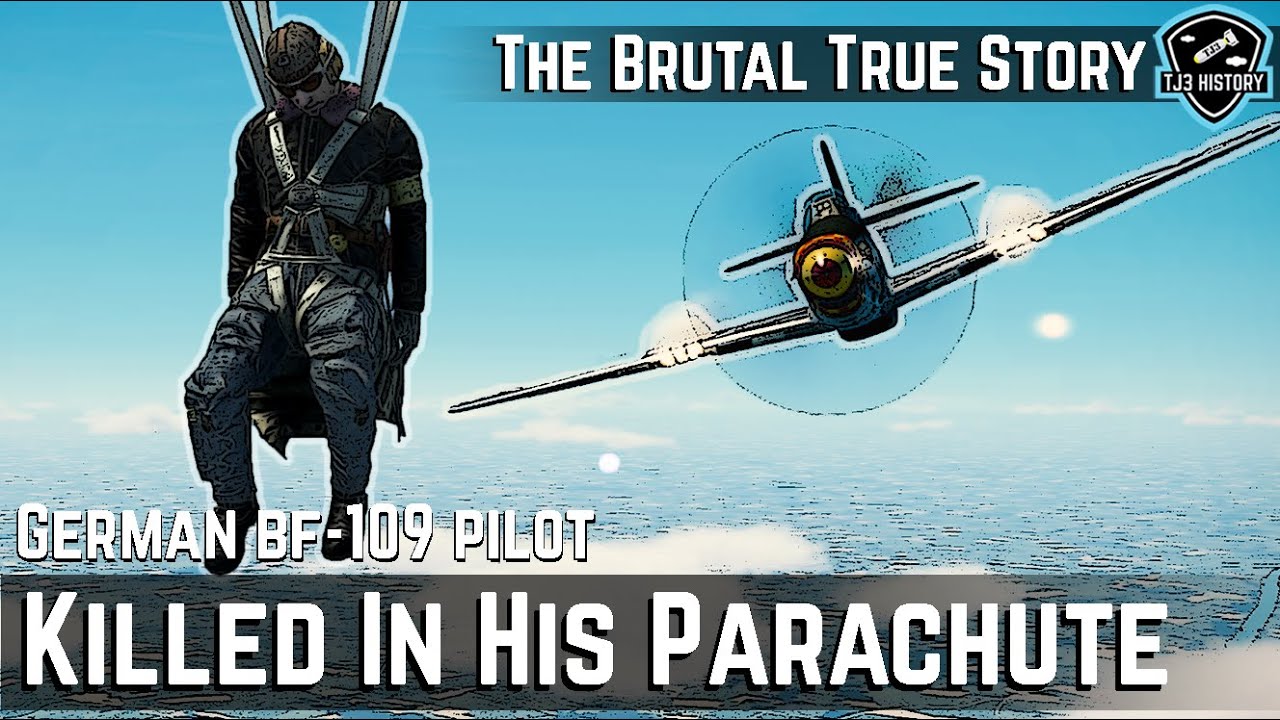
Peterson rolled his P-51 Mustang, dropped into a dive, and settled onto the German’s six o’clock. He had the kill in his sights. One well-placed burst of his six . 50-caliber machine guns would have ended it.
Instead, he began to peck away—deliberate, disabling shots that chewed into the Messerschmitt’s airframe without tearing it apart. Strike after strike, the German pilot knew he was there, knew he was being hit, and knew there was nothing he could do about it. “You’ve met your maker, buster,” Peterson said to himself, his thumb still on the trigger. The German finally pulled the canopy back and jumped.
Peterson watched the man tumble into the slipstream and then hang beneath his parachute, drifting down the same way the American bomber crews had drifted just moments before. The pilot who had been slaughtering helpless airmen was now helpless himself. Peterson pulled his Mustang around, lined up on the descending figure, and pressed the trigger. He damn near emptied his guns.
“By the time I got through with him, he was mincemeat,” Peterson later said. He had sent eight hundred rounds of . 50-caliber ammunition into the man. Six guns firing armor-piercing and incendiary rounds can do a lot of damage.
When he was done, he pulled away. “That was the end of that,” he said. The story that led to that moment began years earlier, in Minnesota, where Richard Peterson was born. In 1942, he joined the U.
S. Army Air Forces, completed his flight training, and was shipped to Europe to fight against Hitler’s war machine. He was assigned to the 357th Fighter Group—one of the most noteworthy fighter groups of the war, and a unit that became home to legendary American aces like Chuck Yeager, who flew a Mustang named Glamorous Glennis, and Clarence Anderson, who flew Old Crow. Like many of his comrades in the 357th, Peterson was assigned to the P-51 Mustang.
The fighter was quickly proving itself formidable against its principal adversary, the Messerschmitt Bf-109. That German fighter was the workhorse of the Luftwaffe and one of the best fighter aircraft in history; at the time, it was the most produced airplane ever built. It was also the most frequent opponent American pilots faced in the skies over Europe. Peterson named his Mustang Hurry Home Honey.
His wife signed every letter she wrote to him from the States with that simple phrase, and he carried it with him into combat on the nose of his fighter. He saw a great amount of success in the 357th. By the end of the war he had become a triple ace, with 15. 5 confirmed aerial victories and another 3.
5 aircraft destroyed on the ground. His success owed a great deal to the experienced aces already flying in his group, seasoned veterans who mentored him along the way and shaped him into a great fighter pilot. His total victory count placed him among the highest-scoring American pilots of World War II. Men like Peterson helped push the Germans back and regain air superiority over Europe in 1944 and 1945.
His most memorable sortie, though, was an escort mission deep over Europe. The P-51 Mustang had only recently been assigned to bomber escort duty, because its improved range allowed it to accompany the bombers all the way into Germany. This was a huge asset for the Allies: it greatly reduced bomber losses as the heavy bombers pressed deep into the Nazi homeland. German Messerschmitts and Focke-Wulfs could no longer wait for the Allied fighters to turn back, leaving the bombers undefended.
Now they had to face the Mustangs head-on. On this particular mission, Major Richard Peterson’s group was assigned to escort B-17 Flying Fortresses as they hammered targets deep within Germany. As the formation approached the target area, they were attacked by German Bf-109s. In the chaos of the engagement, Peterson realized that one of the German fighters was doing something unbelievable.
When B-17s were shot down, their crew members bailed out of the doomed aircraft. Each bomber carried ten men, so just a few planes shot down filled the entire sky with American parachutes. But this time, as the sky filled with silk, a German 109 was attacking the parachutes over and over, killing the airmen as they floated to earth. Normally, nobody—including the Germans—shot at a man in a parachute.
It just wasn’t done. There was no challenge in it. A man hanging beneath a canopy is a sitting duck; you can’t miss. But this German pilot ignored that unwritten rule of aerial combat.
The sky was full of bomber chutes—flak had gotten them near the target area—and he was going from parachute to parachute, shooting up the men as they descended. Peterson watched the slaughter. He could not sit by while American servicemen were killed in cold blood. He made his choice, turned his Mustang, and went after the German.
“God, this was too much as far as I was concerned,” he later recalled. “I didn’t want to blow him up. I wanted him to bail. ”
So he did not simply shoot the Messerschmitt out of the sky.
He took his position perfectly on the enemy’s six o’clock, then opened fire with disabling shots, not kill shots. He pecked away, hitting the German fighter again and again, letting the enemy pilot know exactly who was on his tail and that he was being hit. The German knew the strikes were coming. Peterson kept firing until, after a minute or two of pecking away, he got exactly what he wanted: he saw the German pilot bail out.
The enemy pilot floated down beneath his parachute, just like all the American bomber crew members had. Peterson turned his Mustang around and lined up on the man. He fired, and he kept firing until the guns were nearly empty. He tore the German apart with eight hundred rounds from his six guns.
When he was finished, the man was mincemeat. “Of course, other guys who weren’t there were nervous about me shooting a guy,” Peterson said. “They had to be there to know what I was saying, with this guy going around shooting guys in parachutes who were helpless. And I just tore him up.
”
That was the end of that. In a war where shooting a man in a parachute was considered dishonorable and immoral by every side, Peterson’s action was a rare case where what would normally have been an unfathomable act seemed both right and necessary. He had matched the German’s cruelty with his own, but he had done it as a response to a massacre, in defense of men who could not defend themselves. Richard Peterson survived the war.
He retired from the military soon after returning to the States in 1945. By the time he left the service, he had been awarded the Silver Star and three Distinguished Flying Crosses. After the war, he went on to become a well-respected architect. He passed away in the year 2000 at the age of seventy-seven.
The story of what he did that day over Germany ends, fittingly, in his own words: “That was the end of that. “
