The stone was cold in his hands before he understood what he had done. Ransom Vane stood on the far side of the fallen wall, a flat fieldstone in his grip, the one he had carried a few rods across the line to set as his corner monument. The survey was nearly closed. The upper field, the troublesome corner, the ground four generations of surveyors had refused to chain across—it was almost done, and then a sound he had grown used to over two days stopped.
The creek. Crow Branch, muttering away below the hollow, went silent the way a sound goes when a door is shut on it. The wind died. The birds died.
And the light at the head of the field began to drain away as if poured from a tipped bowl, the same flat grayness he had seen on his first evening at the Harlan place, the light coming up to a line and not crossing it. The line was the line of the old wall. And he was standing on the wrong side of it. He was forty-nine years old in the autumn of 1881, a land surveyor and appraiser out of Frankfort, a tall, dried-out man with a beard gone the color of wood ash and a stiffness in his right knee he had carried home from a field in Maryland nineteen years before.
He did not talk about Maryland. He had been at the creek there, the one the papers named after on the worst single day the country ever spent on itself, and a man who walked through that and came out the far side does not speak easy. He had seen the worst a thing could do, and the worst a thing could do had a shape and a name, and you could measure the ground it happened on. That was the thing about Ransom Vane.
He measured. He carried a brass-bound transit and a sixty-six-foot chain and a leather field ledger soft as a glove, and he believed, the way some men believe in scripture, that anything in this world could be set down in numbers if you were only patient enough. Measure a thing and it stops being a fear. It becomes a figure in a column.
That was his whole religion, and it had served him well. It did not serve him at the Harlan place. The job came to him through a clerk named Wendell Pruitt, a soft-handed, blinking man who kept the deed books in the county seat and clearly wished, the morning Vane came in, that he were keeping anything else. The tract was four hundred and some odd acres at the head of a hollow the local people called the Sorrels, off a creek named Crow Branch, two days’ ride into country where the ridges crowd in close and the roads give up being roads and turn into the memory of roads.
A land company down in Louisville had taken the deed against an old debt and wanted it surveyed clean and priced for sale. Simple work. The kind Vane had done a hundred times. “You’ll want to be quick about it,” Pruitt said, and he did not look up from the book.
“A buyer wants the figures by the end of the month and the season’s turning. ”
“The season turns everywhere,” Vane said. “I’ve worked in snow. ”
“Not up the Sorrels you haven’t.
” Pruitt wet his thumb and turned a page he did not seem to be reading. “Nobody’s worked up the Sorrels in three years. Not since the Harlans went. ”
Vane was not a curious man by trade.
Curiosity is expensive in a surveyor. You go where the corners are and you set your marks and you don’t ask the ground for its history. But there was a catch on the word went, a small thing like a splinter under a nail, and against his own habit he asked, “Went where? ”
And here was the first strange thing.
Wendell Pruitt, who had blinked and fussed and avoided his eyes through the whole conversation, went very still. He stopped turning the page and said in a flat voice with no fuss left in it at all, “That’s what nobody can tell you, Mr. Vane. They went.
The house is sitting there with the table set and they went. ”
Then he found the deed for the tract and turned the book around so Vane could read it, and there was the second strange thing. The first patent on the land ran back to 1806, to a man named Hosea Harlan, who came over the gap with an axe and a sick wife and built a cabin at the head of the Sorrels where the spring came cold out of the rock. Three generations of Harlans held it after him.
But there was a second description folded into the deed, a description of the bounds, and where it came to the highest piece of the tract—the upper field at the head of the hollow—the survey did a thing surveys do not do. It stopped. The line ran up the slope, and then there was a notation in old Latin that Pruitt admitted he could not read. And then the line picked up again on the far side, as if the field at the top had been cut out of the property with scissors.
Excepted. Reserved. The word the old clerk had written small in the margin, in a hand older than Pruitt’s, was simply relinquitur. It is left.
“Left to who? ” Vane asked. “It don’t say to who,” Pruitt said. “Just left.
Every survey of that ground back to the first one carries it. Surveyor goes up to the head of the field and the line just stops. And starts again past it, like none of them would put their chain across it. ”
Vane closed the book.
He was a man who measured, and here was a piece of ground that four generations of men with chains had refused to measure. The only thing that stirred in him was a professional irritation, the way a careful man feels about a sum that won’t balance. “Then I’ll measure it,” he said. “I’ll put my chain right across it and set the corner, and you’ll have a clean survey for once.
”
Pruitt looked at him a long moment, and what was in his face was not fear exactly, or not only fear. It was the look of a man watching another man pick up something he had been told not to pick up, and knowing it was not his to stop him. “Build the wall back when you’re done,” he said. “What wall?
”
“You’ll see it. The old stone wall across the head of the field. Obadiah Harlan pulled it down the last year to clear that ground for tobacco. That’s the last thing he did that anybody knows of for certain.
” Pruitt took his book back and held it against his chest like a man holding a door shut. “If you take a stone off that wall to set your corner, Mr. Vane, you put it back before you sleep. Promise me that much, and I’ll have done my Christian duty.
”
Vane promised him. He would have promised him the moon to get out of that close little office and onto the road. He thought the man was simple. A great many people in those days were simple about the high hollows, and Vane had measured ground in a dozen of them and never met anything in the dark but his own breath.
He rode out the next morning. The road in mattered. It mattered the way the long slow climb up a stair matters in a house where you already half know what is at the top. The first day was ordinary country: farms and stock and the smell of wood smoke, men lifting a hand to him from their fields.
By the afternoon of the second day the farms had thinned to nothing and the ridges had closed in over the road until the sky was just a gray river running between the tree lines. The only sound was his own mule’s feet and the creek somewhere down to his left talking to itself. Crow Branch. He followed it up.
The leaves were turning and falling both at once, that strange double week in the mountains when the trees are at their loveliest and dying at the same time, and the whole hollow was the color of a fire burning low. “It would have been beautiful,” he wrote later, “if it had not been so quiet. ” That was the first thing he set down in his ledger that was not a number. So quiet.
Three in the afternoon and not a bird. He told himself it was the season. Birds go quiet in the fall, but Vane had worked the fall woods his whole life and he knew the fall woods are not quiet. They are loud with going, with jays and crows and the dry racket of squirrels laying up mast.
Here there was none of it. The higher he climbed, the more the silence pressed in, until he found himself listening to it the way you listen to a sound, leaning into it. And that is a thing a man should never catch himself doing: listening to a silence as if it might say something. He came on Asa Crowder’s place at the last bend before the Sorrels proper, where the branch forked and the going got steep.
A small cabin set back under a shelf of rock with a thread of smoke from the chimney, the only living thing Vane had seen in hours, and he was glad enough of it that he turned his mule in at the gate. Asa Crowder was sixty-seven that year, a sang digger and a trapper, a small bent man with a face like a walnut and one ear gone deaf from a powder burn, and he had lived at the foot of the Sorrels his whole long life because, as he put it, somebody had to be the last fence, and it might as well be him. He had Vane down off the mule and a cup of something hot in his hand before Vane had got two words out. When Vane finally said where he was bound and why, the old man set down his own cup very slowly and looked at him with both eyes, the good and the bad, for a long time.
“You’re the man come to measure it? ” he said. “I am. And cut my line across the head of the field, if that’s where the corner is.
”
Asa Crowder nodded the way a man nods at news he has been expecting and dreading both. Then he told Vane what he knew, the way he told it, because Asa Crowder was the last man alive who had known the Harlans to speak to. “There were three Harlans in the end,” he said. “Old Obadiah, who was seventy-some and hard as a fence post, and his sister Sabra, older than him by two years and never married, who kept the house, and before them their cousin Lemuel, who died of his lungs the winter before it all started, so that by the last summer it was just the two old ones up there alone at the head of the hollow.
They were the last of Hosea’s line. ”
“Devout people,” Asa said. “Hard and devout, and proud the way the long-rooted families up the high hollows were proud, the kind that had been on one piece of ground so long they’d stopped being able to tell where the family ended and the ground began. And there was a thing the Harlans had always known, that everybody up the Sorrels had always known, and that nobody said out loud.
The head of the upper field was not theirs, not in the deed sense. In the older sense, there was a wall up there, a low dry stone wall, maybe waist-high, running across the very top of the field where the cleared ground met the dark stand of timber. And the wall was old, older than the cabin. Hosea Harlan had not built it.
Hosea Harlan had found it and asked no questions about it, and built his line up to it, and no farther. And the same with his son, and his son’s son. There was a spring up behind the wall, in the timber, that ran colder than spring water has any business running, and a single chestnut tree dead a hundred years and never fallen, standing white over the wall like a bone. And the rule, the only rule, passed down with the deed and never written in it, was this: you keep the wall built, and you don’t take ground from the far side of it.
You leave it. Relinquitur. ”
“Leave it for what? ” Vane asked the same question he had asked the clerk, and Asa Crowder gave him a better answer than the clerk had, though it was no answer at all.
“For whatever the wall was built to keep on the far side of it,” he said. “Now. ”
Old Obadiah Harlan was a hard man and a devout one. And as he got old, he got the disease the hard devout ones sometimes get: he came to believe that a thing being old and feared was the same as a thing being wicked, a heathen thing, and that a man right with his God had no business honoring a wall his grandfather’s grandfather had been too superstitious to pull down.
He had good bottom land going to nothing, and a wall standing in the way of it. The summer of 1878, against his sister’s begging, Obadiah Harlan went up to the head of the field with a sledge and a span of oxen and pulled down the wall. Stone by stone he pulled it down, and he plowed the ground behind it, the ground on the far side, right up to the foot of the dead chestnut and the cold spring. And he set tobacco in it, and nothing happened.
That was the part Asa Crowder said slowest. For one whole year nothing happened at all. The tobacco came up better than any tobacco on the place. Obadiah Harlan went around for a season like a man proved right, and the people down the branch went quiet the way people go quiet when they have warned a man and been made fools of.
It started the next fall, about that time of year, Asa said. About when the birds should sing and don’t. First it was just the quiet. The Harlans woke one morning and the hollow was still, the kind of still where you can hear your own heart.
Then it was the smell. Sabra Harlan told it to Asa’s late wife over a fence: a smell of cold turned-up earth, of a fresh grave, that came into the house at night though all the ground around was hard and unbroken. Then it was the field. Obadiah would plow his furrows in the upper ground at evening and come up one morning and the furrows would be filled, smoothed over flat the way you’d smooth a bed, as if the ground itself had turned in its sleep and pulled the cover up.
He plowed it again; it filled again. And then the last thing Sabra ever said to a living soul down the branch: there were footsteps in the loft of the cabin over their heads at night. Slow. Walking back and forth over the place where they lay, patient as a man pacing off a measure, counting something out.
Sabra wanted to leave. Obadiah would not. He had taken his stand on that ground in front of the whole hollow and his god, and he would not be run off by, as he called it, a draft and a smell and an old maid’s nerves. The hard ones break last, but they break worst.
The end of it Asa Crowder did not see and would not have looked at if he could. A man named Pruitt’s father, the clerk’s father, who carried the mail up the branches, came up to the Sorrels in the early winter of 1878 with a packet of letters and found the door of the Harlan cabin standing open and the snow blown in across the floor. The lamp had burned dry on the table. The table was set for supper: two plates, two cups, the food gone hard and frozen in the bowls.
Obadiah Harlan’s boots stood by the hearth where a man leaves his boots when he settles in for the night. Sabra Harlan’s shawl lay over the back of her chair. Their two beds upstairs were turned down and empty, and had been slept in and risen from. There was no sign of struggle in the house, the old mail carrier said.
“Nothing thrown, nothing broke, nothing taken. Just two old people gone out of a warm house into a winter night and not one track in the snow to say which way because the snow had come down clean over whatever there had been. They never found them. They never found a thing.
”
The county sent men up, and the men came down and would not go back, and the only thing any of them would say about the upper field was that the furrows Obadiah Harlan had plowed were filled in smooth and flat under the snow. Even, as if no plow had ever touched that ground, as if the field had quietly and entirely forgotten it had ever been opened. And up at the head of it, where the wall used to run, there was nothing now but a long low scatter of fallen stone. “And that,” said Asa Crowder, “is what you’re going up there to measure.
”
Vane sat with the cup gone cold in his hands. He was a fair man, and he gave the old man his due. It was a fine story, well told, the kind of story a hollow grows around an empty house the way bark grows over an old wound. But he was Ransom Vane, and he had stood at the creek in Maryland, and he had a job and a deadline, and a deep professional contempt for any sum that would not balance.
“Two old people died in the cold,” he said, as gently as he could manage. “It’s a hard country. Folks wander off in the winter and the snow takes the tracks. There’s no need to dress it up in a wall and a spring.
”
Asa Crowder did not argue. He did not argue the way a man does not argue with the weather. He just got up and refilled Vane’s cup and said, “You’ll do what you’ll do. You’re not the first measuring man to go up there sure of himself.
But you do three things for an old fool who fed you, and I’ll sleep better. ” He held up three crooked fingers and counted them down. “Don’t sleep in that house if you can help it. Be down off the field by full dark every night, no matter the work left.
And if you take so much as one stone off that wall, you set it back before the dark comes. The wall has to stand whole come night. Whatever’s behind it counts the stones. ”
Vane, to humor him, wrote the three things in his ledger.
The hand was steady and a little amused. Below it he wrote, in the small print he used for his own notes, “The kind of man a job makes you talk to. ” He did not yet know he would be reading that page later by a guttering lamp with hands he could not hold still. He rode up to the homestead in the last of the afternoon light.
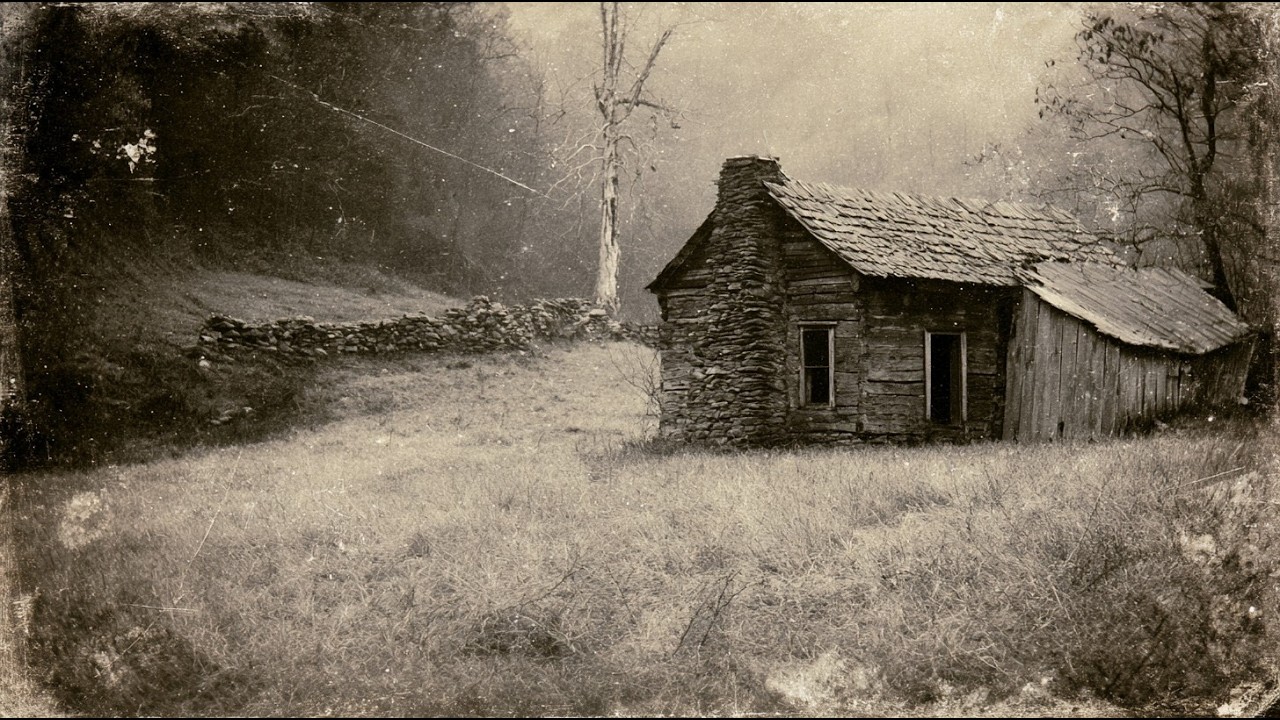
The Harlan cabin stood at the head of the hollow with the fields falling away below it and the dark timber rising behind. It was, on the face of it, just a house: a good square chestnut log house, the chinking mostly sound, the shake roof greened over but holding, a stone chimney, a smokehouse, and a barn gone gray and leaning. Three years empty and it looked it. The dooryard grown up in broom sedge, a shutter hanging.
An ordinary abandoned mountain farm. He had surveyed a dozen. But the light was wrong. That was all he could ever say about it, and he was a precise man, so it galled him that he could not say it better.
The sun was going down behind the western ridge, and the whole rest of the hollow was lit up gold and red with it, the dying leaves on fire. The Harlan house in the upper field above it sat in a kind of flat grayness, as if the light came up to a line and did not cross it. As if something there drank it. He blinked and looked again, and it was just shadow, just the shoulder of the ridge throwing shade early.
Of course it was. But he had marked it, and a thing you have marked you cannot unmark. And it was quiet. He had thought it was quiet down at Asa Crowder’s.
Up here the quiet had weight. He could hear Crow Branch behind and below him, faint, and standing in the dooryard with his mule blowing beside him, he found he was glad of the creek the way you are glad of a single candle. And that gladness frightened him more than the quiet did. He did not sleep in the house.
He told himself it was only sense: an empty house, the chimney maybe unsound, why risk it? He made his camp in the lee of the barn with a good fire and the mule close, and he ate his supper looking at the dark bulk of the cabin against the last green of the sky. And he did the thing a man does to make a fear small: he made plans. He would lay out his baseline in the morning along the bottom of the lower field.
He would run his traverse up the east boundary the day after. He would save the upper field and the troublesome corner for last, when he knew the ground. Three days’ work, maybe four. He would be home inside the week with a clean survey and a story to make Pruitt blush.
The first night nothing happened. He slept hard by his fire and woke stiff and cold and ordinary, and the hollow in the gray morning was just a hollow, beautiful and dead-leaved and still. He laughed at himself a little and got to work. The first day’s work went well.
He set his transit and ran his baseline and drove his stakes, and the numbers came clean and behaved. By evening he had laid out the whole lower field and started up the east line, and he was a happy man in the small flat way that work makes a man happy. He came down off the slope at dusk, mindful of the old man’s warning without quite admitting he was minding it, and made his fire and slept again. And again, nothing came.
It was the second day that the quiet changed. He was up the east line near the top of it, working alone with his chain in the early afternoon, and he stopped to write a measure in his ledger. And as he stood there with the pencil on the page, he understood that he could no longer hear the creek. He stood very still.
He had grown used to it down low, Crow Branch muttering away to itself, the one live sound in the hollow, and it was gone. Not faded with distance—gone the way a sound goes when a door is shut on it. He turned a slow circle. The whole hollow lay below him gold and red and perfectly silent, not a leaf moving, though he could see far down the tops of the trees by the branch stirring in a wind he could not feel and could not hear.
He watched the trees move in their silence for what felt like a long time. Then, all at once, between one breath and the next, the creek came back. The sound of it just returned, the way your hearing comes back after a great bell stops, and with it came the birds: suddenly a whole hollow full of birdsong, as if it had been dammed up somewhere and let go. And the wind he could now feel on his face.
And Ransom Vane stood on the east line of the Harlan tract with his heart going like a hammer and the pencil broken in his fist where he had shut his hand on it. He told himself it was the wind, a trick of the ridges, a fold of ground that funneled the sound away and brought it back. There are such places. He had worked in them.
He almost believed it. He wrote it in the ledger as a fact about the terrain, neutral, measured—”dead air pocket, e-line”—and the writing of it steadied him. But he came down early that second evening, earlier than he needed, and he did not admit to himself why. On the morning of the third day he finally made himself go into the house.
He had put it off as long as the work allowed, but he needed to check the chimney against his sketch, and there was no honest reason left not to go in. So he went in in the full light of midmorning, and the house was just a house, dim and dusty and cold with the cold of a place no fire has warmed in three years. The table was still set. That stopped him in the doorway: two plates, two cups gone to dust, and the dust undisturbed, the food long since dried to nothing in the bowls.
Obadiah Harlan’s boots still stood by the cold hearth. Sabra Harlan’s shawl was still over the back of her chair, and the moths had been at it, and that was somehow the worst thing in the room—that homely ruin, a shawl waiting three years for shoulders that walked out into the snow and never came back. On the mantel above the hearth, swollen with damp, was a thin leather book: Obadiah Harlan’s almanac and daybook, the kind of thing a farmer keeps, weather and plantings and the price of stock. Vane took it down and turned the pages, and it was just that for years and years, a hard old man’s small economy of days, until he came to the autumn of 1878.
And then the daybook changed. It started ordinary. “Fair,” the entry said. “Worked the upper field.
Sabra poorly. ” Then the entries got shorter and the hand got worse. “Quiet today. No birds.
” Then, a few days later, in a hand pressed so hard it had nearly cut the page: “The smell again in the night. Sabra will not sleep in the loft. ” And then, days apart, the entries Vane read three times to be sure of: “Plowed the upper field. ” And the next morning, two words: “Filled in.
” And again a week on: “Plowed it again. Stood the night to watch. ” And then nothing for that day, a blank, and the day after. In a hand gone almost to scrawl: “It does not want it plowed.
It wants the wall. ” And then the last entry old Obadiah Harlan ever wrote, on a December day in 1878, and Vane read it alone, in the cold, with the dust on the two plates and the shawl on the chair. It said: “Sabra says it is at the door now of a night and means to come in and she is right. I have done a wrong thing.
I have taken what was not mine to take, and now it will take what is not its to take, and I cannot build the wall back fast enough alone. God forgive a proud old fool. If any man reads this, build the wall. ”
That was the last of it.
Below it the page was blank, and then the dust, and then the long silence of three years. Vane stood there a while, and even then, with his skin gone to gooseflesh in that dead cold room, the thing he did was reach for a reasonable shape to put it in. Two old people alone, the sister failing, the brother’s mind going with her, a folly shared between them up in their lonely place, two minds tipping each other over the edge of a winter and out into the snow. It happens.
He had heard of it. A madness two people can have together that neither would have alone. That was a thing he could measure near enough. He put the daybook back on the mantel exactly where it had been, ashamed of how careful he was to set it just so, and went back out into the light to finish his survey.
He had one piece of ground left to measure: the upper field. He should have gone up to it in the morning. He knew that even then. But he had lost the morning to the house and the daybook, and the upper field with its troublesome corner was the longest, slowest piece of the whole job, the one he had saved for last.
The buyer wanted his figures by the end of the month. Frankfort was two days’ ride. And Ransom Vane had spent his whole life believing that a column of numbers finished honest was worth more than an old man’s three warnings. So he went up to the head of the hollow in the early afternoon of that third day, with the light already thinking about going, to measure the ground that four generations of surveyors had refused to put a chain across.
He found the wall, or what was left of it: a long, low scatter of fieldstone running across the top of the field where the cleared ground met the dark stand of timber, just as Asa Crowder had said. He could see where it had stood, the line of it plain in the grass, and the work Obadiah Harlan had done three years and more ago, the gaps where the old man had heaved the stones aside and dragged them down to clear the ground behind. And the ground behind. Vane stood at the line of the fallen wall and looked at the few rods of bottom that ran back to the foot of a great dead white chestnut and a dark seep of spring at its roots.
The ground was smooth, flat, grassed over even and untroubled, the way a thing is even and untroubled that has never in its life been disturbed. There was no sign that a plow had ever opened it. None. Three furrows a hard old man swore he had cut, and the daybook said he had cut them twice.
And the ground lay there in the gray light as smooth and patient as the surface of standing water, as if it had quietly closed back over the wound and forgotten there had ever been a wound at all. And it was quiet there. Of course it was. Vane needed a corner.
The line of the survey, the little Latin word, the trouble in the deed—all of it came down to the simple physical fact that to close his traverse honest, he had to set a monument at the head of the upper field, on the far side of where the wall had stood. And to set a monument, he wanted a base for it, and there at his feet was a wall’s worth of good flat fieldstone lying loose in the grass. So he took up a stone from the fallen wall and carried it a few rods onto the far ground and set it for his corner. And he set his transit over it and turned his angle and wrote the measure in his ledger.
And the moment he lifted that stone and carried it across the line of the old wall, the creek stopped. He noticed it at once this time; he had been schooled in it two days running, and his body knew it now the way it knows a held breath. The creek gone, and after it the wind, and after the wind the last of the birds, until there was nothing in all the hollow but the scratch of his own pencil, which sounded in that hush as loud as a saw. And it was getting dark faster than it should.
He looked at the western ridge, and the sun was still a hand above it. But the light down in the head of the field was draining away as if poured out of a tipped bowl, the same flat grayness he had seen the first evening, the light coming up to a line and not crossing it. And the line was the line of the old wall. And he was standing on the wrong side of it.
He did not run. He had learned a long time ago, in the worst place he ever was, that the thing that gets a man killed is the running, the breaking, the body deciding for the mind. So he stood there in the failing gray with his heart going, and he made himself think, made himself measure. The far ground was smooth because it would not be opened.
The footsteps had walked over the Harlans because they had taken what was behind the wall. It does not want it plowed. It wants the wall. And the last words of the old fool in the cold: I cannot build the wall back fast enough alone.
And Vane understood, standing there, the thing the deed had been trying to tell him in a language he could not read, and the clerk had told him in a language he would not hear, and the old man down the branch had told him plainly to his face. The ground at the head of the field was not the Harlans’ to take, and it was not his to measure. It was left. And the wall was not a fence to keep something penned.
The wall was a debt kept paid by the keeping: a line a hundred generations of hands had agreed to honor, and Obadiah Harlan had stopped paying it. And the interest had come due. And now Ransom Vane had taken a stone off the unpaid debt to set a corner on ground that had never once, in the memory of the world, allowed itself to be measured. He looked up from the smooth ground to the line of the timber, to the foot of the great dead chestnut over the cold spring.
And the timber was no longer empty. There was a darkness in among the trees at the head of the field, past where the wall had stood. A standing darkness, the shape of the dark between two close trunks, except that there were no two trunks there. And it was attending to him.
That was the word he wrote in the ledger later. Not watching. Attending, the way you attend to a sum you are working. He could not have said it had a face, because he never once let his eyes rest on the place it was, having learned at the creek in Maryland that there are things a man’s looking calls closer.
But he knew, in the cold animal back of him, that it had been counting. That it had counted the stones of the wall every night for three years and found them every night one short. And that tonight, for the first time since the snow took the Harlans, a living man had come and taken another. And it was nearer than the timber now.
He had not seen it move. It was simply nearer, at the line where the wall had stood, the way the dark in a room is nearer when you look back at it. And the light was almost gone. He built the wall.
He put down his ledger and his transit—the two holiest things he owned, the brass and the figures, his whole religion of measure—in the dead grass. And he turned his back on the standing dark at the head of the field, which is a thing it takes more courage to do than to face it. He picked up the stone he had carried out for his corner and carried it back across the line and set it where it had been in the fallen wall. Then the next stone, and the next.
In the dark now, the full dark, on his knees in the cold grass with the thing at his back coming no nearer while he worked and no farther. He built the wall back stone on stone the way it had stood, fitting them by feel, by the cold rough shape of them in his bleeding hands, because his hands were bleeding before long. The stone took the skin off them and he did not stop. He could hear it behind him then.
Not footsteps. A sound like cold earth settling, like a grave taking its weight, patient and very close and growing no closer only so long as another stone went up. So he kept the stones going up faster and faster, sobbing for breath in the silence with the creek gone and the wind gone and the whole world narrowed to the next cold stone and the next, and the awful arithmetic of it: that as long as he was paying the debt down, it would let him pay, and the moment he stopped, it would collect. He did not know how long.
Hours, maybe. The wall was long, and he built the whole of it back in the dark by feel, with the thing settling and waiting at his shoulder, and the last stretch of it he built weeping like a child—a forty-nine-year-old man who had stood at the creek in Maryland, who had not wept in nineteen years. He set the last stone into the last gap at the western end of the wall, where it ran up against the rock. And the creek came back.
Just like that. Between one breath and the next, the sound of Crow Branch came up out of the dark below him, and then the wind, cold and clean and moving the dead leaves, and far down the hollow a single bird. And Ransom Vane knelt at the foot of the wall he had built in the dark with his ruined hands and listened to the water and understood that he was alone. The thing was gone, back behind the wall, behind the paid debt, to count its stones and find them for the first time in three years whole.
He did not sleep at the homestead that night. He went down off the field in the full dark, found his mule by the barn, and rode out of the Sorrels by feel and starlight, down the bad road he had come up, and he did not stop or look back until the gray of morning found him standing in Asa Crowder’s dooryard, white as the dead chestnut, his hands wrapped in strips of his own shirt, and his ledger and his transit left behind him in the dead grass at the head of the Harlan field, where, so far as anyone knows, they lie yet. Asa Crowder took one look at him and did not ask a single question. He brought him in and saw to his hands and gave him something hot and sat with him by the fire while the light came up.
The only thing he said, after a long while, was, “Did you build it back? ”
Vane said, “I built it back. ”
The old man nodded and said, “Then you done better than the last one. ”
They never spoke of it again.
Vane went back to Frankfort and was a long time mending, and not only his hands. He filed his survey for the land company down in Louisville, and it was the strangest survey he ever turned in: clean and careful and honest in every line but one, because where it came to the upper field at the head of the hollow, the line ran up the slope and there was a notation this time in plain English, in Vane’s own steady hand. It said: “Upper field unfit. Do not clear.
Do not survey across the head. Boundary closed at the existing stone wall which is to be maintained. ” He set the corner at the wall and not beyond it, the way every surveyor for eighty years had done before him. And when the land company wrote back wanting to know what unfit meant, and why a four-hundred-acre tract should be priced as if it were three hundred ninety, Ransom Vane wrote them one line in reply and never another: “Because some ground is not for sale, and the people who knew that built a wall, and the man who pulled it down is not here to be asked.
”
The tract never sold. It is likely sitting there yet, the deed passed from one company’s books to another’s, the Harlan cabin falling in on its set table by inches, the shawl gone now surely to nothing, the upper field smooth and grassed and patient under the dead white chestnut. And the wall, they say, standing across the head of it. But here is the thing Asa Crowder told a man years later, the thing to leave you with.
He said he went up to the Harlan place one time after—just the once, in the broad noon of a summer day—to see for himself the wall the measuring man had built in the dark. And he said it was a good wall, a fine wall, set true by a man who could not see his work, and it ran whole and unbroken across the whole head of the field, but for one thing. There was one stone missing. One gap at the western end against the rock, where Ransom Vane swore, on the daybook of his own memory, that he had set the very last stone with his own bleeding hands.
One stone short. And Asa Crowder, being the last fence and knowing his duty, found a stone the right size and set it into the gap himself, and went home. And the next spring he went up again. And the wall stood whole across the head of the field, but for one stone: one gap at the western end against the rock, as if something behind it, every night in the dark, counts the stones and finds them every night one short.
And waits for the man patient enough, or proud enough, or simply tired enough at the end of a long day’s measuring, to come and take the last one. Ransom Vane lived to be an old man, and he was a careful one to the end. But he was never again the man who had ridden up the Sorrels, sure that a thing measured is a thing made small. He kept a lamp burning by his bed every night of his life.
And his people said that sometimes in the small hours, around three in the morning, he would wake all at once in the dark with his ruined old hands working at the air, fitting stone on stone that was not there. And if you came in to him then and asked him what was wrong, he would look at you a moment like he did not know the room, and he would say, very quiet, the same thing every time: “It’s one short. It’s always one short. Somebody has to keep the wall.
” Then he would let you light the lamp, and he would lie back down. But he never closed his eyes again till morning. And he never once, in all his careful years, let anyone tell him where to set a corner.
