The woman climbed the stairs of the three-story brick house on a Boston West End block, past the smell of pot roast drifting up from the kitchen, and opened the door to a modest room. A small bed, a washbasin, a desk, a window facing the street. For roughly three dollars a week, it was home. The rent covered breakfast, dinner, laundry, and a landlady who treated her lodgers like wayward stepsons.
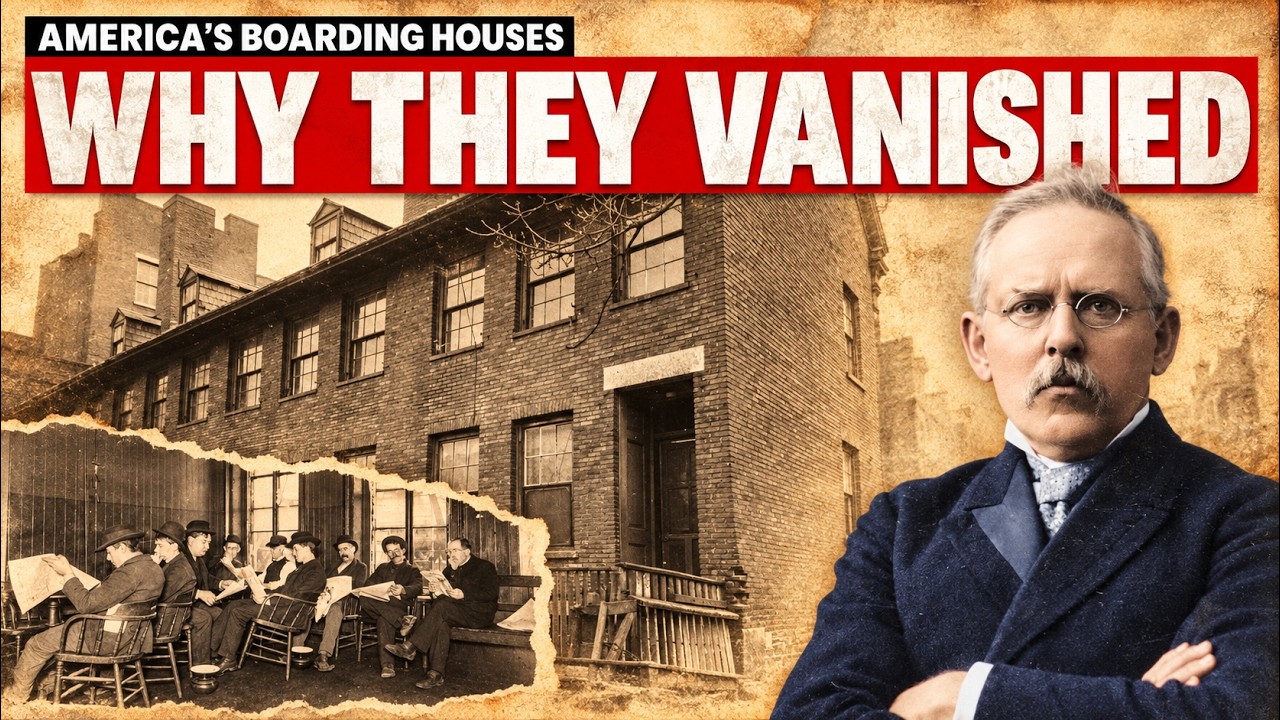
Every evening she sat down to eat with twelve strangers who would, over months and years, become something close to family. At this moment in American history, that woman was not an exception. She was the rule. Somewhere between a third and half of every urban resident in the United States either lived in a boarding house or ran one.
The historian Wendy Gamber, whose book The Boarding House in 19th Century America remains the definitive study of this vanished world, has documented the numbers. In Boston in the 1830s, when landlords, lodgers, and everyone sharing a roof under the system were counted, between a third and half of the city’s entire population lived in a boarding house. By 1860 Boston alone had 583 licensed boarding establishments, concentrated in the West End and the South End. In Philadelphia, roughly one in four houses took in boarders.
In New York, boarding houses accounted for a staggering share of all available housing stock between the mid-nineteenth and mid-twentieth centuries. This was not a fringe arrangement. It was not a desperation move. For the better part of a hundred years, it was the dominant way a working person in America found a place to sleep.
And then it vanished. Not slowly, not gently, and not because the market decided boarding houses were obsolete. The entire category of cheap, dignified, flexible, shared urban housing was systematically dismantled by zoning laws, building codes, tax policy, federal subsidies, and cultural pressure, all stacked together over the course of about seventy years. By the time the dust settled, roughly one million single-room occupancy units had been eliminated from American cities.
The housing ladder had its bottom rungs sawed off. The consequences of that erasure are still rippling through every expensive, overcrowded, housing-starved American metropolis today. This is the story of the cheap boarding house, what it was, why it worked, and why the people in power spent decades making sure it would never come back. To understand what was lost, it is necessary to understand what boarding houses actually were, because the modern imagination tends to picture something like a tenement slum or a creaky horror-movie manor.
The reality was far more varied. In the mid-nineteenth century, boarding houses existed on every rung of the economic ladder. There were respectable middle-class establishments where young clerks and bookkeepers in starched collars took their meals alongside widowed matrons. There were elegant houses that catered to visiting lawyers and merchants, where the dining room boasted silver and the parlor had a piano.
There were working-class houses where Irish longshoremen or German brewers crammed four to a room and ate stew by lantern light. There were houses for actors, for sailors, for vegetarians, for medical students, for marriageable young women, for Chinese laborers, for Jewish immigrants, for black workers in the segregated North. There were even, according to one 1857 guidebook by the English humorist Thomas Butler Gunn, boarding houses where you were expected to flirt with the landlady. In New York in 1869, the cost of living in a boarding house ranged from $2.
50 a week on the low end to $40 a week on the high end. There was something for everyone because almost everyone used them. The structure was simple and ingenious. A proprietor, usually a woman, usually a widow, usually running the operation out of a converted single-family home, rented out individual rooms to tenants.
In exchange for a weekly fee, boarders received a private sleeping space, access to shared bathrooms, two meals a day served family style in a common dining room, and often laundry, cleaning, and a watchful eye on the comings and goings of residents. Lodging houses, a slightly different variant, provided only the room without meals. Rooming houses, which emerged later, were more impersonal and transient. All of these forms coexisted and overlapped.
Together they formed what housing scholars now describe as a complete ecosystem of affordable urban living, a layered market where a newcomer with almost nothing could still find a dignified place to sleep, and a working person could save up over time toward something more permanent. Why did this work so well? Because it matched the actual shape of urban life. Nineteenth-century America was in the middle of an explosion.
The population of the United States quadrupled over the course of the century. Immigrants poured off ships in New York and Boston at a rate that strained every existing social structure. The Industrial Revolution yanked young men and women out of the countryside and dropped them into cities where they knew no one. They needed somewhere to live immediately, affordably, and without a long-term commitment.
Most of them had no savings, no credit, no family nearby, and no interest in signing a year-long lease on an empty apartment they could not afford to furnish. The boarding house solved all of that in one stroke. You showed up, you paid a week’s rent, you got a bed and dinner that night. If you lost your job, you moved out the next week.
If you got a better job, you moved up to a nicer house across town. Flexibility was the point. Affordability was the point. Community was the point.
And the women running these houses were not peripheral figures. They were, in many cases, the first large wave of female entrepreneurs in American urban history. Boarding housekeeping was, as Wendy Gamber put it, women’s work. Landladies, not their husbands, met prospective tenants, collected rent, enforced house rules, planned menus, hired servants if they could afford them, and presided over the dinner table every single night.
In an era when a woman could not vote, could rarely own property outright in her own name in many states, and had almost no respectable path to earning real money, running a boarding house was one of the only ways a widow or single woman could support herself and her children without becoming a domestic servant or a mill worker. One study of nineteenth-century New York State found that women who kept boarders earned between eighteen and twenty-three dollars per boarder annually, which was often enough to pay the rent on the entire house with margin to spare. In Barre, Vermont, in the late nineteenth century, a huge share of working women earned their income from taking in boarders. This was quiet, informal, enormously important economic power.
And every single one of those women lost that income stream when boarding houses were later legislated out of existence. There was another form of cheap housing that often gets confused with boarding houses but was actually distinct: the single-room occupancy hotel, usually shortened to SRO. Where boarding houses typically operated in converted private homes with meals included, SROs were purpose-built or converted hotels, apartment buildings, and commercial structures where a tenant rented one small room, usually without a private kitchen or bathroom, with communal facilities down the hall. SROs emerged in significant numbers in the late nineteenth century and became the dominant form of cheap single adult housing by the early twentieth century.
By 1950, SROs made up roughly ten percent of all rental housing in some major American cities. New York City alone had more than 200,000 SRO units at that peak. San Francisco, according to the historian Paul Groth, whose book Living Downtown remains the definitive study of residential hotels, may have had as many as 90,000 SRO rooms at the start of the 1930s. These were not fringe accommodations.
For millions of Americans, especially single working men, single working women, elderly people on fixed incomes, recent immigrants, seasonal laborers, and anyone whose life did not fit the suburban, married-with-children template, the SRO hotel and the boarding house were the main housing market. They were the floor. They were the entry point. They were the safety net.
So what happened? Why did the entire ecosystem come apart? The answer unfolds in several overlapping waves, and understanding them is crucial because the same forces that killed cheap urban housing in America are still shaping and distorting the housing market right now. The first wave began in the 1880s, carried along by what historians call the Progressive Era Urban Reform Movement.
Reformers in cities like New York, Boston, Philadelphia, and Chicago looked at the overcrowded tenements, the saloons, the disease outbreaks, and the general chaos of fast-growing industrial cities, and they decided that the solution was moral and architectural uniformity. The ideal, as laid out in the writings of men like Lawrence Veiller, the influential New York housing reformer who essentially wrote the template for modern American zoning, was the detached single-family home occupied by a nuclear family. Everything else, in Veiller’s words, had a very bad effect on American life. Multi-family dwellings were suspect.
Shared housing was suspect. Any arrangement where unrelated adults ate at the same table or shared a bathroom was suspect. The culture of the boarding house, with its unmarried men and women living under the same roof, its women earning independent income, its communal meals, its mixing of social classes, its visible immigrants, all of it was reframed by reformers as a social and moral problem to be solved. The 1905 book The Lodging House Problem in Boston by Albert Benedict Wolfe set the tone.
Wolfe lumped boarding and rooming houses together and called them a grave and far-reaching social problem. In 1902, Robert A. Woods, writing in Americans in Progress, declared that the first enemy of the home life of the Boston West End was not foreign immigration but the growth of urban trade that brought all these shared living arrangements. Reformers argued that boarding houses weakened the family, encouraged promiscuity, enabled vice, bred disease, and produced the wrong kind of citizen.
One mid-nineteenth-century New York critic sneered that it may be safely affirmed that there are not ten boarding houses in the city which do not contain improper characters. The language was moralistic, but the underlying anxiety was about class, about immigration, about race, and about the growing economic independence of women. The home ideal was invoked constantly. The boarding house was its foil.
But moral disapproval alone could not kill a form of housing that genuinely served the needs of millions of people. For that, you needed law. And starting in the 1910s, the reformers found exactly the tool they needed: zoning. Zoning, the division of a city into districts where only certain uses are permitted, is such a familiar feature of modern life that it is easy to forget it is a relatively recent invention.
The first comprehensive American zoning code was enacted in New York City in 1916. By the mid-1920s, with the publication of the Standard State Zoning Enabling Act, which was literally drafted with Lawrence Veiller’s involvement, cities across the country were rushing to adopt their own zoning laws. And these laws, almost universally, were written to protect single-family residential districts from everything the reformers disliked, including boarding houses, lodging houses, SRO hotels, apartment buildings, duplexes, corner stores, and commercial activity. The pattern that emerged was ruthless in its uniformity.
Vast swaths of American cities, and then almost all of their suburbs, were designated as single-family-only zones. In these zones, you could not legally build a boarding house. You could not operate a rooming house. You could not run an SRO.
You could not even subdivide an existing large home to take in paying tenants without violating zoning. In many cases, even informal arrangements, like letting a cousin or a lodger live in a spare room, were technically illegal and could trigger enforcement if neighbors complained. Writing in the authoritative housing history that has shaped scholarly consensus on this period, researchers described the Progressive Era reformers using codes and zoning to enforce uniform and protected single-use residential districts of private houses, which was explicitly the reformers’ preferred housing type. By the early 1930s, this consensus was institutional policy.
The legal infrastructure for killing boarding houses was built, piece by piece, and locked into American city planning for the next century. Then came the second wave, and this one came from the federal government. In 1934, in the depths of the Great Depression, the Roosevelt administration created the Federal Housing Administration, usually called the FHA. The stated purpose was to revive the devastated construction industry and to make home ownership accessible to middle-class families by insuring long-term mortgages against default.
The actual effect was to pour an avalanche of federal subsidy over the next three decades into one very specific type of housing: the detached single-family home in a newly built suburb. Between 1934 and 1962, the FHA and the Veterans Administration together financed more than $120 billion worth of new housing. By 1972, the FHA had helped roughly 11 million American families purchase a home. Before the FHA and the VA began subsidizing suburban housing, roughly 45 percent of American housing units were owner-occupied.
By the end of the post-war boom, that number had climbed well above 60 percent. But the FHA did not insure mortgages for just any kind of housing. Its underwriting guidelines strongly preferred single-family detached houses in newly built suburban developments and strongly disfavored multi-family buildings, older urban structures, and anything in a racially diverse neighborhood. The FHA’s underwriting manuals famously institutionalized redlining, the refusal to insure mortgages in predominantly black neighborhoods, with the result that only around two percent of the $120 billion federally backed post-war housing went to non-white families.
In St. Louis, researchers found that five times as much FHA mortgage aid flowed into the city’s suburbs as into the city itself, even though the city still had more single-family homes available. The federal government, in effect, placed its enormous financial thumb on the scale in favor of exactly the type of housing that zoning had already designated as the only acceptable kind, and against exactly the type of housing where boarding houses, SROs, and other shared arrangements lived. The combined effect was devastating.
If you were a landlord or an entrepreneur in 1950, you could not easily build a boarding house because zoning forbade it. You could not easily get a federally insured mortgage to construct multi-family housing. And the post-war middle class you would have rented to was being actively lured out of the city by Levittown-style developments where you could buy a brand-new three-bedroom house with a yard for a down payment of just a few hundred dollars. In 1947, the first Levittown opened on Long Island with mass-produced houses sold at a scale and price that had never existed before.
The young workers and veterans who in a previous generation would have rented a room in a West End boarding house were now being handed the keys to their own front door, backed by federal subsidy. Boarding house proprietors watched their most desirable tenants vanish. By the 1950s, the women who had run boarding houses for decades were increasingly getting out of the business, in part because the respectable single men and women who had been their core clientele were now homeowners, and in part because the operation was becoming economically marginal. And this is when the third wave hit.
In the mid-1950s, as the suburban boom was reshaping where middle-class Americans lived, policy makers turned their attention to what remained of urban boarding houses and SRO hotels, and they decided to finish them off. In 1954, New York City’s housing maintenance code was amended to effectively prohibit any new privately built SRO construction. In 1955, the city formally banned the creation of new SRO units, period. That same year, the city launched a tax abatement program called J51, which created direct financial incentives for landlords to convert existing SRO buildings into market-rate commercial hotels or office space.
The economic calculation for owners became obvious. The city was paying you to get rid of your low-income tenants and turn their rooms into something else. According to the Coalition for the Homeless, by the time the city tried to put the brakes on this process in the mid-1980s, more than 100,000 SRO units had already been lost to this policy regime in New York alone. Since 1955, roughly 175,000 SRO units have been eliminated from New York City.
The city went from having about 200,000 SROs in 1950 to around 19,000 residential SRO rooms by the early twenty-first century. Other cities followed the same arc, often more aggressively. In Chicago, 81 percent of the SRO housing stock disappeared between 1960 and 1980. Between 1973 and 1984, Chicago lost more than 23,000 SRO units.
In San Francisco, where the redevelopment agency under Justin Herman was aggressively clearing low-income neighborhoods, studies estimate that 40,000 residential hotel rooms were destroyed by urban renewal programs, including more than 6,000 in just a five-year stretch. Herman is remembered for his notorious declaration that this land is too valuable to permit poor people to park on it. Between 1975 and 1980 alone, San Francisco lost 6,085 SRO rooms. In Seattle, half of the downtown SRO stock, 16,200 units, was demolished between 1960 and 1973, with a catastrophic fire at the five-story Ozark Hotel in March 1970 providing the political pretext for a wave of demolitions.
Minneapolis bulldozed its entire Gateway District, which had been the city’s main SRO neighborhood, in what was literally the nation’s first federally funded urban renewal project, launched in 1959. In Boston, SRO stock dropped from 35,000 units in the early 1950s to just 9,500 by 1968. In Brookline, Massachusetts, the number of licensed SRO houses collapsed from 282 in 1945 to 31 in 1990. The pattern, repeated city after city, was so consistent that the cumulative statistics are almost impossible to look at without flinching.
Between 1955 and 2013, researchers estimate that nearly one million SRO units were eliminated nationwide through regulation, conversion, or demolition. In the decade following 1973 alone, 4. 5 million housing units were removed from the American housing stock, roughly half of which had been occupied by low-income households. And this was not an accident.
This was not the invisible hand of the market reorganizing itself. This was the result of specific policies pursued by specific politicians and reformers with specific goals. The urban renewal programs of the 1950s and 1960s, backed by billions in federal dollars through the Housing Act of 1949 and its successors, explicitly targeted what planners called skid rows and blighted neighborhoods, which in most cases meant exactly the areas where SRO hotels, flop houses, and cheap lodging houses were concentrated. The buildings were condemned, the residents were scattered, and the land was handed over to private developers for convention centers, luxury hotels, office towers, and high-end residential projects.
The result, decade by decade, was the slow erasure of an entire layer of American urban life. Think about what disappeared when a neighborhood like the Bowery in Manhattan, Scollay Square in Boston, the South of Market in San Francisco, the Gateway in Minneapolis, or Chicago’s Skid Row was cleared. These were not pleasant places in the sanitized post-war sense, but they were functioning communities. They had cheap single rooms starting at ten cents a night in flop houses like the Sunshine Hotel on the Bowery, which opened in 1922 and could accommodate 125 residents.
They had cheap diners and automats where you could get a hot meal for a quarter. They had informal labor markets where a man without a permanent address could still find a day’s work loading trucks or washing dishes. They had bars, missions, pawn shops, barbers, and the small ecosystem of institutions that let people living on the margins hold on to some version of normal life. When urban renewal demolished these neighborhoods, it did not just destroy buildings.
It erased the social infrastructure that had kept hundreds of thousands of marginal Americans housed, fed, and connected to work. And then came the bill. In the 1980s, with the SRO stock gutted, zoning laws making it illegal to build cheap new shared housing almost anywhere, federal housing subsidies cut by the Reagan administration to roughly a tenth of their late-1970s level, and the simultaneous deinstitutionalization of psychiatric hospitals that pushed thousands of mentally ill Americans into communities that had nothing left to catch them, modern mass homelessness erupted onto American streets. According to the social scientist Christopher Jencks, whose careful statistical work on this period remains among the most rigorous, the homeless population grew from a little over 100,000 in 1980 to around 200,000 in 1984, to roughly 400,000 by 1987 and 1988.
In the 1970s, there had actually been more rooms in flop houses than people who needed to rent them. By the early 1980s, the demand for cheap single rooms during the recession exceeded the dramatically shrunken supply, and the people who could not get in ended up on the sidewalks. Dennis Culhane, a professor of social policy at the University of Pennsylvania who has spent his career studying homelessness, has pointed directly at this chain of causation. Many people attribute the growth of street homelessness in the eighties to the loss of the SRO stock that began in the sixties.
The Pew Charitable Trusts, in a 2025 analysis, put it in blunt institutional language: as the nation’s least expensive source of housing disappeared, homelessness soared in major cities across the United States. Had the country’s stock of SRO housing merely grown in line with other types of housing, researchers suggest, the entire shape of American urban poverty would look different today. One New York housing advocate memorably summarized the loss. The people you see sleeping under bridges used to be valued members of the housing market.
They aren’t anymore. Here is where the story becomes something more than historical. The forces that destroyed the boarding house did not stop in 1990. They are still shaping American cities right now, which is why rents in New York, San Francisco, Los Angeles, Boston, Seattle, Austin, Denver, and dozens of other metros are at levels that would have been unthinkable a generation ago.
Why a growing share of young Americans cannot afford to leave their parents’ homes. Why the number of unhoused Americans has climbed to record levels. And why the gap between the housing we have and the housing we need keeps widening. Most of the land in most American cities is still legally restricted to single-family housing.
In many metropolitan areas, more than 70 percent of residential land is zoned exclusively for detached homes on individual lots, which means that building anything denser, cheaper, or more communal is literally illegal across the vast majority of residentially zoned terrain. The lowest rungs of the housing ladder have simply been removed by law. Who won from all of this? That is the question that makes the whole story read less like a tragedy of accidental policy and more like a transfer of wealth.
Suburban homeowners won enormously, because the single-family zoning that strangled urban affordability also protected the market value of their houses by restricting supply. Developers of high-end housing won, because the land that had been occupied by SROs and boarding houses in prime downtown locations was handed to them, often at bargain prices, through urban renewal. Big banks and mortgage insurers won, because the federal subsidy pipeline for suburban home loans turned residential real estate into one of the most profitable sectors in the American economy. Local governments won in the short term, because converting cheap SRO buildings into luxury apartments or boutique hotels generated far more property tax revenue per square foot.
The institutional and professional classes won, because they got the kind of city they preferred: cleaner, more orderly, less visibly poor, more legible to the real estate industry’s business plan. Who lost? Single working people lost their most affordable housing option. Immigrants lost the dignified entry point that had let generations of newcomers establish themselves in American cities.
Women lost one of the few paths to independent urban income that did not require a husband or a factory boss. Elderly people on fixed incomes lost the ability to live independently in cities as they aged. The mentally ill lost the loose decentralized network of SROs that had absorbed them when state hospitals closed. Low-wage urban workers lost the possibility of walking to work from a cheap room near downtown.
And eventually, inevitably, hundreds of thousands of people lost housing of any kind and ended up on the streets where they remain. There is, finally, a slow but real reckoning underway. A handful of American states and cities have started to notice that the housing crisis they are now trying to solve was created in large part by the policies they themselves put in place over the past one hundred years. In 2024, the state of Washington passed a law requiring cities and counties to permit single-room occupancy or co-living housing in areas zoned for multi-family use.
The Institute for Justice, a national nonprofit law firm, has drafted model legislation called the Room Act that would reduce zoning and building code barriers to low-cost shared housing, and has begun lobbying states to adopt it. Philadelphia, under former Department of Licenses and Inspections head Dave Perry, has pushed to legalize single-room residences across the city, with the modest limitation that they not cluster within five hundred feet of each other in single-family neighborhoods. Boston is studying whether a return of SROs could help address its own housing crunch. A nonprofit in Los Angeles called SRO Housing Corporation has created dwellings for more than 2,000 formerly homeless people in what used to be condemned residential hotels.
In cities like Portland, Oregon, actual working SROs like the Broadway Hotel still operate, offering a glimpse of what the entire country used to look like. But reversing a century of policy is slow and politically brutal. Every attempt to legalize cheap shared housing in a residential neighborhood runs into fierce opposition from existing homeowners who use the exact same language the progressive reformers used in the 1890s: that these are the wrong kind of residents, that property values will fall, that the character of the neighborhood will change, that the family-oriented ideal of American life is under threat. The fingerprints of Lawrence Veiller and the Standard State Zoning Enabling Act are still visible on every planning commission meeting where a modest proposal to legalize a few duplexes or a small boarding house gets voted down by three votes to two.
The infrastructure of exclusion is still in place. The ladder is still broken. So, the next time you walk through an American city and wonder why rents are so punishing, why there are so many people sleeping on sidewalks, why young workers cannot afford to move to the cities where the jobs are, why single-income households and single-earner retirees are being priced out of neighborhoods their grandparents lived in, remember the vanished world of the boarding house. Remember Mrs.
Haskell in Boston running her modest establishment on the West End. Remember the three-dollar-a-week rooms in Philadelphia. Remember the Sunshine Hotel on the Bowery. Remember the 200,000 SROs that New York had in 1950 and the 19,000 it has today.
Remember the one million SRO units that disappeared nationwide in the span of a few decades. This was not inevitable. This was not natural market evolution. This was a choice made by legislators, reformers, and city planners over the course of a century to prohibit the kind of housing that millions of ordinary Americans used to live in.
The cost of that choice is still being paid every month in rent checks, in evictions, in tent encampments, and in the quiet mathematics of a working person realizing they cannot afford the city they work in. The lesson is uncomfortable because it cuts against a lot of comfortable assumptions. Markets do not freely produce the housing we need. The housing stock of an American city is the product of a hundred years of specific legal and financial decisions, most of which were made with other goals in mind, and most of which have never been seriously revisited.
The things we treat as natural features of the urban landscape, like the fact that most residential land is reserved for single-family homes, like the fact that unrelated adults cannot easily share a building without triggering code enforcement, like the fact that the cheapest form of housing available in a major city costs ten times what it would have cost a working person in 1920, are not natural at all. They were built, legislated, enforced, and defended. Which means, at least in theory, they can also be unbuilt. Whether that happens in time to prevent another generation of unnecessary homelessness and housing insecurity is the open question of our moment.
The quiet revolutions in Washington state, in Minneapolis, in Portland, in a handful of other cities that have begun loosening single-family zoning, suggest that change is possible. The ferocity of the opposition in most of the country suggests how long and ugly the fight will be. The vanished boarding houses of nineteenth-century America are, in that sense, not just a lost chapter of history. They are a reminder that we once had a working model for cheap urban living, that it served millions of people for over a hundred years, and that we destroyed it on purpose.
The question of whether we can build something like it again in a form that fits twenty-first-century lives is now one of the most consequential questions facing American cities.
