On March 19th, 1943, a man in a fedora and overcoat walked along the railroad tracks in North Riverside, Illinois. He reached into his coat, pulled out a . 32 caliber Colt revolver, and fired three shots into his own head. When police identified the body, Chicago went silent.
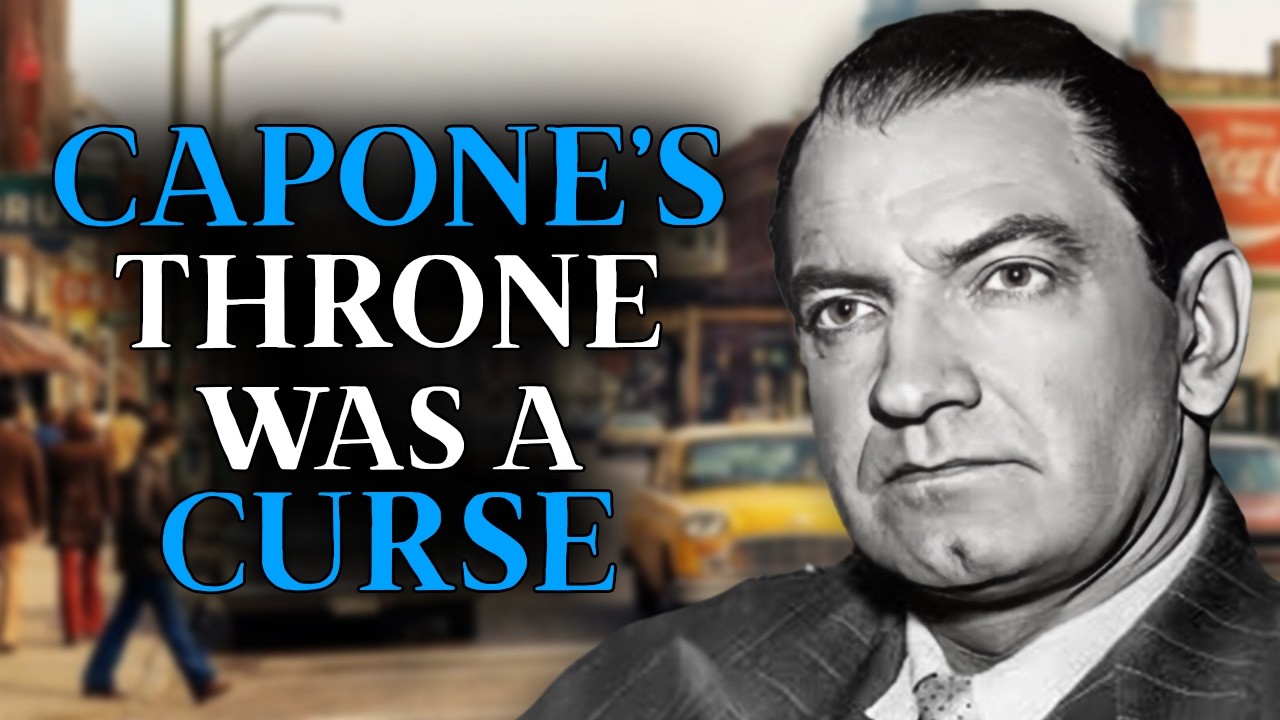
Frank Nitti, the most powerful mob boss in America, the man who inherited Al Capone’s empire, had killed himself. But why would someone at the peak of power choose death over everything he’d built? The Illinois Central Railroad tracks ran through North Riverside like a scar through the western suburbs of Chicago. On that Friday afternoon in March 1943, they were quiet, empty, except for one man walking alone.
Frank Nitti had eaten lunch at home with his wife Anna. He told her he needed to take a walk, needed to think. She watched him leave their house on Selburn Avenue, wearing his best suit under a dark overcoat, his fedora pulled low. She didn’t know it would be the last time she’d see him alive.
Nitti walked nearly a mile to the railroad tracks. He stood there for a moment, looking down the rails that stretched toward the city where he’d built an empire. Then he reached into his coat and pulled out a . 32 caliber Colt revolver.
The first shot grazed his head. The second shot entered his skull but didn’t kill him. The third shot, fired as he fell, struck him in the neck. Frank Nitti collapsed onto the tracks and bled out in the cold March afternoon.
A railroad worker found him around 3:00. At first, he thought it was just another drunk who’d wandered onto the tracks. Then he saw the blood, saw the gun, saw the expensive suit. He ran to call the police.
When North Riverside police arrived, they searched the body. In Nitti’s pocket they found a note. It was brief, matter of fact, the kind of note an accountant might write. It didn’t explain everything.
It didn’t have to. Frank Nitti knew what was coming for him, and he’d made his choice. By 5:00, the news was everywhere. Radio stations interrupted programming.
Newspaper extras hit the streets. Frank Nitti, Al Capone’s right-hand man, the boss of the Chicago Outfit, was dead by his own hand. Chicago, a city that had seen thousands of mob murders, couldn’t quite believe it. Mobsters didn’t kill themselves.
They killed each other. They went to prison. They went down fighting. But Frank Nitti wasn’t like other mobsters.
And to understand why he pulled that trigger, you have to go back to the beginning. Back to a boy from Sicily who came to America with nothing and rose to the top of the most powerful criminal organization in the country. Francesco Raffaele Nitto was born on January 27th, 1886 in Angri, a small town in southern Italy near Sarno. His family was poor, desperately poor, the kind of poverty that makes people cross oceans hoping for something better.
When Francesco was still a child, his father, Luigi Nitto, brought the family to America. They settled in Brooklyn in the Navy Yard section, where Italian immigrants crowded into tenements and worked brutal hours for pennies. Francesco’s mother died when he was young. His father remarried, but the family never escaped poverty.
Francesco, who would soon be called Frank, grew up in the streets. Brooklyn in the 1890s was a training ground for criminals. You learned to fight. You learned to steal.
You learned that the law protected the rich and hunted the poor. Frank learned all of it. By his early 20s, Frank Nitto had moved to Chicago. The reason isn’t entirely clear.
Some say he followed family. Others say he was running from trouble in New York. Either way, by 1913 Frank was in Chicago, and Chicago was about to become the most wide-open city in America. He started small.
He opened a barber shop on South Halsted Street. Legitimate, legal, respectable. But the barber shop was a front. In the back room, Frank fenced stolen goods—jewelry, watches, anything that could be moved quickly for cash.
He had a talent for it, a head for numbers, an understanding of value. In 1917 Frank was arrested for the first time, receiving stolen property. He paid a fine and walked. Two years later, another arrest, another fine.
The police knew who Frank Nitto was. They just didn’t know yet who he would become. In 1919, the 18th Amendment was ratified. Prohibition became the law of the land.
And for men like Frank Nitti, it was the greatest opportunity in American history. Suddenly millions of people wanted something the government said they couldn’t have. Whoever could supply that demand would make a fortune. Frank Nitti was about to meet the man who would change his life forever—a man who saw in Frank exactly what he needed.
A man named Al Capone. By the early 1920s, Chicago was carved up among criminal gangs fighting for control of bootlegging. The biggest gang was run by Johnny Torrio and his rising star, Al Capone. They controlled the South Side, running breweries, speakeasies, brothels, and gambling dens.
They were making millions, but making millions meant managing millions. And that required accountants, enforcers, people who understood both violence and business. Frank Nitti understood both. Exactly how Nitti came into Capone’s orbit is not documented.
Some historians say they met through mutual connections in Brooklyn. Others say Nitti simply proved himself valuable and was recruited. Either way, by the mid-1920s Frank Nitti was working directly for Al Capone. Capone recognized Nitti’s unique skills immediately.
Most enforcers were muscle men who could break legs and intimidate rivals. Nitti could do that. But Nitti could also keep books. He understood profit margins.
He knew how to hide money, how to move it, how to make it look legitimate. Capone put Nitti in charge of enforcement and finances. It was a combination almost no one else in the Outfit could handle. You had to be smart enough to manage millions in illegal revenue and ruthless enough to kill anyone who threatened that revenue.
The Chicago Outfit structure under Capone was simple. Capone was the boss. Beneath him were underbosses and capos who controlled different rackets and territories. Beneath them were soldiers, the men who did the actual work—running speakeasies, hijacking trucks, collecting protection money.
Nitti operated at the highest level. He reported directly to Capone. When someone needed to be dealt with, Nitti handled it. When money needed to be counted or hidden, Nitti handled that too.
He became indispensable. Capone trusted very few people. His brother Ralph, his cousin Charlie Fischetti, his bodyguard Phil D’Andrea, and Frank Nitti. That trust was worth more than gold in the Outfit.
It meant protection. It meant power. It meant that when Capone spoke, Nitti’s voice carried that authority. By the late 1920s, Frank Nitti was one of the most feared men in Chicago.
Not because he was the strongest or the craziest, but because he was smart, efficient, and utterly loyal to Capone. And in the mob, loyalty was everything. Frank Nitti’s reputation was built on two things: precision and terror. He did not lose his temper.
He did not make mistakes. When Nitti was sent to handle a problem, the problem disappeared. There are stories, some documented and some legend, about Nitti’s methods. One tells of a bootlegger who tried to cut the Outfit out of a deal.
Nitti showed up at the man’s warehouse with two men. They did not yell. They did not threaten. Nitti calmly explained the situation.
The bootlegger refused. Nitti nodded, and his men beat the bootlegger so badly he spent weeks in the hospital. The warehouse burned down that night. The bootlegger never crossed the Outfit again.
Another story involves a rival gang trying to muscle into Capone’s territory. Nitti arranged a meeting to negotiate. The rivals showed up thinking they had leverage. They left in body bags.
The meeting was a setup, and Nitti had planned every detail. What made Nitti different from other enforcers was his approach. He did not enjoy violence the way some mobsters did. He did not kill for fun or reputation.
Violence to Nitti was a tool, a business expense. You used it when necessary, and you used exactly as much as the situation required. No more, no less. This made him more dangerous than the psychopaths.
The psychopaths were unpredictable. Nitti was predictable. Cross the Outfit, and Nitti would come for you. It was mathematical.
It was certain. He also understood money in ways most enforcers did not. Capone was making an estimated $100 million a year from bootlegging. That money had to be hidden, laundered, and distributed.
Nitti oversaw much of that operation. He set up front businesses. He moved cash through layers of transactions. He made sure the Outfit’s books balanced, even if those books would never see a legitimate auditor.
This combination of violence and finance made Nitti invaluable. Capone had plenty of guys who could shoot straight. He had accountants who could cook the books. He had almost no one who could do both at Nitti’s level.
By 1930, Frank Nitti was Capone’s right hand. When Capone traveled, Nitti ran Chicago. When Capone was in court, Nitti handled the Outfit’s business. He wasn’t the underboss in title, but he was in function.
And then everything changed. October 17th, 1931. Al Capone was convicted of tax evasion in federal court. The government could not get him for bootlegging, for murder, for extortion.
But they got him for not paying taxes on illegal income. It was brilliant and devastating. Capone was sentenced to 11 years in federal prison. In 1932 he was sent to the federal penitentiary in Atlanta.
Later he would be transferred to Alcatraz. Either way, he was gone. The Chicago Outfit suddenly had no boss. In the mob, power vacuums are dangerous.
Ambitious men see opportunity. Rivals sense weakness. The Outfit could have fractured into warring factions. But it did not, because Frank Nitti stepped up.
Nitti was not the underboss. That was technically Paul Ricca, a Sicilian-born mobster who had risen through the ranks. But Ricca was smart. He knew the Outfit needed a leader who could command immediate respect, someone Capone had trusted completely.
Ricca deferred to Nitti. Not everyone was happy. Some of the older capos thought Nitti was too cautious, too focused on business. They missed Capone’s bravado, his willingness to go to war.
But Nitti understood something they did not. The days of flashy mobsters making headlines were over. The government had taken down Capone with accountants and tax law. The Outfit had to adapt.
Nitti consolidated power quietly. He did not throw lavish parties. He did not give interviews to newspapers. He ran the Outfit like a corporation.
Territories were assigned. Rackets were managed. Disputes were settled through mediation, not murder, when possible. This approach worked.
Under Nitti the Outfit remained stable. Profits continued. The bootlegging empire, though Prohibition was ending, transitioned into other rackets—labor unions, gambling, prostitution, extortion. The Outfit diversified, and Nitti managed it all.
But Nitti’s rise to power came with a target on his back. In Chicago, the mayor and the police were always looking for leverage over the mob. And in December 1932 they came for Frank Nitti with guns drawn. December 19th, 1932.
Frank Nitti was in his office in the LaSalle-Wacker Building, one of Chicago’s newest skyscrapers. It was a legitimate office for his legitimate businesses. On paper Frank Nitti was a businessman. In reality he was the boss of the Chicago Outfit.
That morning, two Chicago police detectives, Harry Lang and Harry Miller, along with two Treasury agents, raided Nitti’s office. They had a warrant. They were there to arrest Nitti on tax evasion charges—the same thing that had taken down Capone. What happened next depends on who you believe.
According to Detective Lang, Nitti reached for a gun. Lang fired in self-defense, hitting Nitti in the neck and back. Nitti went down. Lang called an ambulance.
According to Nitti and later testimony from witnesses, there was no gun. Lang walked into the office and shot Nitti in cold blood. It was an assassination attempt ordered by Chicago Mayor Anton Cermak, who wanted to eliminate Nitti and install his own mob allies in power. Nitti survived.
The bullets missed major arteries. He was rushed to the hospital, underwent surgery, and recovered. The assassination attempt, if that is what it was, had failed. But the story gets stranger.
Six weeks later, on February 15th, 1933, Mayor Cermak was in Miami for a political event. Giuseppe Zangara, an Italian immigrant and bricklayer, fired shots into a crowd. Cermak was hit. He died 19 days later from complications.
The official story was that Zangara was trying to assassinate President-elect Franklin Roosevelt, who was also in the crowd. Zangara missed Roosevelt and hit Cermak by accident. But in Chicago everyone believed something else. They believed Frank Nitti had ordered the hit on Cermak in revenge for the attempt on his life.
Zangara was a mob assassin. Cermak was the target all along. The truth we will never know for sure. Zangara was executed less than five weeks after the shooting.
He never talked. But the coincidence was too perfect. Cermak tried to kill Nitti. Six weeks later Cermak was dead.
As for Detective Harry Lang, he was eventually convicted of assault with intent to kill. The evidence showed Lang had fired on Nitti without provocation. Lang served a short sentence and was kicked off the police force. Frank Nitti walked out of the hospital more powerful than ever.
He had survived an assassination attempt. He had allegedly ordered the death of a sitting mayor. The message to Chicago was clear. Frank Nitti was untouchable.
Or so it seemed. From 1932 to 1943, Frank Nitti ran the Chicago Outfit with an iron grip disguised in a velvet glove. Where Capone had been loud and flashy, Nitti was quiet and efficient. Where Capone courted publicity, Nitti avoided it.
Nitti’s Chicago Outfit operated more like a modern corporation than a street gang. He divided the city into territories, each controlled by a trusted capo. Those capos reported to Nitti. Disputes were settled in meetings, not shootouts.
Violence was a last resort, not a first option. The Outfit’s primary rackets under Nitti were labor unions and gambling. Prohibition had ended in 1933, so bootlegging was gone, but the Outfit adapted. They controlled unions, especially in the service and entertainment industries.
If you wanted to do business in Chicago, you paid tribute to the Outfit through inflated union contracts and protection money. Gambling remained huge. The Outfit ran policy wheels, illegal lotteries popular in Black neighborhoods. They ran handbooks, taking bets on horse races and sporting events.
They ran casinos disguised as social clubs. The money was enormous, and Nitti made sure it flowed smoothly. Nitti also expanded the Outfit’s reach beyond Chicago. He formed alliances with New York’s Five Families, with Kansas City, with Detroit.
The Outfit became part of a national crime syndicate, coordinating operations and dividing territories to avoid conflicts. He also invested in legitimate businesses—restaurants, dry cleaners. These businesses served two purposes. They laundered illegal money and provided cover for mobsters who needed to show legitimate income.
Nitti’s management style was hands-on but low profile. He met with his capos regularly, usually at the Lexington Hotel or in safe houses. He reviewed financial reports. He settled disputes.
He approved major operations. But he never put himself in the line of fire. He learned from Capone’s mistakes. The government had taken Capone down because he was too visible, too arrogant.
Nitti would not make the same mistake. Or so he thought. In the late 1930s, the Chicago Outfit found a gold mine in Hollywood, and Frank Nitti greenlit the operation that would eventually destroy him. The scheme was simple and brilliant.
The Outfit controlled the International Alliance of Theatrical Stage Employees, the union representing movie projectionists. If projectionists went on strike, theaters could not show films, and studios would lose millions. Two Chicago mobsters, Willie Bioff and George Browne, ran the operation. Browne was the president of the union.
Bioff was his enforcer. Both reported to Nitti. Here is how it worked. Bioff and Browne would approach a studio—MGM, Paramount, Warner Brothers—and threaten a strike.
The studio would panic. A strike meant no films in theaters, no revenue. Disaster. Bioff would then offer a solution.
Pay us, and there will be no strike. The studios paid. They had no choice. MGM paid $1 million.
Paramount paid $1 million. Warner Brothers, RKO, 20th Century Fox—they all paid. Over the course of several years, the Outfit extorted more than $2. 5 million from Hollywood, equivalent to tens of millions today.
It was brilliant. It was untraceable. The studios did not report it because they were complicit. The union members did not know because Bioff and Browne controlled the books.
And Frank Nitti, sitting in Chicago, collected his cut without ever setting foot in California. For years the scheme worked perfectly. The Outfit was making money hand over fist. Nitti was on top of the world.
And then Willie Bioff made a mistake. Bioff was flashy. He bought expensive cars. He threw lavish parties.
He drew attention. And in 1941, a Hollywood labor organizer started asking questions. How was Bioff, a union representative, living like a millionaire? The questions reached the FBI.
The FBI started investigating. They dug into Bioff’s finances. They pressured him. And in 1941, Willie Bioff flipped.
Bioff agreed to testify against the Outfit. He laid out the entire extortion scheme in detail. He named names—George Browne, Paul Ricca, Louis Campagna, Phil D’Andrea, and Frank Nitti. In early 1943, federal prosecutors began building their case.
Indictments were coming, and Nitti knew it. He also knew what that meant. Federal prison. Alcatraz.
Probably years behind bars, maybe the rest of his life. For Frank Nitti, that was unacceptable. By early 1943 Frank Nitti was 57 years old. He had been in the mob for over 20 years.
He had survived assassination attempts, gang wars, and police raids. He had built an empire, and now it was collapsing around him. The federal case against him was solid. Willie Bioff’s testimony was damning.
Bioff had receipts, records, and names. The extortion scheme was laid bare. There was no way out. Nitti’s health was also failing.
The bullets from the 1932 assassination attempt had left him with chronic pain. He suffered severe headaches and had trouble sleeping. Some accounts say he was claustrophobic, terrified of enclosed spaces. The thought of prison was unbearable.
Nitti also knew what happened to mobsters in federal prison. Capone had gone in as the most powerful gangster in America and come out a broken man, ravaged by syphilis, his mind gone. Prison destroyed you, and Nitti could not face that. There was another factor.
Nitti was old school. In his world, you took responsibility. If you were the boss, you took the fall. Paul Ricca, Louis Campagna, the other guys facing indictment—they were his men.
If Nitti cooperated, if he testified, he could maybe save himself. But that was unthinkable. You did not rat. Ever.
So Nitti made his decision. He would go out on his terms. In the days leading up to March 19th, Nitti settled his affairs. He met with his lawyer.
He talked to his wife, though he did not tell her what he was planning. He wrote a letter, brief and to the point, explaining why he could not face prison. On the morning of March 19th, Nitti woke up in his home on Selborne Avenue. He had breakfast with his wife, Anna.
He seemed calm, resigned. After lunch, he told her he needed to take a walk. He walked to the railroad tracks. It was a cold, gray Friday afternoon, the kind of Chicago day where the sky feels like it is pressing down on you.
Frank Nitti walked alone along the Illinois Central Railroad tracks in North Riverside, about a mile from his house. He wore his best suit, a dark overcoat, and his fedora. He looked like he was going to a business meeting. In a way, he was—his final appointment.
Nitti stopped at a spot near a crossing. He reached into his coat pocket and pulled out the . 32 caliber Colt revolver he had carried for years. He had used it to enforce Capone’s will, to protect himself, to send messages.
Now he would use it one last time. The first shot was to the head, but it only grazed him. Maybe his hand shook. Maybe he flinched at the last second.
The bullet tore a gash across his scalp but did not penetrate his skull. The second shot was more direct. It entered his head, but the angle was wrong. It did not kill him immediately.
He was still conscious, still standing. The third shot, fired as he fell, hit him in the neck. This one did the damage. Nitti collapsed onto the railroad tracks, bleeding from three wounds.
He lay there for over an hour before anyone found him, the cold March air mixing with the smell of blood and gravel. The man who had ruled Chicago, dying alone on train tracks in the suburbs. A railroad worker spotted him around 3:00 p. m.
At first he thought it was a drunk or a vagrant. Then he saw the expensive suit, the blood, the gun. He ran to call the police. North Riverside police arrived within minutes.
They searched the body and found the note. It was short, written in Nitti’s neat handwriting. It essentially said he could not face prison, that he was sick, that this was his choice. It did not mention the indictment directly.
It did not have to. By 5:00 p. m. the news was everywhere.
Frank Nitti, boss of the Chicago Outfit, was dead by suicide. Chicago, a city that had seen countless mob hits, was stunned. Mobsters did not kill themselves. They did not quit.
They went down fighting, or they went to prison. They did not walk onto train tracks and pull the trigger. But Frank Nitti did, because for him death was preferable to prison. Death was preferable to testifying.
Death was preferable to losing control. And in that final act, Frank Nitti proved he was still in control. They could not arrest him. They could not break him.
He went out on his terms. Frank Nitti’s body was taken to the Cook County Morgue. The autopsy confirmed what everyone already knew—three gunshot wounds, self-inflicted. Time of death, approximately 2:00 p.
m. on March 19th, 1943. The funeral was held at Mount Carmel Cemetery, the same cemetery where many Chicago mobsters were buried. It was a quiet affair, no big procession, no crowds.
Anna was there, a few close associates. The Outfit kept its distance, already distancing itself from the scandal. Chicago’s newspapers ran the story for days. Some portrayed Nitti as a tragic figure driven to suicide by federal persecution.
Others portrayed him as a coward who could not face justice. The truth, as always, was somewhere in between. Within weeks the federal indictments came down. Paul Ricca, Louis Campagna, Phil D’Andrea, and others were charged in the Hollywood extortion scheme.
They went to trial in December 1943. They were convicted. Ricca got 10 years. Campagna got 10 years.
The Outfit’s leadership was gutted, but the Outfit survived. It always did. Paul Ricca, even from prison, continued to wield power. When he was released in 1947, he resumed control.
Alongside him was Tony Accardo, another Capone veteran who would eventually become the longest-serving boss in Outfit history. The Outfit continued operating through the 1940s, the 1950s, and the 1960s. They moved into Las Vegas. They controlled casinos.
They skimmed millions. They adapted to changing times, shifting from street crime to corporate crime. But they never forgot Frank Nitti. In the Outfit’s history, Nitti occupied a unique place.
He wasn’t as famous as Capone. He wasn’t as ruthless as Sam Giancana. But he was the bridge. He took Capone’s empire and transformed it into a modern criminal organization.
He proved the mob could survive without its founder. And then he proved something else. He proved that even at the top, you’re never really free. The life traps you.
Prison or death. Those are the only exits. Frank Nitti chose death. If you know Frank Nitti’s name, you probably know it from the 1980s TV show The Untouchables, or the 1987 movie directed by Brian De Palma.
In both versions, Nitti is portrayed as a vicious, sneering enforcer who meets a dramatic end, thrown off a courthouse roof by Eliot Ness. It’s great television. It’s also completely wrong. The real Frank Nitti was never thrown off a roof.
He was never arrested by Eliot Ness. Ness and Nitti barely crossed paths. Ness was a federal Prohibition agent in the late 1920s and early 1930s, primarily targeting Capone’s bootlegging operations. Nitti wasn’t even a primary target.
The real Nitti wasn’t a mindless thug. He was intelligent, calculating, and surprisingly low-key. He didn’t scream. He didn’t make threats.
He didn’t need to. Everyone knew who he was and what he could do. The Hollywood version of Nitti is all style, no substance. The real Nitti was all substance.
He ran the Outfit for over a decade. He managed millions of dollars. He negotiated with other crime families. He survived assassination attempts and political conspiracies.
And when the end came, he didn’t go out in a hail of bullets or a dramatic rooftop confrontation. He walked to some train tracks and shot himself. Alone, quiet, final. That’s the real Frank Nitti.
Not a movie villain. A man who rose from poverty to power, who enforced Capone’s will, who inherited an empire, and who ultimately couldn’t escape it. Frank Nitti’s life is a perfect illustration of the mob trap. You can fight your way to the top.
You can eliminate your rivals. You can make millions. You can rule a city. But you can’t escape.
The mob doesn’t retire you. It doesn’t give you a pension and a gold watch. It gives you two options—prison or death. Sometimes both.
Nitti knew this. He’d watched Capone go to prison and come out destroyed. He’d seen rivals killed or imprisoned. He knew there was no happy ending for men like him.
So when the federal indictment came, when Willie Bioff’s testimony sealed his fate, when the walls finally closed in, Nitti made the only choice he thought he had left. He chose his own end. March 19th, 1943. Railroad tracks in North Riverside.
Three shots. That was how the enforcer who became a boss went out. Not in a gang war. Not in a courtroom.
Alone, on his terms, refusing to give the government the satisfaction of taking him alive. Frank Nitti built his life on violence and discipline. And he ended it the same way, in control until the very last second. In the mob, you can rise as high as you want, but you can never escape.
The life always collects its debt. Always. Prison or death. Those are the only two exits.
Frank Nitti chose death. And Chicago never forgot.
