It was March of 1821, and the most powerful man Europe had ever produced could no longer stand without help. Napoleon Bonaparte, who six years earlier had escaped exile on Elba, marched across France with barely a thousand men, and reclaimed his throne without firing a shot, was now confined to a bed in a damp house on a remote island in the South Atlantic. Soldiers sent to arrest him in 1815 had thrown down their weapons and joined him. Now he could barely hold down a glass of water.
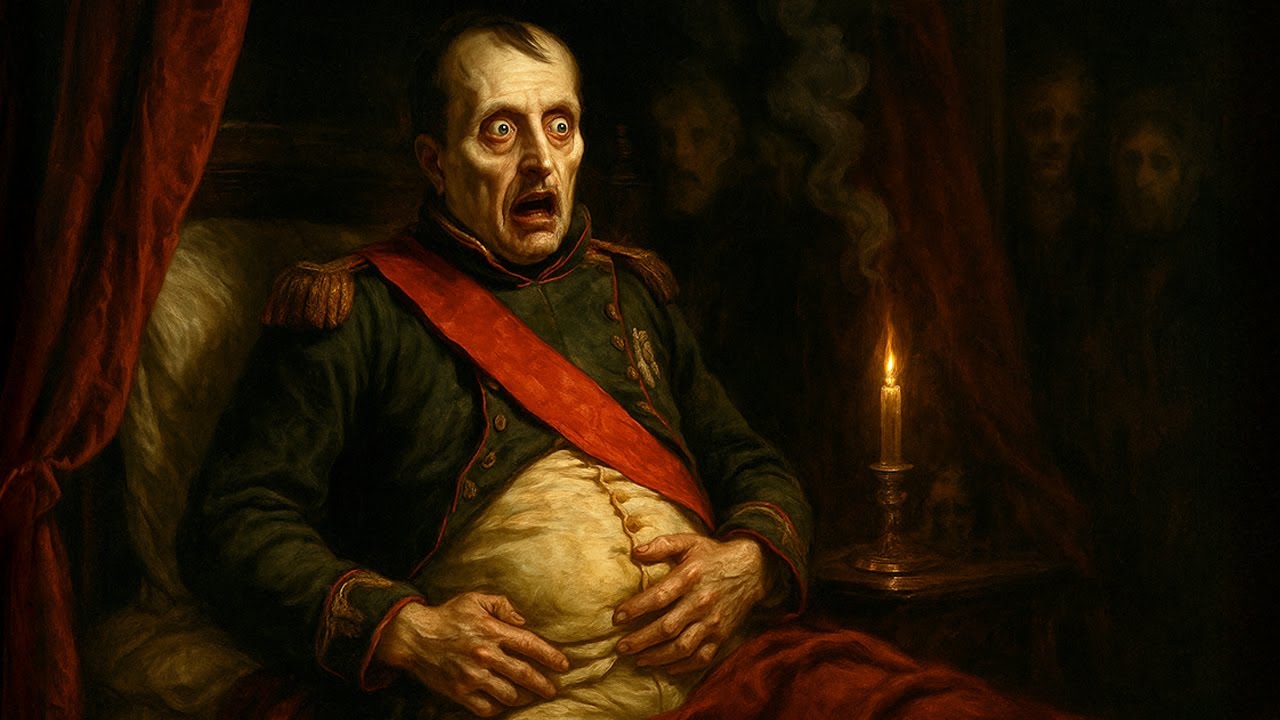
The transformation from military genius to helpless invalid had been slow, then sudden, and it began with something Napoleon did every single day: he took a bath. These were not normal baths. His valet, Louis Joseph Marchand, watched as the former emperor, who had once worked eighteen-hour days, now spent entire afternoons lying in a copper bathtub filled with water so hot it turned his skin lobster red. Six hours, sometimes eight, he would soak, adding more scalding water whenever it cooled.
His skin pruned and peeled while he gripped the edges of the tub with white knuckles. The bath was the only place the fire in his gut would quiet down. Outside that copper tub, every movement felt like someone twisting a hot knife in his stomach. He had eaten his meals in fifteen minutes his entire life, food was fuel, nothing more.
Now, even the smell of bread made him retch. Inside his body, a tumor the size of a fist had taken root in his stomach lining. It was a carcinoma that had grown to over four inches long, wrapping around his stomach like a parasite. Every heartbeat pushed blood into the mass of corrupted tissue.
Every breath made it press against his other organs. It was eating him from the inside, cell by cell, while he sat in that bathtub trying to boil the pain away. By April, his body had begun to transform in ways that horrified his servants. Count Montholon, who had been with him since Waterloo, could not hide his shock.
The emperor’s arms, which had once grabbed cannon wheels and repositioned them mid-battle, had withered down to skin-covered bones. You could wrap your thumb and finger around his bicep with room to spare. But his belly had swollen grotesquely, filled with fluid from the cancer. He looked nine months pregnant.
When he tried to walk, on the rare occasions he could stand, he had to lean backward to balance the weight of that swollen abdomen. The smell in his room had become something beyond description. It was not just body odor or sickness. It was the sweet, cloying smell of tissue death.
The tumor had begun to necrotize, rotting while he was still alive. His servants would burn sulfur and incense trying to mask it. They sealed the windows because the doctors believed fresh air would make him worse. The combination created an atmosphere so thick you could almost taste it.
On April 15th, Palm Sunday, Napoleon summoned Abbé Vignali, a priest. The emperor who had crowned himself, who had imprisoned the Pope, who had treated God as a political tool, wanted last rites. “I know I’m dying,” he told the priest. He said it matter-of-factly, like commenting on the weather.
But even facing death, his ego blazed. He spent his few clear hours dictating his will with military precision, every detail calculated for maximum impact. He left ten thousand francs to Cantillon, the man who had tried to assassinate Wellington. From his deathbed, Napoleon was still firing shots at his enemies, still fighting wars he had already lost.
Then came the treatments that would have been considered war crimes if done to a prisoner. Dr. Archibald Arnott, the British physician, believed in the medicine of his time. When Napoleon could not defecate because the tumor was blocking his intestines, Arnott prescribed calomel, ten grains of mercury chloride.
They were feeding him mercury while his stomach dissolved. The first dose triggered something horrific. Napoleon passed what Bertrand described as the largest stool in a month, black as tar, stinking of blood and decay. Internal bleeding so severe it had turned his waste into something that looked like roofing tar.
Arnott saw this as progress. He prescribed another ten grains. April 28th marked the beginning of the end. Napoleon’s mind, that brilliant tactical computer that had outmaneuvered all of Europe, began to crack.
But it did not go quietly. It exploded into hallucinations so vivid that everyone in the room could follow along. “The cavalry! ” he would scream suddenly, bolting upright in bed, his skeletal arms positioning invisible troops.
“Send in the guard now! ” He was back at Austerlitz, his greatest victory, fighting Austrians who had been dead for fifteen years. His hands moved across invisible maps, his voice calling out positions, coordinating flanking maneuvers against enemies only he could see. Marchand wept openly watching this.
The emperor was not just dying. He was trapped in his own glorious past, fighting battles in a body that could not even control its own bowels anymore. Sometimes he would call for Josephine, dead seven years. Sometimes he was in Egypt demanding water, reliving campaigns from two decades past while his actual body drowned in its own fluids.
May 1st brought a scene of pure horror. Napoleon demanded to walk. He knew he was emperor, and emperors do not lie in bed. Two servants tried to help him stand.
He made it exactly three steps. On the fourth, his legs buckled. As he fell, his stomach convulsed so violently that everyone thought he was dying right there. Ali, his Mameluke servant who had been with him since the pyramids of Egypt, dove forward and caught him.
They carried him back to bed, but Napoleon kept trying to get up. “My army,” he gasped. “Where is my army? ” They had to physically hold him down.
Four grown men restraining the emperor of France while he fought to review troops that existed only in his dying brain. The British doctors decided more aggressive treatment was needed. They applied blistering plasters, patches soaked in crushed beetles that cause severe chemical burns. The theory was that external pain would draw out internal disease.
They covered his chest, feet, and calves with these burning patches. Napoleon’s skin, already yellow from liver failure, now featured angry red welts that oozed clear fluid. They were literally burning him alive while cancer ate him from within. On May 3rd, the doctors administered twenty grains of calomel, enough mercury to poison a healthy man.
But they did not wait for it to work naturally. They followed it with an enema so violent that Napoleon, the emperor who had never shown weakness, who had walked through grapeshot without flinching, screamed. The scream echoed through Longwood House. It was not a cry of pain, but of complete humiliation.
The man who had redesigned Europe’s borders was being held down while strangers pumped mercury-laced water into his rectum. When it was over, he turned his face to the wall and would not look at anyone for hours. The treatment triggered a cascade of horror. Napoleon’s body expelled stool after stool, each darker than the last.
But mixed in with the black waste were chunks of something else. Pieces of his stomach lining. His digestive system was literally falling apart, coming out in pieces. May 4th, dawn.
The mercury had done something catastrophic. Napoleon began vomiting with such force that blood vessels burst in his eyes. The whites turned completely red. What came up was not just blood anymore.
Bertrand saw pieces of tissue in the vomit. Actual chunks of Napoleon’s stomach. Between convulsions, Napoleon tried to speak. Blood frothed from his mouth, mixing with words.
France, mon fils, l’armée. Even as his organs liquefied, his thoughts went to country, son, and soldiers. The smell in the room had become apocalyptic, not just death, but active decomposition. The tumor had perforated his stomach wall completely.
Only a miraculous adhesion to his liver, scar tissue that had formed like a natural bandage, kept his stomach contents from spilling into his abdomen. He was technically alive with a hole in his stomach large enough to put your finger through. At 3:00 a. m.
on May 5th, Napoleon entered what doctors call the death spiral. His breathing had become Cheyne-Stokes, rapid gasps followed by nothing, his brain forgetting how to regulate oxygen. Between the hiccups and groaning from his destroyed digestive system, witnesses heard his last coherent words, but even those are disputed. Montholon heard “France, armée, Joséphine.
” Marchand heard “France, mon fils, l’armée. ” Bertrand recorded “Tête de l’armée,” head of the army. They all heard what they expected from their emperor. Or maybe Napoleon, even dying, was speaking to all of them at once.
By 5:30 a. m. , his throat had swollen shut. He could not speak, could not scream.
He could only make sounds that his servants described as animal-like, guttural noises from deep in his chest. His eyes, those famous gray eyes that had made generals quake, were fixed on something beyond the room. The morning brought a grotesque parody of imperial court. Sixteen people crowded into his bedroom.
They stood around his bed like courtiers, but instead of receiving commands, they watched him die by degrees. Dr. Arnott, desperate, pressed hot water bottles against Napoleon’s swollen stomach. The heat against the tumor caused such agony that Napoleon’s back arched off the bed, his mouth open in a silent scream, his throat too swollen to make sound.
They tried one final torture, mustard poultices on his feet designed to stimulate him back to life. The smell of mustard mixed with decay, creating an atmosphere that made even the doctors gag. Napoleon’s skin, where it was not yellow from jaundice or red from burns, had turned a mottled purple from lack of oxygen. At 5:49 p.
m. , after seventeen hours of final agony, Napoleon Bonaparte stopped breathing. No last words, no grand gesture. His body, pushed beyond every limit, simply stopped.
The autopsy the next day revealed the full horror. When they opened his abdomen, several doctors had to leave the room. The smell of cancer, sweet, rotten, unforgettable, filled the billiard room. The tumor had not just been growing.
Parts of it had been dying and rotting while Napoleon lived. His stomach was almost entirely cancerous, hard as leather. The perforation was exactly where the doctors had predicted, near the pylorus. Dr.
Antommarchi demonstrated the hole by pushing his finger through it. But worse were the white nodules scattered throughout his intestines, metastases like pearls of cancer strung through his guts. Napoleon had been dying for years. Every moment of his exile, every escape plan, every dictated memoir, all while this thing grew inside him, consuming him cell by cell.
They removed pieces of him. Officially, his heart and stomach went into silver vessels to be buried with him. Unofficially, Dr. Antommarchi snipped off rib fragments when the British were not looking.
Locks of hair were taken. And his penis, yes, his penis, was allegedly removed and smuggled away, eventually ending up in an American urologist’s collection where it remains today, resembling, as one observer noted, a piece of leather shoelace. They dressed what remained in his green uniform, placed his bicorn hat at his feet. But the real shock came nineteen years later, when they exhumed him to return his body to France.
When the tomb was opened in 1840, it revealed something impossible. Napoleon was perfectly preserved. Not skeletal, not decomposed. His features were recognizable, his skin white as marble, his uniform intact.
Nineteen years in the ground, and he looked like he had been buried yesterday. The preservation was too perfect. It sparked theories that persist today, the arsenic in his system acting as a preservative, secret embalming, or was this final impossible preservation just one more mystery in a life full of them. In the end, the horror of Napoleon’s death was not just the cancer, the mercury poisoning, or the medical torture.
It was the complete destruction of everything he had been. The tactical genius became delirious. The iron will crumbled into childish begging. The body that had conquered Europe became a grotesque shell, rotting from within while still breathing.
His last coherent thought was of France and his army. Not glory, not power, just a dying soldier calling for his troops one last time. The emperor who had made Europe tremble died trembling himself. Not from fear, but from the uncontrollable spasms of a body destroying itself.
Today, tourists stand in awe at his massive red tomb in Les Invalides. They see glory carved in stone. But inside that sarcophagus lies a man who died vomiting pieces of his own stomach, whose final transformation from emperor to corpse was so horrifying that even his doctors could not watch. The emperor who conquered nations could not conquer the cancer in his gut.
And in those final days, as his body literally rotted from within while he still breathed, Napoleon Bonaparte discovered the truth that comes for all conquerors. In the end, we all die alone. We all die badly.
And death does not care about glory.
