On a bright July afternoon in 1930, in an orchard in the Kentish village of Marden, searchers moved among the apple trees and came upon the body of a woman who had fallen from the sky. Almost nothing was left by which to identify her. In the end, the one thing that made them sure of her was her string of pearls. Her name was Lady Rosemary, a duke’s daughter, born in a Highland castle into one of the grandest families in Britain.
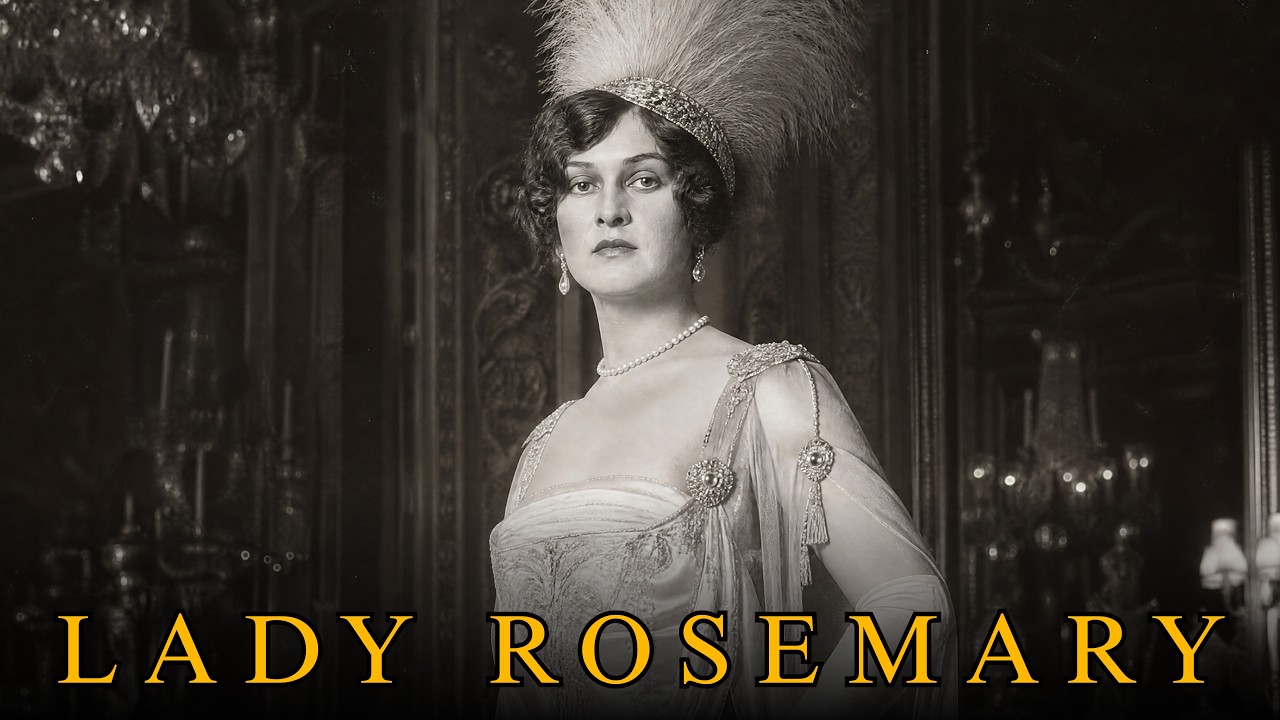
And thirteen years before that fall, the man who would one day be King Edward VIII had asked for her hand in marriage and been refused. Not because of anything she had done, but because of the family she had been born into. She is the woman the crown turned away long before it lost a king to another. She was born in a fairy tale castle on the far northern coast of Scotland into a family that had once owned more of Britain than anyone alive.
The place was Dunrobin, a forest of pale turrets rising above the North Sea in the county of Sutherland, one of the grandest private houses in the whole of Britain. It belonged to her father as easily as the coat on his back. On the 9th of August in the year 1893, Lady Rosemary Millicent came into that house, the youngest of four children, the daughter of Cromartie, heir to the dukedom of Sutherland, and of his wife Millicent, a woman the whole of society already knew by her first name alone. Rosemary was a duke’s daughter from her first breath, and the world arranged itself around that fact before she could speak.
The height she started from shows best in the houses. There was Dunrobin in the Highlands above its cold northern sea. There was Trentham, the family’s great hall in Staffordshire, set in parkland that seemed to have no edge to it. And there was Stafford House in London, so vast and so gilded that Queen Victoria herself, arriving to visit, is said to have told the Duchess that she had come from her house to the Duchess’s palace.
A reigning queen, walking into a subject’s home, and feeling that she had stepped up rather than across. That was the family Rosemary was born into. That was the plain, unremarkable shape of her childhood, the ordinary weather of her days. The Sutherlands had been, by the measure of land, the largest private land owners in the whole of Europe.
Their holdings spread across the far north of Scotland in acres too many to walk in a single lifetime. The money that kept the turrets warm and the long tables laid came from that land and from the industrial age that was remaking the country around them. And it came in quantities that made the family a fixture of every great occasion, every royal season, every list of the people who counted for anything at all. Her eldest brother, George, would in time become the fifth duke.
The whole apparatus of a great house moved around the children like a slow and certain machine. A child raised inside that certainty does not learn that she is rich any more than a fish learns that it is wet. She simply learns the manners of the top of the world. And Rosemary learned them at Dunrobin and Trentham and Stafford House, moving through the seasons of the year and the houses of the family like a small bright figure crossing a very large canvas.
She was, by every account that survives, a warm child who grew into a warm woman. Those who knew her spoke of her mother’s smile passed down whole to the daughter, of a charm that was not performed but simply there in the room with her, of a beauty that the newspapers would later call remarkable without troubling to exaggerate it. She had the long features and the level, unhurried gaze that the portrait painters of the age admired. And she had something the paint could never quite catch: a genuine kindness that people remembered long after the music had stopped and the guests had gone home.
In a world built on advantage and quiet calculation, she was liked simply and widely for herself. And on her from the beginning, there were the pearls. A string of them, the plain and expected ornament of a girl of her rank, worn at the throat for a portrait or a party, and thought about no more than one thinks about the buttons on a coat. Every well-born woman of her world had them.
They were the badge of the class, the quiet sign that said: here is a daughter of a good house. Nothing more and nothing less. Rosemary wore hers through the seasons of her girlhood, without once imagining what those pearls would one day be asked to do in a field on the worst afternoon there would ever be. For all the acres and all the houses, for all the queens who felt small in the family’s hallways, there was a single thing that even a Duke of Sutherland could not simply hand to his daughter.
And it was the thing that would come in the end to define her whole life. He could not choose whom she would be allowed to love, and neither, when it mattered, could she. That decision lay with an older law and a higher house than his, and when the time came, it would be made over her head, against her wishes, and for reasons that had nothing to do with the woman she actually was. But that was years off yet.
First, there was a mother to reckon with, and the mother was a story all her own. The woman who gave Rosemary her smile and her charm was also one day the reason a king said no. Her name was Millicent, Duchess of Sutherland, and she was one of the most talked-about women of her age, admired and disapproved of in almost equal measure. A great lady who flatly refused to be merely decorative.
To know Rosemary at all, one has to know her mother first, because the daughter’s fate would turn entirely on the family’s name. And it was Millicent who gave that name both its brightness and its shadow in the same restless life. She had been born in the autumn of 1867, a daughter of the house of Rosslyn, and she had married Rosemary’s father on her seventeenth birthday, a girl handed into a dukedom before she was fully grown. She might have settled, as so many duchesses did, into a long and comfortable career of hosting and being seen and doing nothing that anyone would remember.
Rather than settle into that comfortable round of appearances, she aimed her formidable drive at the harsh working world waiting just past the grounds of Trentham. In the Staffordshire pottery towns, where the family owned land, she came face to face with the people who glazed the delicate china that set tables much like her own, and she saw what years of exposure to the lead in that glaze did to their bodies. So she resolved, title or no title, to change it. For that they nicknamed her “meddlesome Millie,” partly in derision and partly in reluctant admiration.
She fought to have the lead removed from the glazes, and she secured genuine reforms, saving lungs and lives in towns that had never imagined a grand lady would even notice they were there. The novelist Arnold Bennett, who understood those towns from the inside, put a version of her into his fiction, a countess whose prying interference so often drove the people around her to distraction. It was not offered as praise. Millicent could not have cared less.
She had come to understand that a duchess could be far more than a decoration, that the very rank which confined so many women could, in the right stubborn hands, serve as a lever. And she leaned on it hard for the rest of her life. When her husband died in 1913, and again when the Great War broke out the next year, she leaned harder still. She raised and financed her own ambulance unit and personally escorted it to the front, and she was present at the siege of Namur in Belgium in the opening weeks of the fighting, near enough to the guns to hear them firing.
She established and ran field hospitals in northern France, genuine hospitals performing genuine surgery on shattered men. For that service three separate nations honored her, awarding her the War Cross of France along with the decorations of Belgium and Britain for work carried out under fire. Whatever else was ever said of Millicent, and a great deal was said, she was brave, she was useful, and she was formidable. One of the truly admirable women of her entire generation.
And yet the same woman carried, in the watchful eyes of the court and the respectable families, a lingering hint of the unsuitable that never quite faded. After the Duke’s death she married again, twice, and both marriages ended in the divorce courts, the first on grounds of her new husband’s infidelity, the second on grounds more private and more damaging still. Around her in the wider family were others whose names made the guardians of respectability flinch and look away. There was the uncle, the Earl of Rosslyn, a man who married three times and gambled away a fortune until the bankruptcy courts finally caught up with him.
There was the great aunt, a celebrated beauty of the previous generation, who for years had been the acknowledged mistress of a Prince of Wales who later became a king. The blood of that family was brilliant and quick and charming, and it was also, by the strict and unforgiving reckoning of the palace, tainted. Here is the cruelty that sits at the very heart of this story, and it should be seen plainly before the rest of it unfolds. The very qualities that made Millicent remarkable—her refusal to stay quietly in her place, her willingness to marry for herself and to leave a marriage when it failed her, her whole vivid and unruly life—were the qualities the court would one day count against her daughter.
Rosemary had done nothing. Rosemary was, by every surviving account, gentle and good and kind. But she carried her mother’s name and her mother’s blood. And in the world she was about to enter as a grown woman, a person was judged not by her own conduct but by the reputations that gathered around her like relatives crowding into a photograph.
The bravest woman of her war would become, in the cold ledger of the monarchy, the reason her own daughter could not have the man she wanted. First, though, Rosemary had to meet him. And she met him in the very place her mother had gone to make herself useful. She met him at the war.
When the war came, the beautiful girl from the castle went to France and learned to sit beside men who could no longer speak. She might have done what so many young women of her rank did—rolled bandages in the drawing room of a country house or lent her fine name to a fund and considered her duty done. Instead, like her mother before her, she went to where the wounded actually were. She trained and served as a nurse under the Voluntary Aid Detachment, the great volunteer force of women who staffed the hospitals of that war.
And she gave the better part of four years to it, crossing the water to France and working through the long grinding seasons of the fighting in 1915 and again through 1916 and into 1917 and on toward the bitter end of it. It was not gentle work, and it was not decorative, and it could not be performed at a flattering distance. The hospitals of the Western Front took in men torn apart by the new industrial weapons: men with faces gone and limbs gone and minds gone past finding. And the nurses lived close inside that ruin day after day after day, with the smell of it in their clothes.
Rosemary was a duke’s daughter, raised among marble and footmen and the quiet certainty of comfort, and she chose to spend the years of her early twenties among the carbolic and the blood and the low crying of the dying. What survives of her from those years is not the record of a great lady playing prettily at charity for a season. It is the record of a woman who was genuinely and unshowily good at a hard and necessary thing, and who was recognized for it by people who did not hand out such recognition lightly. She was mentioned in dispatches in the January of 1917, a real honor for real service under strain.
And after the war, she was made an Associate of the Royal Red Cross. There is one story from that time that says more about her than any list of medals ever could, and it deserves to be told slowly, in full. Among the men in her care was a soldier broken not in his body but in his mind. One of the many the age had learned to call shell-shocked, who had retreated so far down inside himself that he no longer spoke at all to anyone.
He lay there mute, beyond anything the doctors or their notebooks could reach, beyond the reach of ordinary speech. And Rosemary stayed with him, not for a quick professional minute on her rounds, but for hours, and then hours again, day after day, saying whatever it was she said, offering whatever a steady and gentle voice can offer a man who has stopped answering the world. And at last, after all that patience, he spoke. The first word he had uttered in no one knew how long, drawn up out of the darkness by a young woman who simply refused to give up on him, was a single tender word.
Darling. Study that scene closely, because it is the truest portrait of her we have. Here was a woman who could have glided through the entire war on her name and her looks, admired safely from a comfortable distance, and instead she gave her hours, her patience, and something harder to name to the least glamorous work the war could offer: the slow coaxing of a broken man back toward the land of the living. That was the Rosemary the war made visible for the first time.
Not the ornament to be admired, but the nurse who did the seeing, who looked at a man everyone else had quietly given up on and refused, hour after hour, to give up on herself. The kindness people had noticed in the child had become, under the pressure of the war, something far closer to a gift, and a rare one. And it was this woman, capable and tender and holy in her own right, whom a very lonely young man happened to see. The Western Front in those years pulled everyone toward it, the lowborn and the high alike.
And among the many figures who passed through that harsh world was the most watched young man alive on the earth: the heir to the throne of the British Empire, in France in a plain uniform, longing to be treated as something other than a prince for once. Deference and careful distance surrounded him always and everywhere. His fame ran so far past the ordinary that it had become a kind of solitude. And somewhere in that gray landscape of hospitals and headquarters, he came to know the nurse from Dunrobin.
And he found in her the one thing his whole position had always denied him. Someone who saw the man and not the crown standing behind him. The war had lifted Rosemary to the highest point of her life so far. She had proved herself, been honored, become fully and finally the person she was meant to be.
She was admired across two continents, spoken of everywhere as one of the loveliest and most eligible young women alive. And now the future king himself had turned his lonely attention toward her. From the outside, it must have looked like the opening of a fairy tale. The nurse and the prince, the beauty and the throne waiting behind him.
It was the very peak of her rise. And like most peaks, it was the last high ground before the long fall began. Because the prince was about to want something that princes, of all people in the world, are not always permitted to have. The heir to the throne was twenty-three.
Adored by millions and desperately alone. And then he met a nurse. His name was Edward, Prince of Wales. And one day, for a short and ruinous while, King Edward VIII.
In the summer of 1917, he was a young man carrying the whole weight of an empire’s expectations and almost none of its ordinary comforts, hemmed in on every side by protocol, watched by everyone who came near him, genuinely close to no one at all. He had the kind of fame that hardens over time into a form of solitude, that puts a pane of glass between a man and every person in the room. And into that solitude walked Lady Rosemary, warm and steady and unimpressed by the glass. And he fell, by every account that has come down to us, very hard indeed.
One of those who watched it happen up close was a close friend of Rosemary’s, a woman remembered as Lady Victor Paget, and it is largely through her that the story is known at all. She saw the prince’s feeling for Rosemary grow from friendship into something a great deal more serious, saw the heir to the throne of England behave like any young man anywhere in the grip of a first great love. By one account, he was crazily in love with her, unable to hide it and unwilling to try. He had been given everything a human being could be given except the one freedom that matters most: the freedom to choose for himself.
And here, in a nurse from a Highland castle, was a person he wanted to choose entirely on his own, for no reason of state at all. It is easy to see what Rosemary offered him, and the seeing explains the whole affair. She was not a courtier angling quietly for advantage, the way so many around him always were. She had grown up higher than almost anyone he was ever likely to meet, so his rank did not dazzle her the way it dazzled the daughters of the season.
She had spent years at the beds of dying men, so she had a depth and a steadiness in her that the drawing rooms could not manufacture. And she was genuinely kind, the sort of person who had once sat for hours beside a silent soldier until he found a word. To a young man half-starved of ordinary human warmth, she must have seemed like clean water in a dry country. He did not want her because she was useful to the monarchy or its future.
He wanted her because, for once, in his watched and gilded life, someone made him feel like a man rather than an institution on two legs. There is a real complication in the record here, and honesty requires that it be set down plainly beside the romance. In later years, it was said that Rosemary herself claimed she had never wanted to marry the Prince of Wales at all, and that when she did briefly consider it, she did so thinking she might, as the phrase of the time went, “make something of him. ” Whether that was the plain truth of her own heart, or the protective story of a proud woman who had been publicly turned down and would not show the wound, no one can now say, and it would be dishonest to pretend to a certainty the record does not give.
Both truths can be held at the same time. A prince who loved deeply and could not help himself, and a young woman far more careful about her own feelings than any fairy tale would like. The record gives us his passion openly, but her heart only in fragments, and those fragments do not always match one another. What nobody doubts is that the feeling ran deep enough to move toward marriage.
This was no single-season London flirtation to be forgotten by autumn. It was discussed, weighed, and steadily pushed forward, the way only a genuine and settled intention is ever pushed forward. And that is precisely what made it so dangerous, because a Prince of Wales cannot simply marry the woman he loves and have done with it. His marriage is not a private matter between two hearts in a quiet room.
It is an affair of state, bound up with law and with the will of the reigning king. And the instant the prince’s feeling hardened into a real intention, it ceased to be a love story and became a question for the palace to sit in judgment on. So the young man who had at long last found someone he wanted purely for himself came up hard against the one wall all his rank could not knock down. He could have palaces and yachts and the roaring adoration of crowds in every corner of the empire.
He could not, it turned out, have Rosemary unless his father agreed first. And his father was the King of England. Everything now rested on a single decision to be made in a room the lovers would never be allowed to enter, by a man weighing his son’s happiness against the reputation of a family in a distant part of Scotland. The proposal was coming.
And so, from the other direction, was the answer. One day she came to Lady Paget and told her the prince had asked for her hand in marriage, and for a moment it seemed the century itself might turn on it. That is how her friend remembered the moment, plainly and without embellishment. The proposal had been made.
The heir to the throne had asked Lady Rosemary to be his wife, which meant, in the plain and startling arithmetic of the monarchy, that he had asked her, in time, to be his queen. A nurse from Dunrobin, a duke’s daughter with her mother’s smile and a war behind her, stood for one breath at the very threshold of England’s throne. And then the door was shut firmly from the other side, by the king. The law that shut it was old and cold and precise.
Under the Royal Marriages Act, passed in 1772, no descendant of the sovereign could marry without the sovereign’s express consent. It had been written a century and a half earlier for exactly this purpose: to stop a prince from marrying wherever his heart, rather than the interests of the state, led him. And it gave King George V an absolute and unarguable veto over his son’s choice of a wife. There would be no eloping, no secret wedding followed by a plea for pardon.
Without the king’s freely given yes, there could be no marriage at all, in law or in fact. And the king, having turned the matter over, said no. Why he said it is the one part of this whole story where the records do not fully agree, and the honest course is to lay out what they offer rather than reach for the neatest single version. What every account agrees on is that the objection was never to Rosemary herself.
King George is said to have liked the young woman well enough. The objection was to her family, to the blood and the reputation on her mother’s side of the house. One strand of the record points to the wider Rosslyn connection: the great aunt who had been a royal mistress, the uncle who had gambled himself into open bankruptcy across three marriages, the general sense of instability and scandal running loose in the line. Another strand points more narrowly and sharply at the duchess herself, at Millicent’s own remarriage and her separation from her second husband, a great lady twice now at the center of the divorce courts and the gossip swirling around them.
The emphasis shifts from one telling to the next. The verdict never shifts at all. The family was judged unsuitable, and the daughter was refused because of it. Sit for a moment with the true shape of that decision, because it is the beating heart of everything that follows.
A young woman who had done nothing whatsoever wrong, who had in plain fact spent her war doing a great deal that was right and hard and good, was told she could not marry the man who loved her because of things other people in her family had done long before and far away. Her mother’s courage under fire counted for nothing against her mother’s divorces. Her own service at the bedsides of dying men counted for nothing against her uncle’s gambling debts. She was, in the coldest possible sense, guilty by association.
Refused a crown for scandals that were never hers. And the instrument of that refusal was a law about permission. The sovereign’s permission. The one consent in the land that simply could not be worked around or lived without.
Everything else in her life had been given to her freely: the houses, the honors, the wide admiration. The one thing she wanted, or at least the one thing being offered to her, required a permission that was withheld. For the prince, the refusal was a wound that never closed. His friend, Lady Paget, put it into words that have outlasted almost everything else about the affair.
The prince, she said, was bitter and furious, and she did not think he ever forgave his father. Hold on to that sentence and carry it forward, because it will matter far more than it can seem to now. The young man who was told in 1917 that he could not marry for love was learning a hard and permanent lesson about kings and fathers and hearts. A lesson he would carry folded away inside him for the rest of his life.
He obeyed. He was, after all, still only the heir, and the great machinery of the monarchy was far stronger than a young man’s will. But he obeyed the way a man obeys a thing he has come to hate. Storing the resentment somewhere deep, where it would sit and wait and slowly harden into something else.
And for Rosemary, that refusal quietly set the shape of everything that followed. She had climbed as high as a woman of her world could climb, right to the edge of the throne, and then she had been sent back from it. Not through any failure or fault of her own, but through an accident of birth she had no power to change. The grand houses and the grand name that had opened every other door in her life had, at the one door that mattered above all others, become the very reason it was shut against her.
She would not be queen. She would not, it appeared, even be allowed to settle the question for herself, one way or the other. The palace had settled it for her. Now the world would arrange the rest, and the world, as it always did with women like Rosemary, would find her a suitable marriage and move briskly on to other business.
The prince was bitter and furious, and something in him did not forgive the king who had refused him. That was the immediate and visible damage of the decision, and it is easy enough to see, because Edward was famous, and his moods were watched and recorded. What is harder to see, and matters just as much, is the quieter damage on the other side of it, in the woman who had been the whole cause of the quarrel without ever once being asked about it. The refusal is nearly always told as the prince’s tragedy, the great romantic wound of the future king.
It was also, and far less noticed by anyone, entirely Rosemary’s. Think carefully about what it meant to be her in those months. She had been courted by the heir to the throne, spoken of openly as a possible queen of England, lifted for a moment to the very summit of what a single life could be. And then she had been quietly set aside.
Not because the prince had stopped loving her, but because a committee of her betters had gone carefully through her family tree and found it wanting. There is a particular and lasting humiliation in being rejected for who your relatives happen to be. It is a verdict you cannot argue against, because it is not about anything you yourself have done or left undone. She could not become any less related to her gambling uncle.
She could not undivorce her mother. She had been weighed on a scale she was not allowed to touch, and found unsuitable for reasons that were by their very nature permanent and forever beyond her reach to change. This is the place where the whole story shows its true and lasting subject. And that subject is powerlessness standing at the very summit of power.
Rosemary had, on paper and in every photograph, almost everything a person could name. She was the daughter of one of the richest and grandest families in all of Britain. She had beauty and charm and hard-won honors and the genuine love of the most eligible man alive in the world. And with the whole of it in her hands, she could not command the single outcome she might most have wanted, because the decision was never once hers to make.
It belonged to the king, in a room she would never see. Her own wishes, whatever they truly were beneath the guarded surface, formed no part of the calculation at all. A woman could own a share of the largest fortune in Europe and still not own the answer to the most important question of her own life. That gap between everything she had and the little she controlled is the gap this entire life keeps falling into.
Her own later words, if they were truly and freely hers, read very differently in this hard light. If she said that she had never really wanted to marry the prince, that she had only considered it thinking she might make something of him, then perhaps that was the plain and level truth of a guarded and private heart. Or perhaps it was the carefully worn armor of a proud woman who had been publicly turned down before the whole of society, and who would not ever give the watching world the satisfaction of seeing that it had hurt her. People who have been rejected very often insist loudly and for years that they had never wanted the thing in the first place.
It is one of the oldest and most human ways of keeping one’s dignity whole. No one can see down into her now, and it would be false to strain to try. But the possibility hangs over the whole story like weather sitting on the hills: the possibility that the woman at the dead center of the great royal romance may have spent the rest of her short life quietly insisting that it had never mattered to her at all. What is certain is that both of them were now free only in the emptiest possible sense of the word.
Free to marry, so long as it was someone else. The prince would carry his old grievance against his father and against his own throne forward with him for years. A man who had been taught early and cruelly that his heart did not get to cast a vote. And Rosemary would be steered gently and firmly, as the young women of her class were always steered, toward a match that the world would find suitable.
Which is to say, a match that offended nobody at all and stirred nothing much in anyone. The season would provide, as the season always did. There was, most conveniently, a young man of exactly the right rank and exactly the right fortune close at hand. A man who happened also to be the prince’s own closest friend.
And the arrangement, when it finally came, would carry a neatness to it that was very nearly cruel. For if Rosemary could not have the prince, she could at the least be given the next best thing available: a man cut from the very same cloth, moving in the very same charmed set, trusted deeply by the very man she had just been refused. It was a solution that let every party to it save face and move on. The prince kept his friend close.
The families kept their dignity intact. Rosemary was respectably and visibly settled. Only the single question of her own happiness was left politely unasked, because in the machinery that governed women like her, her happiness had never really been the point of the exercise. The point was a good marriage, correctly made.
And a good marriage was now duly arranged for her. If she could not have the prince, the world arranged the next best thing: the prince’s closest friend. His name was William Ward, known to everyone as Eric, Viscount Ednam, heir to the Earl of Dudley. And on the 8th of March in the year 1919, less than two years after the refusal, Rosemary married him at St.
Margaret’s Church in Westminster, standing right in the shadow of the abbey, with the great and the grand of the entire land looking on. It ranked among the weddings of the season. A duke’s daughter and a viscount. Two celebrated families bound together at the altar, while the newspapers devoted columns to the gowns, the guest list and the flowers.
Seen from outside, it appeared to be nothing short of a triumph. Examined closely and without hurry, it was a far more tangled affair than that. By the demanding measures of his own circle, Ednam was a substantial prize for any woman. He was a decorated soldier, a cavalry officer who had served gruellingly through the war and emerged from it with the Military Cross for bravery under fire.
Which counted for a great deal in a generation that had witnessed so much of it. He stood to inherit one of the mighty industrial fortunes of the era. He was handsome, well liked, and moved without effort through the loftiest circles in the country. And most revealing of all, he was a close personal friend of the Prince of Wales himself, part of the same swift and golden set, near enough to the prince that Edward would act as godfather to the couple’s firstborn son.
There is an odd and aching arithmetic hidden inside that fact. The woman the prince had been forbidden to marry was now the wife of the prince’s own closest friend. Neatly folded back into his world at one remove. Kept forever near him, and never married to him.
Whether Rosemary loved Eric Ward on the day she wed him, nobody can now honestly say. What can be said is that the marriage bore, from its very first morning, the plain outline of a settlement rather than a romance. Two people of exactly the right rank, joined at exactly the right moment, doing exactly the right and expected thing. She had been denied the man who loved her, and handed instead a man who fitted her.
And the whole distance between those two simple verbs is the distance inside which all the remainder of her life would be quietly lived. That morning she became Viscountess Ednam. In time, had she only lived long enough, she would have become Countess of Dudley, mistress of one of England’s great houses. The road stretched out before her was gilded and secure, and wholly conventional in every respect.
The untroubled road of a great lady in a great and fitting marriage. The wedding itself was a set piece of its age, the sort of glittering spectacle that era staged better than any before or since. St. Margaret’s packed to its doors with the assembled aristocracy of two famous houses.
The bride, admired for her beauty across two entire continents, came down the aisle a duke’s daughter and walked back up it a viscountess. And at her throat, in all probability, the pearls. Worn now as a bride wears them on the great day, that same quiet string which had marked her as the daughter of a good house since girlhood, once again doing its ordinary and expected work of showing that here was a woman of rank at the most public moment of her life. Nobody watching those pearls on that bright March morning could ever have guessed what they would be needed for in the end, or where.
The prince was present through all of it, woven into the very fabric of the arrangement, whether or not he stood in the church. He gave his friendship to the marriage. He gave his own name to its firstborn child. He kept Rosemary close in the only way now left open to him in the world: as the wife of a man he trusted utterly, a familiar presence at the bright edge of his life for years to come.
In the years after the wedding it would be said that Rosemary was still sometimes seen in the company of the prince, and of other men of their circle as well, and that the Wards’ marriage was not the sealed and settled and happy thing the wedding photograph so carefully implied. But that belongs to the next part of the story, and it can wait its turn. On her wedding day, the arrangement held firm. The families smiled for the cameras, and the door to the throne closed for good and all behind her.
What opened in its place was a grandeur of an entirely different kind. Not the ancient royal kind she had been so firmly refused, but a newer and harsher sort, one dug and hammered and smelted out of the very middle of England. For the family she had just married into had not received its great fortune as a gift from kings. It had made that fortune itself, from coal and from iron, from the black and burning country where England was busy building the whole modern world.
And that fortune, and the great house it had paid for, would now become the setting for everything that followed in her life. The family she married into had not inherited its money from kings. It had dragged it out of the ground with its own hands. The Earls of Dudley drew their wealth from the region of the English Midlands so scarred and so smoke-darkened by heavy industry that it was known, without a shred of affection, as the Black Country: a landscape of coal pits and iron works and blast furnaces, where the fires seemed never once to go out, day or night.
Beneath that hard ground lay coal and iron in enormous quantity, and the Dudleys owned a very great deal of both, and turned it steadily into money on a scale that could stand without embarrassment beside the oldest inherited fortunes in the land. Where the Sutherlands had land and long lineage, the Dudleys had industry, the raw and roaring engine of the whole age. The heart of that fortune was iron and steel and coal made tangible in great works. There was the Round Oak steel works, one of the major ironworks of the entire district, its furnaces lighting the night sky above the towns.
There were collieries hauling coal up out of the Staffordshire earth in an endless dark stream. And around them stood the whole vast apparatus of Victorian industry that had made a small handful of families enormously and permanently rich, while the crowded towns around their gates lived hard and short. The Dudley money was not the quiet, polite, inherited wealth of the old countryside. It was the loud and powerful and faintly frightening wealth of the factory age.
New money, with soot still on it. And it built the family a life fully to match its noise. The seat of that life was Himley Hall, a great house in the Palladian style, set within landscaped parkland on the very edge of the industrial district. Grand enough to receive royalty in comfort, and comfortable enough to actually be lived in.
In the years when the family held it at its height, Himley became almost a shorthand for a certain kind of up-to-date opulence: the time-honoured splendour of a country house equipped with every fresh diversion that money could possibly procure. In due course there would be a cinema constructed within the house itself, a swimming pool with a water chute and a cocktail bar standing alongside it, and a private golf course spread out over the grounds. This was the home of a family with industrial millions in the bank and every intention of savouring them to the full. A brilliant stage set for the fast, moneyed world of the 1920s.
Consider what the marriage had secured for Rosemary, set out in the plain and measurable language of scale. She had departed the ancient landed magnificence of the Sutherlands and married straight into one of the greatest industrial fortunes of the entire era. She had a viscount for a husband and a waiting earldom behind her. She had Himley with its cinema and its cocktail bar and its golf course, and the London seasons, and the wardrobe and the jewels and the small army of servants that came packaged with the whole of it.
The estate surrounding the great house was so substantial that when it was at last sold off, years after her death, to the National Coal Board, it passed hands for the sum of £45,000, a figure that carried genuine weight in its time. By any measure the world knew how to count by, Rosemary Ward, Viscountess Ednam, was among the most fortunate women in all of England. And yet the counting itself is precisely the snare this story keeps setting. Every one of those advantages was something money could readily supply.
And Rosemary’s life is at heart the tale of the things money could not reach at all. It could buy Himley, but it could not make the marriage within Himley’s walls a happy one. It could buy the pearls and the gowns and the endless seasons, but it could not restore to her the single choice she had been denied. It could raise a great house on the edge of the coal fields with a swimming pool and a golf course and a picture house of its own, and it could not, when the very worst at last arrived for her, shield a single one of the people she loved most in the world.
The grandeur was entirely genuine. So, exactly, was everything it failed to touch. For behind the wedding photographs and behind the industrial millions, the marriage of the Wards was, by every account that has come down to us, not a union of two hearts closely and gladly joined. It was a partnership of the right sort of people correctly matched.
And like a great many such partnerships in that particular world, it left both partners looking, in their own separate and discreet fashions, elsewhere for what they lacked. The gilded surface held perfectly well in public. Beneath it, two people who had each perhaps been steered firmly away from someone they truly wanted were quietly learning to live a life side by side that was never quite, in the end, a life fully shared.
And by most accounts, they made each other unhappy. This is the portion of Rosemary’s life that the wedding day could not foresee and the newspapers did not print: the long stretch of years lived inside a marriage that looked, from any distance at all, like a complete success. There were three sons in time, and a household run on the grand scale, and every outward sign a person could ask for that a great match was working exactly as such matches were always meant to work. There was also, running quietly beneath it all, the ordinary and human sadness of two people bound together by arrangement rather than by love.
Each of them reaching, in the careful manner of their set, towards some warmth found somewhere other than at home. Her husband Eric was rumoured to have looked elsewhere early and often. The most persistent of the stories tied him to a well-known figure of society, a woman named Venetia Stanley, and it was whispered, and later a good deal more than merely whispered, that a daughter born in the early 1920s was in truth his own child. Whether every version of the rumour was true is beyond any proof now, at this distance.
But the general shape of the thing is clear enough to make out. The viscount was not a faithful husband. And by the loose and discreet code of the upper class of the day, he did not greatly trouble himself to seem one either. A wife in that world was expected to endure such things with composure, to keep the surface of the marriage smooth, whatever churned along beneath it.
And Rosemary, raised to composure since the earliest days of her carefully straightened girlhood, would have understood the rules of it perfectly. She did not, however, merely endure them. By the accounts that have survived, she had her own life at the edges of the marriage, was seen in the company of other men, moved through the same fast society that her husband did, and was not always alone within it. Among the names quietly linked to hers was the prince himself, kept close all these years as her husband’s dear friend, and another well-known man of their wide circle, a figure of both the political and the social world.
How far any of it ever actually went, the record does not say, and it would be wrong and unkind to guess at it now. What the record does clearly suggest is a woman who had been handed a marriage rather than choosing one for herself, and who found, as such women so often did, that a heart refused its first choice does not simply switch itself off and go quiet. It goes on wanting things. It looks for warmth wherever warmth can be found.
Here is the gap that the whole marriage lived its years inside. And it is the very same gap that has run straight through this entire story from the first chapter. On the bright surface, the public couple: the viscount and his lovely viscountess, photographed together at the races and the balls, heirs to a waiting earldom, parents of three handsome sons, the very picture of aristocratic success made flesh. Underneath the surface, the private and unphotographed truth: two people who had each perhaps been turned away from the person they truly wanted, both of them now making the best of an arrangement that satisfied the whole of society and neither one of themselves.
That gap between the two pictures was precisely the space Rosemary had taught herself to inhabit from the instant the king delivered his refusal. By this stage of her life she had become expert at keeping the outward face of things polished and serene. It would be simple enough to turn her into a stock figure of a cold, embittered, joyless woman, and it would be wholly untrue. Everything in the record points to Rosemary remaining, throughout it all, warm and broadly well-liked.
She was still the woman with her mother’s quick smile. Still unmistakably the nurse who had once drawn a shattered man back into speech through long, quiet afternoons. An unhappy marriage need not harden a person to the core, and it does not appear to have hardened her in the slightest. What it appears to have done instead was to set her searching, steadily and deliberately, for something that could lend her life a meaning the marriage plainly could not supply.
Some genuine work of her own, truly hers to choose, in a life where so little had ever been left to her choosing. And she discovered it in the very place her own mother had once discovered her own escape from the merely ornamental existence of a great lady. She discovered it in real service to people who had nothing at all, in the hard industrial towns near her new home, among the children the age had broken and then quietly forgotten. The marriage would give her a title and three sons and a great deal of unspoken unhappiness.
Beyond that, the work she chose for herself would give her the one thing the marriage never could. A genuine purpose that belonged to her, and to her alone. The one part of her life that the king and the marriage market never once arranged for her was the good she chose to do herself. In a story so crowded with decisions made high over Rosemary’s head by kings and courts and careful families, it matters greatly to pause and mark the decisions she actually made herself.
And the clearest and most constant of them all was her charity, which was never the idle patronage of a bored great lady lending a name, but sustained and practical and unglamorous work on behalf of children the world had already thrown away. Near the grim industrial heartland of her husband’s family, in the crowded towns of the Potteries and the coal fields, there were children left crippled by disease and by poverty and by the hard, grinding usage of an unforgiving age. And Rosemary gave a real part of herself to their cause. She became, in the year 1927, the president of the North Staffordshire Cripples’ Aid Society, the plain and unlovely name of a real and deeply necessary thing.
This was not a title lent out for the sake of a line on a letterhead and then forgotten. She threw the full weight of her name and her energy behind the care of disabled children, campaigning openly for the expansion of the orthopedic hospital that served them. Working to see that boys and girls whose own families could give them nothing at all might yet have the surgery and the care and the plain chance at a life that money would otherwise have quietly decided they could never have. It was the very same instinct that had once taken her across the water to the front as a nurse.
The same flat refusal to leave suffering people to suffer alone when she happened to hold the power to help them. There is a straight and unbroken line running from the young woman sitting at the shell-shocked soldier’s bedside to the great lady fighting hard for a children’s hospital. And that line is the truest single thing about her. Rank had been used all through her life as a reason to deny her things, and as a reason to decide important things for her without her leave.
She turned it, wherever she possibly could, into a reason to give instead. In this she was very much her mother’s own daughter. Meddlesome Millie’s child to the bone. The inheritor not of the scandal that had cost her a crown, but of the plain courage that had cleaned the poison out of the pottery glazes and driven the ambulances up toward the guns at Namur.
The family name had always had its two sides to it, the bright and the shadowed. Rosemary chose deliberately and daily to live the better one of them. It is a quiet part of the story, and quiet parts are always easy to hurry past on the way toward the drama waiting further on. But this part should not be hurried past, because it is the place where Rosemary is most fully herself and most nearly free.
Everywhere else across her whole life, she was the one acted upon: the refused bride, the arranged wife, the woman whose largest choices were made for her by others. Here in this work, she was the one deciding, the one acting, the one who actually held the power to change how a thing turned out. And she spent that power freely, on behalf of people who had even less of it in the world than she did. The children of the Staffordshire towns did not know or care whose great aunt had once been a royal mistress.
They knew only that here was a woman who fought hard for them. And the whole district remembered her for it, long after the last of the gossip about the prince had faded away to nothing. By the later years of the 1920s, then, Rosemary’s life had settled at last into a shape that, for all of its private disappointments, held real and lasting substance within it. She was Viscountess Ednam, mistress of a great house, mother of three growing sons, and a genuine and remembered force for good across the whole region she had married into.
The marriage was what it had always been and would go on being. But around it, and beyond it, and quite apart from it, she had built a life with real meaning packed inside it. She was in her middle thirties now. Secure, admired, and useful, with the earldom still waiting ahead of her, and her boys growing up tall around her.
If the story had a natural resting place in it, a quiet point at which a difficult life finds its level and simply goes steadily on, then this was surely it. But this story does not rest there. And it was never going to. Because the last part of Rosemary’s life was not a slow and gentle settling into a comfortable middle age.
It came as a sudden and dreadful chain of losses, all of it landing within a single year, which first took from her the person she cherished above all others, and then took her own life close behind, leaving the great house and the great name to somehow carry on without her. The first of the two blows struck in December of 1929. And it struck a mother full force, in precisely the manner that mothers fear most, through every waking moment. In December of 1929, her second son rode out on his bicycle and never came home again.
His name was John Jeremy, and everyone who loved him called him Jeremy. He was seven years old. One of the three boys who formed the true and pulsing heart of Rosemary’s life, the part of the whole arranged marriage that had given her something to love without arrangement, without condition, and without anyone else’s say-so. On an ordinary day, doing an ordinary thing that children have always done, riding his bicycle, he was struck by a truck.
And he was killed. There is no way to soften it at all, and it should not be softened for anyone’s comfort. A seven-year-old boy out on his bicycle on a winter day, gone in a single instant on a public road. For any parent alive, this is nothing less than the end of the world.
And there is no earthly reason to suppose that Rosemary felt it any less keenly than the poorest mother in the Staffordshire towns she had labored so hard for. Grief of that particular kind does not pause to check the size of the bank account first. The great house, the waiting title, the honors, the whole shining machinery of her fortunate and envied life: they meant exactly and precisely nothing, set against the simple fact of one small and suddenly empty bed. Here once more, at the sharpest and cruellest possible point, was the truth this whole story keeps returning to and circling.
She had everything the world could possibly give a person, and it could not give her back her boy. And none of it could have kept the truck off that road on that afternoon. The powerlessness that had shaped her marriage now cut all the way to the bone of her. The richest kind of life ever devised offers no protection whatever against the oldest and commonest kind of loss.
What she did with the grief tells us, one final time, exactly who she was beneath the title. By the accounts that have survived, she turned it outward and downward, and into the work of her own two hands. And she threw herself into creating a memorial garden for her lost son. A living, growing thing, to be planted and tended in his memory.
It is a small detail, and an almost unbearably human one. A mother trying to make something grow in the very place where a child had been, to hold his memory somehow in leaf and root and flower, because she could no longer hold the boy himself. She had spent her whole life being quietly denied the power to decide the things that mattered most to her. She could not decide this one either.
She could not undo it, or bargain with it, or nurse it back the way she had once nursed a silent man towards speech. All that was left to her was to plant a garden, and to grieve. And so she did both. Through all those months she was a woman deep in mourning, moving slowly through the winter and then the spring of 1930 under the enormous and fresh weight of a terrible loss.
The public life went on around her, the title and the duties and the coming seasons. Because in her world, the surface always went on, no matter what. But beneath that surface, she was a mother who had just buried a seven-year-old son. And no garden, however lovingly planted and tended, has ever yet filled that particular kind of hole in a person.
Anyone who has grieved a death knows that the first long months of it are a kind of fog you walk through without ever quite feeling the ground beneath your feet. Rosemary walked through that fog all through the first half of 1930. Tending her small memorial to Jeremy. Living a life that must have felt, in the very worst of its hours, like going through the motions of something that had quietly lost its whole point.
And here the story reaches the one turn of cruelty that lifts it clean past sad and into something very close to unbearable. Because the loss of little Jeremy was not to be the end of that family’s grief for the year. It was only the first of two blows. And the second was already coming for them, though not a soul alive could see it on its way.
Rosemary had a little over seven months left to live. The woman who had buried her son in December of 1929 would herself be dead by July of 1930. And the mother and the boy who had been so terribly parted in the winter would be laid together in the same ground before the year was even old. The instrument of that second and final blow would be one of the glamorous new toys of the age: the small airplane.
And it would come for her without any warning at all, straight out of a clear summer sky. For the world she moved through had lately taken up flying with all the bright enthusiasm it gave to every new pleasure that came along. To fly across the Channel to France for a long weekend, to Le Touquet with its fashionable crowd, was the smart and modern thing to do. Quicker, and far more thrilling, than the slow old boat and the train behind it.
The little machines that carried them across the water were small and new. And though very few of the passengers cared to dwell on the point, not yet remotely safe. Rosemary, in the high summer of 1930, took one of those machines home from France. It would be the very last decision the story ever let her make for herself.
On the 21st of July 1930, she boarded a small airliner at Le Touquet to fly home to England. It was high summer, and the weather over the coast was fair and bright. Her husband had been staying on the French coast, and Rosemary was flying back across the Channel toward Croydon, the great London airport of the day, aboard a small aircraft chartered from a little company that went by the name of the Walcott Airline. The machine was a Junkers, a low-winged monoplane of German make, only a few weeks old, with just a hundred hours or so in the air behind it since the day it was built.
At the controls was a seasoned aviator, a man decorated for his service in the war, and alongside him a second pilot to divide the duties. Behind the pair of them, in the compact closed cabin, four travelers were making themselves comfortable for the brief hop home across the water. A rather distinguished little company it was, gathered in that cabin. Among them was Rosemary, Viscountess Ednam, bound home to her sons and her sorrow.
There was a marquess among them, the holder of a title ancient and revered, the Marquess of Dufferin and Ava. There was a baronet, Sir Edward Ward. And there was a woman known as Mrs. Loeffler.
Six souls altogether, counting the two pilots in the front. Rising smoothly from the French shore on a bright afternoon, headed for home, anticipating nothing more dramatic than the customary gray prospect of the Channel beneath them, and then the green fields of Kent rising softly to greet them. This was precisely the sort of journey the fashionable took constantly in those days. The modern, handy, faintly glamorous means of getting from one country to the other.
And there was not the slightest earthly reason to suppose that this particular flight would conclude any differently from every other one. The aircraft made the crossing without incident and arrived over the county of Kent, over the commonplace green English landscape of orchards and hamlets and church spires south of the Thames, flying at a certain height with cloud massed around it. And then, at roughly two in the afternoon, high above the little village of Marden, something went gravely wrong up in the air that no one standing on the ground beneath could at first start to comprehend. The people below heard it before they fully saw it.
An odd and abrupt noise descending from the sky, afterward described by those who caught it as very much like an explosion. A harsh, tearing sound, where there should only ever have been the even hum of an engine passing overhead. They raised their eyes toward it. And they watched the airplane break apart in the air above them.
What they witnessed is nearly too much to keep in the mind, and yet the ordinary folk of Marden saw it with their own eyes. On a commonplace summer afternoon, going about commonplace lives, the machine shattered into fragments high over the fields. A wing ripped entirely free and fluttered down by itself through the bright air. The engine dropped away separately, plummeting like a stone.
The tail sheared off behind it. And the little cabin, with the living people still trapped inside, released its passengers into the open air high above the orchards. The wreckage was scattered over a broad sweep of the quiet countryside. One wing coming to ground as far as a mile from the remainder of it.
The tail landing hundreds of yards from where the body of the aircraft at last came down. The engine smashing into the driveway of a house that chanced to be standing empty. And in an orchard named Lealand’s, among the apple trees weighed down with the approaching season, they discovered the fallen. Picture glancing up from your own garden on an ordinary July afternoon, a cup in your hand, and seeing that descend out of a clear sky.
The people of Marden had no need to picture any of it. They lived through it. And then they walked out into their own orchards, to do the dreadful thing that had to be done. All six of the souls aboard were killed.
The second pilot was discovered still buckled into his seat, alive when they first came upon him amid the wreckage. But he never once regained consciousness, and he died shortly afterward, without a single word. All the others were already gone, before they were found. And among them, there in the orchard, was Rosemary.
Thirty-six years old, just nineteen days shy of her thirty-seventh birthday. Thrown out of a clear July sky and down into an English field. She had come through the whole of the war amid the dying men. She had come through the refusal, and the long arranged marriage, and the loss of her own small boy only seven months earlier.
She did not come through a fashionable flight home on a fine summer afternoon. And now the pearls performed the very last thing they would ever be asked to do. The fall had been so dreadful and so total, the record tells us plainly, that scarcely anything remained by which to recognize her at all. Scarcely anything by which to say which of the fallen figures in that quiet orchard was the Viscountess, and which was not.
At the end, they knew her only by her string of pearls. The plain, unremarkable ornament she had worn without a second thought since her earliest girlhood. The simple badge of a duke’s daughter. The quiet mark of a rank she had never once had to consider became, at the last, the single thing able to give her back her own name.
Everything else the world had ever piled upon her—the houses, the title, the enormous fortune on both sides of her—all of it was worth precisely nothing in that orchard on that afternoon. A string of pearls told them who she was. It is her whole life collapsed into a single unbearable image. All of that grandeur, and at the very end of it, a necklace lying in the summer grass.
They could not say, at first, why the airplane had broken apart in the air. And so, for the first time in Britain, they resolved to make the answer public. The death of a viscountess and a marquess together in the sky over Kent was not something the country could quietly fold away and forget. And the questions came at once, and loudly.
How does a nearly new aircraft, flown by an experienced and decorated pilot in fair summer weather, simply tear itself to pieces in midair over a peaceful village? The first attempt at any answer came from the coroner’s inquest, which opened at Marden only two days after the crash, and then sat again in the August that followed. And it could reach only the bleakest of all possible verdicts. The victims, it found, had met their deaths by falling from an airplane.
And the cause of the accident itself was unknown. Cause unknown was nowhere near good enough. Not for the grieving families, and not for a country whose ordinary people were only just beginning to trust their own lives to these fragile machines. And so the whole matter went on to a formal technical inquiry, convened by the committee that oversaw the nation’s aviation research, which sat privately throughout the autumn at Croydon, and then reported early in the following year.
Its conclusion was exact and painstaking, in a place where the inquest had been left with nothing to grasp. The tail section of the machine, it determined in the end, had given way beneath violent buffeting, hammered by disturbed air sliding off the wing as the aircraft drew near the edge of a stall. And once that tail broke apart, the airplane had plunged, then ripped itself savagely to pieces at great speed, the wing collapsing, the engine tearing loose from its fittings. It was a failure of design and of aerodynamics.
A genuine defect in the way that specific type of aircraft behaved under particular conditions of flight. And to grasp it clearly meant, above all, that it could now be defended against in the machines that would be constructed afterward. Here the tale of Rosemary’s death widens into something far bigger than the woman herself. And it is the single small mercy to be found in an otherwise pitiless conclusion.
That inquiry into the Marden crash marked the first occasion in the whole history of the United Kingdom when an official report into an air accident was released openly, for anyone at all to read. The principle we now accept entirely without question—that when an aircraft drops out of the sky, the public is owed a complete and honest reckoning of precisely why, so that the dead may in some small measure purchase safety for the living who follow them—has its genuine origin here, in this crash, in the deaths of these six ordinary and extraordinary people. Rosemary did not elect to become a milestone in the long chronicle of human flight. But her death, and the deaths of all those who fell with her that afternoon, helped firmly to establish that a nation owes itself the truth about why its people perish in the air.
In that narrow and dreadful sense, and never knowing it, she saved lives she would not live to see. For those who had cherished her, of course, there was no consolation whatsoever to be drawn from milestones and principles. She was carried home, and she was buried. And in the earth, she was reunited at last with the son she had lost a mere seven months earlier.
The mother and the boy placed together side by side. Separated so brutally in the winter, and joined once more in the summer of that same terrible year. Memorial services were held for her at the same church in Westminster where she had been married eleven short years before, so that the joyful wedding and the hushed funeral took place within those very same walls inside one decade. And further services in Scotland, among her own northern people.
The great families of the land assembled to mourn a woman who was still, at the moment of her death, standing squarely in the middle of her own life. And one mourner among them all grieved in a manner that told the entire long story of the road that was never taken. The Prince of Wales, by then himself a man well into his middle thirties, received the news of Rosemary’s death. And according to the testimony of the woman closest to him in those years, Thelma, Viscountess Furness, he wept.
She said afterward that it was the only single occasion she ever saw him cry throughout all their years together. That he was shocked and shaken to the very core by it. Set that plainly beside the words of the friend who had watched him lose Rosemary the first time, all those years before. The friend who said that he had been bitter and furious, and had never once forgiven his father for the refusal.
Thirteen full years stretched between the refusal and the orchard. And across all that long span, the feeling had never once faded in him. The woman he had been forbidden to marry now lay dead in a Kent field. And the future king of England wept for her.
The one time in all his life that anyone ever saw him cry. Her charities at least carried her name forward beyond the grave. The following year, the Prince of Wales came in person to open a memorial extension to the very hospital she had fought so hard for. The work she had chosen for herself, when so very little else in her life had ever been hers to choose.
And it was said that he left the building afterward with tears standing in his eyes. A maternity home was named for her. The good she had quietly done outlived her, as real good sometimes does, in bricks and wards, and in the children helped along in her name for years afterward. But the very deepest mark she left behind was not made on any hospital wall at all.
It was made on the man who had wept for her. And it would reveal itself in a manner that no one alive could possibly have foreseen, just five years after they laid her in the ground. Five years later, the same man gave up the throne of England for a woman he refused to give up. And by one account, he spent one of his very last weekends as king beneath the roof of Rosemary’s own husband.
In 1936, the Prince of Wales became King Edward VIII at last, master of the very throne he had once been told he could reach only by surrendering the woman he loved. He held it for less than a single year. Within that year, he had abdicated. Renounced the crown of the whole British Empire rather than give up Wallis Simpson, an American woman twice divorced, whom the government and the church and the whole vast machinery of the monarchy told him plainly that he could not marry and remain their king.
He chose the woman. He turned and walked away from the throne of England, to have her. Now set the two refusals down side by side, and look at them together, because the whole meaning of Rosemary’s life lives quietly in the space between them. In 1917, a young prince was told that he could not marry the woman he loved, because her family had been judged unsuitable.
And he obeyed the order. He was bitter, and he was furious, and he never forgave his father for it. But he obeyed, all the same. In 1936, that same man, older now and a king, was told again that he could not marry the woman he loved, because she too was judged unsuitable.
And this time, he did not obey. This time, he brought his own reign crashing down rather than submit to it a second time. The man who bent in 1917 broke the whole monarchy in 1936. And the difference between those two moments is, in some real part, everything that he had learned the first time.
And here is the one detail that draws the long circle shut so tightly it is almost impossible to bear. In the closing stretch of his brief and turbulent reign, as the crisis over Wallis Simpson rose steadily toward its peak, the king who was on the verge of surrendering absolutely everything is said to have passed one of his last weekends as sovereign at Himley Hall, the grand estate of the Earl of Dudley. Himley was Rosemary’s own home. The seat of the very family she had been given over to when she could not be given to him.
The house of the friend who had married the woman the prince was denied. The man who could not have Rosemary spent his final days as king beneath her roof, a guest of her widower, on the very brink of casting away the throne of England for another woman he would not be told he could not have. If anyone had told the young prince of 1917 how it would all turn out, he would never have credited the strange and cruel shape of it. Because Rosemary is the road the crown did not take.
If King George V had only said yes in 1917, then there is no Wallis Simpson, no abdication, no crisis that shook the throne, none of the reign of the line as the century came to know it. A gentle woman from a Highland castle would have been queen of England, and the whole century that followed for the British monarchy would have turned itself a different way entirely. The history books remember well the woman he abdicated for. They have very largely forgotten the woman he was forbidden.
The first one. The one who obeyed the rules and married his friend and died in an orchard among the apple trees. But she was there first, long before Wallis. She is the ghost standing quietly behind the abdication.
The first refusal that taught a young man exactly what refusals cost a heart. Think of everything her rank and her fortune could buy her, and set it hard against everything that they could not. It could buy a Highland castle, and a London house a queen had called a palace, and a second fortune dug and forged out of the Black Country, and a great house with a cinema and a cocktail bar and a golf course in its grounds, and a string of pearls at her throat from her very first portrait to her very last hour on the earth. It could not buy her the marriage she might have wanted.
It could not buy her a single say in the shape of her own life. It could not keep a truck off a winter road in December. And it could not hold an airplane together in the air over Kent in July. It could not, at the very end of it, do the one thing she might most have asked of it, which was simply to let her decide, even once, even a single time, the things that mattered to her most.
She was one of the most fortunate women in all of England. And she was powerless in every way that truly counted. And both of those things were entirely true at the very same moment. And that, in the end, is the whole of it.
They knew her at the very last only by her pearls, in an orchard in Kent on a clear afternoon in the high summer of 1930. A duke’s daughter. A war nurse who coaxed a broken man back to speech across long silent afternoons. A would-be queen, refused for her mother’s name.
A wife in a marriage she did not choose. A mother who lost her boy, and then followed him into the ground within the year. And though she herself never knew a word of it, the first forbidden love of a king who would one day give up a crown rather than be forbidden ever again. Her friend said that the prince was bitter and furious, and never forgave his father.
The woman closest to him said that he wept, the only time she ever saw him cry. Between those two sentences lies the whole life of Lady Rosemary. And the question she leaves behind her, waiting in that quiet Kentish orchard, still unanswered after all this time. If the king had given his consent back in 1917, would there ever have been an abdication at all?
Or was Edward always going to choose love over the crown in the end, no matter who the woman was?
