Britain gave the world the modern railway. The first public steam railway in history opened between Stockton and Darlington in 1825, and five years later the Liverpool and Manchester line became the first to carry passengers and freight on a regular timetable. Within two decades, the entire world was trying to copy what Britain had achieved. Yet today, the country that invented the railway struggles to run its trains on time and cannot build a high-speed line without costs spiraling beyond imagination.
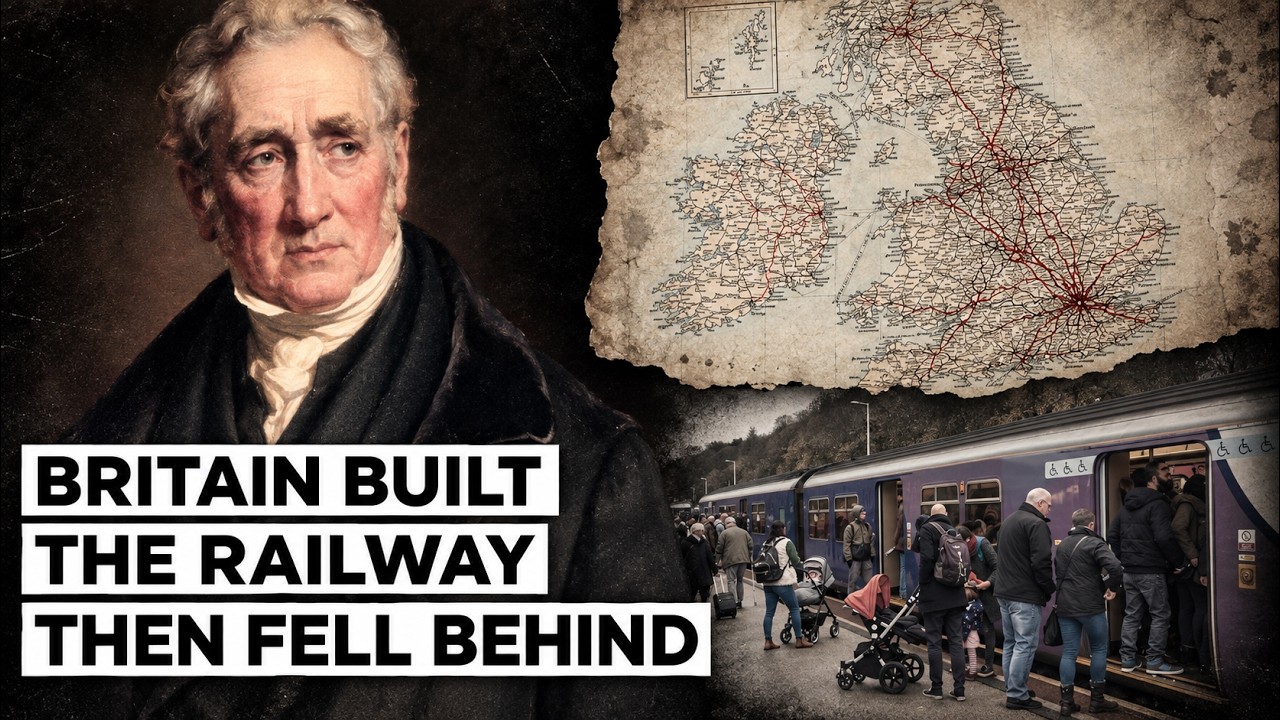
France has the TGV, Japan has the Shinkansen, and China has built more high-speed rail in twenty years than the rest of the world combined. Britain has HS2, an unfinished project that may cost over one hundred billion pounds for a line that currently connects only London and Birmingham. The story of how this happened involves war, greed, political cowardice, ideological stubbornness, a man called Dr. Beeching, and one of the most disastrous privatizations in modern economic history.
In the early nineteenth century, Britain was the workshop of the world, producing more coal, iron, and textiles than any other nation. But moving goods was painfully slow and expensive. Roads were unreliable, canals were geographically and seasonally limited, and anyone moving heavy loads depended on horses, barges, and the weather. The first railways were not built for passengers at all.
They were simple wooden tracks, sometimes reinforced with iron strips, laid by mine owners to move coal from pit to river or dock. These wagonways dated back to the 1560s. A wheeled vehicle running on a smooth guided track required far less effort than one dragged over dirt, and the efficiency gains caught the attention of engineers. By the early 1800s, steam technology had matured enough for someone to put an engine on rails.
George Stephenson, born in 1781 in Northumberland, was the son of a coal miner. He could not read until he was eighteen, but he possessed an intuitive understanding of machinery that bordered on genius. In 1825, his locomotive, Locomotion No. 1, hauled the first train on the Stockton and Darlington Railway, a modest project intended mainly for coal.
The real revolution came in 1830 with the Liverpool and Manchester Railway, designed from the start to carry both passengers and freight with regular services, fixed stations, and signaling systems. It used Stephenson’s latest and more powerful locomotive, the Rocket, which had won the famous Rainhill trials in 1829. The line was an immediate success. Demand exceeded all expectations, and the journey between the two cities fell from hours by carriage to minutes by train.
The result was one of the most extraordinary and reckless episodes in financial history. The Railway Mania swept Britain like a fever in the 1840s. Between 1843 and 1846, railway share prices nearly doubled. In 1846 alone, Parliament passed 263 acts authorizing 9,500 miles of new railway.
By 1850, nearly thirty-six percent of Britain’s annual economic output had been spent on railway development. The mania produced vast wealth but also frauds, the most notorious being George Hudson, a cloth merchant from York who became known as the Railway King. Through mergers, political manipulation, and outright fraud, he controlled nearly a third of Britain’s railways by the mid-1840s. He paid shareholders generous dividends not from operating profits but from capital raised by selling new shares, a pyramid scheme in every sense.
When the bubble burst in the late 1840s, Hudson was exposed for embezzlement, bribery, and insider trading. He lost everything and spent the rest of his life in obscurity. Yet despite the recklessness, the physical infrastructure that emerged was world-class. By 1870, Britain had about 13,500 miles of railway.
At the system’s peak before World War One, there were nearly 20,000 miles operated by more than 120 competing companies. But the network was built by dozens of private firms, each with its own ideas about gauge, signaling, station design, and routes. Lines duplicated each other, stations were placed for competitive advantage rather than passenger convenience, and there was no central planning. Because each line required its own act of Parliament, and many MPs were investors in the companies they voted to license, the system was steeped in conflicts of interest from the start.
World War One delivered the first major shock. The government took control of the railways and ran them as a unified system for the first time. By the end of the war, much of the infrastructure had worn out. Rather than return to the chaos of more than a hundred competing companies, the railways were reorganized in 1923 into four large regional groups known as the Big Four.
The interwar years brought new challenges as cars became affordable and the Great Depression reduced passenger numbers. World War Two placed even greater strain on the system, and by 1945 the infrastructure was in very poor condition. The new Labour government under Clement Attlee nationalized the Big Four on January 1, 1948, merging them into a single entity called British Railways. Nationalization brought order and investment, but it also brought politics.
The government wanted to protect coal-mining jobs, so there was fierce resistance to switching from steam to diesel or electric power. Between 1948 and 1953, British Railways built nearly 1,500 new steam locomotives while France was beginning to plan electric high-speed trains. The timing could not have been worse, as the 1950s brought a revolution in personal transport that the railways were entirely unprepared for. Car ownership surged, buses expanded, and trucks took freight that had once moved by rail.
By the late 1950s, British Railways was in serious financial crisis, with operating losses reaching 104 million pounds in 1962, equivalent to more than a billion pounds today. The government found its solution in Richard Beeching, an industrial physicist and businessman who was chairman of Imperial Chemical Industries. In 1961, the Conservative government of Harold Macmillan appointed him chairman of British Railways with a mandate to make it profitable. Beeching conducted a comprehensive study of every line, station, and service, and his first report, published in March 1963, revealed that about a third of the network carried only one percent of total traffic.
He recommended closing 2,363 stations, abolishing 5,000 miles of railway, and eliminating 67,700 jobs. The reaction was immediate and angry. Protests broke out across the country. The poet John Betjeman campaigned to save threatened lines, and rural communities begged for mercy, but the government was determined.
Between 1963 and the early 1970s, nearly 4,000 miles of railway and more than 2,000 stations were closed in what became known as the Beeching Axe. Entire towns lost their railways, local economies weakened, and communities that had been connected to the national network for over a century were suddenly isolated. But the cuts failed their primary purpose. The savings amounted to only about 30 million pounds a year, while total losses continued to exceed 100 million.
The underlying problems, lack of investment, outdated technology, competition from roads, and political interference, remained unaddressed. The lines were not just closed but dismantled, with rails ripped up, bridges demolished, and land sold off. Today, reopening many of these routes would require starting from scratch. While Britain was dismantling its railways, Japan opened the Shinkansen in 1964, the world’s first high-speed train, connecting Tokyo and Osaka at speeds up to 210 kilometers per hour.
It was safe, reliable, profitable, and enormously popular. France was inspired and began planning its own high-speed network in the late 1960s. After the 1973 oil crisis made the project more attractive, France built the TGV, opening the first line between Paris and Lyon in 1981. It was a commercial success from day one and became one of the most profitable railway lines in the world.
Germany followed with its InterCity Express in 1991, Spain built its own high-speed network, and China embarked on building the largest network in the world, with over 40,000 kilometers of high-speed lines by the 2020s. Britain, meanwhile, did not open its first high-speed line until 2007. High Speed 1, a 67-mile route connecting London’s St Pancras station to the Channel Tunnel, was essentially a French railway built on English soil. It was excellent, but it was one line serving one route, decades behind what other nations had achieved.
In 2009, the Labour government proposed HS2, a high-speed line from London to Birmingham, then branching north to Manchester and Leeds. The original cost was estimated at about 33 billion pounds for the entire network. By 2020, the funding for the first phase alone had risen to 44. 6 billion pounds.
By late 2023, analysts estimated the final cost of just the first phase could reach 60 billion pounds. The project suffered from delays, mismanagement, and political hesitation. Independent reviews in 2025 revealed a catalogue of failures: contracts awarded too early, excessive scope changes, poor cost management, high leadership turnover, and allegations of fraud in the supply chain. There was even a widely documented case of a bat tunnel, built to protect a bat colony, that ended up costing more than the railway section it was meant to protect.
In October 2023, Prime Minister Rishi Sunak announced that the northern leg, from Birmingham to Manchester, would be cancelled. Fifteen years of planning and 2. 3 billion pounds already spent on preparatory work were abandoned. In October 2024, the new Labour government confirmed it would not revive the cancelled sections.
HS2 now consists of a single line connecting London to Birmingham, not opening until the mid-2030s at a cost that may exceed 100 billion pounds. To understand why HS2 failed so spectacularly, one must understand the deeper structural problems of British railways. This leads to privatization, the most significant and controversial decision since nationalization itself. In the early 1990s, British Railways was showing signs of improvement, with passenger numbers rising and government support low.
But the Conservative government under John Major decided to privatize the railways. On April 1, 1994, the Railways Act took effect. The government split the railway into more than one hundred separate parts. The tracks, stations, and signaling infrastructure were handed to a private company called Railtrack.
The trains themselves were sold to three rolling stock companies, which leased them back to operators at market rates. Train services were run by private companies through competitive bidding. The result was a chaos of contracts, overlaps, and conflicting incentives. Railtrack owned the tracks but contracted maintenance to outside companies, which often subcontracted to smaller firms.
No one had a complete view of the system, and responsibility was so fragmented that it was sometimes unclear who was at fault when something went wrong. Disasters followed. In September 1997, a high-speed train passed a red signal near Southall and collided with a freight train, killing seven people. An automatic train protection system that would have prevented the accident had been installed but was not working.
In October 1999, another train passed a red signal at Ladbroke Grove near Paddington and collided head-on with an oncoming train, killing 31 people. The public inquiry found that the signal had been passed at danger eight times in the previous six years, and that an automatic braking system had been rejected for cost reasons. Then came the worst disaster. On October 17, 2000, a train derailed at Hatfield in Hertfordshire after passing over a section of track known to have serious cracks for months.
Four passengers died. Railtrack and its maintenance contractors had known about the problem but failed to make repairs. In the aftermath, Railtrack imposed emergency speed restrictions across large parts of the network, paralyzing services for months. The company’s share price collapsed, and in October 2001 Railtrack was placed in administration, eventually replaced by Network Rail, a nominally private but effectively state-owned body.
Meanwhile, the rolling stock companies had made an extraordinary deal, buying the British Rail fleet at rock-bottom prices and leasing it back at inflated rates. The cost of leasing trains became one of the largest single expenses for operators, draining money from the system. The franchise system created perverse incentives, with companies competing fiercely for franchises by promising ambitious targets and low subsidies, only to discover the economics did not work. Many franchise operators had to be bailed out or re-let.
Yet despite all this dysfunction, passenger numbers rose by more than 120 percent between privatization and the pandemic in 2020, faster than in France or Germany, though there is fierce debate over whether this growth happened because of privatization or despite it. The pandemic exposed the fragility of the entire model. When lockdowns emptied the trains in 2020, the franchise system collapsed almost overnight, and the government had to intervene with emergency contracts. Today, Britain has the oldest railway infrastructure in the world, with signals, track layouts, and station designs still bearing the imprint of decisions made in the 1840s and 1850s.
The network is congested, reliability has declined, and the cost of maintaining this aging infrastructure keeps rising. France’s TGV network covers nearly 3,000 kilometers of dedicated high-speed track. The Shinkansen carries more than 350 million passengers a year with a punctuality record British operators can only dream of. China’s high-speed network, which did not exist at the turn of the millennium, now surpasses any other system on earth.
The contrast is not just about speed but about national ambition. When Japan built the Shinkansen, it was a declaration of intent. When France built the TGV, it was a statement that railways had a future, not just a past. When China built its network, it proved what happens when a nation commits fully to infrastructure investment without being constantly hindered by politics.
Britain has made no such statement. HS2 was supposed to be that statement, but instead it became a monument to hesitation, cost overruns, and political short-sightedness. The northern leg, which was meant to transform connectivity between London and the northern cities, was sacrificed because no government was willing to commit the resources needed. The deeper problem is that Britain seems unable to build large-scale infrastructure at reasonable cost and on reasonable schedules.
The Victorian builders, without modern technology or safety standards, created 20,000 miles of railway in a few decades. Today, with far more advanced technology and much greater national wealth, the country cannot build a single high-speed line without it becoming a national embarrassment. Land costs are astronomical, environmental regulations are far stricter, and modern construction supply chains involve layers of contractors and subcontractors, each taking their share. But much of the problem is cultural and political.
Britain has never developed the long-term infrastructure planning culture found in France, Germany, or Japan. Every major project is hostage to the electoral cycle. Governments announce ambitious plans to win votes, then quietly cut or cancel them when costs rise and political circumstances change. The story of Britain’s railways is, in many ways, the story of Britain itself, a nation that was once pioneering and bold, then allowed complacency, political division, and short-term thinking to undermine the very things that made it great.
The Victorians who built the first railways believed that connecting places and people would create wealth, opportunity, and progress, and they were right. Other nations understood that railways are not just about moving people from one place to another but are an expression of ambition, a reflection of what kind of nation you want to be. Britain has not yet answered that question, not about railways and perhaps not about much else either. The railway lines that George Stephenson created nearly two centuries ago still exist, buried under layers of compromise, neglect, and institutional dysfunction.
The question remains whether anyone still has the vision and will to build something new on top of them, or whether the country that invented the modern railway will continue to depend on the remnants of a system that reached its peak before the twentieth century began.
