On an August afternoon in 2018, Dr. Marcus Webb was cataloging donations at the Montgomery Historical Society in Alabama when a studio portrait stopped him cold. The photograph showed a black family of five posed against a painted backdrop—professional lighting, careful composition, expensive. The father stood dignified beside an ornate chair; the mother sat gracefully with folded hands; three children surrounded them, a boy of twelve, a girl of nine, a younger boy of six.
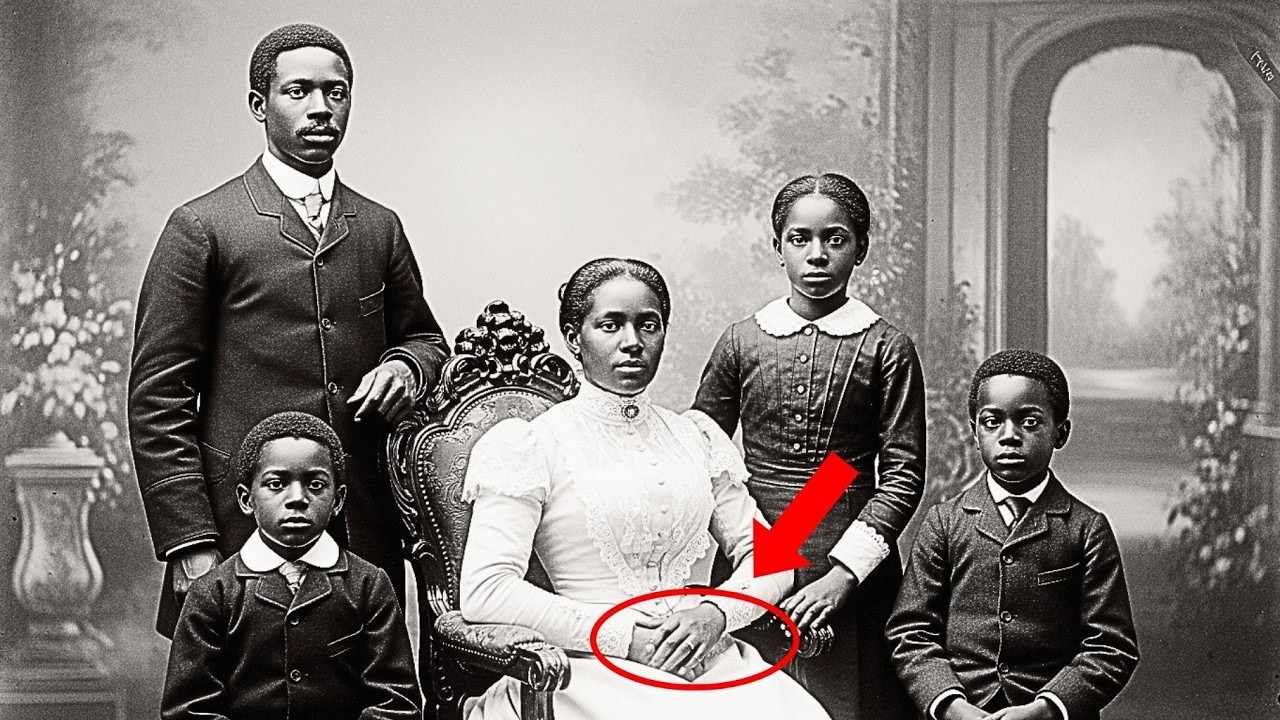
All wore fine clothing that spoke of prosperity. On the back, someone had written: The Harris family, Montgomery, Alabama, June 1890. Twenty-five years after emancipation, this family had clearly achieved success. But something troubled Marcus.
The parents’ eyes held weariness beneath the formal dignity. The children’s smiles seemed rehearsed. The mother’s hands were positioned with unnatural precision. He pulled out his magnifying glass and examined the photograph closely—faces, clothing, the painted backdrop.
Then he focused on the mother’s hands, and his breath caught. On her left wrist, barely visible beneath lace trim, was a faint scar, a thin mark curving around the wrist, the signature of iron shackles. He leaned closer. The scar was unmistakable.
But this was 1890, a quarter century after slavery had supposedly ended. Such marks should have faded—unless they were more recent. He examined her right wrist. Another scar, more hidden.
Both wrists bore bondage marks. He shifted to the father’s hand resting on the chair. The same faint scarring. Marcus sat back, heart pounding.
This wasn’t just a successful family portrait. These people were hiding something. If his suspicion was correct, they were escaped slaves posing as free citizens, carrying proof of bondage on their skin. They had walked into that studio, given a false name, and documented their new life—either extraordinary courage or desperate hope, proof to themselves that they had truly made it to freedom.
Marcus immediately began researching the Harris family. He searched census records, city directories, property registrations, church memberships—anything that might confirm their existence in Montgomery in 1890. Days passed. Every search came back empty.
No Harris family matching this description appeared anywhere. No property, no business licenses, no voter registration. Nothing. The absence was itself evidence.
Prosperous free black families appeared in civic documents. Complete invisibility suggested deliberate hiding. Marcus expanded his search across Alabama and found several Harris families, but none matched the photograph’s ages or composition. Then he changed his approach.
What if Harris wasn’t their real name? Escaped slaves commonly took new identities—new name, new city, new life, praying no one asked questions. He contacted his colleague Dr. Evelyn Torres, a specialist in photographic analysis and African-American migration.
Evelyn examined high-resolution scans in her lab. “The scarring is real,” she confirmed. “Both parents show marks consistent with long-term shackling. But look at the positioning.
” She pointed at the screen. “The mother’s wrists are angled to minimize scar visibility. The father’s placement does the same. Those lace cuffs aren’t decorative.
They’re concealing evidence. ”
“They knew the scars showed,” Marcus said quietly. “They tried hiding them. ”
Evelyn zoomed in on the mother’s wrist.
“But not completely. Any professional photographer would have noticed the scar and repositioned to hide it entirely—unless the family insisted on this exact pose. ”
“Why not hide them completely? ” Marcus wondered.
Evelyn considered. “Maybe they wanted casual observers to miss them, but knew that someday someone looking closely would see the truth. Maybe this photograph was insurance—proof of what they escaped, hidden in plain sight. ”
Marcus felt chilled.
“We need to find who they really were. Where they escaped from. ”
He spent the next week in archives, searching plantation records and newspapers. If they had escaped, there would be documentation.
Even after 1865, owners hunted people who left, calling them absconded contracted workers. Finally, he found it. The Montgomery Advertiser, April 1889. A reward notice for Joseph and Ruth, contracted workers who had abandoned their obligations at Riverside Plantation, Georgia, in March 1889.
Three children missing. Contact the Thornton Estate. Joseph and Ruth—not Harris—had escaped from Georgia fourteen months before the photograph was taken. The description continued: Joseph, age thirty-five, carpenter.
Ruth, age thirty, seamstress. “Dangerous fugitives. ” Dangerous, the notice implied, for wanting freedom. Marcus contacted the Georgia State Archives and requested Riverside Plantation records.
Within days, digitized documents revealed the brutal machinery behind the reward notice. Riverside operated on debt peonage contracts that bound formerly enslaved people in perpetual servitude, differing from slavery only in name. The records showed Joseph contracted in 1875—ten years after emancipation. His contract claimed debts for food and shelter during his transition to freedom.
Ruth was contracted in 1876. They married in 1877, documented as if the owner’s permission mattered. Each child’s birth increased their debt. The ledgers showed charges for midwives, extra rations, lost productivity.
First child 1878, second 1881, third 1884. Each birth added fifty to seventy-five dollars—impossible amounts when labor was credited at pennies a day. The arithmetic was designed to be inescapable. Marcus traced their account balances year by year.
Despite constant labor, the debt grew. By 1889, Joseph and Ruth owed over eight hundred dollars. They would need decades more work, and new charges ensured they never succeeded. The contracts were legal masterpieces, dense language that appeared legitimate while creating permanent bondage.
Joseph and Ruth had agreed to work until their debts were fully satisfied, with the owner holding sole authority over the amounts and what would satisfy them. No appeals. No oversight. No escape.
Worse were the provisions allowing transfer of their obligations. They could be sold—though the paperwork called it “contract assignment. ” Marcus found evidence of three transfers between 1875 and 1885 before they reached Riverside. Then came the final entry.
March 12, 1889: Joseph and Ruth present for work. By March 13, they had vanished with three children. An immediate search was organized. Law enforcement notified.
Rewards posted across Georgia and Alabama. But they had planned carefully. March was planting season, when plantations focused on crops and guards watched the fields, not the quarters. Joseph’s carpentry skills meant he knew how to move silently, how to avoid roads, how to cover tracks.
Montgomery lay one hundred miles from Riverside—reachable on foot in two weeks if you traveled at night and hid by day. Far enough that owners might not search immediately. And Montgomery had a growing black community where newcomers could blend in, find work, and disappear. With Joseph’s carpentry and Ruth’s sewing, they possessed marketable talents requiring no references.
A construction boom meant work without questions, cash payment, no documentation. In black communities, good work mattered more than papers. By July 1889, church records showed one “Harris, Joseph, carpenter” joining Dexter Avenue Baptist Church. They had made it.
They had disappeared successfully. Marcus pieced together how they survived those first desperate months. With their skills, they found work quickly—Joseph on construction sites where bosses cared about ability, not background; Ruth taking in sewing at home while watching the children. No references needed, just good work and word of mouth.
They chose the name Harris carefully: common enough not to attract attention, not so common that anyone would question it. They had arrived in late March or April 1889, found work immediately, and felt secure enough by July to join a church—a significant step showing they believed they had truly disappeared. But the fear never left. Every knock on the door could be slave catchers operating as “contracted worker recovery agents.
” Every white stranger could represent the Thornton estate. Every newspaper might carry their descriptions, their real names, the rewards. The June 1890 studio photograph took on new meaning. Fourteen months after their escape, they had saved enough for professional portraits—fine clothing, a formal setting, careful composition.
An extraordinary achievement. But more than achievement, it was defiance. Walking into that studio as the Harris family, they declared their freedom, created proof that they existed under a new identity, a new life. The photograph was documentation, evidence, a claim to legitimacy.
Marcus now understood why they positioned themselves so carefully, why the scars remained partially visible. They were hiding from the world, but not from history. Perhaps hoping that someday someone would look closely enough to see the truth, understand what they had escaped, understand the courage it took to build this life. Evelyn discovered more.
The Montgomery City Directory for 1891 listed Joseph Harris operating a small carpentry shop on Commerce Street. By 1893, the listing read: Harris Carpentry—Custom Furniture and Home Repairs. They were not just surviving; they were thriving, building a legitimate business under their chosen names. But the fear never disappeared.
There were no property records in their name—they rented, avoiding permanent documentation. No voter registration, despite black men having that right in 1890s Alabama. No business licenses that required extensive paperwork. They remained invisible while building a life.
The studio portrait represented the peak of their success and their greatest vulnerability. Formal documentation of the Harris family meant a permanent record that could someday be discovered. But they took that risk, needing proof for themselves and for their children that they were truly free. Marcus found school enrollment records.
In September 1889, three Harris children enrolled at Centenary Methodist Church School: James Harris, eleven; Elizabeth Harris, eight; William Harris, five. False names, like their parents’, but a real education, real opportunity. Attendance records were consistent through the early 1890s. These children were learning to read and write—skills their parents likely never fully acquired.
This was why Joseph and Ruth had risked everything. Marcus’s research took a devastating turn when Evelyn found a death notice. The Montgomery Examiner, February 1897: “Harris, Ruth, age 38, suddenly. Survived by husband Joseph and three children.
Services at Dexter Avenue Baptist Church. ”
Marcus read it repeatedly, his heart sinking. Ruth had died just eight years after escaping to freedom, at only thirty-eight. The word “suddenly” suggested an accident or acute illness, not a prolonged sickness.
The studio portrait from 1890 had captured her in one of her few moments of peace. Seven years later, she was gone, leaving Joseph to raise three children alone under a false identity. Still fearful of discovery, Harris Carpentry disappeared from the city directories after 1897. Church records showed Joseph through 1898, then nothing.
The children’s school enrollment ended in 1897. The family had left Montgomery entirely—perhaps unable to sustain themselves after Ruth’s death, perhaps finally discovered by Thornton agents. Evelyn suggested searching other cities where Alabama black families commonly migrated: Atlanta, Birmingham, Nashville, and northern cities like Chicago and Detroit. Weeks passed with nothing.
Then a genealogist named Dr. Patricia Holmes in Philadelphia emailed Marcus. “I may have information about your family,” she wrote. “I’ve been researching black migration to Philadelphia in the 1890s.
Found records that might match. ”
Patricia had discovered Mother Bethel Church records listing a Joseph Harris, carpenter, joining in August 1898 with three children—James, Elizabeth, and William. The ages didn’t quite match the Montgomery records; these children were listed slightly older. It could have been intentional misrepresentation.
But what caught her attention was a notation: “Family relocated from Alabama following death of wife and mother. ”
Marcus’s pulse quickened. Joseph had fled Montgomery after Ruth’s death, taking the children north to Philadelphia, where they could truly disappear. Philadelphia in the 1890s had a substantial black community with established churches, schools, and mutual aid societies.
A skilled carpenter could find steady work. The children could attend better schools than were available in the South. And most importantly, Philadelphia was far enough from Georgia that the Thornton estate’s reach would be limited. Marcus found records showing Joseph Harris operating a small carpentry business in Philadelphia’s Seventh Ward from 1899 to 1911.
The business appeared moderately successful, employing several workers by the mid-1900s. Property records showed that Joseph purchased a small house in 1905—the first time he had owned property in his own name, even if that name remained false. After decades of bondage, contracts, and fear, Joseph finally owned something. The children’s records were harder to trace.
James attended Philadelphia public schools through 1895, then disappeared from the rolls, likely beginning work after his mother’s death. Elizabeth appeared through 1898, William through 1902. What happened after? Did they know their real family name?
Did Joseph tell them about Riverside, the escape, the life they had fled? Marcus found a possible answer in an unexpected place. A death certificate from Philadelphia, 1918. Joseph Harris, age sixty-four, carpenter, died of influenza during the epidemic.
Survived by sons James and William. No Elizabeth mentioned, suggesting she had married, changed her surname, moved away, or died. The certificate listed Joseph’s birthplace as Virginia—a lie, since the plantation records clearly showed him at Riverside since 1875, likely born in Georgia or sold there young. Even in death, Joseph maintained the false identity, protecting his children.
His real name, his real history, his courageous escape—all buried with him under the name Harris. Marcus felt a profound sadness for a man who had lived his entire adult life hiding, never able to claim his true identity, never recognized for his extraordinary courage. Joseph had escaped slavery twice. First in 1865, when emancipation supposedly freed him.
Then again in 1889, when he took real freedom for himself and his family. Then Patricia Holmes made a crucial breakthrough. Searching the Riverside records more carefully, she found a document Marcus had initially overlooked: a marriage record from 1877. “Joseph Freeman, aged 23, to Ruth Williams, aged 21, both contracted workers of Riverside Plantation, Burke County, Georgia.
Marriage approved by estate management. ”
Freeman and Williams. Their real surnames, recorded in the plantation’s meticulous documentation. Joseph Freeman and Ruth Williams, who became Joseph and Ruth Harris, who risked everything to save their children from bondage.
Marcus traced Ruth Williams through the plantation records, finding her listed as arriving at Riverside in 1876, transferred from another property. Before that, her trail disappeared into the chaos of Reconstruction. Joseph Freeman’s history went slightly further. He had been purchased by Riverside’s owner in 1875 from a Virginia plantation and brought south for his carpentry skills.
Now Marcus finally knew who they truly were. Not just fugitives, not just the Harris family, but Joseph Freeman and Ruth Williams Freeman. Real people with real names who had been stolen, sold, contracted, and finally freed themselves. In March 2019, Marcus published his findings in the Journal of American History: “The Freeman Family Portrait: Fugitive Freedom and Hidden Evidence in a Reconstruction Era Photograph.
” The article included high-resolution images showing the scars clearly, alongside the plantation records, the reward notices, and the trail of evidence showing the escape and the rebuilt lives. The response was immediate and overwhelming. Historians recognized the significance—photographic evidence of escaped debt peonage workers, documentation of a system that kept black people enslaved decades after the Civil War ended. News outlets nationwide picked up the story.
The studio portrait appeared on front pages, on television, on social media. Ruth’s partially hidden scars, invisible for 129 years, now testified to millions about the reality of post-Civil War freedom. Educational programs incorporated the Freeman family story into curricula about Reconstruction, debt peonage, and the long struggle for actual freedom that extended far beyond 1865. The Montgomery Historical Society organized an exhibition, “Hidden Freedom: The Freeman Family and the Price of Escape.
” Thousands came to view the evidence of courage preserved in a simple family photograph. But Marcus wanted more than academic recognition. He wanted descendants of Joseph and Ruth Freeman. Did any of their children’s children survive?
Did anyone carry forward the Freeman name, or had it remained buried under the Harris alias? Patricia helped search Philadelphia records for James, Elizabeth, and William Harris. James appeared in city directories as a carpenter like his father, operating a small business until his death in 1945. William appeared as a railroad worker, dying in 1951.
Elizabeth remained elusive until they found a marriage record from 1899: Elizabeth Harris to Robert Thompson, a Philadelphia schoolteacher. Through marriage records, death certificates, birth records, and census data, Marcus and Patricia slowly traced the descendants forward through the twentieth century. Some remained in Philadelphia. Others moved to New York, Chicago, and Detroit during the Great Migration.
The family had branched and spread—and none of them, it appeared, knew their true family history. Then Marcus’s article caught the attention of a woman named Diana Thompson in Chicago. She contacted him through the historical society. “Your article mentioned Elizabeth Harris in Philadelphia in the 1890s,” Diana wrote.
“Could this be my great-great-grandmother? We have family stories about Philadelphia, but nothing before that. ”
Marcus and Diana spent weeks comparing records, tracing genealogies, confirming connections. Eventually, the evidence became undeniable.
Diana Thompson was the great-great-granddaughter of Elizabeth Freeman, daughter of Joseph and Ruth Freeman, who escaped Riverside Plantation in 1889. Diana had grown up knowing her family came from Philadelphia, but nothing about the deeper history. Nothing about Georgia or Alabama or a desperate escape. Marcus sent Diana copies of everything—the studio portrait, the plantation records, the reward notices, the documentation of her ancestors’ courage.
Diana called after receiving the materials, her voice shaking. “I’m looking at my great-great-grandparents right now, Joseph and Ruth. I never knew their real names. We always thought Harris was our original family name.
I never knew they were fugitives. I never knew about the scars. ”
She paused. “My great-grandmother Elizabeth died when I was young.
But I remember she used to say something strange: ‘Remember, we paid for our freedom twice. ’ I never understood. Now I do. They were born into slavery, supposedly freed in 1865, then had to escape again in 1889 because freedom was a lie.
”
Marcus helped Diana connect with other descendants. They found relatives nationwide—dozens descended from Joseph and Ruth Freeman, none aware of the full story. In November 2019, twenty-three descendants gathered in Montgomery for a family reunion and memorial service. They stood together at Dexter Avenue Baptist Church, where Joseph and Ruth had first felt safe enough to join a community under assumed names.
Diana spoke, holding a large print of the studio portrait. “Our ancestors Joseph Freeman and Ruth Williams risked everything for us. They escaped from a system designed to keep them enslaved forever. They lived in constant fear of discovery, but they did it so their children could grow up truly free.
”
She continued, addressing the gathered descendants. “This photograph is evidence of their courage. Ruth’s scars are visible because she wanted someone someday to know the truth—to understand what freedom cost, to remember that it wasn’t given freely. It had to be taken, fought for, protected every single day.
”
The family commissioned a memorial marker to be placed in Montgomery, near where the photography studio once stood: “In memory of Joseph Freeman and Ruth Williams Freeman, who escaped from bondage in 1889 to build a life of freedom for their children. Their courage preserved in a photograph, their legacy lives on in us. ”
Marcus attended the ceremony, watching the descendants gather around the marker—children, grandchildren, and great-grandchildren of people declared “dangerous fugitives” for wanting freedom, all living the life Joseph and Ruth had fought to create. An existence without fear, without contracts, without someone claiming to own their labor.
After the ceremony, Diana approached Marcus. “Thank you for seeing what no one else saw for 129 years. For looking closely enough to notice my great-great-grandmother’s scars. For caring enough to find the truth.
”
Marcus shook his head. “Ruth wanted someone to see. She made sure the evidence was there. I just happened to be the one who finally looked closely enough.
”
The memorial became a pilgrimage site for descendants and others moved by the story. People came from across the country to see the marker, to understand what Joseph and Ruth had risked. Local schools organized field trips, teachers using the Freeman family story to teach students about the reality of Reconstruction. The studio portrait traveled to museums nationwide—first Montgomery, then Atlanta, Chicago, Washington DC.
At each location, historians searched their own archives for similar photographs, finding dozens that showed evidence of continued bondage, debt peonage, sharecropping, and exploitation decades after 1865. The Freeman portrait had opened a door, revealing how much history had been hiding in plain sight. The American Historical Association issued a statement acknowledging that the Reconstruction narrative had been incomplete, that slavery’s end was far more complicated and prolonged than previously taught. Textbook publishers began revisions.
Churches across the South organized oral history projects, recording testimonies from elders who remembered family stories about the decades after emancipation. The stories poured out—generations of trauma and survival finally being documented. But the most powerful impact was on the Freeman descendants themselves. Diana Thompson became a speaker and educator, traveling to schools and universities to share her ancestors’ story.
She always brought copies of the studio portrait, pointing out the scars her great-great-grandmother had deliberately left partially visible. “Ruth Freeman wanted us to know,” Diana would tell audiences. “She couldn’t write down the truth. She probably couldn’t write at all.
She couldn’t leave letters or diaries. But she had this photograph, and she made sure it contained evidence. Those scars were her testimony, preserved for 129 years until someone finally saw them and understood. ”
The Freeman family story challenged comfortable narratives about American freedom.
It forced a confrontation with the reality that emancipation was a process, not an event. And for many black families, true freedom came not from government proclamation, but from dangerous acts of self-liberation. Joseph and Ruth Freeman hadn’t waited for the system to grant freedom. They seized it, knowing the risks, choosing their children’s futures over their own safety.
Marcus often thought about that choice—about what it took to walk away from Riverside Plantation in the darkness of March 1889. Joseph and Ruth had three children to protect. No money, no resources, every reason to believe they would be caught and punished. But they went anyway, traveling one hundred miles on foot, hiding by day, moving at night, driven by the absolute conviction that anything was better than raising children in bondage.
And they succeeded. Their children grew up free, attended schools, learned trades, built lives of their own choosing. Grandchildren and great-grandchildren became teachers, doctors, artists, and activists, living dreams Joseph and Ruth fought to make possible. The photograph remained Marcus’s daily reminder of why historical research mattered, why looking closely at the past was essential, why stories needed telling even when they challenged comfortable myths.
Every time he looked at that studio portrait, he saw Joseph’s protective presence, Ruth’s carefully positioned wrists, the children’s serious faces. He saw courage and fear and hope and determination, all captured in a single moment. Scholars began publishing related research building on Marcus’s work—studies examining debt peonage systems across the South, documenting how many black families remained enslaved under different names decades after 1865. Genealogists helped other families discover their own hidden histories of escape and survival.
Photographers examined historical images with new awareness, finding similar evidence in unexpected places. The Freeman portrait sparked a broader conversation about how history gets told, who gets remembered, whose stories are preserved versus buried. It raised questions about complicity: how many white Americans knew that systems like Riverside Plantation existed but said nothing? How many benefited from the legal exploitation of black labor while claiming slavery had ended?
Marcus received letters from people across the country, many sharing their own family stories of grandparents or great-grandparents who had escaped similar situations—stories that had been whispered in families but never publicly told, never documented, never acknowledged in official histories. The Freeman portrait had given permission for these stories to emerge, validation that they mattered and deserved recognition. Diana Thompson organized annual gatherings for Freeman descendants, creating a community around their shared ancestry. At the second reunion in 2020, forty-seven family members attended, nearly twice the first year’s number.
More relatives kept emerging as word spread. DNA tests confirmed connections. Genealogical research connected branches separated for generations. The family Joseph and Ruth had fought to protect and free was coming back together, stronger than ever.
Two years after Marcus Webb first noticed the scars in that studio portrait, he sat in his university office surrounded by letters from researchers, students, and descendants—people moved by the Freeman family story. The photograph had changed how people understood Reconstruction, how they taught the history of freedom in America, how they looked at old photographs with an awareness of hidden truths. The studio portrait now hung in the Smithsonian’s National Museum of African American History and Culture, part of a permanent exhibition on debt peonage and the struggle for freedom after the Civil War. Visitors stood before it daily, reading the story, seeing Ruth’s scars, understanding what Joseph and Ruth had sacrificed to give their children a chance at real freedom.
Marcus received emails from researchers who had begun examining historical photographs more carefully, finding similar evidence of debt peonage, sharecropping exploitation, and continued bondage decades after 1865. The Freeman portrait had opened a door. One afternoon, a graduate student knocked on his office door, carrying a box of photographs from a South Carolina archive. “After reading your work, I thought I should examine these more carefully,” she said.
Marcus smiled, picking up his magnifying glass. “Let’s look together. ”
Because Ruth Freeman’s message had been received. Her quiet resistance in that Montgomery studio had opened eyes nationwide to truths hidden for over a century.
Every photograph deserved a second look. Every story deserved telling. Every scar, every mark, every subtle detail might be evidence of courage, of survival, of people fighting for freedom when freedom was denied. Their story was no longer hidden.
Their courage was no longer forgotten. Their legacy lived on.
