In the autumn of 1966, a demolition crew from Baton Rouge drove out to a low bend of the Mississippi River in West Feliciana Parish, Louisiana, to tear down what the parish called the Beauchamp house. It was a plantation mansion, three stories of brick with a columned porch, empty for a full generation, its windows clouded over and its gardens swallowed by brush. The demolition was supposed to take four days. It took eleven.
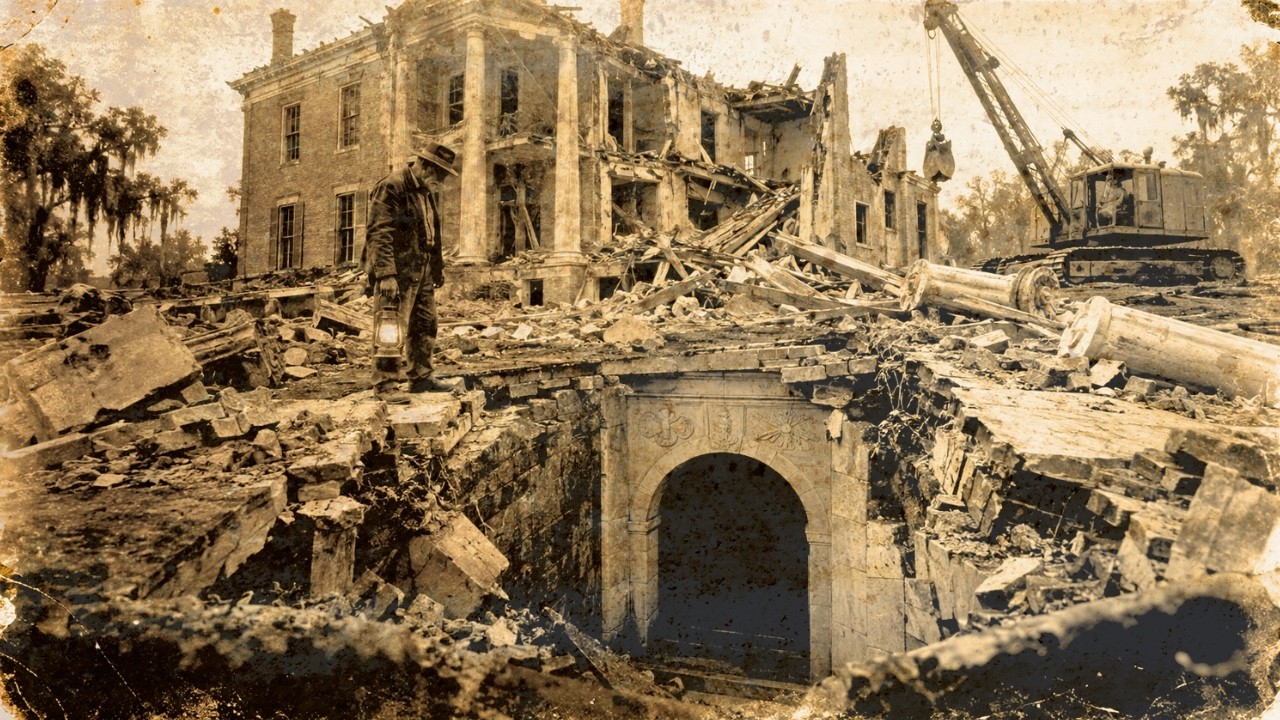
On the third day, when the crew punched through the basement floor to reach a cornerstone they wanted to save, the foreman, a man named Roy Petitbone, wrote a single line in the work log and then stopped writing in it entirely. The line read: “The cellar is not the bottom. ” Beneath the basement, under a slab that no deed, survey, or living memory of the house mentioned, they found a second floor of cut stone, square, dry-stacked without a trace of mortar, with a low arched entrance and a stairway going down into the dark, carved into the stone above that entrance. Symbols that no one on that crew, and no one the parish brought in to look at it afterward, could read.
The house came down. The hole was filled. Within a season, the parish agreed, the way parishes sometimes agree without holding a vote, to forget that anything had ever been found under the Beauchamp house at all. Photographs, if any existed, never surfaced.
The salvaged stone was moved off and used in a levee project and never seen again. Roy Petitbone, who lived another thirty years in that parish, told his grandchildren only that they had dug under the wrong house, that some houses have a house under them, and that the second one was there long before the first. This is the story of the Beauchamp plantation and the thing under its cellar, and where it came from, and who buried it, and why the people who could have answered the question chose, again and again, to fill the hole instead. Start with what can be verified, because that is where the ground is firmest.
West Feliciana Parish sits on the east bank of the Mississippi, north of Baton Rouge, in that stretch of Louisiana where the great houses crowd along the river road. The official history of the region is confident. It has plantations with known founding dates. It has founders with names and painted portraits.
It has a story, clean and often repeated, of wilderness and swamps cleared by imported labor and turned, across two generations, into an empire of cotton and sugar and brick. In that story, the Beauchamp house had a founding date too. Parish records place its construction in the 1830s, built by a planter named Hillaire Beauchamp on land his family claimed title to a decade earlier. Consider those dates closely, because they are the first disturbing number in a story made almost entirely of disturbing numbers.
The 1830s. That is not ancient time. It is not a fog of a thousand years where anything could have happened unrecorded. It is close.
It is within living memory. A house whose builders had grandchildren who lived into the age of the automobile. Which means that everything found under the basement in 1966 was, according to the official account, put there within a window of time short enough for someone to explain it. And no one ever did.
The mainstream answer, of course, is that the second floor under the cellar was simply an older structure over which the Beauchamp house had been built. A prior structure, the foundations of an older building, a colonial French trading post, or a Spanish site, reused by the planter who came later, the way builders have always reused what came before. It is a good explanation, and for a certain kind of person it closes the case entirely. Keep it in your pocket.
You will need it more than once. But it has a problem, and the problem is the stone. Because a reused colonial foundation would be brick, or rough fieldstone, or the soft local sandstone the whole parish was built from. It would be mortared.
It would be crude because it was meant to be buried, meant to bear weight and nothing more. That is not what the crew described. The three men who were still alive and who spoke about it decades later, who were named in a parish oral history project that was quietly shelved and never published, agreed on the same details even though they agreed on nothing else. The stone under the cellar was not brick and not sandstone.
It was pale, hard, fine-grained, a stone none of them could name, from a parish with no quarry, no rock outcropping, no source of hard stone for a hundred miles in any direction. The blocks were square-cut. They were set in dry-stack construction without a single grain of mortar. One of them said the joints were so tight a razor blade could not pass through.
The entrance was finished, arched, engineered, decorated. You do not decorate a foundation. And consider who those three men were, because their testimony is the pillar on which this entire story rests. One of them was a mason himself, a workingman who had spent his whole life building river houses.
A man whose entire craft was reading stone and mortar and how a wall holds together. He knew brick the way a man knows the sound of his own name. He knew the soft local sandstone. He knew imported granite.
He picked up a piece of what they found under the cellar and turned it in his hands and said he did not know what it was. He could not name the stone. He could not identify the style of construction. When a man like that says the object in his hands is outside his craft, that is not a farmer confused by a rusted pot.
That is an expert admitting he has been handed something that does not belong to the world he trained in. And the colonial builder reusing an old foundation does not drag pale hard stone from a hundred miles away, cut it to fit without mortar, arch an entrance he intends to seal shut, and carve writing over it that nobody in nineteenth-century Louisiana, French, Spanish, or American, could read. That is not reuse. That is discovery.
Hillaire Beauchamp did not build over an old building. He built over something he had found, and understood, or understood well enough, to bury. Researchers who have gone deep on this puzzle did not care about the Beauchamp house because it was old. They cared because of the date.
The second city, the buried layer, the thing under the thing, keeps showing up in the same time period: roughly the mid-nineteenth to early-twentieth century, when the name “Tartaria” vanished from the maps, when great old buildings were found sunk a full story into the earth, and when the entire inherited world suddenly changed ownership and received a new founding date. Tartaria in the mainstream account was just a name. For hundreds of years, European mapmakers used the word to label the vast, poorly surveyed stretch of central and northern Asia about which they knew almost nothing. A placeholder.
A polite way of writing “here be dragons” across the parts of the map no one from Paris or London had walked. That is the official story, and it is not a mad one. Old maps do indeed say “Tartaria” in giant letters across half the world. Historians will tell you an empire never existed as a unified state, the word was an umbrella term, and there is nothing mysterious about a placeholder disappearing from the map as surveying improved.
Keep that explanation too. But here is where it gets strange. Within that same window, the word “Tartaria” does not just fade from maps. It is erased.
Edition after edition in different languages, published by different houses, all quietly agree to forget the same word at roughly the same time. And not just the name fades in that period. Entire cities do too, according to the people who have spent years studying it. They do not fade.
They get a new deed, a new founding date, a new story that begins conveniently where the old story ends. The theory says what the Beauchamp crew punched through was not a colonial foundation at all. It was a piece of the buried world. The first layer, on which the second was built, sank into the mud or the soil or the time, and then was re-registered, re-dated, and re-founded as the property of a planter who arrived long after the real builders had left.
The researchers insist the erasure was systematic, because it was not one map in one country that lost the name. Map after map printed by different publishers in different languages across the same few decades, all quietly agreeing to forget the same word at roughly the same time. Cartographers who had faithfully copied that label from their predecessors for generations stopped, all at once, within a single working lifetime. The land was still there.
The rivers were in the same places. But the label was gone, and where the label had been, there were now the confident borders of brand-new countries with brand-new names and brand-new founding stories of their own. And this is the same era in which the modern chronology of the entire world was being fixed, when the timelines you learned in school were being written, reviewed, and printed into the first mass-produced textbooks, and drilled into a generation of children young enough to believe anything they were told. The three men went down the stairs.
Roy Petitbone and two others took lamps and went through the arched entrance on the fourth day, before the parish officials arrived and before the hole was filled. What Petitbone told his grandchildren and what one of the other men repeated to the shelved oral history project matched the way two frightened testimonies to a single real thing match. The stairs descended deeper than the cellar. The depth was considerable, deeper than the water table of a parish on the edge of a floodplain should have allowed, where a six-foot hole fills with river seepage by morning.
But this stone chamber was dry. Completely dry. And it was not just a chamber. It was the beginning of a passage, a corridor of the same pale dry-stacked stone running straight into the dark in a line that followed neither the river, nor the road, nor any feature of the ground above.
Petitbone said the walls were smooth as poured glass. Along them at intervals were the same carved symbols as above the door, and below them shallow troughs set into the stone, and inside the troughs there was fine pale dust. And the dust, when one of the men touched it, was warm. You can call that a dying man’s invention meant to frighten his grandchildren.
Maybe it was. But compare it to the ordinary explanation. Even if the warm dust was a tall tale, and even if the passage was ten feet long instead of a hundred, you still have polite, dry, imported stone laid in a straight line under the plantation, older than the plantation itself, inscribed with text the people of that century could not read. The most extravagant detail may be false, and the load-bearing wall of the mystery still stands.
Someone built that thing in that place out of stone that had to be transported there before the founding date, and left no other record of themselves except the thing the demolition crew stumbled on. And there is a detail about the dryness that stops even a skeptic for a moment, because it does not resolve easily. That parish floods. It has always flooded.
The entire economy of that river region is built on the fact that the Mississippi overflows its banks and lays down the most fertile soil in the world, and the price of that soil is water; standing water, water in every low spot, water that fills a grave before the mourners get home. A dry chamber below the water table in that ground is a real physical oddity. Either the passage was sealed so tightly so long ago by builders who understood water in a way the planters above them did not, that it stayed dry through over a century of floods, or the dryness is an exaggeration, a detail swollen in retelling. Both are possible.
But notice which one the ordinary account requires. To keep the boring story, you have to throw out the dryness. And the moment you throw it out, you are editing testimony to fit the conclusion, which is exactly what the skeptic accuses the believer of doing. The argument was never meant to rest on one cellar in one parish.
The argument is that this cellar is one of hundreds. Start with the stone itself, because the stone is the thread that ties the Beauchamp house to a much larger mystery. Pale, hard, fine-grained, dry-stacked, and transported from non-local sources. Recall those characteristics and ask what they describe, and the honest answer is that they describe the same anomaly that shows up in account after account across the whole erased window.
Those stately old buildings of the world, the domed courthouses, the columned capitals, the railroad palaces, said to have been built by young muddy frontier communities of a few thousand souls and hard conditions, and yet made of stonework at a level no local crew is recorded as having the skill or the time to reproduce. The researchers propose a simple point that is hard to ignore. When you dig under these places, the buried level is not crude. It is finished and decorated, sometimes with windows.
Rooms clearly built to be lived in at street level in daylight, then buried while still beautiful, and never mentioned by the people who rebuilt above them. This is the phenomenon they call the “mud flood,” and it is as dramatic as it sounds. At some point, the timing fiercely disputed, a wave or series of waves of sediment swept over large parts of the inhabited world. Not a biblical flood over a weekend, though some tell it that way, but a burial.
A slow or sudden accumulation of mud and soil that filled the ground floors of standing buildings, drowned the streets, and left survivors rebuilding atop the new, higher ground. The evidence they point to is everywhere if you know how to look. Ground-floor windows that are now below the pavement, ornate doorways leading into dirt, entire floors that later owners had to dig out again, to find beautiful finished rooms underground that no one recorded building. The argument is strong.
If this were mere ordinary street-level rise, or slow accumulation over centuries, the buried levels would be crude, just foundations and cellars and stores, rough stone meant to be underground. Instead, what gets dug up is finished and decorated and windowed. You do not slowly, over three leisurely centuries, forget that your ground floor had windows. And that is exactly what the Beauchamp cellar was.
Not a rough foundation, but a finished passage, arched and carved and swept, buried beneath a house whose builders, if the theory is right, simply poured over it, and pretended the earth began where they wanted it to begin. You cannot bury a decorated passage by accident. You cannot slowly, over three leisurely decades, forget that your cellar had a second floor with steps leading down. Something put that stone there faster than memory could absorb, and whatever it was, it happened recently enough for the house to still be standing, but far enough into that convenient window for no one who witnessed it to remain.
The skeptic’s answer is patient and fair. The ground rises. This is a real, documented, boring phenomenon. The Mississippi has been depositing silt across that floodplain for ten thousand years, at a rate of a foot per century in flood years, and any structure built low near the river will be swallowed by that silt as surely as night follows day.
Colonial Louisiana was full of French and Spanish sites, trading posts, forts, churches, built and abandoned and built over. The planter in the 1830s building a house on an old riverbank site would certainly find brick and stone under his feet, and would certainly build over it, because that is what builders have always done. Cities around the world have been raised for the most ordinary reasons. Chicago physically lifted itself out of the mud in the 1850s, whole city blocks raised on jackscrews, all of it recorded and photographed and documented.
No catastrophe required. A buried basement near the Mississippi is not evidence of a lost civilization. It is, most of the time, just a river behaving like itself. That is a genuinely strong argument, and you cannot ignore it, because those who do are selling you comfortable certainty, and certainty is the one thing no one in this story has a right to.
But the theory pushes back on ground that actually interests the audience of this story, and that is money. Suppose the river buried the lower level. That explains the silt. It does not explain the stone.
Because the Mississippi carries mud, not square-cut stone blocks set without mortar. Silt does not form an arch for an entrance. The rising river does not carve text no one can read on the wall of a corridor running straight against the nature of the ground. The flood explains why the old level was buried.
It does not explain who built it of stone that had to be carried from a hundred miles away, in a place and time the official history swears was a swamp. Follow the money, because money is where lies unravel. Who benefits from a stone passage built under a Louisiana plantation never being properly examined? Ask that question in 1966 and then ask it in 1835, and the answer starts to take shape because both times it is the same answer.
It is the man whose title to the land depends on the story that he was first. The owner’s entire claim, his deed, his founding date, his right to say this land is mine and I made it worth owning, depends on the story that the land was empty when he came, and the wilderness was tamed by his effort and the hands of his imported workers and no one else’s. What happens to that claim if a demolition crew pulls a decorated passage out of the ground under his cellar, older than his grandfather, built by people the deed does not mention? It does not embarrass the founding date.
It annihilates it. It says the land was not empty. It says someone was here, and built here, and owned here before the deed was written, and the deed is not a record of creation but a record of transfer, from an owner who was erased to an owner who wrote his name as the beginning. No lawsuit fixes that.
There is only the concrete slab poured over it, and the silence poured over the slab. And the slab and the silence are exactly, precisely, what the record says happened at the Beauchamp house twice. Once in the 1830s, when the owner buried it. And again in 1966, when the parish filled the hole and moved the stones to a levee and agreed, without a vote, to forget.
Consider how land ownership actually works, because that is the mechanism at the heart of the whole economic argument. A deed does not just say you own something. It rests on a chain. A chain of previous owners going back to some point of origin, where the land is said to have entered the world of property clean, claimed, granted, as first land.
The entire value of the chain depends on that first link being genuinely first. Now imagine holding such a deed, and imagine your fortune, and the fortunes of the men who lent you money against it, all valued in that single word: first. The only thing that can poison the chain at its root is not a rival claimant with a competing deed, because a competing deed you can sue or buy. The one thing you cannot sue is an old finished structure older than the first link in your chain, sitting in the ground under your house, built by people your deed does not mention.
That structure does not mean another man owns your land. It means the concept of your origin is a fiction, that the land was owned before your beginning, that you did not reclaim a wilderness but moved into a graveyard and changed the locks. There is no clerk who can fix that. There is only the concrete foundation, and they poured it.
Now the hardest honesty is owed. This is a theory of motive without proof of the act. There is no photograph of the passage. There is no surviving block of stone, because it was buried in an earthen levee.
There is a line in a site manager’s logbook that was itself lost, quoted from memory by grandchildren. And an oral history project shelved before publication. Notice how often the primary source in a Tartaria story burns down, or is lost in a flood, or is thrown out in a renovation, or is quietly absorbed by an institution that no longer exists. The believers say this is the fingerprint of a cover-up.
The skeptics say this is what happens to old paper and old testimony, and that memory makes a pattern of loss, and that a theory which treats every lost record as evidence is a theory that can never be wrong, which is the same as saying it can never be right. Both are true at once. That is the maddening core of it. Small parishes lose records in the ordinary way all the time.
Projects run out of money. A volunteer dies. Boxes of cassette tapes sit in a courthouse basement and get thrown out during renovation by someone who does not know what they are. A shelved project by itself proves nothing and hides nothing deliberately.
But the believers’ reply is not about that one project. It is about the correlation. Lost records seem to disappear more than chance would predict exactly in the accounts that documented the anomaly, while ordinary parish records, tax rolls, marriage licenses, crop reports, survive in dusty abundance. And a historian is allowed to notice a pattern of gaps, because it is not just that one seller whose gaps were filled.
It is a whole category of discoveries appearing in the same window, vanishing into the same institutional fog. When the same shaped absence appears again and again in the same place in the record, at some point the absence itself becomes the entrance. There is a principle in accounting that speaks to this. When you cannot audit a transaction directly, you audit the counterparties who benefit from its obscurity, and ask whether the pattern of lost records follows their interests.
If records vanished randomly, spread evenly across all subjects, that is entropy, and entropy acquits everyone. But if the lost records cluster around one category of uncomfortable fact, and the same short list of interests turns out to have been the last to touch each one, then the randomness hypothesis starts to collapse. It does not break. It collapses.
And an honest auditor does not scream fraud when the randomness hypothesis collapses; he opens an investigation. All the frustration in this subject is that the counterparties are dead. Their arrangements dissolved, their boxes and stones buried long ago, and the only thing left to investigate is the shape of the gap they left behind. Consider the founding dates of the great river houses themselves and do the arithmetic the researchers do, because it is the itch you cannot scratch once you feel it.
A plantation on that river road, founded on empty land according to its own plaque, somehow within twenty or thirty years possesses hand-fired brick and polished stone, turned and fluted columns, plaster cornices, ironwork, a scale of ornament that would embarrass an European house. Built by whom? With what skilled labor in a swamp parish of a few thousand souls, from what quarries in a country with no stone, over what roads that barely existed? The official answer is not shallow, to be fair.
Skilled builders and ironworkers moved through the cotton boom chasing money. Wealth flowed from the river trade into prestige projects, and owners competed to out-build each other. Enslaved labor, brutal and vast and documented, made the impossible familiar. Historians have the records, the builders’ names, the sale invoices.
But hold also that doubt, because the theory does not stand on one anomaly, but on accumulation. And the accumulation in that country is thick, because the Beauchamp cellar was not the only thing in West Feliciana that surfaced suspiciously. There are the walls. Along the bluffs above the river, in tracts of forest the maps show as never-cleared land, there are rows of tightly stacked stones running across the high ground with no agricultural purpose anyone can identify.
The parish has no explanation but evasion, guessing that some planter’s slaves must have stacked them, though no record documents the work, no fence follows them, and no field was ever plowed on that wind-scoured bluff where the longest runs. There are the mounds scattered all along the lower Mississippi, tens of thousands of earthen mounds, some older than the pyramids by reliable estimate, raised by a people the textbooks now attribute to the ancestors of Native nations, after being attributed for over a century before that to a vague vanished master race, until the real builders were ignored and their descendants dispossessed. Watch that trick closely, because you will see it again and again in this story. A great developed past, hard for the usual narrative to explain comfortably, is assigned to a fictional vanished people and then quietly kept at a distance so no one has to wonder who was really here and whether they had a claim.
And there are the star forts, which this field always returns to. Even without the more extravagant claims, they are genuinely strange objects. All over the world, within that older stratum, you find fortifications built in the shape of perfect multi-pointed stars, with precise geometrical bastions of stone and earth, surrounded by moats, laid out with mathematical exactness that would challenge a modern surveying team. There are thousands of them, and there are examples along the lower reaches of this very river at the old river-mouth defenses, written off as ordinary military engineering, a well-documented and certainly correct explanation for many of them.
The star shape was a response to cannon. Angle every wall so no shell can hit it squarely, and give each point a clear field of fire across its neighbors’ faces. Ingenious and boring geometry. But the theory looks at the same stars and asks why so many exist in places no army ever threatened, and why the geometry is far more precise than a gun platform requires.
It has no evidence for that claim that survives contact with a real engineer, and the star fort as an energy station is the point where the theory fully detaches from evidence. But notice, again, that you do not need it. You can grant the skeptic every star fort and still hold the real question, which was never about machines. It was about money.
Who owned the network? Who lost it? And who wrote the deed that claimed it was always theirs? There is the problem of aluminum, which belongs in this story too, because the stone under the Beauchamp house was not the only impossible material coming out of the ground at that time.
In the mid-nineteenth century, the most abundant metal in the earth’s crust, the metal in the clay of that river’s banks, was more expensive than gold. The story goes that Napoleon III served his most honored guests food on aluminum plates, while lesser guests had to make do with gold. Then, in a short span in the 1880s, the price collapsed. A refining process was patented, and within a few years the thing that was priceless became disposable, the thing we wrap our sandwiches in and throw away.
Official history calls this progress and names the men who made fortunes, but the researchers look at the same timeline and ask a colder question. What if the process did not invent cheap aluminum, but explained a sudden supply of it? A supply the old world had been working freely, which surfaced on the market in those same decades the old world was being dismantled and its ownership recast. A founding date stamped on material that already existed.
The chemistry is real, the patents are real, and if you want the boring version it is complete and self-consistent. But pause on one raw fact before dismissing the rest. Within a single human lifetime, the most common metal on earth went from priceless to worthless. And in that same lifetime, a Louisiana planter’s work crew, a generation on, was pulling pale unknown stone out from under his house, moving it away to a levee, and no one asked what it was.
And here is the piece that ties the metal to the people, the piece this whole approach returns to because it is the cruelest of all. In the decades around that suspicious window, the records fill with orphans. An extraordinary, hard-to-explain flood of parentless children. Orphan trains carrying tens of thousands of children across the entire continent to be distributed to strangers.
Orphanages built on a scale that dwarfs anything before or after. Massive institutional buildings in that same grand style, built specifically to house a generation of children who seem to have come from nowhere. The mainstream explanation is grim but ordinary: disease, poverty, war, the death traps of crowded industrial cities, all documented facts. But the theory looks at the orphans themselves and asks a colder question.
What if not all the adults died of influenza? What if there was a reset, a span of years in which the adult population of the old world collapsed catastrophically, and what survived was a generation of children too young to remember the world that had just ended? Children who could be gathered, resettled, educated, given a brand-new history. A generation with no memory of the old owners, no memory of the dry-stacked stone except as a curiosity, no memory of the first house except as the ground the second house stood on.
You would not need to hide anything from anyone. You would only need to wait one generation. Memory does not survive a gap it cannot cross. Return, then, to the passage and to the one detail held back from the beginning: the writing, the letters carved above the arched door and running along the passage walls.
This is the part that even the foundation-reuse explanation cannot fully absorb, and the part that ties the Beauchamp house to the strangest thread in the whole theory. The three men who saw the inscriptions all said the same thing, and said it the way people talk about something that frightened them. It was not French. It was not Spanish.
It was not any Indian marking any of them had ever seen on rock or tree. One said it was not letters at all, and not pictures of anything. They were regular, repeated, carefully made signs, cut deep and clean into stone so hard a modern chisel would bounce off. And Petitbone, in the account passed down by his grandchildren, said the worst part of those signs was not that he could not read them.
It was that standing before them, he felt they were reading him. That is the exact formula, almost word for word, that appears in account after account of the buried world, from mountain road-cutting crews to plains well-diggers. You can call that a shared ghost-story infection, and maybe it is. Or you can notice that a message carved to endure by hands that wanted it read, now unreadable by the civilization standing above it, is exactly what any reset would leave behind.
Not a war that leaves songs and survivors, not a plague that leaves buildings standing for newcomers to find, but something more complete. Something that took the people, and the memory of the people, and the knowledge of how to read what they wrote, until a message meant to outlast everything became just a set of marks that made men feel watched. We accept unreadable writing without a second thought. The old world is full of it, tablets and obelisks and inscriptions whose keys are lost, whose owners died, whose languages went silent so long ago that no living tongue can be considered a distant relative.
We classify that under deep past, the fog of millennia, and are comfortable with it because it is so far away in time. But the Beauchamp writing, if it existed, was not far away. It was under a house built in the 1830s, a house whose builders’ grandchildren had phones in their pockets. Unreadable writing is not strange in itself.
But unreadable writing directly beneath a nineteenth-century American plantation, carved by hands the nineteenth century could not identify, is something of a different order entirely. It ends that comfortable distance. It buries the fog of millennia under a cotton planter’s cellar floor, six feet down. And collapsing that distance is the essence of the entire Tartaria theory.
Not that the lost world is impossibly old, but that it is impossibly recent. Close enough to touch. Close enough that someone alive when the second house was built knew the truth and chose silence. The parish brought in a man to look at the inscriptions.
The accounts agree on that much. They say he was a university professor from a college in Baton Rouge, who came on the fifth day and went down the steps with a lamp. And here the story does what it always does, and the pattern is the point. The professor went down.
The professor came up. The professor did not say what he thought of the signs, and within two days the parish had a work order to fill the cellar with rubble and seal it. The demolition, which had stalled, suddenly accelerated. The stones that were supposed to be resold were diverted to a levee contract, buried under dirt and rock, never seen again.
No college in Baton Rouge has any record of sending a professor. No paper was published, no report filed. The passage went back into the earth as quietly and completely as the name was erased from the maps, with the founding date left above it untouched. Notice the shape of that, because it is the same shape as the man who comes to buy every anomaly in these stories.
There was someone, somewhere, listening for such news who had the influence to move fast, to send a man and divert a contract to close a hole. Think what that requires in a rural parish in 1966. It is not the nineteenth century, but it is not the connected world either. News of strange discoveries under demolished buildings travels by word of mouth and local papers, slowly, conversation by conversation.
And yet the record says the man came fast, fast enough that the passage was open when he arrived, for him to see it and judge it and move the machinery of forgetting before the story spread beyond the parish. That is not the behavior of a college with idle curiosity about an old foundation. That is the behavior of an existing order with an interest in a particular discovery not being counted, and the money and influence to move within days. The believers say this is the machine, revealed.
The skeptics say it is a story swollen in retelling, the professor arriving faster and the contract getting more suspicious with each version, until the timeline itself is the evidence. And there is an added complication about the professor that cuts against the simpler reading. If the passage had been a clear colonial foundation, an understood ruin of no particular interest, a professor would have come out, taken a look, said “French, eighteenth century, carry on,” a note would go into the departmental file, a line in the local paper, and everyone would go home. That is what usually happens.
Ordinary things are noisy. Ordinary things get written down because there is nothing to hide and every reason to take credit for the identification. What actually happened, if the accounts are true, is the opposite. Silence, speed, a diverted contract, and no record anywhere that the man was ever sent.
You do not get silence about the mundane. You get silence about the uncomfortable. And that inversion of expected behavior, the noise that should have been there and was not, is itself a small piece of evidence, just as the dog that did not bark is evidence, that what was under that cellar was not the boring thing the boring explanation needs. Imagine the fourth morning at the Beauchamp house.
The upper floors already down, the brick in piles, the columns dropped and stacked like logs. Imagine Roy Petitbone, a practical, hard man with a mortgage and a crew to pay, standing at the edge of a hole in the cellar floor that his machine did not dig so much as fall into, looking down at an arched entrance of pale stone that has no business being there, in ground his parish swore was river or swamp a lifetime and a half ago. Imagine him going down because the foreman goes down, standing in a dry corridor under a floodplain, passing his lamp over a wall smooth as glass, past marks he cannot read, troughs of warm dust, feeling that specific human dizziness of a man who has just realized that the house he was hired to demolish was not the first house on that site and was never the real house, and the real house is still here below, waiting, and has been waiting a very long time. He did not have the words for it.
He had a job to finish. And when the parish men came and ordered him to fill it in and move on, he did what almost anyone would do, which is the thing the whole system runs on. He filled it, not because anyone threatened him, but because the arrangements understood his position better than he understood theirs. A supervisor with a contract and payrolls does not stop the machine over a strange stone room.
He just needs a work order and a reason not to look too closely. The work order came, and the reason was the professor’s silence. Petitbone poured the rubble over the door and sealed it, moved the stones to the levee, and carried the rest for thirty years, setting it down only when he was too old to carry it any further. Think of the cruel efficiency of that, because it is the same efficiency the whole system runs on.
You do not need to threaten a man like Petitbone. You do not need to send anyone in the night. You only need to understand his position better than he understands yours. A supervisor with payrolls and a schedule and payments due on his equipment does not need coercion to pour concrete over a strange room.
He just needs to receive a work order that makes it his job, and the silence of the only expert present telling him there is nothing here worth the trouble. He will do the burying himself with his own hands and his own machine. And he will believe, for a while at least, that he has done the sensible thing. Petitbone was not a fool for filling that hole.
He was a rational man making the rational choice: finish the contract that feeds his family rather than halt everything over a mystery no one in authority even named. The system did not defeat him. It simply priced him accurately. And that is how the quietest transfer in history can continue, one rational man at a time, each filling his own small hole for his own good reasons, until the whole old world is under the new world and no single person has done anything that could be called a crime.
Strip away the warm dust and the unreadable texts and every claim that cannot be defended, and what remains is one testable hypothesis: that in a narrow window, a vast amount of anomalous structure surfaced while the old world was being dug up, and a quiet, enormous effort was made to bury it again. And the men who made that effort were the same men whose title to the land depended on the story that there was nothing before them. Here the story stops being a single house and becomes a matter of records, because the Beauchamp house is a door, and the room it opens onto is the real subject. That room is the transfer.
The largest, quietest transfer of property in the history of the world. Think of that window again, from the 1850s to the early twentieth century. It is the window in which the name Tartaria fell off the maps in all languages at once. The window in which great old buildings were found sunk a full story into the earth, their finished ground floors buried in mud that arrived faster than memory could register.
The window that saw the rise of the world’s fairs, those astonishing white cities of domed palaces built at impossible speed, photographed showing erosion and settling and sunken stone foundations decades old, then demolished within a year and described as temporary cleanup. The window in which a generation of orphans flooded the records, tens of thousands of parentless children moved by train across continents and redistributed, children too young to remember whatever world had just ended, housed in institutions grander than the towns around them, taught a new history from the first mass-produced textbooks. And the window in which a short list of families you already know extended stunning control over banking, land, transportation, and the written word. Pause on the world’s fairs for a moment, because they are the strongest thread the theory has, the one even skeptics find genuinely strange once it is laid out.
In the decades around that window, a series of immense, breathtaking exhibitions was mounted across the world. Entire temporary cities of breathtaking architecture built in months, visited by millions, celebrated as the showcase of progress. Great palaces, domes, columns, towers, lakes, canals, fountains. Then, almost without exception, demolished, wrecked, burned, erased within a year or two of construction.
Stop and consider that alone before any theory touches it. You build the most beautiful structures your civilization has ever produced at enormous cost and impossible speed, then deliberately destroy them almost immediately. The official reason is that they were always temporary, just plaster over wood, never meant to last. But the theory looks at the same events and asks: what if the fairs were not construction at all, but demolition disguised as celebration?
What if the great palaces already stood, survivors of an older world, and the fair was just a cover story? A paid-for, applauded pretext to bring in the crowds, photograph the old buildings one last time as a brand-new plaster fantasy, then tear them down while the whole world clapped and called it progress. You do not demolish an ancient mysterious city because that raises questions. You demolish a temporary exposition because that is just cleanup, and nobody mourns a fairground.
The photographs hold details the theory clings to: weathering and staining and settling on structures supposedly one summer old, foundations sitting lower than the surrounding ground, plaster that looks aged decades in a single season. You will never settle it from a photograph. But if you look at those images long enough, you understand exactly why this theory has its grip. The consolidation of family fortunes is not theory.
That part is history you can look up in an afternoon. The families are real, the fortunes are real, the timing is real. It is public record that a handful of families and institutions gained stunning control over banking, land, transportation, and the printed word in precisely these decades. That part is not disputed.
The theory adds only one line to the record: that this was not building a new world, but re-titling an old one. And that the stone set under the Beauchamp cellar is the physical remnant of the world that was struck from the records, the debris that surfaced when a demolition crew dug a little too deep, and had to be moved to a levee and forgotten before anyone counted it in the wrong column. Whoever owned the old world lost it. Whoever wrote the new deeds and the new textbooks kept it.
And the surest way to keep something you have taken is not to guard it forever, but to raise a generation that never learns to ask whether the land had a previous owner. Then let that generation teach the next in complete good faith, believing every word, until the theft is not hidden but simply faded. A plantation with a passage under its cellar can be demolished and refilled by men who never once asked why the founding date always comes so conveniently right after the old story goes quiet. That is why this subject keeps returning to the printed word and to the deed, because those are the tools that made every other transfer permanent.
You can seize a house and lose it again within a generation. You can fill a cellar and someone can dig another. But if you control the deed and the textbook, you control the only thing that renews itself with every new batch of schoolchildren and every new property search. You do not have to guard the theft forever.
You only have to guard its story for one generation, and after that, the story guards itself. The skeptic has the most important thing to say in this entire story, and it must be weighed honestly. Every anomaly here has a logical, documented explanation, and taken one by one, they are solid. Tartaria was just a placeholder name, and its disappearance tracks the rise of real nation-states and better surveying.
The buried lower levels near the Mississippi are just the river doing its ordinary thing, depositing silt over low ground. The pale stone, if it existed at all, was possibly stone imported by colonists as ship ballast and then reused, a genuinely common practice along those coasts. The unreadable marks were probably just ordinary mason’s marks, or erosion, or frightened men’s fancies in a dark hole by lamplight. The lost photos and the shelved oral history are the natural result of poor record-keeping in a poor rural parish.
The world’s fairs were plaster meant to fall. The orphans died of plague and poverty, and there are death certificates to prove it. The aluminum was a patient, documented chemical process. Every brick examined alone crumbles.
And if you find the realistic version more convincing, you are in good company with nearly every professional historian alive. Honesty requires saying that the mainstream account is not just a cover story. It is a mountain of dull, interlocking facts, and dull facts are usually true because they are simply dull. No one bothers to fake a levee contract.
But here is why people keep holding to this theory, even the ones who know all that. The skeptic answers each brick individually. The theory asks about the wall as a whole. Why do all these ordinary anomalies cluster in the same few decades?
Why does the name vanish, and the ground rise, and the fires burn, and the orphans flow, and the aluminum collapse, and the sites get refilled, all in the same span? Coincidence is a real thing, and unconnected processes can overlap in time. Steam shovels, demolition crews, and wholesale turning over of old soil genuinely explain why so much surfaced at once, because you only discover what is in the ground when you dig. That is a strong answer.
But it explains the surfacing only. It does not explain the reburial. The river that exposes an old foundation does not require anyone to send a college professor, divert a contract, and pour rubble over an arched doorway within forty-eight hours. Digging explains why a discovery appeared.
It does not explain why that discovery merited being buried again so fast, and why it must never be spoken of. And that behavior, the second burial, is not the behavior of a world ignoring an old foundation. It is the behavior of a world filling an uncomfortable void. Because a genuine old foundation, a real French base or a real Spanish church pad, threatens no one.
You photograph it, you write the little plaque, you put it in the county history, you take pride in your storied colonial past, you charge admission. The discovery of the ordinary is celebrated. Only the discovery of the uncomfortable is refilled fast and never mentioned. The very speed and silence of that second burial of the mound is a judgment, and a judgment means someone knew the difference and had a reason to prefer the dark.
So which is it? A world where dozens of boring processes overlap in the same lifetime, and we pattern-seeking apes drew a face in the noise? Or a world where the boring explanations are the noise, poured carefully over something we were never meant to count? This story does not answer that.
Anyone who tells you they know, from either side, is selling you something. What the Beauchamp house asks of you is the same thing every honest mystery asks. It asks you to count. To go past the founding date on the plaque and do the arithmetic on the brick and stone that supposedly rose in the next twenty years.
To notice when a hole in the ground brings up something that does not fit, and who paid to fill it, and what would have happened to their title if it had stayed open. That discipline survives every attempt at refutation. Even if the passage was a colonial foundation, even if the mason misremembered the stone, even if the professor never existed and the fire that took the parish records was pure chance, the discipline the story teaches remains intact. Question the founding date.
Audit the counterparties. Ask who benefits from the record being poor. Wars, collapses, vast fortunes whose paper trails are complete and undisputed were also written by victors, and victors had their reasons too. The Beauchamp passage may be an illusion.
The method it demands is not. Take one last trip to the levee, because that is where the stones went. The pale dry-stacked blocks of the passage under the Beauchamp cellar, the arched entrance, the glass-smooth wall carved with marks that met a man’s past, all of it was broken up and hauled from the scrap yard to a levee construction contract on the lower river, where it was placed under dirt and rock to hold back water, where it is presumed still there, a piece of the first world forced to work protecting the second, buried a third time, holding back the very river that buried it the first. There is a bitter economy in that.
It was not destruction. No one smashed the stones to gravel and scattered them. They moved them intact from a place where they could be seen to a place where they could not, and put them to work. The old world was not merely erased.
It was reused. Its bones were set into the wall protecting the fields owned by the new owners, so that the structure of the older civilization now silently holds up the deeds of the people who erased it. If you want one image for this whole theory, it is that. Not a bonfire, but a levee.
The past not burned but buried, and made to carry the water for its heirs, holding back the flood for the men who poured the concrete, asking nothing, saying nothing, its unreadable name pressed forever into the mud, with the river on one side and the cotton on the other. Maybe there never was a passage. Maybe Roy Petitbone is a modern invention, and the warm dust a fable, and the professor a story that grew with retelling. The whole cellar a misunderstanding of an ordinary colonial foundation by men who did not want to work in the dark.
That is entirely possible, and it must be kept as an option. But perhaps, just perhaps, there is a layer under the layer, a first house under the second, a world of dry-stacked stone and unreadable writing and warm dust in troughs, under the world of the deed and the slab and the columns and the founding date. And perhaps the reason you have never heard of the Beauchamp passage is not that it never existed, but that someone, somewhere in that suspicious window, decided it would be much more profitable if you never heard of it. The house was demolished.
The passage returned to the dark. And somewhere under the second house, wedged in a levee on the lower Mississippi, the first house waits, dry and silent, inscribed with a name we cannot read, waiting for someone to stop filling the hole and start wondering who this place was really built for, long before it belonged to anyone who would tear it down. The question is the only thing they never managed to erase.
