On a Friday morning in November, a five-year-old girl was in a classroom inside the White House, practicing her letters and playing with friends, with no idea that fifteen hundred miles away her father had been shot. Before anyone could find the words to tell her the truth, the most powerful man in the world was already gone. The little girl once called America’s princess would spend the next sixty years burying nearly everyone she ever loved: her father when she was five, her uncle when she was ten, her mother at sixty-four, her brother in a plane crash at thirty-eight, and at last her own daughter, taken by cancer at thirty-five. Five losses, six decades.
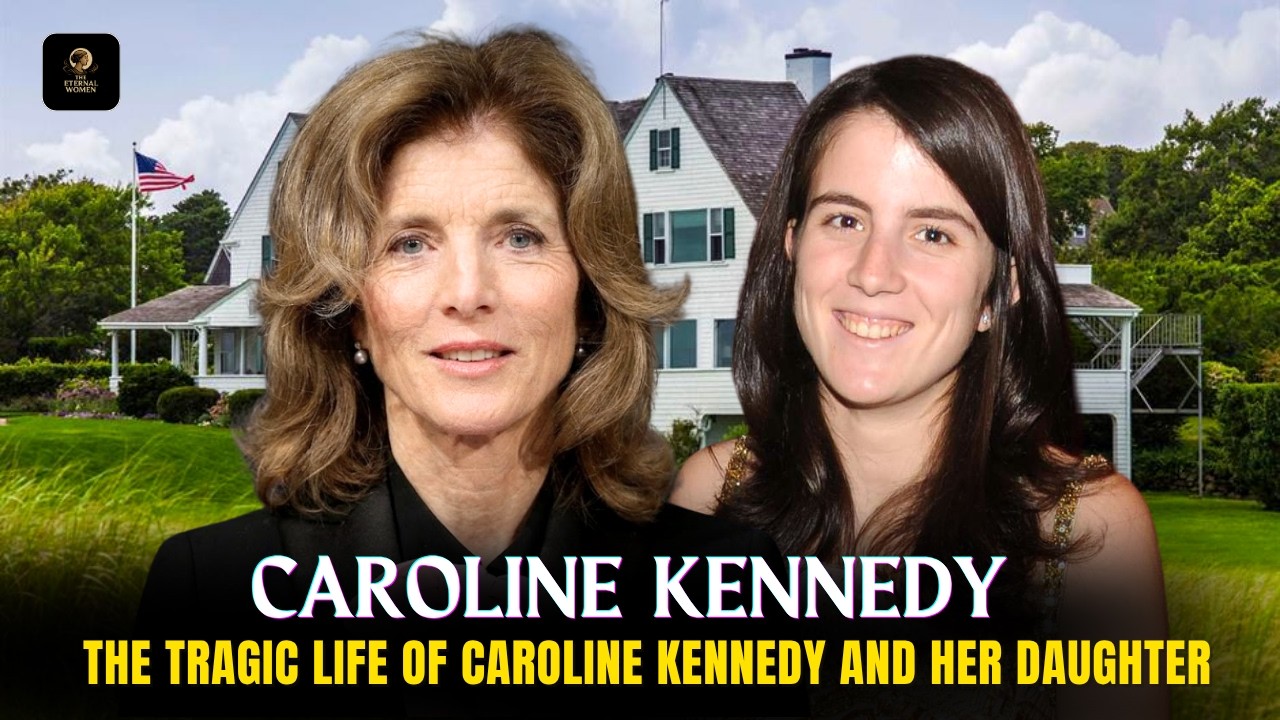
This is the story of Caroline Kennedy, the last one standing. Caroline Bouvier Kennedy was born on November 27th, 1957, in New York City. Her father was a senator from Massachusetts with his sights set on the presidency. Her mother was Jackie, already elegant, already captivating, already the kind of woman the cameras could not stop trailing.
Caroline came into that world bringing something neither of her parents had quite expected: relief. Before Caroline, there had been loss. A miscarriage. Then a stillborn daughter in 1956, a girl Jack and Jackie named Arabella, a name kept private for years, a grief borne quietly between two people learning that even the most privileged lives were not shielded from the worst kinds of pain.
When Caroline finally arrived, healthy, loud, and very much alive, she carried with her the particular joy that comes only after sorrow. For the first three years of her life, she lived something close to an ordinary childhood. The family home in Georgetown was busy and political, but Jackie made it a home. She was fiercely protective of her daughter’s privacy even then, before privacy had become the luxury it would later seem.
Caroline had a pony. She had a mother who read to her and a father who, despite the unrelenting demands of a rising political career, made time to be there. Then November 1960 arrived. Jack Kennedy was elected president of the United States.
Caroline was three days shy of her third birthday, and the ordinary childhood her mother had been trying to build vanished overnight. Two weeks after the election, her baby brother John arrived. Two days after that, Caroline turned three. In less than a month, she had gone from being a senator’s daughter to the most photographed child in America.
She was too young to grasp what that meant, but the cameras were already watching. She had been born into a family that already knew how to grieve. She just did not know yet that she would spend her whole life learning the same lesson. John F.
Kennedy was the youngest man ever elected president, the first Catholic, the embodiment of a new generation taking the wheel: young, vigorous, beautiful, full of possibility. And he had a wife who was the most glamorous first lady since Dolly Madison, and a little girl who had just become the most watched child in America. On January 20th, 1961, the Kennedy family moved into the White House. It is a strange place to call home: enormous, drafty, filled with history and staff and security, and the weight of everything that had ever happened within its walls.
Most children who grow up in unusual places adapt, because children are adaptable, but the White House was not merely unusual. It was the most photographed, most scrutinized, most symbolically loaded building in the United States. And inside it, a three-year-old girl was trying to figure out how to be a child. Jackie Kennedy understood the challenge better than anyone.
She had not wanted to be first lady in the conventional sense, the ribbon cuttings and the teas and the performance of wifehood on the national stage. But she was brilliant at the parts of the role that mattered to her, and one of those parts was protecting her children. She created a kindergarten classroom in the White House solarium, a sunny glass room at the top of the building, and invited a small group of children from good families to attend with Caroline. The goal was normalcy, for her daughter to have the experience of being around other children without the constant intrusion of cameras and reporters and the crushing weight of national attention.
It worked, in part. Caroline had friends in that classroom, lessons and play and the ordinary chaos of small children figuring out the world together. But there was no fully escaping her circumstances. Secret Service agents followed her everywhere.
Every public appearance was photographed and analyzed. When she rode her pony, Macaroni, a gift from Vice President Lyndon Johnson, a shaggy little horse that became one of the great symbols of the Kennedy White House, the photographs of her cantering across the South Lawn became iconic images the country adopted almost as their own. Americans fell in love with Caroline Kennedy with a tenderness that was genuine and also slightly possessive. She represented something they wanted to believe in: that this new era, this bright young administration, this Camelot the press was beginning to call it, was not just a political moment but a human one.
There was a family in the White House. There were children. There was a little girl with a bob haircut and serious eyes who sometimes wandered into her father’s Oval Office and hid under his desk. When photographs of those moments found their way into the public record, the whole country exhaled with something like joy.
Caroline could not have understood what she meant to people. She was three, then four, then five years old, learning to read and ride her pony and be a sister to her little brother John, a year and a half younger than her, who already had the easy, sunny charm that would make him famous in his own right. They were a unit, Caroline and John, the first children, as the press called them. If their childhood was not normal, it was at least shared.
They had each other. But the summer of 1963 brought the first crack in Caroline’s world. In early August, Jackie gave birth to Patrick Bouvier Kennedy, a second brother for Caroline, a third child for a family that seemed to be expanding into the fullness of its promise. Patrick had been born five weeks early, and his lungs were not fully developed.
The doctors at Boston Children’s Hospital did everything they could. Jack Kennedy sat by his son’s incubator and held his finger and wept in a way that startled everyone around him, because John Kennedy was not a man who let himself be seen weeping. Patrick lived thirty-nine hours. Then he was gone.
Caroline was five years old and did not fully understand what had happened. But she understood that her father cried, which she had never seen before. She understood that the White House felt different, heavier, quieter, full of a grief the adults were trying to manage and mostly failing. She understood that the brother she had been promised would not be coming home.
It was the first time death entered Caroline Kennedy’s life. It would not be the last. And the next time, it would shatter everything. Jackie recovered slowly.
In September 1963, she and Jack took a trip to Greece together, sailing the Aegean on the yacht of Aristotle Onassis, a trip that later attracted criticism, though at the time it was simply a couple trying to grieve and heal together. When she came home, Jackie looked more like herself. She threw herself back into the work of being first lady, into planning the restoration project she cared about, into being present for Caroline and John. The fall was coming.
The administration was looking toward the 1964 election. There were trips to plan, appearances to make, the ordinary business of governing and campaigning and moving forward. Life, as it always does, was insisting on continuing. On November 21st, 1963, Jack flew to Texas.
He was going to San Antonio first, then Houston, then Fort Worth, then Dallas, a political trip meant to shore up support in a state that would be crucial the following year. Jackie went with him, which was unusual. She had reduced her public travel after Patrick’s death, but she was feeling stronger, and Texas was important, and her presence beside her husband on the campaign trail meant something to the crowds. Back in Washington, in the White House, five-year-old Caroline went to bed on the night of November 21st with no more weight on her than any five-year-old carries.
Tomorrow was an ordinary school day. She would go to her classroom in the solarium. She would learn things and play with her friends and wait for her parents to come home from Texas. She had no way of knowing that ordinary days were over.
November 22nd, 1963, started like any other Friday. In the White House solarium, the children’s classroom was filling with its usual small population, Caroline and her classmates settling in for a morning of lessons, the ordinary noise and energy of five-year-olds who had no idea that anything in the world was wrong. Maud Shaw, the British nanny who had been with the Kennedy family since Caroline was born, was going about her day. The household staff was doing what household staff does.
It was a Friday morning in November. Nothing was wrong. In Dallas, Texas, the motorcade left Love Field at 11:50 in the morning, local time. It was a beautiful day, sunny and warm, the kind of day that made people line the streets and press against the barriers to get a glimpse of the president and his wife.
Jackie wore a pink suit and matching pillbox hat. Jack rode in the open limousine, tanned and smiling, waving to the crowds. They turned onto Elm Street and entered Dealey Plaza. At 12:30 p.
m. Central Time, the shots rang out. The president slumped forward, then sideways. The motorcade erupted into chaos, Secret Service agents scrambling, tires screaming, the limousine accelerating toward Parkland Memorial Hospital at the kind of speed that meant there was no time to be careful anymore.
In the car, Governor John Connally, also shot, was screaming. Jackie, crouched over her husband’s destroyed body, was silent in the way people are silent when the thing that has happened is too large for sound. At 1:00 p. m.
Central Time, John Fitzgerald Kennedy was pronounced dead. He was forty-six years old. Back at the White House, word reached the staff in the stuttering, disbelieving way that catastrophic news always travels. First a rumor, then a report, then the awful confirmation.
The president had been shot. The president was in surgery. The president was dead. Each update landed like a physical blow.
People wept openly. Secret Service protocols activated. And somewhere in the building, five-year-old Caroline Kennedy was still in her classroom, still doing the things that five-year-olds do, still waiting for her ordinary Friday to continue. The question that fell to Maud Shaw was among the hardest questions a human being can face.
How do you tell a child that her father is dead? How do you explain assassination? How do you find words that honor the truth without destroying a little girl who still has to continue living? Shaw decided she could not wait.
The news was everywhere, on every television, in every conversation, impossible to contain. Better that Caroline hear it from someone who loved her than from a stray comment overheard in a hallway. That evening, as Caroline was getting ready for bed, Shaw sat beside her and spoke gently. She told Caroline that her daddy had been hurt very badly in Dallas.
She told her that the doctors had tried their very best to help him. She told her that her daddy had gone to heaven and that he would not be coming home. Caroline asked the question that only a five-year-old could ask, the question that broke everyone who heard it, then and now. “Will daddy come down from heaven to visit?
” Shaw told her no. And in that moment, something in Caroline Kennedy’s understanding of the world shifted permanently. Her father was not coming home, not tomorrow, not ever. Heaven was not a temporary arrangement.
It was the place where people went when they were gone, really gone, the kind of gone that was forever. She was five years old, and she had just lost everything. Jacqueline Kennedy was thirty-four years old when she became a widow. She was also, in the most complete and unforgiving sense of the phrase, on camera.
The assassination had been witnessed. The hospital had been surrounded by press. Air Force One, which carried the body of the dead president and the new president being sworn in, had photographers aboard. The world was watching every moment of Jackie Kennedy’s grief, and Jackie Kennedy knew it.
And Jackie Kennedy made a decision that history has never stopped marveling at. She would not let them have her. She would be composed. She would be dignified.
She would plan the most powerful, most historically resonant state funeral she could design. She studied the funeral of Abraham Lincoln, insisted on the flag-draped caisson, the riderless horse with boots reversed in the stirrups, the route through Washington that allowed millions of people to say goodbye. She would give the country something they needed, a way to grieve together, a ritual that could hold all the shock and horror and disbelief that was flooding through America. And she would do it all while wearing the same pink suit, deliberately still stained with her husband’s blood, because she wanted the world to see what had been done.
Into this extraordinary performance of grief and dignity, she had to fit two small children. Caroline was dressed in a pale blue coat with white trim and white gloves. John Jr. wore a short blue coat and shorts.
They stood next to their mother at the Capitol, at the church, along the funeral route, two tiny figures encircled by the most powerful people in the world, attempting to do as they had been instructed, attempting to grasp something that lay fundamentally beyond grasping. The moment the nation could not turn away from, the image that became and still remains one of the most heartrending photographs in American history, arrived as the flag-draped coffin went past St. Matthew’s Cathedral. Someone had taught John Jr.
only three days short of his third birthday, how to salute. And as his father’s casket rolled by, he lifted his little hand to his forehead. The world fell apart. Seasoned reporters wept.
Heads of state who had witnessed war and death and the toppling of empires covered their mouths with their hands. The image of that small boy saluting his father’s casket traveled the globe within hours and has never ceased circulating since. It is nearly unbearable to look at, the intolerable distance between what the gesture meant and the child performing it, the awful dignity of a three-year-old doing the only thing he knew to do. Caroline walked part of the funeral procession with her hand in her mother’s.
She was five years old in her blue coat, making her way through the streets of Washington while the crowds lining the route wept without restraint. She could not have fully grasped what was taking place, but she grasped the grief. She could feel it rising off the crowds like heat. She could see it in her mother’s face, tightly held in check yet there, always there.
She could feel it in the way people looked at her with a sorrow and gentleness that even a five-year-old could not mistake. The funeral was more than a farewell to a president. It was also, though nobody put it into words, the instant Caroline Kennedy’s public role was set in amber. That image, the small girl in the blue coat holding her mother’s hand, walking behind her father’s coffin, would stay with her for the rest of her life.
People would see her at sixty and see the five-year-old. They would come across her name in the news and picture the white gloves. She had become, without anyone seeking her consent, a symbol. And symbols, once created, are very difficult to undo.
The day after the funeral, Jackie helped Caroline write a letter to her father. It was a child’s letter, plain and sincere and utterly, completely shattering in its innocence. They put the letter in the coffin. Caroline had sent her father something to read in heaven.
She was five years old. And the entire world was watching her mourn. The weeks following the assassination were a peculiar, suspended stretch of time. Everyone was in shock, going through their duties mechanically.
The White House was full of a grief that had nowhere to go. Lyndon Johnson and his wife, Lady Bird, were remarkably kind. They told Jackie to take whatever time she needed. They understood that demanding a widow and her young children leave the house at once would have been barbaric.
And so Jackie remained, walking through the mansion that was no longer hers, trying to work out what came next. What came next, she decided after two weeks, was leaving. She moved the family to a house in Georgetown, back to the neighborhood they had lived in before the presidency. But the house that had once been their private home was now a tourist attraction.
Tour buses crept past it. People stood on the sidewalk at every hour, hoping for a glimpse of the widow and her children. The photographers were unrelenting. Caroline could not step outside without being photographed.
An outing to the park turned into a news event. The simplest, most ordinary moments of childhood were out of reach. Within months, the situation had grown untenable. Jackie moved again, to a penthouse apartment on Fifth Avenue in Manhattan, on the Upper East Side, the sort of neighborhood where wealth and privacy occasionally managed to coexist.
New York was large enough, anonymous enough, quick enough that perhaps a widow and her children could vanish into it a little. Perhaps they could find something close to normal. Caroline was enrolled at the Convent of the Sacred Heart, a prestigious Catholic school on East 91st Street. It guarded its students’ privacy.
It provided structure and routine and the company of other children from prominent families, children raised to be discreet, whose parents had told them not to make a fuss about who their classmates were. It was as near to a normal school experience as Caroline was likely to get. But normal was never truly within her reach. Secret Service agents sat outside her classroom.
Her name turned up in the papers regularly, not because she had done anything, but simply because she existed and the world remained captivated by her existence. Other children treated her with the awkwardness that comes from not knowing what to say to someone who has been through something incomprehensible. Some were awed by her. Some were uneasy.
Almost none of them could simply treat her as a regular classmate, because she wasn’t one and everyone knew it. Biographers who have examined Caroline’s childhood describe a girl who grew increasingly shy and private as she got older, who withdrew from the spotlight as far as it was possible to withdraw when the spotlight was essentially her permanent address. She was thoughtful and serious and somewhat distant, bearing a weight her classmates could not share and could scarcely imagine. She couldn’t simply be Caroline.
She had to be Caroline Kennedy, daughter of the slain president, guardian of a legacy she had never requested, symbol of a grief that belonged to the entire nation. She was six, seven, eight, growing up the way a child does, learning and changing and building a sense of herself, but always within the glass case of the Kennedy name. And always aware that somewhere in the world there were people who felt they had a claim on her grief. Robert Francis Kennedy was, in many respects, the most complicated of the Kennedy brothers.
He was smaller than Jack, more intense, more openly emotional. Where Jack had been naturally charming, effortless, warm, always seeming to relish the room he was in, Bobby was earnest and at times awkward and burning with something those who knew him well called passion and those who did not sometimes called ruthlessness. He had served as his brother’s attorney general, had battled organized crime and the mob and the systemic racism of the Jim Crow South. Over the years of the Kennedy administration he had grown into something his earlier self might not have recognized, a man who truly cared about the suffering of other people.
In the aftermath of Dallas, Bobby Kennedy was shattered in a way he could never quite hide. Despite their differences, he and Jack had been bound together with uncommon depth. And out of that ruin, Bobby made a choice that would shape the coming years of his niece and nephew’s childhood. He would be there for them.
Bobby brought Caroline and John Jr. along on excursions to the family compound at Hyannis Port, to his own home in Virginia, on adventures and camping trips and ski holidays. He was physically affectionate with them in the manner the Kennedy men sometimes showed toward children, tossing them into pools, wrestling, drawing laughter out of them. He spoke with them about their father.
He kept Jack’s memory alive and present in the room, honored rather than left as something too painful to mention. To Caroline, Bobby was not a stand-in for her father. Nobody could be that. But he was something vital: evidence that the Kennedy men could be trusted, that grown-ups could be counted on, that love remained available even after unimaginable loss.
She became deeply attached to him. He was Uncle Bobby, the one who turned up, the one who made her laugh, the one who carried a part of her father with him wherever he went. By 1968, Bobby had decided to run for president. The country was in crisis, the Vietnam War tearing at the national fabric, the civil rights movement demanding its reckoning, Lyndon Johnson’s administration crumbling under the weight of the war he had escalated.
Bobby declared his candidacy, and the response was extraordinary. Crowds swarmed his campaign appearances in a way that felt almost messianic, reaching for him, weeping at the sight of him, seeing in him the brother he had lost and the hope that had died in Dallas. Caroline was ten years old, watching her uncle campaign, grasping as a ten-year-old can that he might become president, that the White House might once again be the center of her family’s life. It must have felt like something being restored, like history offering a second chance.
On June 4th, 1968, Bobby won the California primary. It was a crucial victory. The road to the nomination seemed open. He delivered his victory speech at the Ambassador Hotel in Los Angeles, gracious and funny and brimming with the energy of a man who believed he was going to win.
When he finished, his campaign staff guided him through the hotel kitchen toward the next event. In the kitchen of the Ambassador Hotel, a young man named Sirhan Sirhan was waiting. Bobby Kennedy was shot three times. He died the following day, June 6th, 1968.
Caroline was ten years old. In under five years, she had watched two of the men she loved most taken by gunfire. Her father at five, her second father at ten. And the pattern that would come to define her life, love followed by the sudden, violent removal of love, had been written into her childhood in indelible ink.
Jackie Kennedy, hearing the news, said something that has been quoted ever since, that if they were killing Kennedys, then her children were targets too. She was terrified, not abstractly, but concretely, physically terrified for her children’s safety. The country had murdered her husband. The country had murdered her brother-in-law.
The country was not safe. She began to look for a way out. Four months after Bobby Kennedy’s death, on October 20th, 1968, Jackie Kennedy married Aristotle Onassis. The reaction in America was somewhere between shock and outrage.
Onassis was sixty-two years old to Jackie’s thirty-nine. He was Greek, not American. He was a shipping magnate, not a statesman. He was, in the opinion of many Americans who had appointed themselves guardians of Jackie’s widowhood, entirely the wrong person for the woman they still thought of as the embodiment of Camelot.
Jackie did not particularly care what those Americans thought. She had watched her husband be murdered in front of her. She had watched her brother-in-law be murdered. She had two children who had grown up in the crosshairs of a country that seemed to destroy the people she loved.
She needed safety, security, and distance. Onassis could provide all three on a scale that no one else could match. For Caroline, now ten years old, the marriage brought a complicated new reality. She had a stepfather.
He was not her father. Nothing about him was like her father. But he was present, and he tried, in his way, to win over Jackie’s children. He was extravagant with gifts.
He took them on his enormous yacht, the Christina, sailing the Greek Islands in a world of blue water and ancient light. He introduced them to a different culture, a different language, a different understanding of what wealth and power looked like. Caroline was polite but reserved. The relationship between stepchildren and stepparents is always complicated, and this one had additional layers: the ghost of JFK still present in every room, the awareness that this man had married her mother not out of the kind of love that fairy tales describe, but out of a more complicated arrangement of mutual need.
Caroline was a perceptive child, and she understood things about the situation that she was not yet old enough to articulate. Life took on a split geography, half Manhattan, half Greece, with summers and holidays on the Christina or at Onassis’s private island, Skorpios. Caroline attended school in New York, where the Sacred Heart nuns continued their work of providing structure and privacy. She grew older, quieter, more self-possessed.
And then in the autumn of 1975, she went to London. She was seventeen years old, taking a year-long course in art history at Sotheby’s auction house, the kind of educational experience that wealthy families arranged for their children in those years, a finishing of sorts. She stayed with Sir Hugh Fraser, a conservative member of parliament, and his wife Antonia. On the morning of October 23rd, 1975, she was preparing to leave for Sotheby’s, but she was running slightly behind schedule.
The car was outside and Sir Hugh was waiting. But Caroline had not yet come down from the house. Under the car, an IRA bomb was waiting. When the bomb detonated, Caroline was still inside the house.
A neighbor, Professor Gordon Hamilton Fairley, a distinguished oncologist who had been walking his dog past the Fraser home, was killed instantly. If Caroline had been ninety seconds earlier in her routine, she would have been in that car. She had nearly died, not because of who she was particularly, but because she was in the wrong place, staying with the wrong person, on the wrong morning. The Kennedy curse, if it was real, seemed to extend beyond the Kennedys, leaving destruction in its wake even when it missed.
Caroline returned to New York. She did not speak publicly about the incident for years. She folded it into the private archive of her family’s encounters with violence and moved forward because moving forward was what the Kennedys did. It was in some ways the only thing they knew how to do.
There is a way Caroline Kennedy’s story might have unfolded that would have been entirely different. A girl brought up in the long shadow of assassination, scarred by loss from the earliest age, encircled by the ruins of a dynasty—such a person would have had every justification to fold in on herself, to allow the sorrow and the strain and the crushing burden of the Kennedy name to become an excuse to quit, to vanish into riches or diversions or resentment. Plenty of people with far less reason to give up have done precisely that. Caroline Kennedy took another road, not with drama, not with any public declaration of purpose, but quietly and steadily, in the manner that resilient people usually do their most meaningful work.
She enrolled at Radcliffe College, the women’s college tied to Harvard, and majored in art history. She was a dedicated student, concentrated and driven, not gliding along on her surname but securing her spot through genuine merit. She earned her degree in 1980. Her mother Jackie was in attendance, along with her brother John and Uncle Ted, the remaining Kennedys coming together for a moment of real joy, a morning of achievement unmarred by sorrow.
Once Radcliffe was behind her, she took a position at the Metropolitan Museum of Art in New York, helping out in the film and television department. It was there she crossed paths with Edwin Schlossberg—Ed, to his friends—an artist and designer known for building interactive installations and exhibits. He was thirteen years her senior, intellectually exacting, and blessed with the uncommon ability to be truly at ease with complexity. He grasped what it meant to be near someone whose life had played out in public, without any wish to capitalize on it.
What drew him was Caroline Kennedy the woman, not Caroline Kennedy the icon. Their love grew gradually and deliberately, the way Caroline approached nearly everything. She attended Columbia Law School and received her degree in 1988, later than most of her peers, since she had set aside time for work and living in between. She felt no urgency to put her ambitions on display for anyone.
She was constructing something authentic at her own speed, by her own rules. On July 19th, 1986, Caroline Kennedy wed Edwin Schlossberg at Our Lady of Victory Church in Centerville, Massachusetts, on Cape Cod. Her cousin Maria Shriver stood beside her as matron of honor. Uncle Ted escorted her down the aisle.
It was a gorgeous day, warm and full of light, the sort of day Cape Cod delivers in high summer when it is showing off. The photographers were on hand, naturally. They were always on hand. Yet within the church, surrounded by those who cherished her, something authentic was taking place.
The small girl who had clutched her mother’s hand at her father’s funeral was now deciding her own destiny. She was twenty-eight. She had endured every hardship her childhood had delivered. And now, she was creating something fresh.
She retained her name. She would remain Caroline Kennedy through her marriage, her career, her whole life—not out of any attachment to a legacy, but because the name belonged to her, had always belonged to her, and she had earned the privilege of bearing it on her own terms. For the first time in Caroline Kennedy’s story, something fortunate had occurred. Something had been erected that the shadows had not yet reached.
It would not remain that way. But for the moment, for this chapter, this instant, Caroline Kennedy was content. The Schlossberg children came in rapid succession, and each appeared to embody something Caroline had been working toward without quite being able to put it into words. Rose Kennedy Schlossberg was born in 1988, named after her great-grandmother, the Kennedy matriarch, who had survived so many of her children and grandchildren with a faith that seemed almost otherworldly.
Tatiana Celia Kennedy Schlossberg came along in 1990, and in 1993, John Bouvier Kennedy Schlossberg—Jack, as the family would call him—finished the portrait. Three children, a family of her own creation. A Manhattan home intentionally calmer and more sheltered than the Kennedy compound at Hyannis Port, further removed from the dynasty’s machinery and its accompanying turmoil. Caroline was constructing something distinct, not a repudiation of her heritage but a hushed rendition of it, freed from the relentless performance and scrutiny and public burden.
She had given careful thought to what she wished to pass on to her children, and what she wished to shield them from. She wanted them to understand who they were. They were Kennedys, and that carried meaning—a history, a set of principles, a dedication to public service that she sincerely believed in. But she did not want it to swallow them whole.
She did not want them raised the way she had been raised, forever conscious of the lens, forever mindful of the symbol, forever bearing the grief of people they had never known. So she gave them a degree of privacy she herself had never had. She guarded it fiercely, turning down nearly all interview requests, keeping her children away from public view whenever she could, insisting that their everyday lives stay everyday. She walked them to school, took them to the park, brought them on holidays without turning any of it into a photo opportunity.
She was their mother first, a Kennedy daughter second. The irony, which Caroline surely recognized, was that by shielding her children from the weight of the name, she was also shielding them from a full grasp of what that name had cost. They knew their grandfather had been president. They knew he had been assassinated.
They knew about Uncle Bobby and the plane crash that had claimed Uncle John. But they knew these facts the way children absorb history—at a distance, softened by the careful narration of adults who cherished them and wanted to give them room to grow up whole. Rose blossomed into an imaginative, self-reliant young woman drawn to film and storytelling. Tatiana became a journalist and environmental writer, incisive and earnest and carrying her mother’s reflectiveness.
Jack inherited his great-uncle John Jr.’s appearance, that remarkable Kennedy face, along with his own particular intelligence and ambition. Caroline had succeeded. She had broken something—not the curse, which does not bend to willpower, but the cycle of public exposure, the belief that Kennedy children must be devoured by their name.
Her children were Kennedys, certainly, but they were also their own people, or so it appeared in those years when everything still held together. In the winter of 1994, Jacqueline Kennedy Onassis was diagnosed with non-Hodgkin’s lymphoma. She was sixty-four years old. Aristotle Onassis had passed away in 1975, and in the years since she had fashioned a life as a book editor at Doubleday, a quiet intellectual existence that fit her far better than any version of the public role she had once been compelled to inhabit.
Everywhere she went, she was still instantly recognized. To the strangers who halted and gaped on Manhattan’s sidewalks, she remained the widow of Camelot. Yet in that final stretch of her life, she had somehow done what few would have bet on—she had become a person entirely her own. The diagnosis arrived quickly and moved even quicker.
Non-Hodgkin’s lymphoma is often treatable. Jackie’s case was not, or at the very least it was not caught and treated in time. Barely four months passed between diagnosis and death. She faded fast, and by the spring of 1994 it was plain to everyone that she would not survive.
Throughout those final weeks, Caroline and John Jr. stayed by her side almost without pause. They were thirty-six and thirty-three. No longer children, and yet in this one respect they were still their mother’s children—and they were about to lose her.
The woman who had protected them from the harshest parts of the world. The woman who, still reeling from shock, had arranged their father’s funeral with remarkable grace. The woman who had battled every single day of Caroline’s girlhood to give her daughter something close to an ordinary life. She was dying, and nothing could change that.
On May 19th, 1994, Jacqueline Kennedy Onassis passed away in her Fifth Avenue apartment, with the people who loved her gathered close. She was sixty-four—far too young, though she had packed more into those years than most people do in much longer lives. The funeral took place at the Church of St. Ignatius Loyola on Park Avenue, the same church where she had been baptized.
The world arrived to mourn. Heads of state, former presidents, the entire machinery of public grieving that had trailed Jackie Kennedy since 1963. Caroline and John stood side by side in the church, just as they had stood together at their father’s funeral thirty years earlier. Only this time they were the grown-ups, forced to carry their sorrow in full view, required to keep their composure for cameras that had never once looked away.
For Caroline, Jackie’s death meant more than losing a mother. It meant losing the only other living person who had been present through those particular November days of 1963, who had borne the peculiar weight of being the Kennedy family’s center of gravity, who knew from the inside what it had all cost. With Jackie gone, Caroline and John were the last two people who remembered what it was to be a family inside the White House. They were the last two who shared that history, that sorrow, that private understanding of what the Kennedy name meant from within.
Now they had only each other, and for five more years that would have to suffice. By nearly any standard, John Fitzgerald Kennedy Jr. had grown into a remarkable man. He was strikingly handsome.
He had gotten the finest features of both parents—the dark Kennedy hair, the wide-set eyes—along with a physical ease that made people freeze mid-step when he walked into a room. People magazine had named him the sexiest man alive, an honor he found both mortifying and comical in equal parts. He had passed the New York bar exam on his third attempt, after failing twice, and the press had covered it with such breathless cruelty that it revealed more about their fixation on him than about his intelligence. He had launched George, a political magazine that sought to make the meeting point of politics and pop culture accessible and engaging.
In 1996 he married Carolyn Bessette, blonde and beautiful, a publicist for Calvin Klein with cheekbones that stopped conversations cold. The wedding, held in secret on Cumberland Island off the Georgia coast, became public knowledge almost at once, because nothing John Kennedy Jr. ever did remained private for long. Through all of it, Caroline and John had stayed close.
They spoke often. They understood each other the way only people who share a singular, unrepeatable history can. They were the children of Camelot, and whatever that carried—burden, gift, complication—they carried it side by side. Caroline had one worry, and it was John’s flying.
He had earned his pilot’s license in April 1998 and bought himself a Piper Saratoga, single engine, capable, the sort of aircraft recreational pilots favored. Caroline fretted. She had seen enough of her family’s history to know that planes had never been kind to Kennedys. Their cousin Michael had died in a skiing accident in late 1997, and John had briefly suspended his flight training while he mourned.
Quietly, Caroline had hoped he would abandon it. He did not. He picked his lessons back up. Caroline never pushed hard enough to stop him—or perhaps she understood that pushing would have made no difference.
John was simply John. On the evening of Friday, July 16th, 1999, he intended to fly from Essex County Airport in New Jersey to Martha’s Vineyard, where he would set down his sister-in-law, Lauren Bessette, before going on to Hyannis Port for their cousin Rory Kennedy’s wedding the following day. His wife, Carolyn, and Lauren would be aboard with him. The weather was poor.
As darkness settled over the Atlantic, haze had cut visibility sharply. John held a pilot’s license, but he was not yet certified for instrument flight—which meant that in conditions of poor visibility, where the horizon blurred into the water beneath, he was flying without the skills required to compensate. He lifted off at 8:38 that evening. Somewhere over the waters south of Martha’s Vineyard, the plane started to descend in a pattern investigators would later identify as spatial disorientation—the terrifying state in which a pilot loses all sense of which way is up.
In the haze and the dark, with no horizon in sight and no instrument rating to guide him, John could not tell whether he was rising or falling. The plane struck the ocean at high speed. John, Carolyn, and Lauren were killed instantly. When the aircraft failed to arrive, alarms were raised.
The Coast Guard mounted a search. The Navy was called in. For five days the nation waited, hoping, praying, refusing to accept what the silence was already telling them. Caroline waited as well, knowing somewhere deep inside that she already had the answer, yet still holding out for the miracle that would not come.
On July 20th, Navy divers located the wreckage on the ocean floor, 120 feet down. They brought up three bodies. John was still strapped into the pilot’s seat. Caroline Kennedy, forty-one years old, was now the only surviving member of her immediate family.
Her father taken by an assassin’s bullet when she was only five, her infant brother Patrick gone after just two days, her mother lost at sixty-four, and now John, her John, the small boy who had saluted their father’s casket, the man who had stood beside her carrying every burden, gone at thirty-eight. There was no one left who shared her particular history, no one left who recalled being a child inside the White House, no one left who bore the same sorrow, the same knowing, the same singular grasp of what it was to grow up a Kennedy child. For the first time in her life, she was utterly alone within her own story. The ashes of John Jr.
Carolyn, and Lauren were committed to the sea from the deck of the USS Briscoe. Caroline demanded privacy. There would be no public display of this mourning. It belonged to her, to her alone.
She had earned that right. Grief, once it grows deep enough and old enough and has stayed with you long enough, either breaks you or turns into the force that drives everything you do. For Caroline Kennedy, it became that force. She had long been engaged with her family’s legacy.
She had helped establish the Profile in Courage Award in 1989, the yearly honor bestowed in her father’s name upon public servants who showed political courage. She had filled a range of roles at the John F. Kennedy Presidential Library and Museum in Boston, which preserved the records and objects of her father’s administration, and she labored to teach the public about his life and presidency. These were worthy contributions, yet they were also largely out of sight, the labor of someone who cared profoundly but chose not to stand before the cameras.
Following John’s death, she immersed herself more deeply in that work. She became a prolific writer, producing books on constitutional law, the Bill of Rights, and her mother’s devotion to poetry. Her volume, The Best Loved Poems of Jacqueline Kennedy Onassis, turned into a bestseller, a homage to Jackie’s literary taste that was, read between the lines, also a daughter’s gesture of love toward a mother she was still grieving. Through her writing, Caroline discovered a means of controlling her own story, of speaking in her own voice about what mattered to her, without subjecting herself to the interviews and profiles that had always felt like intrusions.
In 2008, she made her most public political gesture, openly backing Barack Obama for president, a choice that bore tremendous symbolic weight. The daughter of John Kennedy endorsing the first black man with a real shot at the presidency was no minor matter, and everyone grasped it. She penned an op-ed in The New York Times likening Obama to her father, and the nation sensed something change. In 2013, President Obama named her United States Ambassador to Japan.
She said yes. The appointment mattered. Japan is no minor outpost. It is among America’s most vital alliances, a relationship rooted in the tangled history of World War II and the decades of partnership that came after, a nation whose internal politics and global stance carry enormous weight for American interests in Asia.
Caroline approached the role with seriousness, mastering the protocols, studying the relationship, arriving with the same quiet diligence she had applied to everything she had ever undertaken. She remained until 2017. By most measures, she was outstanding, admired by her Japanese counterparts, effective at preserving and reinforcing the alliance. In 2022, President Biden named her ambassador to Australia, another weighty posting at a time when the Pacific alliance structure was growing ever more important.
Throughout it all, she held fast to the privacy she had always demanded. She granted few personal interviews. She never wrote a memoir. She never appeared on talk shows to speak about her grief.
She kept her family, Rose, Tatiana, Jack, and Ed, as far from the public eye as anyone could when the name is Kennedy. She had endured. She was still standing. Out of the wreckage of everything she had lost, she had built a life of real meaning and purpose.
And then came November 22nd, 2024. The date was no accident. Tatiana Schlossberg picked November 22nd, 2024, precisely sixty-one years after her grandfather’s assassination, to publish her essay in The New Yorker. The piece was called “A Battle With My Blood,” and in it Tatiana revealed to the world what her family had known for months, that she was dying.
She was thirty-four. She had been married for several years to George Moran, a man she met at Yale. They had two young children. She was a journalist and author, tackling environmental issues with the same gravity and intelligence that marked everything she did.
By all accounts she was brimming with life, curious and keen and profoundly engaged with the world. In May 2024, not long after the birth of her second child, she had been diagnosed with acute myeloid leukemia, AML, one of the most aggressive blood cancers, known for how fast it moves and how stubbornly it resists treatment. The diagnosis struck like a shock. She was young, healthy, with no evident risk factors.
But cancer follows its own rules, and AML does not wait for permission. The treatments were savage. Chemotherapy that left her violently sick. Bone marrow transplants that forced her into isolation for weeks, cut off from her small children, her husband, her family.
Clinical trials for immunotherapy, hoping experimental approaches might succeed where standard ones had failed. She bore it all with a bravery the essay described without ever quite calling it bravery, because Tatiana Schlossberg was not the sort to narrate her own courage. In the essay, she wrote of trying to be a good daughter, of spending her whole life trying to shield her mother from further pain, of the strange and unbearable irony of now being the source of that pain despite having tried so hard. For Caroline, reading those words must have been an experience beyond anything language could reach.
Her daughter trying to spare her grief. Her daughter, the journalist who had written so thoughtfully about the world, now writing about her own death. Her daughter, thirty-four with two small children, confronting the same terminal certainty that had claimed so many people Caroline had loved. The date, November 22nd, brought it all surging back.
It was the day that had shaped Caroline’s life since she was five years old. It was the day that had cleaved her existence into before and after. And now her daughter had chosen it to declare that she was dying. Not as a theatrical gesture, but perhaps as a form of acknowledgment.
This family has always been scarred by this date. Here is one more scar. The treatments went on through the close of 2024 and into 2025. Tatiana fought.
She wrote. She spent time with her children. She tried to be present in the moments she had, knowing that their number was limited in a way she could watch drawing near. On December 30th, 2025, Tatiana Schlossberg died.
She was thirty-five. The JFK Library Foundation made the announcement. Their lovely Tatiana had died that morning. She would remain in their hearts forever.
Caroline Kennedy, sixty-eight, buried her child. No words are sufficient for that. Parents are not meant to outlive their children. When the natural order flips, when the old are left to make room for the young instead of being mourned by them, that is one of the most profound wounds human life can inflict.
Caroline had already lost far more than most people lose across an entire lifetime. She had already stood at more gravesides, hand in hand with someone, than anyone should ever have to. But this was not the same. This was her child.
This was the person she had brought into the world precisely so that she could be shielded from this very kind of loss. The Kennedy curse, if such a thing exists, if there is truly a pattern of loss so relentless and so brutal that it earns a name, had not finished with Caroline Kennedy. It had never finished. It had merely paused between one loss and the next, just long enough for her to draw breath.
And then it took her daughter. Caroline Kennedy is sixty-eight years old. She is the only surviving member of her immediate family. Her father was murdered in Dallas when she was five.
Her brother Patrick, who lived two days. Her mother Jackie, dead of cancer at sixty-four. Her brother John, lost to the sea at thirty-eight. Her daughter Tatiana, taken by leukemia at thirty-five.
She has outlived every one of them. She is the last one standing, which is both a fact and, in its own way, a particular form of grief. She still has her husband, Ed Schlossberg, beside her after nearly forty years of marriage, a steadiness the Kennedy family has not always been granted, a partnership that has weathered everything the world has hurled at it. She still has her daughter Rose and her son Jack.
She has her grandchildren, Tatiana’s children, who will grow up without their mother but will, one hopes, grow up knowing who she was. She has her work, her mission, her resolve to honor her family’s legacy through public service rather than public spectacle. She has spoken out in recent months against her cousin, Robert F. Kennedy Jr.
the anti-vaccine activist and political figure nominated for Secretary of Health and Human Services, writing to senators to urge them not to confirm him, accusing him of exploiting their shared family history for political purposes she finds dangerous. The public feud has reminded the country, if it needed reminding, that the Kennedy family is not a monolith. It is a collection of individuals shaped differently by the same history, pointed in different directions by the different conclusions they have drawn from what they’ve lived. Caroline has drawn her conclusions quietly and consistently over six decades.
Public service matters. Privacy is worth protecting. Grief is yours to keep. Legacy is best honored by living it rather than performing it.
What does it mean to be the last one standing? It means carrying the stories of everyone who is no longer here. It means being the only person alive who remembers what her father’s voice sounded like, the way he held her hand, the specific weight of his presence in a room. It means being the living archive of a family that America has claimed and consumed and mourned for sixty years without ever quite grasping that the people inside it were simply people, people who loved each other, who lost each other, who got up every morning and tried to make something meaningful from the time they had.
It means that when the last Kennedy of that generation goes, a door closes on something the country has not been ready to lose. Not Camelot. Camelot was always partly a myth, a story told over the bodies of real people to make the loss easier to contain, but something real. The living memory of what those days were, what those people were, what it felt like to be inside that particular American moment.
Caroline Kennedy has never exploited this. She has never written a memoir that would make her rich and famous all over again. She has never given the interview that would give the world the grief it seems to want from her. She has kept her own counsel, done her work, raised her children, and attended one funeral after another with the same composure her mother modeled for her on a November day in 1963 when she was five years old and wearing white gloves.
That composure is not emptiness. It is not the absence of feeling. It is something far harder and far rarer. The decision made over and over again across a lifetime that your grief is yours and your strength is also yours, and neither one is available to people who want to consume them.
She was five years old the first time she held her mother’s hand at a funeral. She has been holding someone’s hand at a funeral ever since. Her father, her uncle, her mother, her brother, and now her daughter. Each time she has stood up straight.
Each time she has kept her composure. Each time she has carried the grief home quietly and gone back to work and continued the business of building a life that the losses could not fully take from her. The Kennedy curse, if it is real, has taken almost everything from Caroline Kennedy, but has not taken her. She is still here.
She is still standing. She has endured things that would have destroyed most people, and she has done it without becoming bitter, without becoming broken, without letting the public consumption of her family’s grief turn her into a symbol rather than a person. She is Caroline Kennedy, daughter, sister, wife, mother, diplomat, author, keeper of stories, guardian of names, the last one standing, still standing.
