The phone rang, and David Armstrong-Jones answered it into a nightmare. The voice on the other end was polite at first, insinuating, then it hardened into a threat. Two strangers had something they said belonged to him: a mobile phone video, a digital grenade with his name on it. They claimed it showed the Queen’s nephew snorting lines of cocaine off a glass table, drunk, making crude sexual remarks about a female royal aide.
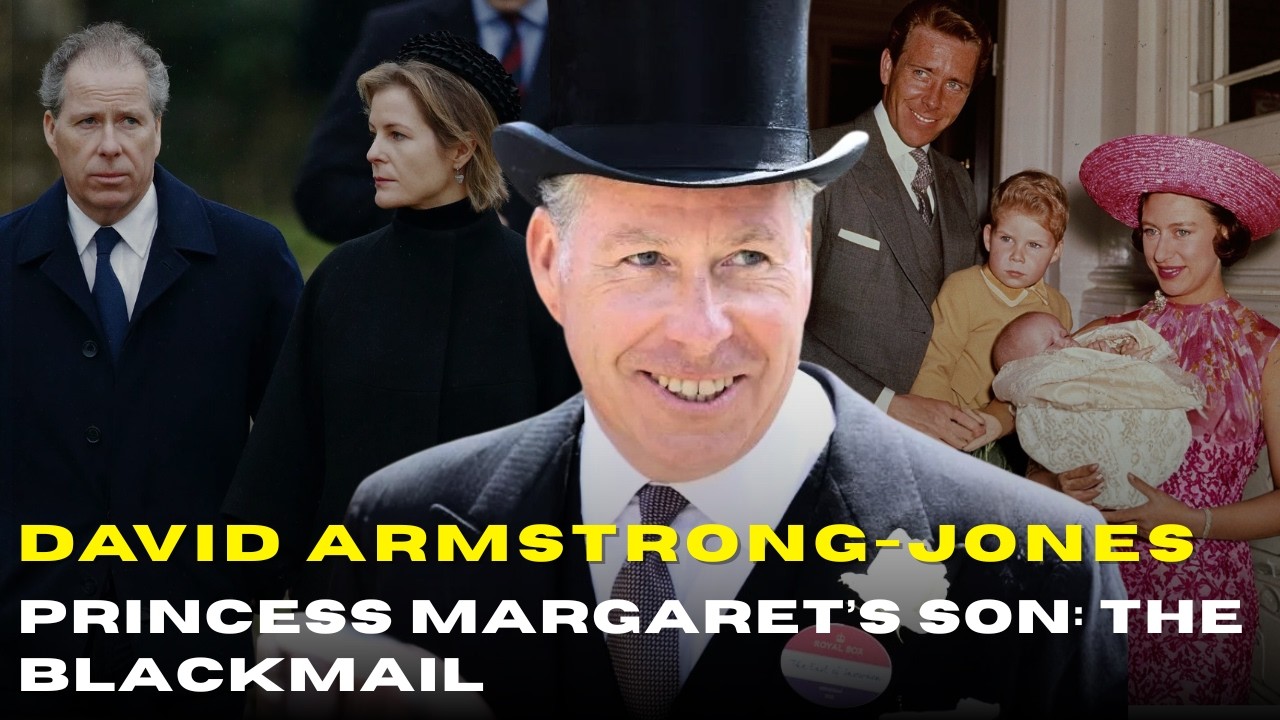
The price for keeping that footage private was £50,000. Pay it, they said, or watch your reputation burn. For forty-six years, David had built his life on being the opposite of everything that phone call implied. He was the anti-Margaret, the stoic son who buried himself in manual labor to escape the toxic, gin-soaked chaos of his parents’ marriage.
He was the boring, safe businessman, the one who was supposed to break the family curse. But as the blackmailers tightened their grip, David was forced to confront a brutal truth: you can hide in a workshop for a lifetime, but you can never sand away your own blood. The story begins in the autumn of 1961, when Britain stood on the threshold of a new era, a decade that would be defined by the Beatles and a cultural revolution. At Clarence House, one of London’s most regal residences, David Albert Charles Armstrong-Jones took his first breath on November 3rd.
He was the firstborn child of a union the press had dubbed the modern fairy tale: the marriage of Princess Margaret, the Queen’s beautiful, volatile sister, and Anthony Armstrong-Jones, the dashing photographer who became the first commoner to marry a king’s daughter in four centuries. The world looked into David’s cradle and saw a prince in all but name, fifth in line to the throne, swaddled in silk and destiny. But the reality inside the gilded walls of Kensington Palace was far from a fairy tale. David was not born into a sanctuary; he was born onto a battlefield.
The marriage of Margaret and Tony was a high-speed collision between two massive egos, two artistic souls fueled by passion, alcohol, and a mutual talent for cruelty. David’s early years were spent in an atmosphere thick with cigarette smoke and the clinking of crystal tumblers. Kensington Palace in the 1960s was the epicenter of London’s high society, a place where parties bled into dawn and actors, bohemians, and socialites drifted through the rooms like glamorous ghosts. For a child, it was a world both mesmerizing and terrifying.
David grew up collecting fragmented, haunting memories: the sound of his mother’s laughter, sharp and brittle as broken glass; the feeling of his father’s camera lens, cold and scrutinizing; the pervasive sense of loneliness in a room full of people. Princess Margaret was a complex mother. She loved her children, but her love was colored by deep-seated frustration. She had been denied her true love by the establishment and had shackled herself to a royal life she both despised and demanded.
Her disappointment often spilled over onto those closest to her. The children became the unwilling audience for her operatic emotional shifts. Some days she was sweet, doting on David as her little precious; other days she was cold and distant, lost in a fog of whiskey and existential boredom. If Margaret was a volatile flame, Tony Armstrong-Jones was a shard of ice.
He was a genius behind the lens, a man who could see the naked truth of a subject in a split second, but he was also a master manipulator who treated human relationships with clinical detachment. To David, his father was a figure of awe and fear. Tony was not the kind of father who sat on the floor to play with toy soldiers; he was the kind who would throw his son into the deep end of the pool to see if he would sink or swim. One of the most chilling anecdotes of David’s childhood involved notes.
As the marriage rotted from the inside, Tony developed a habit of leaving venomous little notes tucked inside Margaret’s books or drawers, brutal cutting sentences like “You look like a Jewish manicurist” or “I hate you,” waiting for her to find. David, a sensitive and highly intelligent boy, grew up in the crossfire of this silent artillery. He learned to walk softly, to read the temperature of a room the moment he entered it. He became a child diplomat, constantly trying to navigate the minefield between his parents, trying to be invisible so as not to trigger an explosion.
In this chaotic maelstrom, David found a lifeline, a sanctuary that would define his entire adult existence: the workshop. While other aristocratic boys were tutored in grouse shooting or polo, David found spiritual peace in the company of wood. Wood was honest. It did not lie, drink, or have affairs.
If you planed it flat, it stayed flat. If you cut a dovetail joint with precision, it held together forever. For a child living in a world where everything was fluid, emotional, and performative, the rigidity and reliability of carpentry were a sedative. David began spending hours in the small school workshop and later in the basement of the palace, immersed in the smell of sawdust, the tang of varnish, and the rhythmic sound of the saw.
It was the only place where he had control. He could take a rough, ugly piece of timber and turn it into something beautiful and ordered, something he could never do with his parents’ marriage. It was not just a hobby; it was a survival mechanism, a wall between himself and the hysteria of the palace, a space where the royal spotlight could not penetrate. As David entered his teenage years, the cold war between Margaret and Tony escalated into total destruction.
The 1970s were the dark ages of the Snowdon family. The parties became wilder, the arguments louder. Tony was frequently absent, chasing photographic assignments and other women, leaving Margaret alone and furious in Kensington. She sought solace at the bottom of a bottle and in the arms of younger men.
David, then a student at Bedales, a boarding school known for its liberal arts focus, watched the disintegration of his family play out on the front pages of the tabloids. He saw his mother mocked as a royal parasite, his father rumored to be sleeping with half of London. A deep, burning shame took root in the young man’s heart. He learned a bitter lesson early: fame is a double-edged sword.
It brings privilege, but it strips you of your humanity. The climax of this slow-motion tragedy was the arrival of Roddy Llewellyn, a landscape gardener seventeen years Margaret’s junior. Their affair, splashed across newspapers with photos of them in swimsuits on the island of Mustique, was the final nail in the coffin. In 1978, Buckingham Palace issued an announcement that stunned the nation: Princess Margaret and Lord Snowdon were divorcing, the first divorce in the immediate royal family since King Henry VIII.
To the world, it was a scandal. To David, then seventeen years old, it was the collapse of his universe. The divorce confirmed what he had always feared: that he was the product of a historical mistake, torn between loyalty to his crumbling mother and admiration for his brilliant but utterly selfish father. In the wreckage, David made a silent vow that would steer the course of his life for the next thirty years: he resolved to be normal.
He would not be a royal hanger-on. He would work, earn his keep with his own calloused hands, and build a life based on merit, not titles. This is why, in the early 1980s, when his cousins were cutting ribbons or joining regiments, David Armstrong-Jones put on a pair of overalls and walked into a dusty workshop in Dorking. He founded his own company, Linley.
He sold his beloved Fiat 500 to buy tools, slept on the floor of the workshop in a sleeping bag, ate cheap sandwiches, and worked eighteen-hour days sanding veneers and drafting designs. The image of the Queen’s nephew covered in wood dust, hunched over a workbench, became a powerful symbol. The Queen herself, who had watched her sister’s life implode with helpless sorrow, looked at David with profound relief. In him, she saw stability, the work ethic she valued above all else.
David became the good son, the reliable one, the man who kept his mouth shut and his head down. But there was something the Queen and the public failed to see. Psychological wounds cannot be healed by hard work alone. Beneath the veneer of the successful businessman, beneath the politeness and charm, David was still the boy from the glass room.
He carried the Snowdon blood, a bloodline infused with artistic genius but also with addictive personalities and a propensity for self-destruction. Repression is a dangerous game; it is a debt that gathers interest. David buried his pain deep, covering his latent desire for rebellion with layers of professional success. He played the role of the perfect gentleman for so long that he began to believe the mask was his face.
But the shadow self is patient. It waits for the cracks to appear. By the time the 1990s gave way to the new millennium, David seemed to have won the game of life. He had a thriving business, a respected place in the royal family, and in 1993 he married Serena Stanhope, a calm, elegant aristocrat who bore a striking resemblance to a young Queen Elizabeth.
Their wedding was a model of decorum, a stark contrast to the chaotic unions of Charles and Diana or Andrew and Fergie. David had proven to the world he had beaten the odds. But destiny is a cruel playwright, saving its most painful twists for the final act. David did not know it, but the peace he was enjoying was merely the eye of the storm.
The hurricane was brewing within him, fed by the exhaustion of a lifetime of pretending to be okay. The year 2002 was the year the floor fell out. Within seven weeks, the royal family was struck by a double tragedy. In February, Princess Margaret, the fiery, difficult, undeniable center of David’s universe, died in her sleep after a series of debilitating strokes.
In March, the Queen Mother followed her daughter into history. For the public, it was a time of national mourning, a prelude to the Golden Jubilee. But for David, the death of his mother was not just a loss; it was a redundancy. For most of a decade, as Margaret’s health disintegrated, David had been her keeper.
He managed her finances, smoothed over her tantrums, screened her visitors, and held her hand as the light faded. When she died, the job was over. The silence that descended on Kensington Palace was deafening. And in that silence, David confronted a dangerous question: who is the fixer when there is nothing left to fix?
Grief is a strange architect; it often dismantles before it rebuilds. In the years following Margaret’s death, David engaged in an act that shocked sentimentalists but made perfect sense to the pragmatist within him. He decided to sell everything. In 2006, Christie’s announced the auction of the collection of Her Royal Highness the Princess Margaret.
The Poltimore tiara, the towering diamond crown Margaret had worn in her bathtub, went on the block. Her cigarette cases, her furniture, her intimate letters, the debris of a royal life lived at full volume—all of it was cataloged, tagged, and sold to the highest bidder. The press called it cold, whispering that Linley was cashing in on his mother’s legacy. But those closer to the truth saw it differently.
This was an exorcism. David was physically dismantling the museum of dysfunction that had been his childhood, clearing the decks. He didn’t want to live in a shrine to the past; he wanted to bury it. The auction raised nearly £14 million, a staggering sum.
But the psychological payoff was supposed to be freedom. However, freedom is a terrifying thing for a man who has lived his entire life in a cage of duty. By 2006 and 2007, David was in his mid-forties, wealthy, successful, happily married. He had achieved the normalcy he craved.
Yet a restlessness began to stir. Psychologists know the phenomenon well: the survivor’s crash. After spending half a lifetime managing the crises of others, the adrenaline fades, and the survivor is left alone with his own suppressed appetites. London in 2007 was a city of excess, the peak of the pre-financial-crash boom, a time of easy credit, cocaine in the bathrooms of Mayfair clubs, and a blurring of lines between the aristocracy and the flashy money of the underworld.
Into this neon-lit landscape, the sensible Viscount Linley began to drift. The man famous for going to bed early began to stay out late. He was seen at clubs like Annabel’s and the hunting grounds of the rich and restless. But it wasn’t just the establishment clubs.
David began mixing in circles far below his pay grade, circles populated by fixers, hustlers, and people who viewed a royal title not with reverence but as a target. It was the classic mistake of the aristocrat who believes his privilege is a shield. David assumed that because he was the Queen’s nephew, the people he met would respect the unwritten rules of discretion. He forgot he was swimming in shark-infested waters.
And sharks do not care about lineage; they care about blood. Enter Ian Strachan. He wasn’t a mastermind; he was a drifter, a Walter Mitty character who had reinvented himself multiple times. Born with a much more pedestrian name in Aberdeen, Strachan had restyled himself as a royal insider, a man of connections.
He was desperate to be somebody. It remains unclear exactly how the paths of the Viscount and the drifter crossed—perhaps at a party, perhaps through a mutual acquaintance—but Strachan, with his patter to please, managed to slip through David’s defenses. David, perhaps seeing Strachan as a harmless court jester, let his guard down and invited him into his private sphere. It was a catastrophic error of judgment, the equivalent of opening the gates of Troy and inviting the wooden horse in for a drink.
The events that allegedly took place in September 2007 are reconstructed from court testimonies and the sordid details that later leaked. The setting was an apartment in Battersea, a bachelor pad atmosphere, alcohol flowing, a sense of off-the-clock relaxation. For David, this was likely a night of blowing off steam, a momentary lapse where he could stop being Lord Linley and just be a man in a room. But for Strachan and his associate Shawn McWeogan, this was a business opportunity.
As the night wore on and inhibitions crumbled, the mobile phone came out. In 2007, the smartphone revolution was just beginning, but the cameras were good enough to destroy a reputation. The lens captured a scene that was the antithesis of everything David stood for. The blackmailers later claimed the video showed David making lewd comments about a royal aide, engaging in sexual banter that was humiliatingly crude.
But the nuclear component of their claim was the drugs. They alleged the footage showed the Queen’s nephew snorting cocaine. Cocaine, the Snowdon powder. In the 1960s, drugs had been part of the artistic bohemianism of his parents’ set.
But for David, the royal carpenter, to be caught with Class A drugs was not just a scandal; it was a betrayal of his brand. His entire identity was built on being the anti-drug, the clean-living contrast to his father. If true, the video proved that the apple hadn’t fallen far from the tree—it had just rolled into a different gutter. David left the apartment that night unaware that he had left his life behind.
He went back to his wife Serena, back to his workshop. He didn’t know that the digital ghost of his indiscretion was now sitting in the memory card of a hustler’s phone. The trap was not sprung immediately. Strachan and McWeogan waited, letting the asset ripen.
They knew what they had. This wasn’t just a celebrity sex tape; this was leverage over the royal family itself. They fantasized about selling it to the News of the World, the tabloid then at the height of its terrifying power. But they got greedy.
Why sell to the papers for a one-off fee when you could bleed the victim directly? Sometime in early September, the first contact was made. It wasn’t a dramatic ransom note cut from magazines; it was text messages and phone calls. The tone was insinuating, then threatening.
We have the footage. We know what you did. Imagine what the Queen would think. The psychological violence of blackmail is a form of torture; it turns the victim’s own memory into a weapon.
Every time the phone rang, David was forced to replay the events of that night in Battersea, dissecting every second, wondering how much was true and how much was on tape. The demand crystallized at £50,000. For David, the dilemma was excruciating. The sum was manageable; he could have paid it, driven to a drop-off point, handed over a bag of cash, and hoped the problem would vanish.
This is what ninety percent of public figures do. They pay the stupidity tax and move on. But David possessed a stubborn streak his blackmailers had failed to account for. He was his father’s son, yes, but he was also his mother’s son.
Princess Margaret may have been a tragic figure, but she was never a coward. David looked at the abyss opening beneath his feet, at the wreckage it would cause his wife, his children, and his aunt the Queen. If he paid, he would be owned by these men forever. They would come back for more in a month, in a year.
He would spend the rest of his life looking over his shoulder. He realized that to save his life, he had to be willing to blow it up. In a move that required nerves of steel, David made the decision that would define the rest of the scandal. He did not go to the bank.
He went to the police. He walked into a police station and confessed—about the night out, about Strachan, about the threat. He essentially handed the police the gun pointed at his head and said, “Pull the trigger, but make sure the bullet goes through them first. ”
It was a gamble of epic proportions.
By involving the police, he was creating an official record, guaranteeing that if the sting went wrong or the case went to court, his anonymity would be stripped away. He was risking total exposure to avoid partial enslavement. The detectives at Scotland Yard must have been stunned. This wasn’t a celebrity complaining about paparazzi; this was the inner circle of the monarchy reporting a felony in progress.
The machinery of the state began to turn. A plan was hatched. They wouldn’t just arrest Strachan; they would catch him in the act, verify the existence of the tape, record the demand, and take him down in real time. The stage was set for a confrontation at the Hilton Hotel on Park Lane.
September 11th, 2007 was a Tuesday. In the lobby of the Hilton, the atmosphere was one of hushed corporate luxury. Businessmen discussed mergers over Earl Grey tea; tourists consulted concierge maps. The air smelled of expensive lilies and old money—the perfect camouflage for a crime.
Into this beige sanctuary walked Ian Strachan and Shawn McWeogan, carrying themselves with the nervous electric energy of men who believe they are about to become rich. In their minds, they were masterminds, players in a high-stakes game of royal poker. They were holding the ace: the video footage of Viscount Linley. Waiting for them in a private suite was a man they believed to be David Armstrong-Jones’s personal fixer, a discreet aide sent to hand over £50,000 in cash.
In reality, the man was an undercover detective from Scotland Yard’s elite kidnap and special investigation unit. The sting operation was a masterpiece of theater. The detective played his role to perfection, projecting an air of weary resignation, the exhausted servant of a royal master trying to make a problem disappear. Strachan, emboldened by the presence of the money, took the bait.
He produced the evidence, playing the video clips on a laptop, narrating the grainy footage with gloating commentary. “There he is,” Strachan reportedly said, pointing to the screen. “That’s the Queen’s nephew, snorting coke, talking about eager assistance. Not very regal, is it?
” The detective watched and asked confirming questions. Every nod, every affirmation from Strachan and McWeogan was a nail hammered into their own coffins. They were confessing to blackmail on tape to a police officer. At a pre-arranged signal, the illusion shattered.
The door burst open, the fixer dropped the mask, and uniformed officers flooded the room. Strachan and McWeogan were pinned to the plush carpet. The £50,000 never existed. The only thing they would be taking away from the Hilton was a criminal record.
Miles away, David received the call. It was done. The blackmailers were in custody; the phone had been seized. For a brief moment, David must have felt triumphant relief.
He had rolled the dice and won. He had neutralized the threat without paying a penny. He likely believed the nightmare was over, that the police would quietly process the criminals, the courts would lock them up, and he could go back to sanding tables in peace. He was wrong.
He had survived the crime, but he was about to be destroyed by the punishment. The British legal system is designed to deliver justice, not discretion. By pressing charges, David had triggered a public trial. And in a public trial, the defendant has the right to a defense.
The strategy of Strachan’s legal team was simple, brutal, and effective: if you cannot deny the blackmail, destroy the victim. They would argue that Strachan wasn’t a blackmailer but a friend, a confidant who had provided services to a wealthy degenerate and was simply asking for his wages. To prove this, they would have to paint David not as a victim but as a predator. The trial began in 2008 at the Old Bailey, the central criminal court of England and Wales.
The judge, sensing the radioactive nature of the case, granted David anonymity; he was referred to in court documents only as “Witness A. ” It was a futile gesture. In the age of the internet and a voracious press, Witness A was a riddle the public solved in about five minutes. Everyone knew who sat in the witness box behind the blue curtain.
For David, giving testimony was an ordeal of humiliation. He stood shielded from the public gallery but visible to the jury and the accused, listening as his character was flayed alive. The defense counsel launched a scorched-earth attack, describing a secret life of debauchery that made his parents’ bohemian excesses look quaint. They alleged the royal carpenter was a regular user of cocaine, that he frequented sex parties, that he used his royal status to lure people into his orbit only to discard them when bored.
Strachan took the stand and spun a tale of intimacy. He claimed he and David were mates, that the money wasn’t blackmail but a consultancy fee for keeping David’s secrets. He tried to reposition himself as the victim of a powerful aristocrat using the police to silence a former friend. The most damaging moments came when the contents of the video were described in open court.
The jury was told the footage showed Witness A in a state of high intoxication, making crude sexual remarks about a female royal aide. Then came the drug allegations. The defense insisted the video showed David snorting cocaine. David vehemently denied taking drugs.
He admitted to being drunk, to being foolish, but he drew the line at Class A substances. “I have never taken cocaine,” he told the court. But in the court of public opinion, the denial is often less powerful than the accusation. The headlines were devastating: “Royal Cocaine Shock,” “Linley’s Secret Life,” “The Queen’s Nephew and the Sex Tape.
” The Queen, reading the morning papers over breakfast, saw her favorite nephew dragged through the muck of the Old Bailey. The shame was not just David’s; it was institutional. And for Serena, the trial must have been a crucifixion, maintaining dignified silence while the world discussed her husband’s alleged infidelity and drug use. Yet amidst the carnage, the jury remained focused on the facts of the law.
Blackmail is a specific crime; it requires a demand with menaces. Whatever David had or hadn’t done in that flat in Battersea was irrelevant to the charge. Even if he had snorted a mountain of cocaine, it was still a crime to demand £50,000 to keep it quiet. The jury saw through Strachan’s defense.
They saw a hustler trying to monetize a mistake. On May 1st, 2008, the verdict was delivered. Ian Strachan and Shawn McWeogan were found guilty of blackmail. The judge, Mr.
Justice Cook, was withering in his sentencing remarks, calling their actions “dirty and unpleasant. ” He sentenced them to five years in prison. David had won. The criminals were going to jail.
But as David walked away from the legal battle, he looked like a man who had lost everything. He had won the case but lost his narrative. The invisible man was now the most visible scandal in Britain. The good son was now the cocaine royal.
The tragedy of the trial was that it stripped David of his greatest asset: his ambiguity. Before 2008, he was a blank slate onto which the public projected their respect. After 2008, he was a known quantity, and the quantity was flawed. He had proved he was not the antidote to his parents; he was merely a variant of them.
He returned to his workshop, but the wood felt different now. The silence he had cherished was filled with the echo of the courtroom. He threw himself back into his business. Linley continued to grow; he took on prestigious commissions and became chairman of Christie’s UK.
He climbed the ladder of the establishment, accumulating titles and board memberships like armor plating. But the eyes of the establishment had changed. When he walked into a room at Windsor Castle or Sandringham, there was a shift in temperature. The gold standard had been devalued.
He was still loved—family is family—but he was no longer revered. And in the quiet moments late at night, David must have wondered if the victory was worth the cost. The scandal didn’t just damage his reputation; it placed a stress fracture on the foundation of his private life that would take another decade to fully break. The perfect marriage to Serena had survived the headlines, but the trust had been eroded.
The water was seeping into the hull. As the years passed and David transitioned from Viscount Linley to the second Earl of Snowdon, he began to look more and more like his father. The resemblance was physical—the same hooded eyes, the same set of the jaw—but it was also spiritual. He was becoming the lion in winter, a man alone in his workshop, surrounded by beautiful objects, guarding a fortress that had already been breached.
The final twist of the knife was yet to come. In January 2017, Anthony Armstrong-Jones, the first Earl of Snowdon, died at the age of 86. The relationship between David and his father had always been a complex tapestry of admiration and resentment. Tony was a genius but also a monster of ego, a distant, critical father who preferred his secret families and his camera to his legitimate son.
Yet in his final years, frail and crippled by the return of childhood polio, Tony had softened, or perhaps just weakened. David had been there, dutiful as ever, visiting the old man in his studio. When Tony died, David inherited more than just a title. He became the second Earl of Snowdon.
Titles in Britain are not just words; they are spells. When David became Lord Snowdon, he stepped into his father’s skin. He was now the patriarch, the custodian of a history defined by artistic brilliance and emotional wreckage. The obituaries were glowing about the photography but brutal about the man.
The stories of Tony’s mistresses, his cruelty to Margaret, and his illegitimate children were retold in vivid detail. David had to stand at the funeral, the new Earl, and accept condolences for a man who had made his mother’s life a misery, shaking hands with half-siblings he barely knew. The pressure of being the Snowdons was exhausting. They were the cool royals, the artistic ones, the bridge between the palace and the art world, expected to be glamorous and perfect.
By 2019, rumors began to circulate in the drawing rooms of Chelsea and Kensington: David and Serena were spending time apart, leading separate lives. The warmth had gone out of the union. Then, in February 2020, the announcement came. It was brief, polite, and devastating.
The Earl and Countess of Snowdon were to amicably divorce. The news hit the royal family like a physical blow. Of all the royal marriages, this was the one supposed to last. If David and Serena couldn’t make it, who could?
For David, the divorce was the final defeat in his lifelong war against his heritage. He had spent fifty years trying to prove he was not his parents. He had built a business to prove he wasn’t a dilettante, married a stable woman to prove he wasn’t chaotic, lived a disciplined life to prove he wasn’t a hedonist. And yet here he was, divorced just like Margaret, alone just like Tony.
The cycle was complete. The Snowdon curse—that peculiar inability to sustain happiness—had claimed another victim. But the story of David Armstrong-Jones is not just a tragedy of repetition; it is a study in resilience. In the aftermath of the divorce and his father’s death, David did what he has always done: he went back to work.
With the departure of Prince Harry and Meghan and the disgrace of Prince Andrew, the working royals were thin on the ground. David, though not an official working royal, became a vital supporting player. He was there at state dinners and funerals, walking behind the coffin of Prince Philip and later the Queen herself. The death of Queen Elizabeth II in September 2022 was the end of an era for the world, but for David it was the loss of his second mother.
The Queen had always had a soft spot for her nephew; she admired his grit, forgave his scandals, saw in him the last link to her beloved sister. When David walked behind the Queen’s coffin, his face etched with grief, he looked like a man carrying the weight of a century. He was the last of the old guard of the Queen’s intimate circle, the repository of the family secrets. He knew what happened at Mustique, knew the truth about the blackmail tape, knew the real story of Tony and Margaret.
And like a good royal furniture maker, he kept the secrets locked in a cabinet with a very expensive key. Today, the second Earl of Snowdon is a figure of quiet, almost melancholic dignity. He is still designing; his furniture is still beautiful, precise, and expensive. He is still rich, but there is a solitude about him that is palpable.
He is a man who has won every battle but lost the war. He defeated the blackmailers but lost his reputation. He built a business empire but lost his marriage. He inherited the title but lost his family.
Walk through the showrooms of Christie’s in London or visit the Linley boutique in Belgravia, and you will see the physical legacy of David Armstrong-Jones: desks of marquetry so intricate they look like paintings, chairs with lines as clean as a razor’s edge, humidors that hum with the quiet confidence of extreme wealth. These objects are perfect, flawless, everything their creator is not. The second Earl of Snowdon, now in his sixties, walks a path of solitary distinction. He is seen at the coronation of King Charles III, standing near the front, a silver-haired figure of impeccable breeding and absolute discretion.
To the casual observer, he is the picture of aristocratic success. But look closer, at those heavy, hooded Windsor eyes that have seen too much. They are the eyes of a man who watched his mother drown in whiskey and his father drown in ego, who sat in a police station in 2007 and bartered his privacy for his dignity, who realized too late that the Snowdon curse was not a superstition but a psychological inheritance. The tragedy of David Armstrong-Jones is not that he failed; it is that he succeeded in the wrong things.
He succeeded in business, in the law courts, in duty. But he failed in the one mission he set for himself as a boy in the glass room of Kensington Palace: to break the cycle of loneliness. He is the keeper of the cabinet, holding the keys to the darkest secrets of the modern monarchy, knowing the true cost of the crown not in pounds and pence but in human wreckage. In the quiet of his workshop, surrounded by the smell of sawdust and memory, he finds a fleeting peace.
With a chisel in his hand, he is not the earl, not the victim, not the nephew. He is just a craftsman trying to make two pieces of wood fit together perfectly—an act of union and repair that life, in its cruelty, never allowed him to achieve with his own heart.
