Andrew Carnegie called it the most modest, plainest, and most roomy house in New York. He was lying. The residence that opened in 1902 at Fifth Avenue and 91st Street had sixty-four rooms, covered more than fifty-six thousand square feet, and sat on an entire city block with one of the only enclosed private gardens in Manhattan. The exterior was pink granite with Beaux-Arts styling.
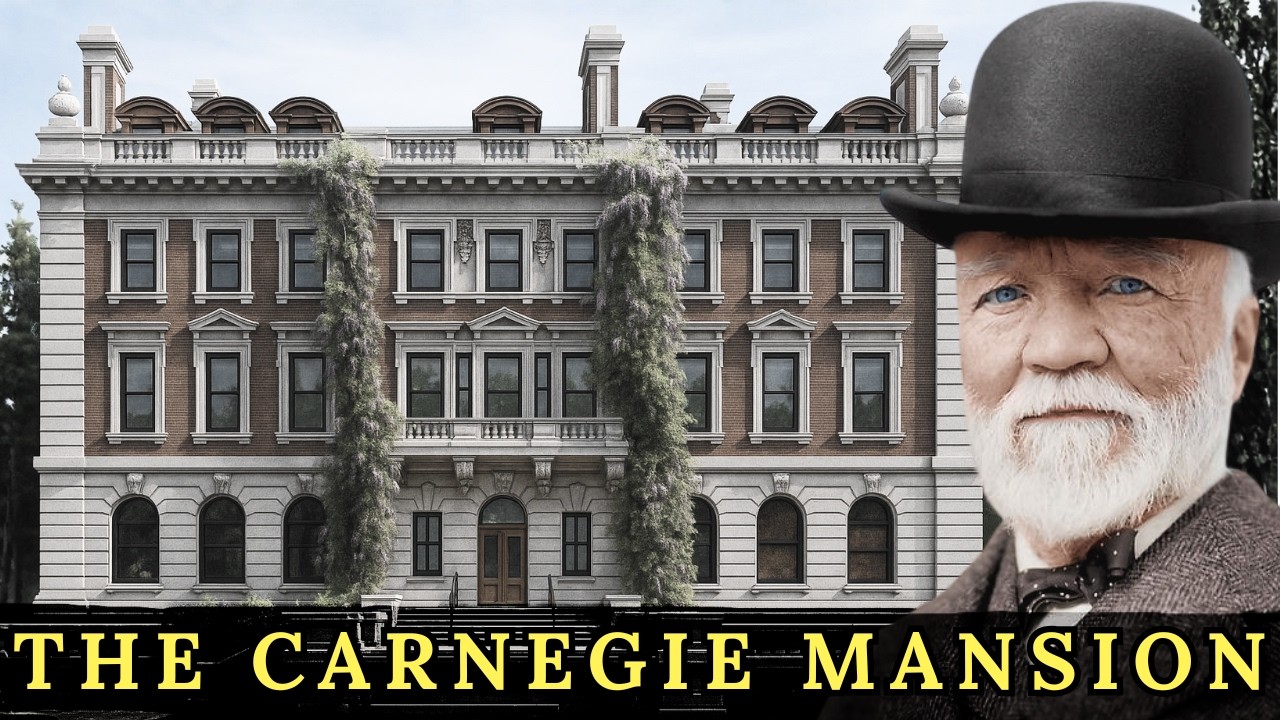
Inside, carved teak from India lined entire rooms, a Tiffany stained-glass window dominated the reception area, and ceilings soared twenty feet high. It was not modest. It was not plain. But compared to the marble fortresses the Vanderbilts were raising along Fifth Avenue, it looked almost restrained.
That was the point. Carnegie had been born in a one-room cottage in Scotland, where his entire family cooked, ate, and slept in a single space. He had worked seventy-hour weeks as a child for $1. 20.
He had clawed his way from absolute poverty to become the richest man in the world. When he sold his steel company to J. P. Morgan in 1901 for $480 million, he personally received $225 million, more money than anyone in America except John D.
Rockefeller had ever possessed. He could have built a palace that made the Vanderbilts look poor. Instead, he built far north of where the other millionaires lived, designed it to look like an English country home rather than a French chateau, and filled it with books and music instead of gold leaf and marble statues. He wanted people to know he was different from the other robber barons.
His residence was part of that message. He had written an essay called The Gospel of Wealth, arguing that rich men had a moral obligation to give their fortunes away, declaring that the man who dies rich dies disgraced. But the building told a more complicated story. It revealed the contradictions of a man who preached simplicity while living in sixty-four rooms, who claimed to champion workers while his company crushed unions with violence, who spoke of moral obligation while building one of the greatest personal fortunes in history.
By 1900, the Vanderbilts owned Fifth Avenue. The section between 50th and 60th Streets had become known as Millionaires’ Row, lined with marble facades, carved stonework imported from Europe, ballrooms with gilded ceilings, and grand staircases that could accommodate a hundred guests ascending at once. Carnegie watched this display with distaste. In 1898, when the time came to build a home in Manhattan, he deliberately chose a location blocks north of fashionable society.
He purchased an entire city block bounded by 90th Street, 91st Street, and Fifth Avenue. He wanted space, specifically room for a garden. His instructions to the architectural firm of Babb, Cook, and Willard were specific: build him the most modest, plainest, and most roomy house in New York. They designed a structure in the style of a Georgian country house, red brick, simple lines, classical proportions without excessive decoration.
Construction took three years. The finished building contained sixty-four rooms spread across four floors. The entrance hall rose two stories, a grand staircase curved upward, and rooms opened into more rooms, a library, reception room, music room, dining room, and conservatory. No ballroom.
No marble walls. No excessive gilding. Carved wood rather than elaborate plaster. Comfortable rather than ostentatious.
The garden completed the property. A private green space of lawns, trees, flowers, pathways, a conservatory for exotic plants, and a pergola for shade, all enclosed by an elaborate cast-iron fence with granite posts. In Manhattan, where land was the most expensive commodity, a private garden this size was almost obscene luxury. The press described the building as surprisingly modest for a man of such wealth.
His neighbors on Fifth Avenue noticed too. Within a few years, other wealthy New Yorkers began building nearby, and the neighborhood became known as Carnegie Hill. Property values doubled. The northern boundary of fashionable Fifth Avenue moved from 60th Street to 90th Street almost overnight.
One man had created a new district simply by deciding to live there. But the reality was more complicated than the image. You don’t build sixty-four rooms because you value simplicity. You don’t import teak from India because you’re plain.
The modest residence cost a fortune to build and required dozens of staff to operate. Yet it looked restrained compared to the Vanderbilt palaces, and in the world of Gilded Age New York, appearances mattered more than reality. Carnegie had learned something important during his rise from poverty: perception creates reality. If he said his house was modest and plain, and if it looked modest compared to the competition, then it was, regardless of the sixty-four rooms and imported materials.
The fortune that built that house had been earned in ways that were anything but plain. Andrew Carnegie was born on November 25, 1835, in Dunfermline, Scotland. His father, William, was a skilled hand-loom weaver producing damask linen. The family lived above the workshop in one room, roughly twelve feet by twelve feet.
By the 1830s, the industrial revolution was destroying the hand-loom trade. Power looms improved, factories produced decent cloth at a fraction of the cost, and American tariffs on linen returned in 1837. William Carnegie watched his profession disappear. The family fell into poverty.
In 1848, Margaret Carnegie made a decision. Scotland offered no future for her family. The Carnegies auctioned their possessions, borrowed twenty pounds from friends, and boarded a small sailing ship called the Wiscasset in Glasgow. The voyage took fifty days.
They arrived in America that summer and settled in Allegheny, Pennsylvania, across the river from Pittsburgh, where Margaret’s sister had already immigrated. Andrew was twelve years old. Pittsburgh in 1848 was already becoming the center of American iron and coal production. Factories lined the rivers, furnaces burned constantly, and smoke created a permanent haze over the city.
The family needed income. Andrew’s formal education ended when he left Scotland. His mother found him a job at a cotton factory, where he became a bobbin boy, tending machines that wound thread, earning $1. 20 per week for seventy hours of work, six days a week, twelve hours a day.
He was twelve years old. He hated it. The noise, the heat, the monotony, the exhaustion. In 1849, an opportunity appeared.
The Ohio Telegraph Company needed a messenger boy, paying about $2. 50 per week. More importantly, it meant escaping the factory. At age thirteen, he got the job, delivering messages around Pittsburgh.
He taught himself Morse code, practicing with the operators during slow periods until he could read messages by ear without writing them down. By age fifteen, he was promoted to telegraph operator. By age seventeen, he was working for Thomas Scott, superintendent of the Western Division of the Pennsylvania Railroad, at $35 per month. Scott taught Carnegie how business really worked.
In 1856, Scott told his young secretary about an investment opportunity in the Woodruff Sleeping Car Company. Scott was investing $500. Would Carnegie like to buy in? Carnegie didn’t have the money, so he asked his mother to mortgage the family house.
Margaret agreed. Within a year, the investment was paying dividends. Carnegie later wrote about receiving that first dividend check for $10, calling it the moment he understood how wealth was actually built. Labor earned wages.
Capital earned returns. By the early 1860s, Carnegie was making more from investments than from his railroad salary. He left the Pennsylvania Railroad in 1865 at age twenty-nine and focused on iron and steel. He started with the Keystone Bridge Company, then acquired operations throughout the production chain, iron mines near Lake Superior, coal operations in Pennsylvania, railroads, and factories.
In the early 1870s, he adopted the Bessemer process, which blasted air through molten iron to create steel in minutes rather than hours. In 1873, he established the Edgar Thomson Steel Works near Pittsburgh, named after the president of the Pennsylvania Railroad, one of his largest potential customers. When the panic of 1873 triggered a six-year depression, Carnegie saw opportunity. He bought out failing competitors, acquired facilities at bargain prices, and invested in improvements while others cut costs.
His management approach was ruthless. Every operation was analyzed for efficiency. Every cost was scrutinized. Workers were pushed to produce more.
Facilities that couldn’t compete were shut down. He pioneered detailed cost accounting in the steel industry, knowing exactly what each part of the production process cost. He could price steel lower than competitors and still make a profit because his costs were lower. By 1890, Carnegie Steel dominated American steel production.
The facilities were dangerous. Workers endured twelve-hour shifts in extreme heat. Injuries were common. Deaths occurred regularly.
Pay was low relative to the profits being generated. Carnegie lived mostly in New York by that point, traveled to Scotland each summer, wrote essays about the obligations of wealth, and spoke about workers’ rights. But he left the actual management of his steel operations to Henry Clay Frick, a coke producer who had joined the company in 1881. Frick was brilliant at operations and ruthlessly anti-union.
That distance proved disastrous. On July 1, 1892, Carnegie was in Scotland at Skibo Castle. His Homestead steel works employed 3,800 workers, about 800 of whom belonged to the Amalgamated Association of Iron and Steel Workers. Their contract expired at the end of June.
Negotiations had been underway since February. The union wanted a wage increase. Production had increased sixty percent at Homestead after recent improvements. Frick refused the union’s demands.
On June 25, he locked out the union workers, built a fence around the facility topped with barbed wire, erected guard towers, and hired three hundred armed Pinkerton guards. The locked-out workers responded by taking control of the town of Homestead. Early in the morning of July 6, two barges moved up the Monongahela River with the three hundred Pinkerton guards aboard. Thousands of workers and townspeople lined the riverbank.
When the barges attempted to land, the crowd prevented them. Someone fired a shot. To this day, no one knows which side fired first, but once the shooting started, it didn’t stop for fourteen hours. Three Pinkertons were dead.
Seven workers and townspeople were killed. Dozens were wounded. Finally, around five in the afternoon, the Pinkertons surrendered. When they came ashore, the crowd attacked them, and the guards barely made it out alive.
The workers won the battle but lost the war. Pennsylvania’s governor sent in 8,000 state militia troops, who arrived on July 12 and took control of the town and the plant. With military protection, Frick reopened the plant using non-union workers. Striking workers could return only as individuals, renouncing the union.
The strike continued for four more months before the union gave up. The Amalgamated Association was defeated. The union’s power in the steel industry was broken for the next four decades. At least ten people died, dozens were seriously injured, and workers who had participated were blacklisted.
Carnegie’s reputation suffered permanent damage. He had been in Scotland during the entire crisis, but everyone knew the strategy was his. His essays about workers’ rights now seemed hypocritical. On July 23, an anarchist named Alexander Berkman tried to assassinate Frick in his office, shooting him twice and stabbing him repeatedly.
Frick survived. The assassination attempt revealed the depth of anger the strike had generated. For the rest of his life, Homestead would be associated with Carnegie’s name. When he built his mansion eight years later, he was acutely aware of public perception.
The house couldn’t be another Vanderbilt palace. It had to communicate restraint and responsible use of wealth. But the blood at Homestead couldn’t be washed away with architecture. By 1900, Carnegie Steel was generating approximately $40 million in annual profits.
J. P. Morgan, the most powerful banker in America, saw an opportunity to combine Carnegie Steel with competing operations to create a monopoly. Negotiations began in late 1900.
Morgan asked if Carnegie might be willing to sell. Carnegie wrote a number on a piece of paper: $480 million. Morgan looked at it and accepted the price without negotiation. The sale was finalized in March 1901.
Carnegie Steel became the foundation of United States Steel Corporation, the first billion-dollar corporation in history. Carnegie’s personal share came to approximately $225 million, making him by most measures the richest man in the world. At sixty-five years old, retired from business, he was free to do what he wanted, and what he wanted was to give it away. From his office in the mansion at 91st Street, he managed the distribution of hundreds of millions.
Libraries became the primary focus. He believed education and access to knowledge were keys to improving society. Over the next eighteen years, funding went to more than 2,800 libraries across America, Britain, Canada, Australia, New Zealand, and the Caribbean. Universities received funding.
The Carnegie Institute of Technology in Pittsburgh was established, eventually becoming Carnegie Mellon University. The Carnegie Endowment for International Peace received $10 million. The Carnegie Hero Fund received $5 million. The giving became systematic.
Every morning in his office, requests were reviewed, checks were signed, millions flowed out each year. By 1919, when death came, approximately $350 million had been given away, roughly ninety percent of his fortune. He hadn’t died rich. The mansion stood as a symbol of this complicated legacy, modest enough to show restraint, large enough to manage a philanthropic empire.
The journey had been extraordinary, from a one-room cottage to sixty-four rooms, from absolute poverty to the richest man in the world, from nothing to everything, and then from everything back to something resembling humility. Carnegie died quietly on the morning of August 11, 1919, at Shadowbrook, the family’s Massachusetts estate, with his wife Louise beside him. He was eighty-three. His grave at Sleepy Hollow Cemetery bore no monument, no statue, only a simple stone with his name and the years of his life.
After Louise’s death in 1946, the mansion passed to their daughter Margaret. In 1949, she transferred the mansion to the Cooper Union, which renamed it the Cooper Hewitt Museum of Decorative Arts and Design. The Cooper Hewitt Smithsonian Design Museum opened its doors to the public in 1976, and after a major renovation between 2011 and 2014, it continues to stand today at Fifth Avenue and 91st Street, the house Carnegie called plain, now a museum dedicated to design and progress.
The garden remains open, green against the city’s stone, a reminder that progress does not always mean building higher, but building with purpose.
