The mortar round screamed in from nowhere. June 1942, the final defense of Sevastopol, and the city was already a graveyard of broken stone and charred steel. Ludmila Pavlichenko had been lying in her position for hours, watching the enemy lines through the scope of her Mosin-Nagant, when the world turned white and then black. Shrapnel tore into her.
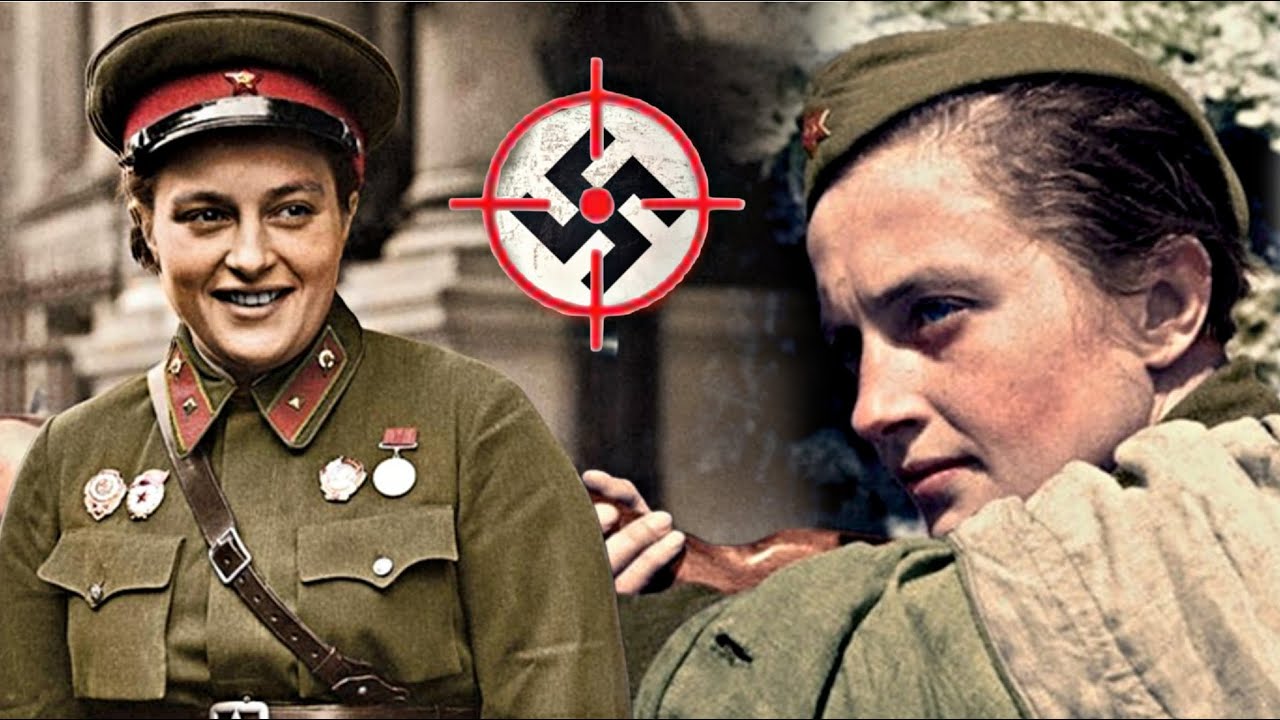
The last thing she remembered before the medics dragged her away was the taste of blood and the desperate wish to stay. She begged to return to the front. She pleaded with officers, with doctors, with anyone who would listen. The Soviet command refused.
They could not risk their most famous heroine, not when her name had already become a weapon more powerful than any rifle. Lady Death, the Germans called her. The woman who never missed. The sniper with more than three hundred confirmed kills to her name, including thirty-six enemy snipers who had come looking for her and found only the silence of a grave.
She was twenty-five years old, wounded, furious, and her war was not over. It had simply changed shape. The shell that wounded her had ended one chapter of her life. But the story of how Ludmila Pavlichenko reached that moment, how a history student from a small Ukrainian town became the deadliest sniper in the Red Army, began long before the first shot she ever fired in anger.
The year 1941 found the Soviet Union standing on the edge of an abyss. From dawn, the sky trembled with the roar of enemy planes. Columns of black smoke rose from bombed cities and ravaged villages. Streets that had once been full of life fell silent, interrupted only by the echo of distant explosions and the cries of those fleeing the chaos.
Families hid in basements and improvised shelters. Markets stood empty. Factories stopped producing. Trains packed with refugees crawled eastward.
More than three million German soldiers, supported by tanks, artillery, and aircraft, had crossed the Soviet border in Operation Barbarossa, the largest land invasion in history. Ukraine, Ludmila’s homeland, became an inferno of fire and steel. A young woman walked through the devastated streets, past rubble and destroyed buildings, past the exhausted faces of her fellow citizens. She did not yet know that her life was about to change forever.
Ludmila Mikhailovna Pavlichenko was born on July 12, 1916, in Belaya Tserkov, a small Ukrainian town that at the time was part of the vast and turbulent Russian Empire. It was an era of violent change. The daughter of a working-class family, she grew up in a home where sacrifice was not an abstraction but daily reality. Her father, Mikhail Pavlichenko, was an industrial worker, a man of firm character shaped by physical labor and a military background that had instilled discipline and a sense of duty.
Her mother, Elena, was a teacher, convinced that education was the safest path to dignity and progress. In that household, where work mingled with books and rigor with tenderness, Ludmila learned three things early: the importance of study, the value of discipline, and a deep sense of patriotic duty. She was not a docile or fearful child. She was competitive, direct, ambitious.
If she set her mind to something, she pursued it to the end. The moment that marked the beginning of her legend came during adolescence. A group of boys mocked her when she expressed a desire to practice sport shooting. To them, it was a man’s activity, reserved for soldiers or hunters.
The teasing ignited a spark of pride that became a flame. She not only decided to learn to shoot, she set a goal few could have imagined: to be the best. At the age of fourteen, she joined a local shooting club. There, for the first time, she felt the cold weight of a rifle in her hands.
It was an instrument of precision, concentration, and absolute control. While other girls her age dreamed of dances and dresses, Ludmila dreamed of perfect aim, of hitting targets almost invisible at a distance. She saw shooting as a spiritual discipline, a form of active meditation. Her progress was rapid.
She spoke little, but when she aimed, she never missed. Through her youth, she alternated studies with shooting practice. Her mother insisted she not neglect her education, and Ludmila complied rigorously. She was interested in history, in the formation of nations, in the social movements that had shaken Europe.
In 1937, at twenty-one, she moved to Kiev to study history at the National University. She wanted to dedicate her life to studying the past, to unraveling the processes that had shaped her nation. But the history she had admired in books would soon arrive with a brutality no text could anticipate. In 1941, she was in her final year of university.
Her life seemed set: an academic career, a thesis to write, a future among archives and libraries. She could have stayed in Kiev, sought refuge, or fled east like so many others. She did not. The same determination that had driven her to challenge the boys at the shooting club reappeared.
She decided to enlist voluntarily in the Red Army. When she arrived at the recruitment office, the officers looked at her skeptically. She was young, slender, with a serene face and polished manners. They suggested she would fit better as a nurse in a field hospital.
Ludmila refused categorically. She took her shooting notebook from her bag, placed it on the table, looked the officer in the eye, and said firmly: “I am a trained sniper. I want a rifle. ”
She was assigned to the 25th Infantry Regiment.
They gave her a Mosin-Nagant bolt-action rifle with a Soviet telescopic sight and sent her to the southern front, where the war was decided meter by meter, hill by hill. Her baptism by fire came in Odessa, a strategic port city on the Black Sea. That summer, Odessa was no longer a cheerful port. It was a besieged fortress.
Bombs fell day and night. Sirens were the prelude to horror, and ruins were the daily landscape. On her first day in combat, Ludmila fired two shots. Two enemy lives extinguished.
Two fewer threats for her comrades. The dry sound of the bolt, the rifle’s recoil, the silence after the shot: this was the baptism of a new identity. The Soviet officers could not believe it. On a front dominated by men hardened by war, a small, focused, relentless woman displayed a cold-bloodedness many soldiers did not possess.
Her shots were clean, precise, deadly. Soon, rumors spread through the trenches like a wind of hope. The girl who never misses, they whispered. For seventy days, Odessa withstood the siege.
The Nazis, supported by their Romanian allies, attacked with fury, sending wave after wave of infantry and aerial bombardments. Moving like a ghost through the debris, Ludmila hunted enemy observers, artillerymen, and snipers. In just over two months of combat, her personal tally rose to more than 180 confirmed kills. Every shot meant more than an enemy downed.
It meant a Soviet life saved, a position protected, an advance halted. Her reputation grew so much that commanders entrusted her with an additional task: training new snipers. With no formal school and no time for practice, she taught recruits how to blend into their surroundings, how to merge with the landscape until they disappeared, how to listen to the battlefield, the crunch of a boot, the whistle of a shell, the silence before an attack. She taught the hardest lesson too: the patience to wait for hours without moving, the serenity to shoot only when necessary.
But Odessa’s heroic resistance could not last forever. The German and Romanian forces broke through the defenses. The city fell. The Red Army received orders to retreat to the last southern stronghold: Sevastopol on the Crimean Peninsula.
Sevastopol was more than a military base. It was a symbol, a wall against the Nazi advance. For Ludmila Pavlichenko, it became the stage of her definitive consecration. She fought there for more than eight uninterrupted months under conditions approaching the inhuman.
Winter brought cold, hunger, and daily bombardments. Caves and trenches were her refuge. The sky roared relentlessly. Yet she remained at her post, rifle in hand, observing, waiting, calculating.
Her aim became so feared that the enemy began to refer to her with a nickname that sent chills down the spine: Lady Death. Every time a German officer fell, every time a Nazi shooter failed to return, the rumor repeated, “It was Lady Death. ”
The Nazi snipers began hunting her. They knew her name, recognized her face.
They considered her a trophy, a threat to be eliminated at any cost. She did not flee from danger. She accepted duels with the calm of someone who masters her craft. In one of these encounters, she fought a three-day duel against an elite German sniper.
Both waited, moved stealthily, measured every sound. For three days and nights, Ludmila remained almost motionless, observing, measuring the wind, waiting for the enemy’s mistake. Finally, a slight shadow betrayed his position. She fired.
The silence afterward was absolute. When she checked the fallen sniper’s body, she discovered a chilling detail: among his belongings, the man carried a photograph of Ludmila Pavlichenko, marked with a red cross over her face. The enemy feared her, studied her, hunted her, and had failed. Each sniper duel was a mental battle, a game of nerves in which the mind mattered as much as the eye.
A sniper does not shoot on impulse. They breathe, observe, listen. One false move can mean death. Ludmila controlled her breathing, conquered fear, eliminated trembling.
She knew hesitation meant death. By mid-1942, her official tally exceeded 309 confirmed kills, including 36 enemy snipers. The Soviet high command recognized in her not only an exceptional soldier but a symbol of the moral and psychological power of the Red Army. She was promoted to lieutenant and awarded the title Hero of the Soviet Union, the highest military distinction a combatant could receive.
Then came that June day in Sevastopol, the mortar explosion, the shrapnel, the evacuation she fought against with everything she had. Her war on the front was over. Even before her full recovery, her name had become a living legend. In Red Army camps and hospitals, her story was told quietly, almost like a prayer.
“If Ludmila could endure, so can we,” exhausted soldiers said, clinging to her example like a talisman. She had put down the rifle, but not the cause. The war continued, and she had to fight with a new weapon: her voice. In September 1942, Ludmila traveled to the United States as part of a Soviet delegation to strengthen the alliance with the Allies.
She was the first Soviet citizen to be received at the White House during the war. There she met Eleanor Roosevelt, who was impressed by her firmness, intelligence, and serenity. In a country accustomed to seeing women far from the battlefield, Ludmila’s presence had an immediate impact. A young woman in military uniform, medals on her chest, a steely gaze, not as propaganda decoration but as living proof that war had shattered all boundaries.
In her first speech in Washington, journalists bombarded her with trivial questions. They wanted to know if she wore makeup, if she preferred skirts or pants, if she felt feminine wielding a rifle. Ludmila stopped them with a single phrase that became legendary. “I haven’t had time to talk about that.
I’ve been too busy killing Nazis. ”
Her response traveled around the world. Headlines changed. She was no longer just a Soviet sniper.
She was the face of women’s struggle against oppression. During her tour of the United States and Canada, she visited universities, factories, and military camps. At every encounter, she spoke simply, without embellishment. “I do not come to ask for compassion.
I come to ask for support. Every day you hesitate, our children die. ”
Her speeches inspired empathy and respect. The press, initially curious, ended up admiring her.
Woody Guthrie, the legendary American singer-songwriter, dedicated a song to her, “Miss Pavlichenko,” a popular anthem that immortalized her as a symbol of courage and dignity. For the first time, a Soviet hero was celebrated in the heart of America. After her North American tour, Ludmila visited the United Kingdom. She was received by Winston Churchill and honored as one of the most significant military figures of the Eastern Front.
In her lectures, she emphasized one message: war was not only for men, and courage had no gender or border. Her presence in London, still under the echo of bombings, served as a reminder of human resilience. “If the Soviets can resist in Sevastopol, we can resist at home,” declared the British press. But being a symbol has a price.
Pavlichenko, who had lived in mud and gunpowder, now wore formal suits, smiled for cameras, repeated speeches. Deep down, she was still a soldier. Every round of applause reminded her of the faces of her fallen comrades. In her memoirs, she wrote that the tours were harder than the front.
“At least on the battlefield I knew where the enemy was. ” Still, she accomplished her mission. She awakened international support, showed the human face of Soviet sacrifice, and demonstrated that female courage was not an exception but an example. When the war ended in 1945, Ludmila Pavlichenko was barely twenty-nine years old.
She had survived hell, faced the best snipers of the German army, and traveled halfway across the world as a symbol of Soviet valor. But the war, though over on the maps, continued within her. The physical wounds healed. The emotional ones did not.
She carried the shadows of war: memories of fallen comrades, the sound of gunfire, the faces that disappeared in the scope of her rifle. She never returned to the front. Instead, she began a new battle, that of educating and remembering. She was appointed military instructor and adviser for the Red Army, training new generations of Soviet snipers.
Her experience was essential for tactical training in the postwar years, especially in camouflage techniques and long-distance accuracy. She also worked with the War Veterans Association, where she became a respected voice in keeping the memory of those who did not return alive. In the 1950s and 1960s, she found refuge in writing and teaching. She published her war memoirs, a raw and honest testimony that remains a reference for military historians.
In them, she did not present herself as a heroine but as a woman who fulfilled her duty, a woman who, in her own words, learned not to fear death, but never stopped fearing oblivion. She did not remarry. Her great love, a Soviet officer she met during the defense of Sevastopol, died in combat. From then on, her personal life remained marked by absence.
During Victory Day parades, she could be seen walking among much younger veterans, her uniform impeccable, her face serene, yet with the gaze of someone still looking through an invisible telescopic sight. Over time, history began to recognize her beyond the myth. She was awarded the Order of Lenin, received the title Hero of the Soviet Union, and her name was inscribed in schools, museums, and monuments throughout Soviet territory. In Ukraine, her homeland, she is remembered as one of the most important female figures in modern history.
Ludmila Pavlichenko passed away in 1974 at the age of fifty-eight. Her funeral was quiet, attended by veterans, family members, and former students. No bullets were fired that day, but millions of memories accompanied her. More than three hundred enemies fell before her sight.
Her greatest victory was reminding the world that even in the darkness of war, the light of dignity can shine. Every Soviet female sniper who followed in her footsteps, every story of silent heroism that emerged behind the Eastern Front, carries a piece of her within it. History is not always written by the powerful, but by those who have the courage to act when all seems lost. Ludmila Pavlichenko crossed that threshold.
She was no longer observing history. She was writing it with every shot.
