Before the outlaws and the gunfights, there was wheat. For the thousands of families who pushed onto the American frontier between the 1840s and the 1880s, wheat was not a crop bound for some distant market. It was the arithmetic of survival—the single calculation standing between a family and the slow, grinding death of starvation in a winter that came early and intended to stay. The first enemy was always the prairie itself.
The deep-rooted, densely matted grassland of Kansas, Nebraska, and Dakota Territory had been accumulating itself for centuries. Root systems reached down three, four, and five feet into the earth in a tangle so dense that the standard Eastern plow shattered against it like a hand against stone. The answer was the breaking plow—heavier, longer, pulled by multiple oxen, designed specifically for the resistance the prairie presented. A man and a good team could break perhaps an acre a day under favorable conditions, and favorable conditions were not what the frontier offered as its standard terms.
Miriam Davis Colt arrived in Kansas Territory in 1856 and wrote in her diary that the first planting felt less like farming and more like an argument. The seed dropped into ground that had not yet decided whether it intended to accept it. Standing in that first broken field in the spring evening, looking at the turned sod stretching to the horizon, she felt not hope exactly, and not fear exactly, but the specific combination of the two that the frontier produced in people who had committed to something whose outcome was genuinely uncertain. The earth argued, then slowly yielded.
The wheat came up. The daily life that wheat sustained was not romantic. It was not the life described in the promotional literature distributed by railroad companies and territorial land offices. It was harder than that, more mechanical, more completely dependent on a chain of contingencies: weather, soil, seed quality, the mercy or cruelty of a particular season.
Grinding was the labor the harvest created. A frontier family without a mill within reach—and reach on the Kansas plains was measured in hours of travel rather than minutes—ground their wheat by hand. Stone against stone, the upper quern turned by arms already exhausted from the previous season and now drafted back into service by the coming winter’s need. It took hours of labor to produce pounds of flour.
The flour produced bread: dense, dark, nutritionally sufficient, entirely without the qualities that made bread anything other than fuel. Fuel was what the frontier required of it. The bread sustained the men breaking the next field. The next field produced the next harvest.
The next harvest produced the next winter’s flour. The cycle was mechanical in the way survival is always mechanical, each component necessary, none optional. A failed harvest broke the cycle, and the frontier broke harvests without apology. Drought came first in the years when the rain simply did not arrive.
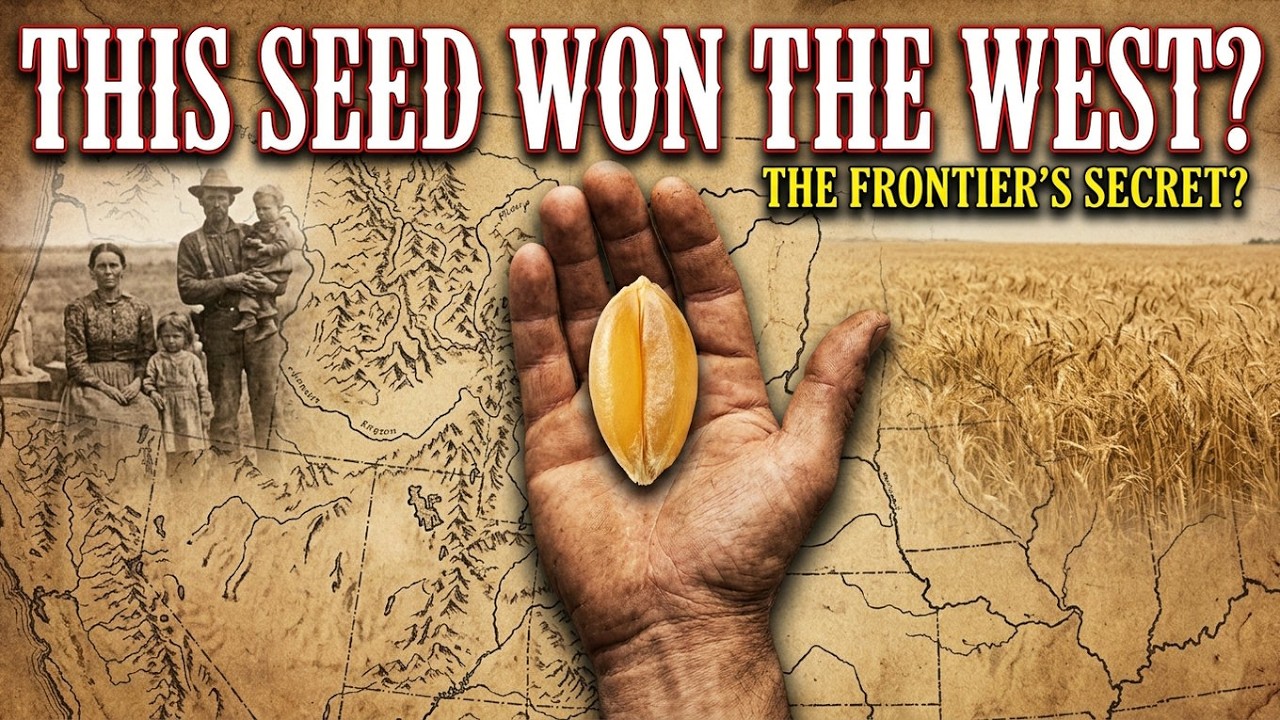
The sky stayed clear through May, June, and July with the cheerful indifference of weather that had no awareness of what was depending on it to behave otherwise. Wheat planted in dry ground either did not germinate or reached six or eight inches and then stopped, its growth arrested by the absence of moisture. The stalks thinned and yellowed through the July sun until the field that had been planted with everything a family owned was a field of dust and failed calculation. In the autumn of 1874, a group of Mennonite families arrived in Kansas from the steppes of southern Russia carrying something in their luggage that would alter the future of the American interior more completely than any railroad, government policy, or military campaign the frontier produced.
They carried seed: Turkey Red winter wheat. Developed on the Russian steppes through generations of careful selection by farming people who had learned through accumulated and sometimes catastrophic experience what cold, dry, wind-punished grassland soil demanded of anything planted in it. It was a hard red winter variety that went into the ground in October and slept through winters that destroyed every other wheat variety in the field. It came up in April with a density and vigor and a color—the deep, burnished, almost arterial red that had given it its name—that the Kansas farmers who had been losing the argument with the climate for years walked out to their fields to see and found no adequate words to describe.
It stood against the dry springs. It pushed through the late cold snaps that arrived in April as if personally offended by the warming soil. It headed in June with the fullness of a crop that the ground had finally agreed to produce without reservation. The yields rewrote what was possible.
Word moved the way genuinely good news moves in communities where good news has been scarce: farm to farm, county to county, through the testimony of men who had seen the fields themselves and had no reason to disbelieve what they were looking at. Neighbors wanted the seed. The seed moved. The fields expanded across the Southern Plains with the momentum of something whose time had arrived.
The flour Turkey Red produced was finer, whiter, more consistent. The bread baked from it was still fuel, but it was fuel that worked better, stretched further, and sustained more completely through the months when stored flour was all that stood between a family and the arithmetic the winter was patiently running against them. The wheat frontier is not the frontier of legend. There are no gunfights in it, no famous names, no dramatic confrontations preserved because they were dramatic enough to warrant preservation.
There are no monuments to the women who ground wheat by stone in sod houses while the temperature fell and the walls pressed inward and the January wind worked at every gap the building had neglected to close. There are no monuments to the Mennonite families who crossed an ocean carrying seed in their luggage because seed was the most valuable thing a farming people could carry into an uncertain future. There are fields. There are hands.
There is the specific and undramatic courage of people who dropped seed into ground that had not agreed to receive it, in weather that had not agreed to cooperate, on land that the continent had not agreed to surrender without a fight—and who came back the following spring and dropped it again when the previous attempt had produced nothing but the evidence that the attempt had been made. The wheat survived. Most years, not all years, not without the cost the frontier extracted from everything it permitted to survive within it. But enough years, in enough fields, in the hands of enough families who had come far enough and refused at the specific moment when refusing was the only dignified thing left available to them to stop planting.
The ground gave back wheat. The wheat gave back the settlers. The settlers gave back a nation.
And that nation was standing there—quiet, unheroic, made of bread and broken sod and the accumulated endurance of ordinary people in extraordinary circumstances—long before the first gunfight gave the legend something more dramatic to talk about.
