On Christmas Eve 1895, snow covered the Blue Ridge Mountains of western North Carolina. The approach road wound for three miles through planned forest before the chateau rose into view, its steep roofs and chimneys silhouetted against the winter sky. Inside, electric lights illuminated rooms filled with art collected across Europe. A fire burned in the banquet hall beneath a barrel-vaulted ceiling seventy-five feet high.
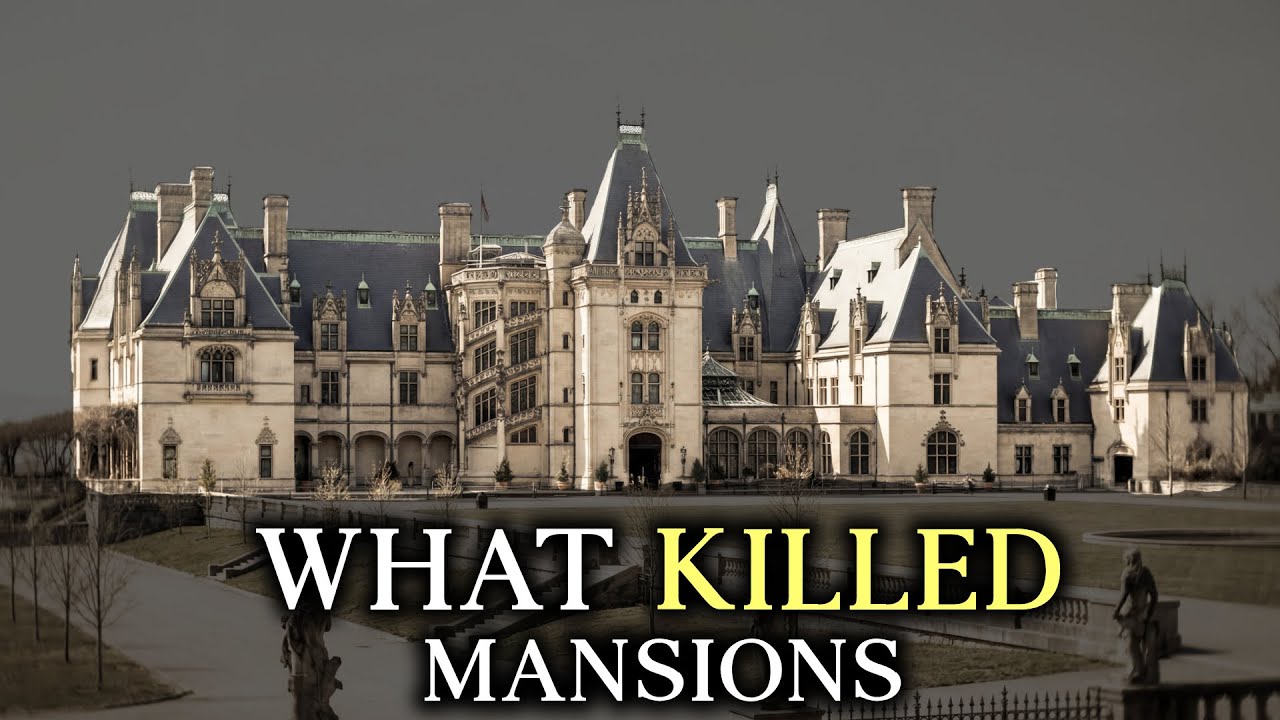
George Washington Vanderbilt II was thirty-three years old, and he was opening the largest private residence ever built in America to his family for the first time. It had taken six years and roughly six million dollars to reach this night, a sum that exceeds two hundred million in today’s currency. The house contained 250 rooms across four stories plus a full basement: 35 bedrooms, 43 bathrooms, 65 fireplaces, and roughly 175,000 square feet of finished floor space. No American has built anything remotely comparable since.
The reason has nothing to do with changing architectural tastes or declining ambition. The world that made the house possible was deliberately destroyed through taxation, regulation, and public fury at extreme wealth. What replaced it reveals something darker about modern inequality: the billionaires did not disappear, they simply learned to hide. George Vanderbilt was different from his relatives.
His older brothers built mansions in Manhattan and Newport, competing to erect the most elaborate showpieces on Fifth Avenue and along the Rhode Island coast. They hosted costume balls that cost fortunes and filled newspapers with scandalized accounts of excess. George preferred books to parties. He spoke eight languages, collected art, and traveled Europe studying architecture and landscape design.
He was shy, intellectual, and uncomfortable with the performative wealth displays that defined Gilded Age society. In 1888, he visited Asheville, North Carolina for his health; doctors recommended the mountain air for his chronic respiratory problems. The town sat in a valley surrounded by the Blue Ridge Mountains, accessible by railroad but still isolated from eastern cities. The climate was temperate, the scenery spectacular, the land cheap.
George saw something beyond a health retreat. The forests reminded him of European estates. The mountains provided natural boundaries and privacy. The region was economically depressed, which meant labor and materials cost far less than in the industrialized north.
Within a year he had acquired approximately 125,000 acres surrounding Asheville, an area larger than many eastern cities. Local owners, struggling economically after the Civil War’s devastation, sold eagerly to a wealthy northerner offering cash. He hired the best designers money could procure. Richard Morris Hunt, America’s preeminent architect, trained at the École des Beaux-Arts in Paris, had designed the pedestal for the Statue of Liberty and numerous Fifth Avenue mansions for the Vanderbilt family.
Frederick Law Olmsted, who had designed Central Park and pioneered landscape architecture in America, received the landscape commission. At sixty-seven, Olmsted was at the peak of his reputation. The initial conception was modest. George spoke of building a country house where he could retreat from society.
Hunt sketched a comfortable residence. Olmsted proposed gardens and a working farm. The project expanded rapidly. George wanted a library for his book collection, guest rooms for extended visits from family and friends, entertainment spaces for occasional social obligations, and technological systems that would make the house modern.
Hunt looked to the Loire Valley for inspiration, designing a four-story limestone structure in the style of the French Renaissance, with a steeply pitched roof, massive chimneys, and elaborate stone carving. Olmsted conceived something unprecedented in America: a managed landscape encompassing the entire property, with formal gardens, planned forests demonstrating scientific forestry, and a model farm that would prove modern agricultural methods could restore the region’s depleted soil. Construction began in 1889. A private railroad spur was built to the site to transport materials.
Limestone was quarried in Indiana and shipped south. Craftsmen were recruited from across America and Europe. At peak activity, more than 1,000 workers labored on the house and grounds simultaneously. The foundations required excavating into bedrock.
The steel structural frame supported stone walls four feet thick. The roof covered more than an acre. Every system was designed for permanence, as though the house would stand for centuries. George visited regularly, making decisions on details ranging from stone selection to furniture placement, working directly with Hunt and Olmsted as the structure rose.
The house was designed around specific functions. The ground floor contained public spaces: a banquet hall that could seat sixty-four guests, a library designed to hold 10,000 volumes, a billiard room, and multiple sitting rooms. The second floor held family bedrooms and guest suites; the third, additional guest rooms and storage; the fourth, servants’ quarters. Below ground, a basement contained kitchens, mechanical systems, and a swimming pool.
Technology was integrated throughout: electric lights powered by the estate’s own generator, central heating that carried steam through miles of pipes, an intercom system between floors, and elevators for people and supplies. Olmsted’s landscape work proceeded simultaneously. He planted hundreds of thousands of trees and shrubs, many imported from Europe and Asia. He created a three-mile approach road that wound through planned forests, designed to build anticipation before revealing the house.
Formal gardens descended from terraces behind the residence. The farm encompassed thousands of acres with dairy operations, vegetable gardens, and livestock. When the house opened on Christmas Eve 1895, the numbers defined what George had built. The library shelves stretched two stories high, designed for 10,000 volumes; his collection already numbered more than 20,000 books in eight languages.
The winter garden featured a central fountain surrounded by tropical plants blooming year-round beneath skylights three stories above. A bowling alley in the basement used equipment imported from European manufacturers. The indoor pool measured seventy feet long, lined with tile from specialists in Turkish baths. There was a gymnasium, a billiard room, a three-story entrance hall lit by a massive wrought-iron chandelier.
The staff required to operate it numbered more than eighty people living on the estate. Thirty servants worked inside the house as cooks, maids, butlers, and footmen. The fourth floor was devoted entirely to servants’ quarters, with a network of back stairs and service passages that allowed staff to move through the building without disturbing the family. The annual operating cost exceeded $250,000, equivalent to millions today.
Already, within a few years, it was clear the estate consumed wealth faster than George’s investments generated it. He married Edith Stuyvesant Dresser in 1898; their daughter Cornelia was born in 1900. The house that could accommodate dozens of guests and required a staff of eighty was occupied by a family of three. George tried various schemes to make the estate financially viable: a commercial dairy, timber sales from the managed forests, experiments with different agricultural approaches.
None generated sufficient revenue to offset the crushing operating costs. The house was simply too large and too expensive to maintain, even for a Vanderbilt. The problem was structural, not personal. Biltmore represented the absolute peak of what private wealth could build in America at the end of the nineteenth century, built during a brief window when vast inherited fortunes faced almost no taxation.
That window was closing. George died unexpectedly in 1914 at age fifty-one, following complications from an appendectomy. His widow, Edith, inherited the estate and confronted the financial crisis he had been delaying. Property taxes were rising.
The national mood was turning against ostentatious displays of inherited wealth. In 1930, she opened the house and gardens to paying tourists to help cover operating costs. The private residence became a public attraction. The family continued living in a small section of the house, but most rooms were now displayed for visitors who paid to see how the ultra-wealthy had lived a generation earlier.
The forces that made Biltmore impossible to repeat were already gathering strength in 1895. In 1913, the same year George Vanderbilt died, the United States government fundamentally altered the rules of American wealth. On February 3, the states completed ratification of the Sixteenth Amendment, giving Congress permanent authority to tax income from whatever source derived. Before 1913, the federal government had imposed an income tax only briefly during the Civil War, a measure that expired in 1872; the Supreme Court struck down a subsequent attempt in 1895.
For most of the Gilded Age, wealthy Americans faced no federal income tax whatsoever. Congress passed the first permanent income tax law in October 1913. The initial rates appeared modest: no tax on income below $3,000, 1 percent on income between $3,000 and $20,000, and a top marginal rate of 7 percent on income exceeding $500,000 annually, affecting perhaps a few hundred families nationwide. The rates did not stay modest.
World War I demanded unprecedented government revenue. Congress raised the top rate to 15 percent in 1916, then to 67 percent in 1917, then to 77 percent in 1918. A man who earned $2 million in 1918 would surrender more than $1. 5 million to federal taxation.
After the war, the rates came down somewhat, reaching 25 percent in 1925. For a few years, wealthy families resumed building and spending as they had before. The Great Depression destroyed that hope permanently. Public fury at the wealthy intensified as bread lines lengthened and shantytowns spread.
President Herbert Hoover, himself a wealthy man, proposed raising taxes on the rich to address the deficit and fund relief programs; Congress passed the Revenue Act of 1932, raising the top marginal rate to 63 percent. When Franklin Roosevelt won the presidency in a landslide that November, he made higher taxes on the wealthy a centerpiece of his New Deal agenda. The Revenue Act of 1935 raised the top rate to 79 percent on income exceeding $5 million annually. Roosevelt called it the Wealth Tax and defended it explicitly as an attack on concentrated fortunes, arguing that extreme inequality threatened democracy itself.
The Supreme Court upheld the new rates. By 1940 the top rate reached 81 percent; during World War II it climbed to 94 percent on income over $200,000. For the next three decades, the top rate never dropped below 70 percent. The income tax was only part of the squeeze.
Congress imposed a federal estate tax in 1916 at a maximum rate of 10 percent on estates exceeding $5 million. The rate rose steadily, reaching 77 percent by 1941. Property taxes escalated simultaneously at state and local levels. The combination was devastating.
A fortune that survived income taxation while the original builder lived faced estate taxation when he died; if his heir attempted to maintain the family mansion, annual property taxes consumed additional wealth. The three-legged tax system ensured that even the largest fortunes would eventually be dispersed or depleted. The mathematics were simple and brutal. Consider a mansion requiring $250,000 annually to operate, similar to Biltmore’s costs.
In 1913, a man with $500,000 in annual income faced no federal income tax and could easily cover those expenses. By 1935, that same income faced federal taxes approaching $400,000. The remaining $100,000 could not maintain the estate, pay property taxes, and support the family. The servants who maintained these houses were also disappearing.
The domestic service industry, which had employed millions of Americans before World War I, contracted dramatically during the 1920s and collapsed during the Depression. Industrial jobs paid better. Social attitudes shifted against servitude as a career. The Fair Labor Standards Act of 1938 established minimum wages and maximum hours for most workers.
The cheap, abundant labor that had made Gilded Age estates economically feasible was vanishing. Technology partially compensated, but no machine could eliminate the fundamental problem: a 250-room house remained vastly more expensive to operate than a 20-room house. The wealthy adapted by reducing scale. New construction in the 1920s and 1930s featured far fewer rooms.
Twenty or thirty rooms became the new standard for the very rich; fifty marked exceptional ambition. No one attempted to match Biltmore’s 250. Existing mansions became liabilities, actively destroying wealth through operating costs and taxation. Families faced a choice: maintain the mansion and watch the fortune disappear, or demolish the house and liquidate the asset.
Most chose demolition. The demolition began on Fifth Avenue. In 1926, the mansion that Cornelius Vanderbilt II had built at the corner of Fifth Avenue and 57th Street came down. Completed in 1883, the house had occupied an entire city block with 130 rooms and a ballroom that could accommodate 1,200 guests.
Demolition took less than six months; a bank and office building replaced it. The pattern repeated across Manhattan. William Kissam Vanderbilt’s mansion at 660 Fifth Avenue, completed in 1883, was demolished in 1927. Caroline Schermerhorn Astor’s mansion at Fifth Avenue and 65th Street disappeared in 1926 to make room for a luxury apartment building; her ballroom held exactly 400 guests, giving rise to the phrase “the 400” as shorthand for high society.
In 1900, more than 100 major Gilded Age mansions lined Fifth Avenue between 42nd and 96th Streets. By 1950, fewer than 10 survived. The wave spread beyond Manhattan. Newport, Rhode Island, had been the summer capital of Gilded Age society.
The Breakers, built by Cornelius Vanderbilt II in 1895 at a cost of $7 million, survived only because the family donated it to the Preservation Society of Newport County in 1948. Marble House, built by William Kissam Vanderbilt in 1892, followed the same path in 1963. Chicago lost virtually its entire collection: Potter Palmer’s castle on Lake Shore Drive, completed in 1885 with 42 rooms and a three-story art gallery, was demolished in 1950 because the land was worth more empty than occupied. What replaced these mansions revealed the transformation clearly.
Apartment buildings generated rental income from dozens or hundreds of units on the same land that had held one family. Office buildings created even higher returns. The American real estate market had become too sophisticated and too expensive to tolerate single-family mansions on premium urban land. The few mansions that survived did so by transforming their function entirely: the Frick Collection opened as a museum in 1935, Andrew Carnegie’s mansion was donated to the Smithsonian in 1972, J.
P. Morgan’s library survives as a museum while the house is gone. Institutional use justified preservation; residential use guaranteed demolition. Even Biltmore, the largest and most famous of all American mansions, survived only by opening to tourists in 1930.
The house became a museum that happened to have family members still living in one wing. By 1950 the transformation was complete. The American mansion as Gilded Age symbol had become extinct. Those that survived did so as museums, schools, or institutional buildings.
None functioned as private residences in the way their builders had intended. The era of building palaces for oneself had ended permanently. The wealthy did not disappear. They simply learned to live differently.
The modern billionaire owns more than George Vanderbilt ever imagined; the public just cannot see it. Bill Gates lives in a house called Xanadu 2. 0 on the shore of Lake Washington near Seattle: approximately 66,000 square feet spread across multiple buildings on five acres. It is large by any standard, but it is not a palace.
Trees screen the property from public view. The design prioritizes technology and privacy over grandeur and display. Gates’s net worth has exceeded one hundred billion dollars; he could have built ten Biltmores. He chose not to.
Jeff Bezos spread his real estate across multiple properties worth hundreds of millions collectively: a mansion in Beverly Hills, apartments in New York, a ranch in Texas, a compound in Washington. Each is substantial, but none approaches palace scale. Mark Zuckerberg bought his Palo Alto home in 2011 for $7 million, then purchased the four surrounding properties for a combined $43 million. The strategy was not expansion, but privacy: by controlling the neighboring land, he created a buffer zone.
The investment was defensive, not ostentatious. This pattern reflects a deliberate calculation. A visible palace creates multiple problems. Ostentatious display attracts unwanted attention; kidnapping became a serious concern after the Lindbergh baby abduction in 1932.
Property assessors notice palaces, generating enormous annual tax bills. Building a palace invites media coverage and public criticism; Occupy Wall Street in 2011 demonstrated continuing hostility toward visible wealth inequality. The strategic response has been to shift wealth away from residential real estate entirely. The compound strategy exemplifies this approach.
Rather than building one enormous house, wealthy individuals construct multiple smaller structures on large properties. Larry Ellison, founder of Oracle, purchased approximately 98 percent of the Hawaiian island of Lanai in 2012 for an estimated $300 million, controlling nearly an entire island of roughly 140 square miles. He built no single mega-mansion; he developed multiple properties, invested in luxury resorts, and implemented agricultural and conservation projects. Owning the island itself became the estate.
Ted Turner owns approximately two million acres across Montana, Nebraska, New Mexico, and other western states; John Malone owns approximately 2. 2 million acres, making him the largest private landowner in America. Their residences remain relatively modest. The power lies in controlling vast territories, not in building impressive houses.
Ownership structure matters as much as physical structure. Modern billionaires typically hold property through limited liability companies, trusts, and other legal entities that obscure personal connection. The privacy is deliberate and professionally maintained. A $100 million mansion represents $100 million subject to estate tax when the owner dies; the same $100 million invested in productive assets generates income while growing in value.
Conservation easements provide additional tax deductions while restricting future development. The calculation is straightforward: a $500 million palace is a wealth destruction machine, while the same capital invested in a diversified portfolio is a wealth multiplication machine. The question is where that wealth goes, if not into palaces. The answer reveals something more troubling than Gilded Age ostentation.
John D. Rockefeller built Kykuit, his estate overlooking the Hudson River; his foundation built the headquarters of the United Nations. The mansion cost millions; the foundation controls billions. The modern charitable foundation operates as something between a nonprofit organization and a dynastic trust.
Assets placed in the foundation avoid estate taxation entirely; family members often serve as trustees controlling billions in perpetuity. The Bill and Melinda Gates Foundation holds an endowment exceeding $50 billion, making it the largest private charitable foundation in the world; its annual grant making exceeds $5 billion. The Chan Zuckerberg Initiative, established in 2015, went further, structuring itself as a limited liability company that can make political donations, invest in for-profit companies, and lobby for policy changes in ways traditional foundations cannot. Media ownership provides another channel for influence.
Jeff Bezos purchased the Washington Post in 2013 for $250 million, pocket change for a man worth more than a hundred billion, but providing ownership of one of America’s most influential newspapers. Elon Musk’s acquisition of Twitter in 2022 for approximately $44 billion represented the extreme version: control over the algorithms that determine what hundreds of millions of people see, the moderation policies that govern what they can say, and the features that shape how they interact. Mark Zuckerberg controls Facebook, Instagram, and WhatsApp, platforms with more than three billion combined users, a larger population than any nation state. The comparison to Gilded Age power is instructive: John D.
Rockefeller controlled 90 percent of American oil refining, but his power operated through market mechanisms and was ultimately constrained by antitrust law. Modern platform owners control the systems through which information flows. No king, president, or prime minister exercises comparable power over so many people. Yet the ultra-wealthy still need somewhere to live.
What they build now reveals the final transformation of American elite culture. Beginning in 2014, Zuckerberg purchased approximately 1,000 acres on the northern shore of Kauai for more than a hundred million. In 2016 he began constructing a six-foot wall around portions of the property, triggering local controversy and accusations of colonialism. The wall was functional, designed to prevent observation and access.
George Vanderbilt built his mansion on a prominent hilltop and invited visitors to marvel at its scale; Zuckerberg hides behind walls on a remote island. The doomsday bunker trend reveals something darker. Since 2008, survivalist preparation has become increasingly common among Silicon Valley elites. Peter Thiel purchased property in New Zealand and obtained citizenship there, reportedly as insurance against social collapse in the United States.
Companies now specialize in converting decommissioned missile silos into luxury underground residences with air filtration systems, independent power generation, and extensive food storage. The psychology differs fundamentally from Gilded Age mansion building: Vanderbilt built Biltmore to display confidence and permanence; modern billionaires building bunkers expect society to collapse and plan accordingly. Today Biltmore receives approximately 1. 4 million visitors annually.
They arrive by car and tour bus, purchase admission tickets, and walk through rooms preserved exactly as they appeared when George Vanderbilt died. The banquet hall still displays the long table set for Christmas dinner. The library still holds thousands of books on shelves rising two stories high. The estate operates as a profitable business: admission fees generate more than a hundred million dollars in annual revenue, with hotels, restaurants, a winery, and retail operations employing more than 2,000 people, making Biltmore one of the largest employers in western North Carolina.
The craftsmanship that built Biltmore cannot be replicated today. The stone carving, the woodwork, the ceiling details, the technological systems all represent skills and techniques that have largely disappeared from American construction. Modern building codes, labor costs, and architectural priorities make such work prohibitively expensive, even for billionaires who could theoretically afford it. Of the hundreds of comparable houses built during the Gilded Age, fewer than a dozen survive in anything approaching original condition.
The Vanderbilt mansions on Fifth Avenue are gone. The Palmer mansion in Chicago is gone. Dozens of Newport cottages are gone. An entire approach to construction disappeared with them; the knowledge of how to build a Biltmore has been substantially lost.
Standing on Biltmore’s terrace, looking across the Blue Ridge Mountains that George Vanderbilt surveyed more than a century ago, visitors see a landscape that appears timeless. The house still stands because it transformed. The fortune that built it dispersed because it could not be protected. The world that made such construction possible ended definitively within two decades of Biltmore’s completion.
Whether future generations will visit museums dedicated to charitable foundations, tour the preserved headquarters of defunct platforms, or examine the archives of twenty-first-century media empires remains uncertain. These institutions may exercise more power than Biltmore ever did, but they will leave fewer monuments for tourists to photograph.
