In the fall of 1892, a fur trapper named Émile Fontenot lost his compass during a storm in the dark waters of Louisiana’s Atchafalaya Basin. Paddling blindly, he drifted into a swamp that appeared on no parish map. There he found a cabin, and inside that cabin, a family that had lived undisturbed for what parish authorities later estimated to be more than four generations. They had names.
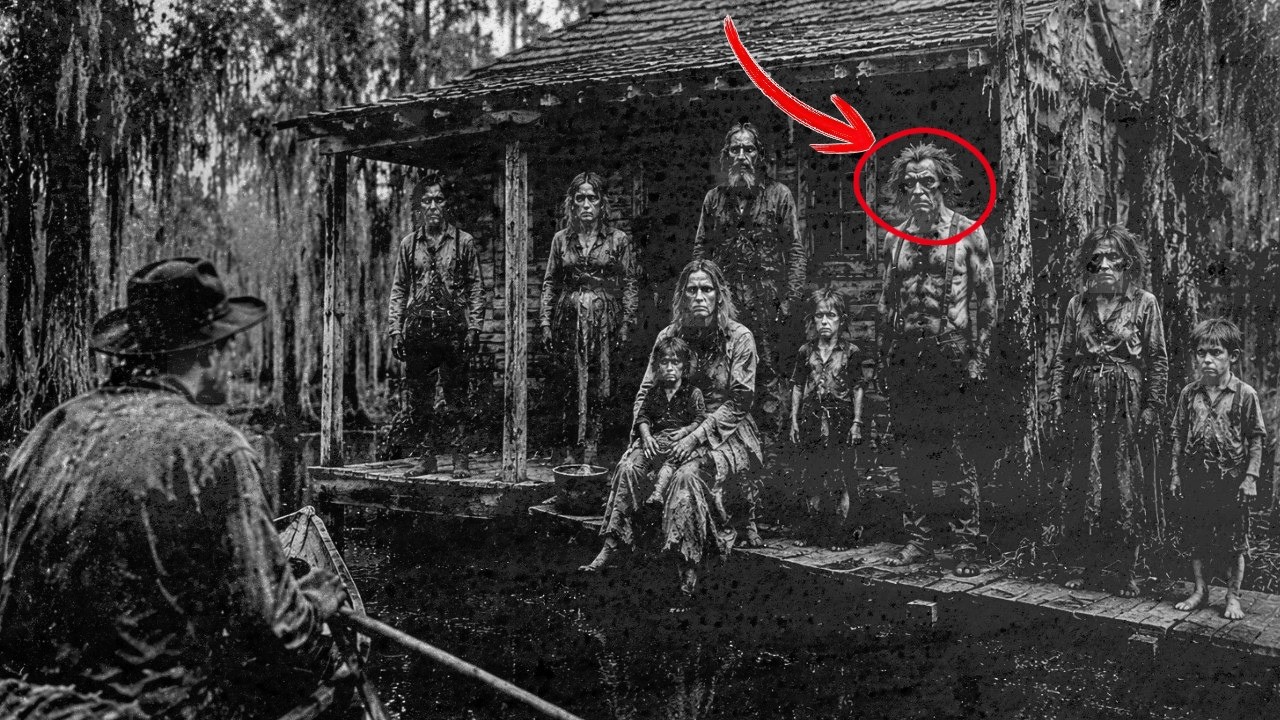
They had their own language. They had rules. They had a patriarch so old that even his sons could not remember a time before him. They also had a room in the back of the cabin that the sheriff, when he finally arrived, ordered sealed, then burned, then never spoken of again.
This is the story of the Boudreaux family of Terrebonne Parish, the most isolated swamp family in Louisiana history, and the reason their records were pulled from the state archives in the spring of 1893 and never returned. The Atchafalaya Basin is not a marsh or a simple swamp. It is the largest river swamp in North America, a vast flooded forest of cypress, tupelo, and black gum covering nearly a million acres. Its waters move slowly, and some channels appear only during high water.
There are deep stands of cypress so dense that sunlight never reaches the water beneath them, even at noon in summer. By 1892, the parish that came to be known as Terrebonne Falls occupied part of that basin, about forty miles northeast of Morgan City. It was one of the poorest parishes in Louisiana. The census two years earlier counted 841 residents spread across three settlements, two logging camps, and a number of isolated homes.
It had one sheriff, one deputy, one Catholic priest who rotated between three churches, and one general store. There was no railroad, no telegraph, and no doctor reliably reachable in less than twelve hours by boat. The section of the basin where the Boudreaux cabin was eventually found was known locally as Prairie Perdu, or the Lost Meadow. It was not lost in the literal sense; everyone knew it existed.
The name meant that this part of the swamp did not behave like the rest. Compasses swung without reason. Dogs that entered refused to return. In 1878, two boys from the Grand Coteau settlement entered its edge looking for a stray goat, and only one came back.
He was never right in the mind again and died before his eighteenth birthday. There were songs too, including one the older women hummed without seeming to notice. It was a slow tune in a minor key, with words that had faded from coherent meaning generations earlier, but the end of each verse contained a phrase that translated roughly to “they are still in the trees and still hungry, and the door is not a door. ”
The practical reason no one entered Prairie Perdu was that it was genuinely dangerous.
The water was slower and blacker, which meant more alligators, more cottonmouths, and more disease. The cypress was older and larger, the vegetation denser, and navigation by sun or stars impossible for hours at a time. If you got lost in Prairie Perdu, you stayed lost. So for as long as anyone could remember, trappers drew an approximate oval around it on their working maps and avoided it entirely.
Whatever was inside was left alone. Over quiet decades, it became whatever it became. Émile Fontenot was thirty-seven years old in the fall of 1892, a second-generation trapper known in the parish as cautious and sober, a man who did not tell stories he could not prove. He knew about Prairie Perdu and respected it.
He would never have gone near it in normal circumstances, but the circumstances that evening were not normal. A storm came in from the Gulf faster than anyone expected, and Émile was caught in the middle of it. By the time he realized his mistake, he was already inside the tree line of Prairie Perdu. The light was fading.
He sat motionless in his pirogue and listened. Beneath the familiar sounds of the swamp, he heard something else. It was low and rhythmic, coming from deeper in. It was a chant, not quite a song, since a song has a beginning, a middle, and an end.
This had none of those. It was repetition, the low voices of what sounded like at least four women, or perhaps children, layered slightly apart. He sat and listened for three or four minutes. Then, because the light was dying and he had no other clear route back, he made the decision that would change every remaining year of his life.
He turned his boat toward the sound. Around a slow bend, the chanting sharpened, the trees opened, and he saw the cabin. It was not built on stilts, as every dwelling in the basin was. It sat directly on a mound of packed clay, an island about forty feet across at its widest, ringed by tupelo trees that grew in an irregular circle, as if planted to conceal it.
The cabin was old, not in the way of a well-kept parish home, but old in the way of something continuously patched for so long that nothing of its original material remained. Around the base, arranged in shallow trenches, were bones. They were not scattered like animal remains but placed deliberately. He could see the long bones of what he thought were deer and the smaller bones of raccoons or opossums.
Nearer the door was a set of ribs whose size and curve matched none of those animals. He did not allow himself to identify them. He kept paddling, and he began to pray quietly in French. The chanting came from inside the cabin.
From this distance, he could tell it was multiple voices, at least four distinct ones, one possibly a child. But what frightened him most was not the chanting. The cabin door was open, and in the open doorway, watching him from the darkness, was a face. Émile Fontenot was a hunter.
He had seen the faces of many things. He told the sheriff that the face in the cabin doorway was a face the way a burn mark on pine is a face. The features were there, arranged in roughly the right places, but the proportions were wrong, the placement of the eyes was wrong, and the expression, if it could be called that, was a blankness unlike any human face he had ever seen. It did not move.
It did not blink. If the face belonged to one of the chanters, that chanter was singing without moving his lips. Émile tightened his grip on his paddle, turned his boat as quietly as he could, and moved back the way he had come. He did not stop moving.
He did not look back. He paddled for three hours through water he did not know, and when the storm finally broke and the last light faded, he found himself at the mouth of a channel he recognized, less than two miles from the general store. He pulled his boat ashore, walked the rest of the way in wet boots, and when he pushed open the store door, the old women inside were humming that song, the one about the door that is not a door. Émile Fontenou began to cry in a way grown men in that parish were not generally permitted to cry.
The storekeeper sat him on a barrel, put a cup of chicory coffee in his hands, and said quietly, “Tell me what you saw. ” What Fontenot told him that night, and repeated to the parish priest the next morning, became the beginning of an official record that no longer exists in any public archive. What survives comes from a few documents that escaped the sealing order, either because they were sent to New Orleans first or because they remained in private hands and were later donated to church collections and university libraries. The Boudreaux family of Prairie Perdu descended from a man named Alcide Boudreaux, baptized in St.
Martin Church in 1798. Nothing in his baptism record suggests he would become anything other than an ordinary parish farmer. He appears again in 1821, at age twenty-three, in a marriage record to a woman named Élodie Landry, age sixteen. He is described as a farmer.
She is described as a spinner. They received the customary small dowry of a pig, a rooster, and three yards of fine linen. After that marriage record, Alcide Boudreaux disappears from the parish records for forty-six years. He does not baptize children.
He does not attend Mass. He appears in no dispute records, no land transactions, no census. But tax records show he is alive, somewhere in the parish, periodically paying a small tax in cash or furs. The address listed every year is the same.
It reads, in the clerk’s cramped handwriting, “Prairie Perdu. ”
The forty-six-year gap ends in 1867 with the most important surviving document from before 1892: a letter from the parish priest, Father Théodule Léger, to the bishop in New Orleans. He describes a three-day visit to a settlement in the deep swamp at the invitation of a man named Alcide Boudreaux. He celebrated Mass at Alcide’s request in a clearing behind an old, much-repaired dwelling.
At the end of the visit, he baptized fourteen individuals, aged roughly three to perhaps twenty-two. None had ever received any sacrament. None understood French, English, or any language the priest knew, though a few could muddle through the baptismal formula when coached. Alcide Boudreaux, then sixty-nine, presented himself as the father of all fourteen.
Father Léger also noted, in a passage that later became the subject of extensive analysis, that he was quite sure, from physical resemblance and certain remarks made in his presence, that a large proportion of the fourteen had also been born to mothers who were themselves Alcide Boudreaux’s daughters. He chose to perform the baptisms anyway, because his pastoral responsibility to those souls outweighed, in his judgment, the ecclesiastical concerns raised by the circumstances of their birth. He asked the bishop for guidance. He noted that the oldest woman in the gathering, a woman named Odelie, whom he believed to be both daughter and wife to Alcide Boudreaux, asked him during the meal after Mass whether the outside world still existed.
He confirmed that it did. She received this information without any visible reaction. He intended to return within a year. Father Léger never returned.
He died of what the parish records listed as a sudden fever in the fall of 1867, less than three months after sending his letter. His young replacement, a priest from Baton Rouge, received written instructions from the bishop not to travel into the deep swamp under any circumstances, and to leave the Boudreaux settlement and its spiritual welfare in the hands of God. He complied for the remaining twenty-five years of his service. The Boudreaux family received no other visitor from the outside world, according to any surviving document, from the fall of 1867 until the day Émile Fontenot’s boat drifted into their swamp.
Twenty-five years. Fourteen individuals, all or most of them products of a breeding arrangement that would have been a serious crime in any civilized society on earth, were left entirely to their fate on a mound of packed clay in the middle of a swamp, under the management of a patriarch who was ninety-four years old by the time the sheriff arrived. In the twenty-five years between Father Léger’s visit and Fontenot’s arrival, Terrebonne Falls had seen a series of disappearances that were statistically unusual. They were scattered, spread out, never forming an obvious pattern.
In any given year, the parish record showed about one missing person, which could reasonably be attributed to the ordinary dangers of swamp life: a trapper who did not return, a child who wandered off and was presumed drowned, an elderly woman who entered the woods confused and was never found. In a parish of 800 people spread across a million acres of dangerous water, one disappearance a year was not alarming on its face. But Sheriff Antoine Thibodeau, when he plotted twenty-five separate disappearances on a map in chronological order, found that they formed a rough spiral. The oldest cases were near the outer edges of the parish.
The newer ones trended gradually inward. The geometric center of the spiral, the point around which all the disappearances clustered, was exactly the mound where the Boudreaux cabin was later found. The smallest of the twenty-five missing was a six-year-old girl, Cécile Robichaux, who wandered away from her family’s yard in the summer of 1890. Her remains were identified in the cabin by a birthmark on her left shoulder.
A mother identified a hunting knife found on a shelf inside the cabin as belonging to her son, Sylvain Cormier, who had not returned from a trip in the winter of 1882. The handle was made of antler, engraved with the young man’s initials by his father. She sat in the sheriff’s office, turned the knife slowly in her hands, put it on the desk, and said very quietly in Cajun French that she had known for ten years that her son was dead, but she had not known until that moment that he had been eaten. The word she used was from the local dialect and does not translate precisely into English.
It carried meanings overlapping with the verb “to eat,” but older and more specific, related to certain Acadian folk beliefs about the ways a thing can consume another and thereby acquire some of the qualities of what it has consumed. The sheriff wrote the word in his notes without translating it. When she spoke it, several deputies present made the sign of the cross and backed away from the desk without being asked. There were seventeen personal items found in the cabin, identified by surviving family members as belonging to people lost over the preceding decades.
There was a rosary belonging to an elderly woman named Marcelite Doucet, missing since 1874. There was a tortoiseshell hair comb belonging to the daughter of a plantation overseer from a neighboring parish, missing since 1888. There was a pair of small leather shoes, sized for a child of five or six, not definitively linked to any specific missing person, but of a make and style sold at the parish general store around 1880. And there was, in a wooden box under the bed, a collection of thirty-one human teeth arranged by size, each wrapped in a small square of cloth cut from what a laundress later identified as a common New Orleans morning fabric popular in the 1860s.
Many of the teeth had been extracted while the person was still alive, according to the sheriff’s brother, a New Orleans dentist consulted in secret. The wrapping of the teeth in mourning cloth was a detail the sheriff never publicly commented on. It matched no known ritual tradition. It appeared to be a private Boudreaux family practice developed in their isolation, for reasons the family members themselves, when questioned, could not or would not explain.
The most disturbing personal item was found on a shelf above the fireplace. It was a small framed daguerreotype of the type produced in New Orleans studios in the 1850s. It showed a young woman in formal dress sitting on a photographer’s chair with a small dog in her lap. On the back, in faded pencil, was the name “Élodie Landry” and the date 1852, with a short note in what was likely the woman’s own handwriting indicating the portrait was taken as a gift for her mother.
Élodie Landry was the name of Alcide Boudreaux’s wife, whom he married in 1821. If the daguerreotype was hers, she had traveled at some point between 1821 and 1852 from Prairie Perdu to New Orleans and back, a journey requiring at least a week of hard travel by boat and steamer. No surviving record mentions such a trip. No indication exists that anyone in the parish ever saw Élodie Landry alive after her wedding day.
On the back of the daguerreotype, in the same handwriting as the saint’s day note, was a second line, written in pencil, seemingly much more recent, dated 1891, in French in a slightly trembling hand: “Tell them I have not forgotten you. ” It was signed with a single initial. The letter A. Sheriff Antoine Thibodeau was forty-one years old in the fall of 1892, six years into his term.
He was a large, methodical man, not given to impulsiveness. When Fontenot’s account was presented to him, his first step was not to organize a posse. It was to sit at his desk in the parish courthouse and spend most of the day silently reading the old case records of his predecessor. By evening, he had the spiral pattern of disappearances arranged on the floor of his office with pins, its center in the deep swamp, at roughly the same location Fontenot described.
He walked across the square to the church and asked the young priest, now in his twenty-fifth year of service, whether the bishop’s original instructions were still in force. The priest said they had never been revoked. The sheriff thanked him, walked back across the square, gave his lead deputy, Placide Arceneaux, a list of six additional men to recruit, and told him to have them at the courthouse with their rifles at dawn the next day. The expedition that left on the morning of October 10, 1892, consisted of eight men: the sheriff, his deputy, six temporary deputies chosen from the most experienced hunters in the parish, and Fontenot, who agreed to serve as guide after a long discussion with his wife, on the condition that his family receive a specific pension from the parish if he did not return.
They traveled in four pirogues. They carried rifles, dry provisions for five days, ammunition, rope, lanterns, and, at the sheriff’s insistence and over the priest’s mild objection, a small vial of holy water and a wooden cross blessed at the church altar the night before. They reached the tree line of Prairie Perdu at midday of the second day. They camped that night with two men on watch at all times and no fire.
The men slept poorly. As they entered Prairie Perdu at first light, the water was so calm and the silence so complete that it felt, as one deputy later put it, as though the place was listening to them in return. Around the slow bend, the trees opened. The mound appeared, the cabin standing on it exactly as Fontenot had described.
The door was open. No face appeared. The sheriff waited a long moment, watching the door, the smoke, the water, the tupelo trees. Then he raised his rifle, not to aim but to make it visible, and called out in clear, formal Cajun French that he was the sheriff of Terrebonne Parish, that he had come on official business, and that he wished to speak with Alcide Boudreaux if he was willing to come to the door.
For a long moment, there was no response. Then an old man came slowly out of the cabin into the doorway. He was small and thin, dressed in what appeared to be stitched hides of various animals. His long white hair was tied at the nape of his neck with a ribbon that the sheriff later confirmed was a women’s belt from a style sold in New Orleans in the 1860s.
His deeply wrinkled face was not deformed in any noticeable way. He looked at the sheriff, raised one hand in a gesture that was neither quite a greeting nor quite a warning, and said, in perfectly clear French in a dialect the sheriff later described as belonging to a version of the language not used in the parish since before the war, that he had been expecting the sheriff for some time, that he was glad the sheriff had finally come, and that he had already asked the children, in preparation for this visit, to bring the good chairs out to the yard. The good chairs turned out to be four arrow-back chairs of very old New Orleans manufacture, a style obsolete since the 1830s. They were in excellent condition.
The straw seats had been re-woven, apparently many times, with materials that included, in at least one of the chairs, human hair. The children who brought out the chairs did so without a word. They placed them in a neat row on the packed clay of the mound, then retreated and stood behind the old man in a silent, watchful line. There were seven of them, roughly four to fourteen years old, four boys and three girls.
They were all thin. They were all, without exception, completely silent. They looked at the sheriff and his men with a kind of curiosity that lacked any of the usual components of childish curiosity. It was not shy.
It was not playful. It was examining. It was, as the sheriff later wrote in his report, like the look of a hawk at a rabbit from a distance, before the hawk decides whether the rabbit is worth the effort of the strike. The old man, who confirmed in response to the sheriff’s questioning that he was indeed Alcide Boudreaux and that he was ninety-four years old, invited the sheriff and one deputy of his choosing to enter the cabin and accept a small meal.
The rest of the group could rest in the yard, and the children would bring them water. The sheriff accepted after a moment of thought, chose Arceneaux, instructed the remaining six men to keep their rifles at hand, to accept no food or drink from the children under any circumstances, and to fire a warning shot at the first sign of any movement from inside the cabin that they had not been expressly told to expect. The interior of the cabin was smaller than it appeared from outside and much cleaner. The floor was packed earth, swept smooth.
The main room contained a fireplace with a small iron pot boiling something that smelled strongly of game meat, a low wide bed against the far wall covered with a patchwork of hides, a mantel shelf on which the sheriff immediately saw the framed daguerreotype of Élodie Landry, and a rack of hunting knives. There were three doors leading off the main room. Two were closed. The old man gestured for the sheriff and Arceneaux to sit in two of the arrow-back chairs.
He sat across from them in a third. He ladled soup from the pot into three wooden bowls and provided spoons of fine New Orleans silver, engraved with initials the sheriff did not recognize. He said a short prayer in old Cajun French before eating, invoking the mercy of the Virgin and the goodness of the earth. He began to eat.
He waited to see if the sheriff and Arceneaux would eat. Neither did. He did not appear offended. The conversation that followed lasted, by the sheriff’s estimate, nearly four hours.
The sheriff asked questions; the old man answered patiently and at length in his clear, ancient French, occasionally pausing to think of a phrase before speaking it, at other times searching for a word he admitted he had not had occasion to use in a very long time. He confirmed the basic facts of the family history. He and Élodie Landry had come to the mound in the year of their marriage, directed by his father to work a small trap line his father had begun developing in the deep swamp. His father had died that year of a snakebite.
He and Élodie continued the line, and in time, they had children. When asked about Élodie herself, he said she had gone away for a time in the 1850s and then returned. She had died of a fever in 1861 and was buried under a large cypress at the edge of the mound. He offered to show the sheriff the grave whenever he wished.
The sheriff did not respond to the offer at that time. He asked instead about the children. He asked how many children the old man had fathered in his life. The old man paused for a moment longer than any previous silence.
He said, in a level voice, that he could not give an exact number. He said the number depended on what one considered a child, and on what one considered a completion of a child. He said that in his family’s tradition on the mound, these were categories that had, over the years, acquired somewhat specialized meanings. He said he could show the sheriff the back room of the cabin if the sheriff wished, and that the back room contained a complete record, and that after the sheriff saw that record, he would understand why any simple number was difficult to provide.
The sheriff, who by this point understood much about the nature of what he was dealing with, said in the calmest tone he could manage that he would like to see the back room. The old man rose, walked to the second of the two closed doors, lifted the latch, and opened it. Then he stepped back to allow the sheriff and Arceneaux to enter. Arceneaux did not, in the remaining eleven years of his life, speak in detail about what was in that back room.
He referred to it indirectly in private conversation as “the record. ” The sheriff described the room in one paragraph of his official report, in language that was as direct and brief as he could make it. The room was roughly eight feet by ten. Its floor was packed earth.
Its walls were the same cypress boards as the rest of the cabin. It contained shelves running along three of its four walls from floor to ceiling. On the shelves, carefully arranged, were the small skeletons of what the sheriff estimated to be between forty and sixty infants and young children, their apparent ages at death ranging from newborn to perhaps four years. Each skeleton was intact.
Each was placed on a piece of the same New Orleans morning fabric that had wrapped the teeth in the box under the bed. Each bore a marker at the head of its shelf: a small wooden tag engraved with a name in careful handwriting. The names were in no language the sheriff knew. They were single or occasionally double syllables, resembling a naming system the family had developed for its own use.
The sheriff copied a sample into his notebook with the intention of consulting a linguist in New Orleans. The linguist he eventually consulted could make no progress with them and returned the sample with a note indicating that the language to which these names belonged bore no relation to any known family of human languages. On the fourth wall, free of shelves, there was a small alcove in which a low wooden bench had been placed, and on that bench, arranged with the same care as the small skeletons, were three larger skeletons of adult women. These bore no markers.
The sheriff asked the old man, in a voice Arceneaux later described as unnaturally calm, who the three women on the bench were. The old man said, with what seemed like genuine reflection, that the three women were the mothers of most of those on the shelves, that they had died in ordinary circumstances, and that in his family, according to the practice that had grown up on the mound, the mother of a completion was buried in the same room as her completion, so that she would not be lonely when she woke on the last day. The sheriff nodded. He said he understood.
He turned, left the back room, passed the old man without attempting to stop him, and walked out of the cabin. He stood in the yard for a moment, looked at the children, and gave the order to remove all seven of them from the mound immediately, by whatever means necessary, and to put Alcide Boudreaux in irons. The children did not resist. When the deputies took each of them by the wrist, they walked along without any physical struggle.
Two of them, the youngest boy and the middle girl, made a faint whimpering sound, like a puppy separated from its littermates, and stopped as soon as they were seated in the boats. The old man did not resist either. He submitted to the irons with an expression several deputies later described as mild interest. He sat in the bow of the sheriff’s boat for the two-day journey back to Coteau Blanc, drinking water when offered, and never once asking where he was being taken or what would become of the seven children in the boats behind him.
They arrived at Coteau Blanc on the evening of October 12. News of the expedition had spread, and a small crowd had gathered at the landing. The crowd was completely silent. There was no shouting, no cheering.
When the seven children were led from the boats and up the muddy bank toward the courthouse, only the sound of water against the pilings could be heard. The children looked at the crowd. The crowd looked at the children. Then the crowd, in a movement that seemed to happen without anyone initiating it, opened a wide path, let the deputies and the children pass through, and closed behind them.
No one in that entire crowd attempted even to touch them. The children were housed in a large empty storeroom behind the courthouse. They ate with their hands, drank water, and did not speak to any of the women asked to care for them. They did not speak to each other in any language the women could recognize as speech, though they occasionally made faint clicking sounds with their tongues that seemed to carry a form of coordinated understanding.
They slept the first night in a single tight pile on one blanket, the smallest girl in the center, the oldest boy at the edge, facing the door. His name, according to the old man, was Vidal. He was the first survivor of the current generation of children, and he was the one to whom the old man transmitted the knowledge he saw fit to transmit. The sheriff spent much of the following week with Vidal.
He learned that Vidal was not incapable of speech. He simply lacked any of the ordinary reasons for using it. In his experience on the mound, speech was used economically and for specific purposes, almost entirely in the presence of the old man, who used it as a ceremonial instrument. Among the children, communication was almost entirely through clicks and gestures.
Vidal understood the ancient form of French the old man used with him, but he was not fluent in speaking it. He understood, with much greater clarity, the set of instructions the old man had instilled in him since childhood about operating the cabin, maintaining the trap line, arranging the bones in the back room, and the specific practices he did not attempt to describe in detail, which were performed when the old man brought a stranger to the mound over the years for purposes Vidal referred to only as “completing the count. ”
In time, the sheriff came to understand that the count was the central organizing principle of the life they had lived on the mound. The count was a cumulative record in the old man’s head of a number, revealed to him by some agency Vidal could not describe, at some time in the old man’s youth, before Vidal himself was born.
The count had a purpose. The purpose was a specific number. When the count reached the target, something would happen, and that something would be, in Vidal’s words, the reason the family had been placed on the mound in the first place. By the fall of 1892, the count had reached a total Vidal could give the sheriff precisely.
It stood at 91. He believed the target was, or would be, 100. The sheriff asked Vidal what the count was counting. Vidal looked at him for a long moment with the same patient, examining attention as the other children, and then said, in his slow, careful French, that the count counted the things in the back room, and that the things in the back room were those that had been completed, and that completing them was what the family did, and that the family had been placed on the mound by whatever agency placed them there for the purpose of doing that.
He said he did not know the reason. He said he had never been told the reason. He said his father, who was ninety-four and had been counting since he was a boy, had not been told the reason either. He said his father had expressed, on more than one occasion in his hearing, his own opinion that no one would ever be told the reason.
That the point of the arrangement was that the count itself was the answer. That the answer would arrive when the count was complete, and that this arrival, in the old man’s phrase, was the door. The sheriff wrote his first of five long letters to the office of the governor of Louisiana on the evening after that conversation. He described, in precise and direct language, everything recovered from the cabin, everything Vidal had told him about the count, and everything he had come to believe about the nature and duration of what the Boudreaux family had been doing on the mound in Prairie Perdu.
He requested guidance. He requested resources. He requested, specifically, that the state consider the seven children not as a matter of criminal law, where they would ordinarily be handled as accomplices or witnesses, but as a matter of care and custody, since it was his considered opinion that none of the children had ever, at any point in their lives, possessed the capacity to understand that what had surrounded them was wrong in any sense of the word. The reply came by state courier on November 15.
It was brief. It instructed the sheriff, in the clearest possible terms, to take three specific actions and no others. First, to arrange the immediate and quiet transfer of the seven children to a Catholic institution in New Orleans, the name of which was provided in a sealed envelope, where they would be received without any official record of their origins. Second, to hold Alcide Boudreaux in the parish jail until a physician from the state medical board arrived to conduct an evaluation, and to accept the physician’s judgment regarding the old man’s final disposition without appeal.
Third, to direct the parish clerk to seal and remove every document in the parish records that referred directly or indirectly to the Boudreaux family, to Prairie Perdu, or to any of the disappearances his investigation had connected to the mound, and to hand the sealed documents to the state courier, who would arrive to collect them within thirty days. A subsequent note in the governor’s own hand informed the sheriff that the state had, on more than one previous occasion in this century, dealt with situations broadly similar in other parishes and other parts of the country, and that the state had learned from those occasions that public understanding of such situations was best served by not allowing the public to possess any understanding of them at all. He was thanked for his service. He was assured that his handling of the matter was, in the state’s estimation, exemplary.
He was told, in the closing sentence of the letter, that the cabin on the mound in Prairie Perdu must be burned to its foundations before the end of the calendar year, that the burning must be carried out by a team of state agents, and that neither he nor any of his deputies should accompany the team or know the date on which the burning would take place. He complied. The seven children were taken to New Orleans on November 22. The physician arrived in December, examined Alcide Boudreaux for most of the afternoon, and declared him, in a phrase that appeared in the physician’s report and nowhere else, insane and unfit for public trial.
The old man was removed from the parish jail by the physician himself the next morning in a private carriage. Where he was taken, no surviving document indicates. His name appears in no record of any kind again. He was ninety-four years old on the day he was taken away.
The cabin was burned on December 14, 1892. The mound, when an outside party next visited it in the spring of 1894, contained no cabin, no bones, and no visible trace that any human habitation had ever existed there. The seven Boudreaux children were kept together for the first two years at the institution in New Orleans, in a closed wing of the convent grounds set aside for their exclusive use. They were taught slowly and with limited success to speak French.
They were given ordinary names from the calendar of saints, though these names were used only among the nuns, and the children never seemed to accept them. Vidal, the oldest, died of a respiratory illness in the winter of 1894. Two of the other boys were transferred at some point in 1895 to a state facility in another part of Louisiana, with no further record in any surviving archive. The three girls and the youngest boy remained at the convent until adulthood.
Their long-term fates were never publicly determined, and the few researchers who attempted to trace them over the decades encountered, in every case, the same wall of sealed and destroyed documents that Sheriff Thibodeau had been ordered to create in the winter of 1892. Sheriff Antoine Thibodeau served three more terms as sheriff of Terrebonne Parish. He retired in 1904 at age fifty-three and spent the remaining eleven years of his life on a small farm outside Coteau Blanc. He never spoke, according to his daughter, about the Boudreaux family.
He kept in a locked drawer of his desk a small waterproof notebook he had carried on that expedition. After his death, his daughter opened the drawer. The notebook was not there. Whether he destroyed it himself in his final months, or whether another party removed it after his death, was never determined.
Terrebonne Falls Parish, if you look for it on a modern map of Louisiana, will not be found. Its territory was absorbed into three neighboring parishes in a series of quiet legislative actions in the 1890s. Its name was dropped from the official registry. Prairie Perdu still exists there.
Its oval still appears on the working maps of contemporary trappers who continue to run their lines through the deep swamp. No one, as far as any current inquiry has been able to determine, has built anything on the mound at its center since the fire of 1892. No one, as far as anyone admits, has spent a single night there. The old songs the parish women used to hum, the ones about the door that is not a door, are no longer sung.
The last person known to have hummed one in public, a woman named Elsie Guidry, a distant descendant of the old sheriff’s predecessor, died in 1978 at the age of ninety-one. On the day of her death, she was sitting on the porch of her home in what was formerly Terrebonne Falls Parish, and according to her granddaughter, who was with her in her final moments, her last words were not in French or English, but in a language the granddaughter did not recognize, consisting of a short series of syllables the granddaughter had not been able, in the years since, to get out of her head. Whether the count Vidal described to Sheriff Thibodeau was ever completed is not a question that can be answered from any of the surviving documents. It was at 91 when the state closed the file.
The target, by Vidal’s understanding, was 100. The gap between those two numbers is nine. Nine completions, nine additions to the shelves in the back room of a cabin that no longer exists. The reasonable conclusion, the one expected of a careful person weighing the available evidence, is that the burning of the cabin and the removal of the family ended the arrangement, and that whatever the count was meant to precede was prevented from occurring by the intervention of the state of Louisiana in the winter of 1892.
It is also worth noting that in the parishes formed from the absorbed territory of Terrebonne Falls in the decades following the fire, the rate of disappearance of young children from rural farms, adjusted for population, never returned to the level consistent with the rest of the state. It remained slightly elevated in a pattern public health officials periodically attempted to explain by reference to the standard hazards of the basin. It was never fully explained by any of those attempts. It has slowly settled, over the past century, toward the state average.
It has not reached it. Whether that is a matter of geography, statistics, or long-term continuation of a poor and isolated population, or something else, is not for a text such as this to say. All it can note, in closing, is that the count, whatever it was, stood at 91 when the state closed the file, and the mound is still there, in the middle of the lost meadow, waiting.
