In the summer of 1670, Henrietta of England, known at the French court simply as Madame, sat down to dinner at her country house above the Seine. On the following afternoon, the twenty-six-year-old drank a glass of chicory water, clutched her side, and cried out that she had been poisoned. By two the next morning, she was dead. Her daughter, eight years old, would carry that suspicion with her for the rest of her short life.
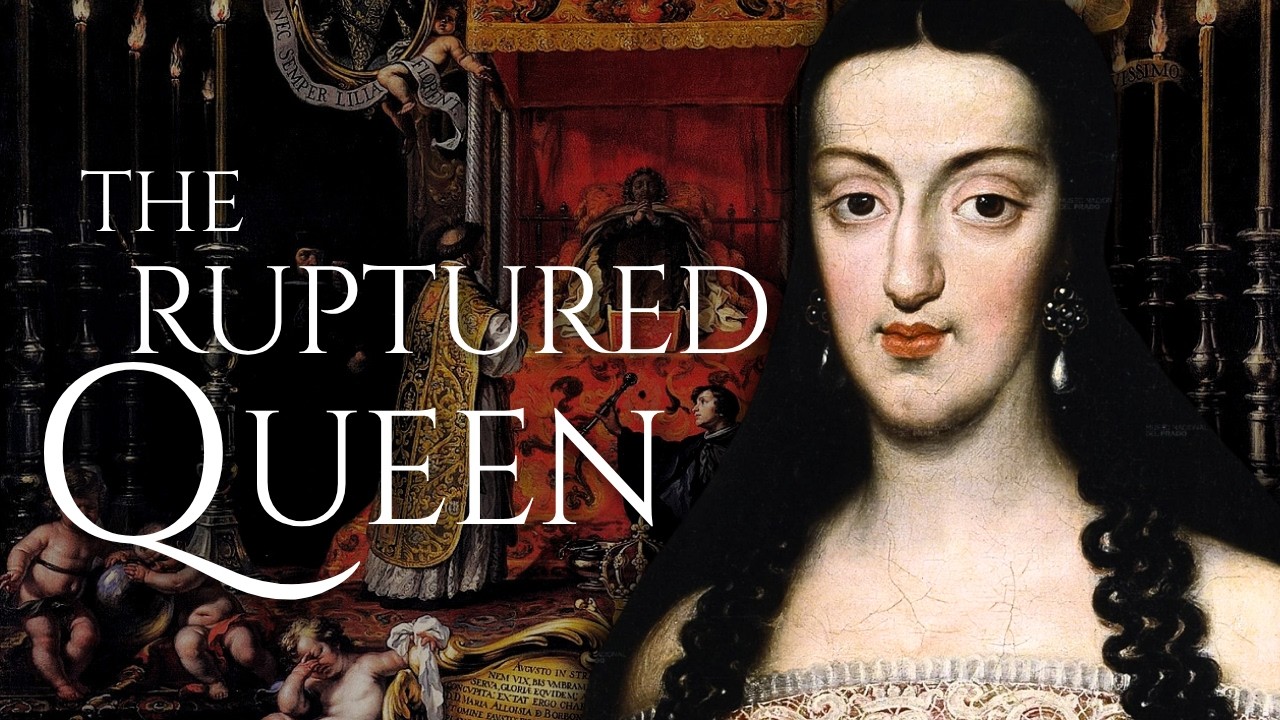
The daughter was Marie Louise d’Orléans, a niece of Louis XIV. She had been born in 1662 into a marriage that had soured almost from the start. Her mother, Henrietta, was clever and admired; her father, Philippe, Duke of Orléans, was vain, openly devoted to his male favorites, and by his own admission had never loved his wife for more than a fortnight. But he did love his daughter.
Marie Louise was widely regarded as his favorite child. When Henrietta died, the court whispered that she had been poisoned. Her body was opened in front of witnesses, and the surgeons found a small hole in the wall of her stomach. The official conclusion was a sudden overflow of bile.
Poison was never found. The rumors never died. Marie Louise grew up in that household, watched over by her father and later by a kind stepmother, Elizabeth Charlotte of the Palatinate, who wrote to her twice a week for the rest of her life. The girl was taught music and riding, and she grew into a lively, dark-eyed young woman.
She had expected to marry her cousin, the Dauphin of France. Her uncle had other plans. France and Spain had just finished another war, and the peace was to be sealed with a bride. In Madrid, a sickly seventeen-year-old king named Carlos II had been shown her portrait.
He had never met a foreign princess in his life, but he stopped sleeping. He wore her portrait over his heart and held long conversations with it. The king wanted the girl in the picture, and in the summer of 1679 a Spanish ambassador arrived in France to ask for her. Marie Louise, then seventeen, tried to refuse.
She wept and threw herself on her knees, but a niece of the King of France had no power to refuse him. The wedding was held by proxy at Fontainebleau, and within weeks she was on her way to Spain. At the border, a small river marked the frontier, and there she was handed over with ceremony. Most of her French household was dismissed.
She was allowed to keep only four of her waiting women, including the old nurse who had been at her side since the day she was born. On the Spanish bank, the rules were different. She lost the freedom to ride, the freedom to dine in public, and the freedom to speak French with her own servants. She spoke little or no Spanish.
Her new household was run by the Duchess of Terranova, an elderly, formidable woman who controlled what the queen could eat, when she could go out, and whom she was permitted to see. Marie Louise was now trapped in a court where etiquette was famously strict and where the person of the queen was surrounded by prohibitions. When she wanted to look out of a window, the duchess stopped her. Queens of Spain, she was told, did not look out of windows.
Her husband did not behave like a distant king. Carlos had dressed in French style to meet her. He greeted her by pressing her arms between his hands and repeating the same two words over and over: mi reina, mi reina, my queen. They were married that same day in a village, with almost no ceremony.
The marriage that followed was watched by every court in Europe. Spain needed an heir. Carlos was the last male of his line, and if he died without a child, his kingdoms in Spain, Italy, Flanders, and the Americas would be fought over by every power on the continent. The watching began on the wedding night.
Courtiers examined the sheets of the marriage bed. A French ambassador bribed a woman in the palace laundry to hand over the king’s undergarments and the linen from the queen’s bed. Her mother-in-law kept count of her cycle. Her father wrote from France that it was high time to think of the succession.
Marie Louise did what she could. She played the king’s favorite game, a children’s game of picking up small sticks, for three or four hours a day without letting him see that it bored her. The two of them ate, slept, and went to bed together every day at eight. She slept ten to twelve hours a night and ate meat four times a day.
She was young, and sleeping and eating were two pleasures the duchess could not easily forbid. No child came. The public mood turned on her. Early poems called her a lily, a French flower brought to Spanish soil.
Later verses accused her of failing to fruit. The most famous pun turned on the Spanish word for giving birth, which sounded exactly like the name of the city she came from. Have a baby or go home, the verse said. The Austrian party at court spread it about that Louis XIV had picked her knowing she was barren.
She told her French ambassador that she was not really a virgin any longer, but that as far as she could figure things, she believed she would never have children. She said that when she was twenty-six, after nine years of marriage. It was a strange thing to have to figure out. The doctors could not agree on whether her husband was capable of fathering a child.
Carlos himself came to believe that a spell was keeping him from becoming a father. In 1685, the queen’s household blew apart in a scandal. Her old nurse, who had been with her since birth, was accused of giving the queen a counter-poison in secret, a compound meant to preserve her against assassination. The charge grew into a plot to poison the king himself.
The nurse was tortured on the rack for an hour and a quarter. She did not confess, and that saved her life. She and every French servant were banished across the Pyrenees. The king did not tell his wife until the morning after the last of them had been taken away in the night.
Marie Louise was twenty-three. The woman who had fed her as a baby had been put on the rack and sent away. In the winter of 1689, her health failed. In early February, she went hunting, and her horse reared.
The pommel of the saddle struck her hard in the stomach. Two days later, on the ninth of February, she sat down to a heavy, cold meal. The Spanish National Library still holds a manuscript listing what she ate: a dish of veal gristle in broth, chilled with four pounds of snow, then cold oysters with plenty of lemon, olives, oranges, and a cup of cold milk. She passed the night in great distress.
At five in the morning her physician was sent for. She had stomach pains, vomiting, and a flux of the bowels that would not stop. The doctors called it cholera morbus, the same two words that had been written on her mother’s autopsy report at Saint-Cloud. She told them she was afraid she had been poisoned.
One of the physicians answered her directly. It is true, madam, he said, that the body is full of poison, but it is the poison your majesty has taken with your own hands. If it were of another sort, I would draw it out of you. Let your majesty not think that such a thing is done in Spain.
They treated her with an emulsion of opium, salt of pearls, and an extract of egg yolk. They cupped her, drawing the flesh up into warm glass domes. Nothing worked. She received the last anointing.
Before her speech went, she said goodbye to her husband. Your majesty may have many wives, she told him, but none who will love you more than I do. Marie Louise died on the morning of the twelfth of February 1689. She was twenty-six.
They opened her body, and the physician wrote his report. Her intestines were white and not corroded, which the doctors took as proof there was no poison. Her lungs were full of blood. Her womb, he recorded, was without defect.
She had not been made barren by anything she swallowed. The word poison went around the palace anyway, and it has never stopped. The French court was certain she had been murdered. The Spanish court insisted she had eaten recklessly while already unwell.
Later doctors have suggested food poisoning from the raw oysters, or a burst appendix, or the blow from the saddle, or an infection in the pelvis. Others still see the hand of the Austrian party, which wanted her gone. The documents can be fitted together more than one way, and people have been doing it for over three hundred years. Her husband was given little time to mourn.
Less than a month after her death, the name of her successor was announced. The new wife was a German princess chosen because her mother had raised seventeen children. A daughter of that house, it was thought, could hardly fail to give Spain an heir. She had no more success with Carlos than the French girl had.
No child was ever born. Carlos himself was failing. By thirty he looked like an old man. An English ambassador watched him walk in public and reported that he could not make one straight step.
He was convinced that something had been done to him. He asked the Inquisitor General to find out whether the king of Spain was bewitched. An exorcist’s demon answered, after some prompting, that the king had been bewitched at the age of fourteen with a cup of chocolate containing parts of a dead man, placed there to ruin his health and corrupt his seed. The demon named his own dead mother as the one who had ordered it.
Carlos went out to the Escorial in the autumn of 1699 and paid a visit below the church, where the royal coffins stood in the vault. He ordered the urns opened. His father’s mummy crumbled when touched. He had them open Marie Louise.
The chroniclers recorded that her body was still whole, with all her clothes, her face a little colored. He had been thirty-seven. She was still twenty-six. He gazed at her for a long time.
Popular retellings give him a speech, calling her his queen again and promising to join her soon. No contemporary source records those words. How the visit ended is on firmer ground. He ran away from the coffin, frightened.
He lived one more year. On the first of November 1700, Carlos II of Spain died at thirty-eight. They opened him as they had opened her. His heart was no bigger than a pigeon’s egg and as soft as spoiled chalk.
His liver was almost rotten and held a black stone. Of all his entrails, only his spleen was sound. The Spanish version of the report adds one more detail: he had a single testicle, as black as coal. It is the answer to the question a French ambassador had once bribed a laundress to settle.
Marie Louise had believed she would never have children. She was right, and she died without knowing why. In his will, Carlos left his entire kingdom to a French prince, a grandson of Louis XIV and the son of the Dauphin Marie Louise had once expected to marry. The will was not accepted.
The war that Europe had been expecting since the first childless years of her marriage began that spring and went on for thirteen years. The new king was given a wife, a thirteen-year-old daughter of the Duke of Savoy. Her mother was Anne Marie, Marie Louise’s own sister, the baby who had been spared formal mourning clothes in the summer of 1670. That girl, who shared her aunt’s name, gave Spain four sons and became one of its beloved queens.
Marie Louise lies in the Pantheon of Infantes at the Escorial, on the side that was never reserved for mothers of kings.
