On a September morning in 1939, Unity Mitford walked alone into the English Garden in Munich. The woman who had spent five years at the center of the Nazi inner circle carried a pearl-handled pistol, a gift, and placed it against her own head. She pulled the trigger. The bullet did not kill her.
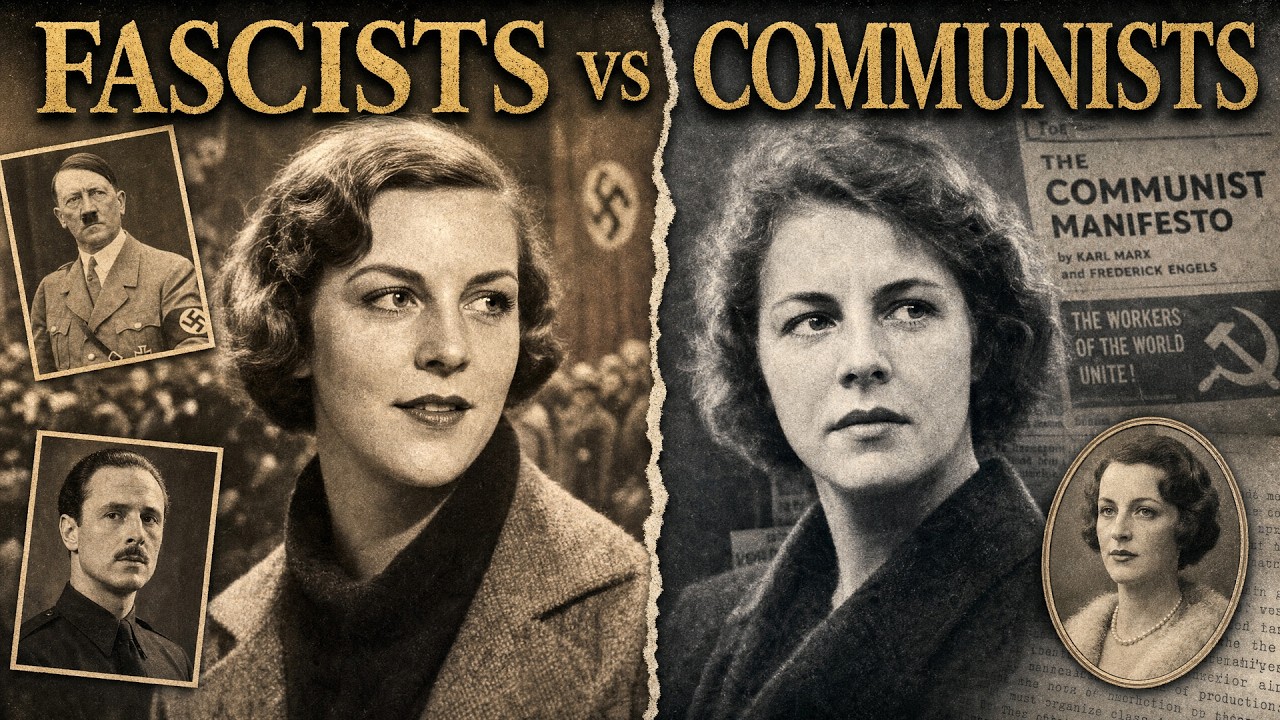
It lodged permanently in her skull, destroying much of her brain, and she would spend the remaining eight years of her life as a childlike invalid under her mother’s care. But before that catastrophic act, and long before the war that drove her to it, there were six sisters in one family who chose six different paths through the most dangerous decades of the twentieth century. One loved Hitler. One fought for communism.
One married a fascist in Hitler’s own reception room. One wrote bestselling novels about all of them. One became a duchess. And one chose a quiet life while the world around her went mad.
The Mitford sisters were the product of an England that was already beginning to crack. By the early 1930s, the Great Depression had spread across the country, devastating agricultural income and weakening the financial foundations of the landed aristocratic families who had ruled for generations. The younger generation, raised in comfortable privilege but facing an increasingly unstable world, felt the future demanding an urgent choice. From the east, the Soviet Union offered the promise of communism, a revolutionary response to inequality that threatened to wipe out the established social hierarchy entirely.
In opposition to that, authoritarian nationalism rose across Europe, promising order and national rebirth. Benito Mussolini maintained his rule in Italy, and in 1933 Adolf Hitler seized absolute power in Germany. By 1936 the Spanish Civil War had begun, ending in 1939 with the victory of General Francisco Franco. Surrounded by these aggressively competing ideologies, young members of Britain’s elite class faced immense pressure to abandon their parents’ quiet traditions and take sides.
The Mitford children grew up between a townhouse in London and their country properties, including Batsford House, Swinbrook, and the cottage they called Swinbrook Cottage. David Freeman Mitford, the second Baron Redesdale, and his wife Sydney raised seven children, six daughters and their brother Tom. Despite being shielded by aristocratic privilege, the family struggled financially. Living largely isolated from the outside world, the girls received no formal schooling.
Instead, they were educated by a succession of governesses. Left largely to their own devices, they created a closed, intensely intimate world filled with childhood nicknames and their own invented language. They called themselves the Hons, meaning respected persons, and formed an unbreakable conspiratorial bond. But the atmosphere inside their home was far from peaceful.
Lord Redesdale was an erratic, deeply reactionary man whose pre-war outlook leaned toward virulent anti-Semitism and pro-German sympathies, while Sydney quietly became sympathetic to British fascism. Under the same roof, the girls grew up in a world where extremist political currents ran directly through their parents’ drawing room. The eldest, Nancy Mitford, was born in London on November 28, 1904. She possessed a sharp, glittering intelligence that she used to dissect the world around her, and she transformed her family’s peculiarities into celebrated art.
In 1945 she published The Pursuit of Love, followed in 1949 by Love in a Cold Climate. These brilliant comic bestsellers were thinly veiled portraits of her own family’s eccentric behavior, depicting the aristocratic marriage market with ruthless precision and establishing her as a major literary voice of her generation. Yet beneath the glittering satire lay a lifetime of quiet emotional endurance. During the war, Nancy fell deeply in love with Gaston Palewski, a charismatic French politician.
Driven by her infatuation, she eventually moved to Paris and waited for decades for a formal commitment that never came. Palewski was involved in other relationships, leaving Nancy trapped in a hopeful exile, devoted to a companion who kept her at a distance. This emotional isolation darkened her final years. In the early 1970s, Nancy was diagnosed with Hodgkin’s lymphoma and entered a long, painful physical decline.
As her strength faded, so did her ability to remain connected. Palewski, whom she had loved and waited for more than thirty years, did not come to see her during the painful months of her final illness. On June 30, 1973, Nancy died at Versailles at the age of sixty-eight. She had written about her family’s glittering world with sharp wit, but privately she endured a profound and lonely grief.
Pamela Mitford, born in November 1907, chose a life that was the complete opposite of her sisters’ turbulent paths. While the others pursued fame and political causes, Pamela found refuge in the quiet rhythms of the English countryside. A lifelong love of horses, farming, and animals defined her world. This peaceful domestic life kept her at a safe distance from the dangerous political extremism that threatened to tear her family apart.
In 1936 she married Derek Jackson, a wealthy physicist and an eccentric scientist of considerable talent. The marriage lasted fifteen years, ending in divorce in 1951. Afterward, Pamela chose a quiet life in the Swiss countryside and later in Ireland. Because her life lacked the public scandals that marked her siblings’ lives, she remained largely invisible to the press.
History often remembers those who involve themselves in controversy, while the quiet ones go unwritten. Some observers have interpreted Pamela as the most ordinary of the Mitford sisters, or perhaps the happiest. But such labels are only external guesses. Whether her withdrawal from public view was a sign of wisdom, a luxury of aristocratic privilege, or simply her natural temperament remains an unanswered question.
She died in London in 1994 at the age of eighty-six, having lived a peaceful life on her own terms. Diana Mitford, born in 1910, was known as the great beauty of the family. In 1929 she married Bryan Guinness, heir to a vast brewing fortune, which seemingly secured a life of glittering aristocratic comfort. Yet she chose to abandon that comfortable existence.
In 1932 Diana met Sir Oswald Mosley, the leader of the British Union of Fascists, and became captivated by his radical political vision. Their alliance was a total political commitment that led her directly into the dark heart of European extremism. On October 6, 1936, Diana and Mosley were secretly married in Berlin. The ceremony took place in Joseph Goebbels’s reception room, with Adolf Hitler present as a special guest.
As Britain prepared for war against Germany, Diana’s political loyalties made her a direct threat to national security. In June 1940 she was arrested under Defence Regulation 18B, which allowed the government to detain suspected sympathizers without trial. Imprisoned at Holloway, she endured years of isolation, even giving birth to her son Alexander while incarcerated. In November 1943, she and Mosley were released on health grounds, provoking widespread public outrage across a nation still struggling to survive.
The end of the war and the terrible revelations of the Holocaust did nothing to change her beliefs. Diana and Mosley stubbornly refused to abandon fascism. Settling in France, Diana spent the rest of her long life defending her pre-war activities and her personal friendship with Hitler. When she died in Paris in 2003 at the age of ninety-three, she remained completely unrepentant, a chilling reminder of how easily high society can accommodate the indefensible.
Unity Valkyrie Mitford was born in 1914, entering a world that would soon be divided by the very extremist forces she came to worship. Her fascination with National Socialism began in adolescence, after she read Mein Kampf. Where her sister Diana sought structured political alliances, Unity’s devotion was a deeply personal quest. Her childhood in an isolated family left her searching for a grand purpose, which she found in absolute reverence for Adolf Hitler.
She was determined to insert herself directly into his life. In the summer of 1934, at the age of nineteen, she moved to Munich alone. For months she sat day after day in the Osteria Bavaria café, where Hitler came regularly. She waited from a distance, watching, until the German leader finally noticed the young English aristocrat and invited her to his table.
That meeting began a five-year close relationship. Unity became a fixture in Hitler’s inner circle, attending Nazi rallies as his personal guest and traveling to his private mountain retreat. She met Hitler’s companion Eva Braun, and at the time reports circulated of intense jealousy between the two women. The German government held her up as a representative of Nordic femininity, while British intelligence watched her activities with growing concern.
On September 3, 1939, Britain declared war on Germany. Faced with the reality that her own country was now at war with the man she loved, Unity refused to choose between her homeland and her leader. She walked into the English Garden in Munich, drew the pearl-handled pistol she had received as a gift for her own protection, and shot herself in the head. The bullet did not kill her.
She survived the wound she inflicted on herself, and records indicate that Hitler visited her in the hospital. Various accounts suggest he personally paid for all her medical treatment before arranging her transfer to Switzerland. In January 1940 she was sent back to England, returning as a broken, severely disabled figure. The bullet remained permanently lodged in her skull, causing severe brain damage and reducing her to a childlike state under her mother’s constant care.
She lived another eight years in silence, out of the public eye, and died on May 28, 1948, at the age of thirty-three. The official cause of death was listed as meningitis, believed to be a direct complication of the embedded bullet. Jessica Lucy Mitford, born in September 1917, built an identity completely different from the rest of her family. From an early age she was the family’s dedicated rebel, rejecting her parents’ aristocratic conservatism and her sisters’ fascist leanings.
Her defiance evolved from teenage rebellion into a lifelong commitment to left-wing politics. In July 1937, at the age of nineteen, Jessica carried out the greatest escape of her life. She fled with Esmond Romilly, her second cousin and the nephew of Winston Churchill. Romilly was a committed socialist who had already fought against General Franco’s forces in the Spanish Civil War.
The Redesdale family was horrified when Jessica ran off to wartime Spain with a communist. For Jessica, the journey was deeply personal, binding her life to the anti-fascist struggle. When the world war began, Romilly joined the Royal Canadian Air Force as an observer. In November 1941, his aircraft went missing during a bombing mission over the North Sea.
He was twenty-three years old. Widowed in America, Jessica rebuilt her life in California. She married Robert Treuhaft, a civil rights lawyer, and joined the Communist Party of the United States in 1944. She remained a member until 1958, leaving when information about Soviet atrocities began to emerge.
During those years Jessica devoted herself entirely to the civil rights movement in the American South, working through the movement’s most violent years. She fought against racial segregation and took the side of the oppressed, using her sharp intellect to challenge institutional oppression. In 1960 she published Hons and Rebels, a satirical memoir reflecting on her strange childhood. Three years later she published The American Way of Death.
That groundbreaking work of investigative journalism exposed the exploitative practices of the funeral industry, demonstrating her sharp, muckraking intelligence. Jessica died in California on July 23, 1996, at the age of seventy-eight, leaving behind a legacy of thoughtful, unyielding rebellion. Deborah, born in March 1920, grew up as the youngest of the sisters and chose the path of practical stewardship rather than political rebellion. In 1941 she married Lord Andrew Cavendish.
The ceremony took place at St Bartholomew the Great church in London, damaged by bombing, and it soon brought unexpected responsibilities. In 1944 Andrew’s older brother William was killed in action in Belgium. Six years later, the sudden death of the tenth Duke of Devonshire passed the dukedom to Andrew, along with a massive inheritance tax bill and the crumbling, cold rooms of Chatsworth House in Derbyshire. Burdened by enormous debt, Deborah set to work saving the estate.
She had helped open the historic house to the public as early as 1949. As duchess, she led a vast effort to make Chatsworth self-sufficient. She launched a farm shop and commercial farmyard, wrote bestselling books about country life, and rented the estate out for film productions. Under her direct supervision, the family home that had been on the verge of ruin was transformed into one of England’s most beloved country estates.
Throughout all the years of political estrangement, Deborah served as the family’s mediator, maintaining close relationships with her deeply divided sisters. When Nancy lay on her deathbed at Versailles, it was Deborah who sat beside her, holding her hand. One by one, she watched her siblings pass away, and outliving them all, she became the family’s last surviving member. Deborah died on September 24, 2014, at the age of ninety-four, a quiet and dignified end to an extraordinary generation.
The correspondence between the sisters, once filled with childhood playfulness, turned increasingly cold as the map of Europe broke apart. By the mid-1930s, the exchange of letters between Jessica and Diana had subsided into a quiet, decades-long silence. Their political beliefs had become completely irreconcilable, leaving no middle ground where sisterly affection could survive. The rupture was not a sudden explosion but a door permanently closing.
The bonds formed in the childhood nursery, their shared jokes, their secret language, their absolute trust, were systematically shattered by the harsh realities of the decade. For more than half a century, the two sisters did not speak. No letters were exchanged, no attempt at personal reconciliation was ever made, and no common understanding between them was ever found again. Even in their final years, the separation was absolute.
The letters they left behind from the time of the break reveal the painful limits of family love. Faced with an ultimate ideological divide, their shared past became a sacrifice to the present. As the years turned into decades, the silence between them remained unbroken, a stark testament to the emotional cost of their choices. The belief systems they had adopted did not just divide nations.
They permanently shattered their own family, proving that some divisions are so wide that even the bonds of sisterhood cannot cross them. The ink dried, the correspondence stopped, and two worlds went their separate ways. Nancy’s bestselling novels in New York had turned the private eccentricities of Swinbrook into public laughingstocks. But beneath the laughter lay a sharper sting.
Her sisters saw themselves presented in print, thinly disguised, portrayed as brilliant figures yet often treated in a cold, satirical manner that broke apart their personal beliefs. This public exposure created lasting resentment, turning their shared childhood memories into caricatures for readers. At the same time, the weight of the daughters’ choices destroyed their parents’ marriage. After the war, Sydney maintained her protective sympathy for the disgraced Diana and Unity, refusing to abandon them.
But David chose a different path, publicly renouncing his pre-war German associations in a declaration of renewed British patriotism. This bitter division created a permanent rift between husband and wife, ending their life together. The childhood certainties were lost, replaced by a divided household where political judgments and literary exposure had permanently separated the surviving members. Today, the ideological divisions that shattered the Mitford family seem terribly familiar.
As dogmatic beliefs continue to polarize our world, their lives stand as a quiet, powerful warning. Belief can shape history, but it can also destroy homes. When ideology takes the place of love, the price is always paid in silence.
