For 1,400 years, people have stood on the shores of a single Scottish lake, waiting. They have brought telescopes, submarines, and sonar arrays worth millions of pounds, sweeping the black water like fingers searching a dark room. And for all of that effort, the loch has kept its secret. But the truth, when it finally came, didn’t arrive on a research vessel or in a grainy photograph.
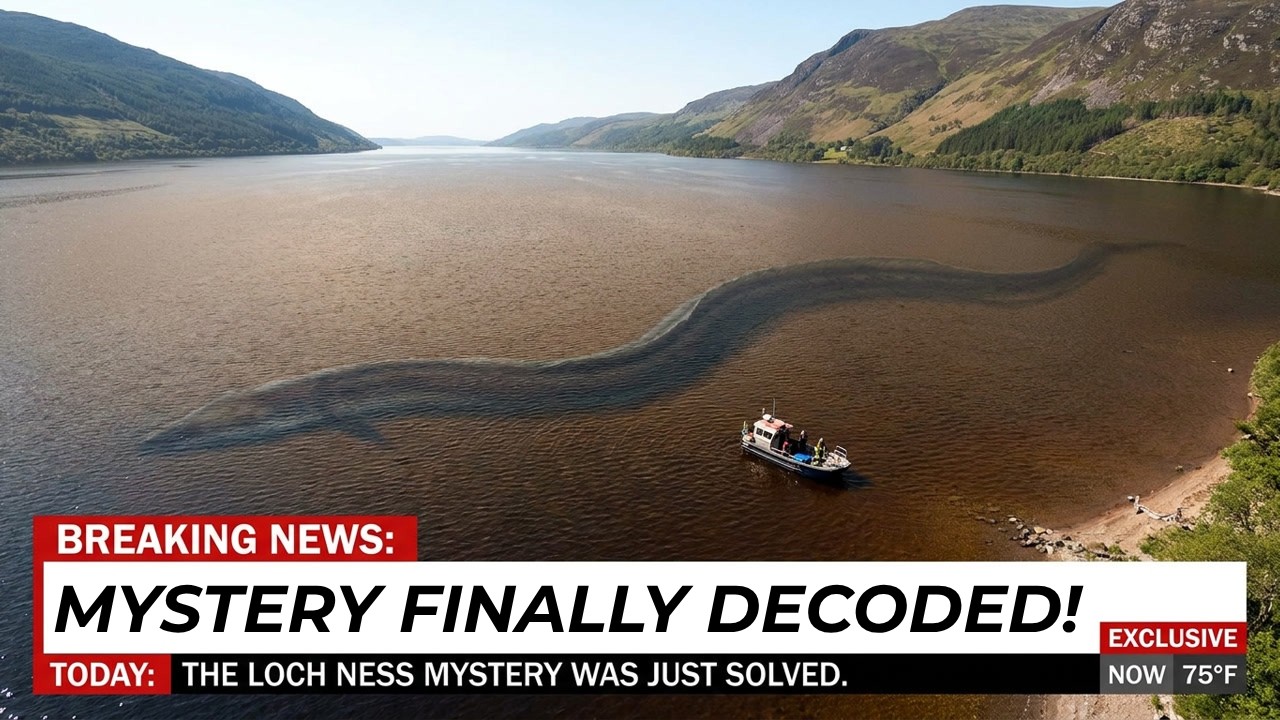
It arrived in a plastic bottle. Two hundred and fifty of them. And what those bottles revealed was stranger, older, and far bigger than the monster anyone had been looking for. To understand what happened, you have to understand the pull of the place first.
There is something about Loch Ness that gets into people and never lets go. Stand on its banks at dawn before the tour buses arrive, and the water lies flat and dark as poured tar. The hills rise steeply on either side, wrapped in mist that seems reluctant to leave. The air smells of wet bracken and cold stone.
And the surface, that vast, silent surface stretching further than you can see in either direction, holds a quality of stillness that feels almost watchful. It is easy standing there to believe anything. The legend most of us grew up with is specific. Not just a monster, but a particular kind of monster.
A long-necked, small-headed, barrel-bodied creature with flippers. The very image of a plesiosaur, a marine reptile that supposedly went extinct when the dinosaurs did. The idea took hold that somehow, impossibly, a pocket of these creatures had survived, hidden away in the deepest, coldest, darkest lake in the British Isles, surfacing only rarely, only for the lucky few. People wanted it to be true so badly that they saw it.
Over and over, they saw it. And they are still seeing it. Early in 2025, before the tourist season had even properly begun, there was already a claimed first sighting of the year. A visitor watching the water reported something bulging just beneath the surface, a dark, rounded mass moving when nothing should have been moving, rising and pushing the water outward before sinking away again.
Photographs were taken. The story spread within hours. The monster does not age. The monster does not tire.
And the monster, apparently, does not die. But for all the passion, all the belief, all the hundreds of eyewitness accounts stacked up over the decades, one thing was always missing. Proof. And this is where the story takes its first sharp turn.
Because the man who would come closest to finding it wasn’t a monster hunter at all. He was a geneticist. And his weapon of choice was almost laughably ordinary. In June of 2018, a professor named Neil Gemmell arrived at Loch Ness with a plan that made the seasoned hunters raise their eyebrows.
Where others had spent fortunes on sonar and deep diving robots, dragging expensive equipment through the murk for weeks on end, Gemmell brought bottles. Empty ones. Two hundred and fifty empty bottles. He wasn’t going to look for the creature at all.
He was simply going to look for what it left behind. Everything that lives sheds itself constantly. Flakes of skin, strands of hair, cells sloughed off with every breath and every movement. A creature living in water does exactly the same thing.
It sheds cells into the water around it. Inside those cells is DNA, a molecular fingerprint that stays suspended in the water, detectable for up to a full day after the animal has gone. You don’t need to see the fish to know a fish was there. You just need to scoop up the water and read what’s floating inside it.
Environmental DNA. eDNA. The idea was this. If there really was a large, unknown animal living in Loch Ness, anything at all, plesiosaur or otherwise, then it could not possibly hide its own genetic code.
Every time it moved, it would be signing its name in the water. Gemmell was going to collect that water and read the signature. For nearly a century, people have been trying to find the monster by looking. Gemmell was going to find it by listening to the water itself.
Not for sounds, but for molecules. The team loaded up their bottles, boarded their small boats, and set out onto that dark, tea-colored water to do something no monster hunter had ever seriously attempted. Not to catch the creature, but to sample the entire lake. And sampling the entire lake was not as casual as dipping a bottle over the side of a boat and screwing on the lid.
A creature might live at the surface, or halfway down in the middle depths, or pressed against the freezing floor of the loch. So the team collected at three distinct layers. They took water from the surface, where most human sightings have ever occurred. They dropped their collection gear into the middle depths, that strange twilight zone where the temperature begins to plummet.
And they reached all the way down toward the bottom, into the crushing cold and total blackness. Loch Ness isn’t a pond. It’s a vast, narrow gash of water 23 miles long, split by geography into two great basins. The team worked both, tracking north and south, dipping their bottles at station after station, building a map not of what the water looked like, but of what the water carried.
Each bottle was carefully labeled, sealed, chilled, and protected, because the whole experiment depended on not contaminating the samples with stray DNA from the people handling them. A single sneeze in the wrong place, a careless touch, and you’d be reading the genetic code of the boat crew instead of the loch. To do this properly, Gemmell brought in a man who understood Loch Ness better than almost anyone alive, a naturalist named Adrian Shine, who had been studying this lake with quiet, patient obsession since 1973. Shine had seen the expeditions come and go.
He had watched the submarines and the sonar sweeps. And through all of it, he had kept his own careful counsel, gathering data, refusing to be seduced by the legend or dismissive of the people who believed in it. If anyone knew where a large animal might hide in that loch, where the currents ran, where the cold pooled and the darkness deepened, it was Adrian Shine. Picture it.
A small boat, low in that black water. The wind carrying the smell of wet heather and cold stone off the surrounding hills. The surface not blue, not green, but a deep, unsettling brown, like a cup of tea left to go cold. And a team of scientists, hands careful, faces set, lowering bottles into a lake that had defied every technology thrown at it for a hundred years.
Armed with nothing but glass, water, and the certainty that no living thing can keep a secret from its own cells. Over the course of that summer, the bottles filled. Two hundred and fifty of them, plus more. When the sampling was done, the water went to laboratories, not one, but several, spread across different countries, so that no single team could bias the results.
Inside those labs, the DNA was extracted, amplified, and sequenced. Every fragment of genetic code was compared against enormous global databases, libraries of known species. If a strand of DNA in that loch matched a known animal, the database would name it. And if something in that water matched nothing at all, if there was a signature that belonged to no creature science had ever recorded, then Gemmell would know.
He would have found, molecule by molecule, the ghost that a century of hunters had chased. The results took more than a year to assemble. And while the world waited, the legend did what it always does. It kept breathing.
People kept coming to the shore with their cameras and their hopes. The old stories got told again in the pubs of Drumnadrochit and Fort Augustus, passed hand to hand like heirlooms. Then, on the 5th of September 2019, the waiting ended. Gemmell stood before a room of journalists and cameras at the Loch Ness Centre, the results finally compiled, the loch’s molecular census complete.
Whatever lived in that water, every fish, every microbe, every mammal that had passed through, every bird that had dipped its feet, was now written down in a list of roughly 3,000 species. And Gemmell had decided to do something that made the moment far more than a dry scientific report. He was going to take the four biggest, most famous theories about what Nessie could be, and test each of them one by one against the genetic evidence. The first theory on the table was the oldest and the most beloved.
The plesiosaur. The ancient, long-necked marine reptile, a survivor from the age of dinosaurs, somehow persisting in this cold Scottish lake for 66 million years after its kind was supposed to have vanished from the earth. If it were real, if any such creature drew breath in that loch, its DNA would be everywhere. The room leaned in as Gemmell prepared to read what the water had said.
Nothing. That was the answer. Not a single fragment. In 250 bottles sampled from surface to floor, from the northern basin to the southern reaches, across every depth and every current, there was not one strand of reptilian DNA that matched anything like a plesiosaur, or indeed anything like a reptile of that scale at all.
The creature that had launched a thousand expeditions had left no trace in the water because it had never been in the water. Gemmell said it plainly. There was no evidence of a reptilian sequence anywhere in the loch. The dinosaur theory, the most romantic of them all, was dead on the table.
The second candidate had always been the sober scientist’s choice. The sturgeon. A real, living, enormous fish, armored, prehistoric-looking, capable of growing longer than a man is tall, with bony ridges down its back that could easily be mistaken for the humps people swore they saw breaking the surface. The DNA said no.
There was no sturgeon signal in the water. Not at the surface, not in the middle depths, not down in the cold, black bottom. Theory two, gone. The third was stranger, and it had gathered momentum in recent years.
The Greenland shark. A deep-water leviathan that can live for centuries, some individuals thought to be 400 years old. Slow-moving, cold-loving, ghostily pale, drifting through the black like something half-dead. People had speculated that one could have found its way in from the sea, prowling the depths where no camera could reach.
But sharks shed their cells into the water they move through, and Gemmell’s samples held not a whisper of shark DNA. No Greenland shark. No shark of any kind. Theory three joined the others on the pile.
The fourth was the one that a certain kind of dedicated watcher had clung to for decades. The Wels catfish. A massive European freshwater predator, dark and slippery and secretive, lurking on the bottoms of rivers and lakes across the continent. It had been introduced to British waters in the Victorian era, and to some it was the perfect answer.
Real, large, elusive, and just plausible enough that it might have slipped into the loch unnoticed and grown to monstrous size in the dark. And once again, Gemmell looked at the data and shook his head. No catfish. Not a trace.
The water that should have carried its DNA at every depth carried none. Four theories, four of the most argued-over, most defended ideas in the entire history of the mystery, and all four of them collapsed in a single afternoon, undone not by ridicule, but by molecules. You might think that would have been the end of it. But that is not what happened.
Because when Gemmell had finished eliminating the famous suspects, he was left holding something he had not expected. Something the water kept insisting on over and over in sample after sample. It was a presence so strong, so consistent, so undeniable that even a scientist who had come to Loch Ness fully prepared to find nothing at all found himself genuinely surprised. Eels.
European eels, Anguilla anguilla. Their DNA lit up the readings like a signal flare. Not in one spot, not in one basin, not at one convenient depth. Everywhere.
At the glassy surface where the sightings happen, in the middle layers where the light already fails, down in the crushing cold at the bottom where no camera has ever returned a clear image. North and south, shallow and deep, again and again, the eels were there in numbers that stopped Gemmell mid-analysis. He had known there would be eels. Everyone knew there were eels in the loch.
What he had not anticipated was the sheer concentration of them, the way their genetic fingerprints saturated nearly every sample he pulled. The loch, molecularly speaking, was thick with them. For 90 years, people had asked what enormous, exotic, impossible creature might be hiding in Loch Ness. They had imagined reptiles and sharks and monsters from other epochs.
And now the science had swept all of that away and left a single, ordinary, extraordinary suspect standing in the center of the room. An eel. A creature already living there in astonishing abundance. One that grows long and dark and serpentine.
That moves with exactly the sinuous, rippling motion people had described for generations. Gemmell was careful not to overstate it. But even he could see the shape of the story the data was telling. The most likely explanation for the thing people kept seeing was not a monster at all.
It was an eel. Possibly, just possibly, a very, very large one. But to understand why that answer is not as simple or as disappointing as it sounds, why an eel in this particular lake might be capable of things eels elsewhere could never manage, you have to stop thinking about the creature and start thinking about the water. Because Loch Ness is not an ordinary lake.
It does not behave like other lakes. It was not made the way other lakes are made. Everything strange that people have ever seen on its surface begins not with biology, but with a wound in the earth that has been open for hundreds of millions of years and has never fully stopped moving. That wound has a name.
The Great Glen Fault. It slices across Scotland for 62 miles in a nearly straight line, a seam where two halves of the country ground against each other long before there was anyone to notice. Ice came later, exploiting the weakness, gouging out a trench so deep and so steep-sided that when the glaciers finally retreated, they left behind a basin unlike almost anywhere else on the planet. Twenty-three miles long, 755 feet deep in places, holding more fresh water than every lake in England and Wales combined, poured into one narrow black slot in the earth.
And the fault beneath it did not go quiet. It shifted in 1816. It shifted again in 1901, tearing a crack in the ground 500 meters long. Engineers who built the Kessock Bridge nearby took the threat so seriously they set the whole structure on hydraulic buffers weighing 2.
5 tons each, designed to absorb the shudder of a fault that still to this day whispers and groans beneath the water. And the water itself hides everything. Below 100 meters, the loch sits at 5 degrees year-round, in permanent darkness and crushing pressure. The peat washing down from the surrounding hills stains it the deep brown of strong tea, thick with humic acids that swallow light within inches.
Sonar scatters. Cameras return nothing but murk. A creature could pass 3 feet from a diver and never be seen. This is a lake built to keep its secrets.
Now add the seiche. In the early 1970s, a researcher documented something few people ever consider. A lake this deep, layered warm over cold, does not sit still. Wind pushes the warm upper layer to one end, and when the wind drops, that layer sloshes back, slowly, invisibly, for weeks.
An internal wave you cannot see from shore. But its effects rise to the surface as dark, gliding humps that move across the water, sometimes unnervingly against the breeze. A witness sees a hump travel the wrong way and knows, absolutely knows, it must be alive. It isn’t.
It’s the lake breathing. And here is the cruel joke the loch plays. The seiche’s surface signatures show up best on flat, glassy, windless days. Exactly the conditions the investigation bureau, watching from 1962 to 1972, came to call “Nessie weather.
” The calmest, most credible sightings happen precisely when the water is most likely to be lying to you. Even the oldest account fits. In the year 565, a holy man is said to have driven off a water beast in the River Ness. A geologist, centuries later, seized on three Latin words in that story.
Ingenti fremitu, “with a great roaring. ” Not the sound of an animal, he argued, but the sound of the fault itself. Gas bursting up. Ground convulsing.
The 1755 Lisbon earthquake produced a measurable seiche on this loch from 1,300 miles away. The fault roars, the bubbles rise, and people have been mistaking geology for biology for 1,500 years. So what is Nessie? She is not one thing.
She is five forces braided together. Eels thick in every sample, long and serpentine and real. Seiches, dark humps sliding against the wind. Gas and tremor from a restless fault.
Water so opaque it erases proof. And a thousand years of story teaching every eye what to expect. Gemmell couldn’t rule out a 4-meter eel, outside the normal range, but not impossible. A later paper put the odds of even a 1-meter eel at roughly 1 in 50,000.
Slim, but not zero. And there are eels that begin life in the Sargasso Sea, drift on the Gulf Stream, and simply refuse to leave, growing and growing for decades. One in Sweden reportedly reached 155 years. Two men have given their lives to watching this water.
One has kept a 33-year vigil and still believes in a catfish the DNA never found. He sold everything, moved into a weathered van on the pebbles at Dores, and traded an entire ordinary life for the chance to be looking at the exact second something breaks the surface. The DNA study told him his catfish isn’t there. He heard the verdict, thanked the scientists, and kept watching anyway.
The other, who has studied the loch since 1973, shrugs and says most sightings are boat wakes, otters, swans. “We call them swans. ”
And still the loose threads dangle. Sonar contacts in 1987 no one ever explained.
A fifth of the DNA that matched nothing on record. A strange pulsing sound recorded in 2024. Sightings are fading now because everyone carries a sharp camera, and mystery does not survive high resolution. But it hasn’t died yet.
That fifth of the DNA, the 20% that matched nothing in any database on Earth, has never been fully explained. Gemmell was careful about how he said it. He didn’t say monster. He said “unknown.
” In science, those are very different words. Most of that unmatched material is almost certainly ordinary life whose genome simply hasn’t been cataloged yet. Bacteria, microscopic invertebrates, fragments too degraded to read. That’s the honest, boring answer, and it’s probably the true one.
But probably is a heavy word to carry when you’re standing on a black shore at dawn with mist coming off water 700 feet deep. The loch had never really been about the animal. It was about the not knowing. And the not knowing is a kind of company on a lonely shore.
That’s the quiet truth underneath all 1,500 years of this. We didn’t invent Nessie because we’re foolish. We invented her because a lake this deep, this dark, this alive with tremor and current feels like it owes us a secret.
