In the summer of 1920, a crew of engineers in Steven, Minnesota, bolted a twelve-horsepower tractor onto a road grader frame, started the engine, and watched the world’s first self-propelled motor grader crawl forward at a mile and a half per hour. It had no cab, no hydraulics, and no rollover protection. The operator sat on an open platform, fully exposed to the elements, cranking cast iron hand wheels against thousands of pounds of resistance just to raise and lower a six-foot blade. That single machine replaced three teams of horses, but it also created one of the most physically punishing jobs in American construction history.
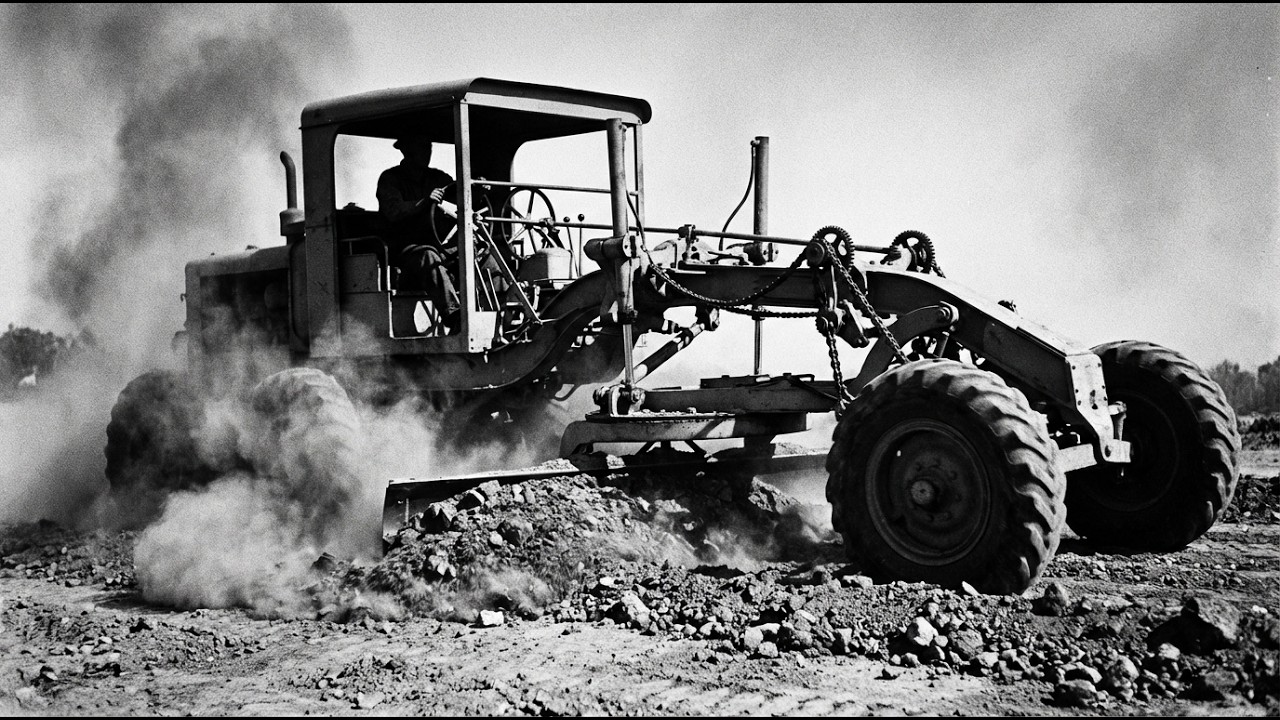
Over the next two decades, men would sit on machines just like it for sixty hours a week, breathing silica dust on unpaved roads, making hundreds of manual blade adjustments per shift on equipment that killed operators at rates approaching those of combat soldiers. And those men built every road we drive on today. To understand why the motor grader was so desperately needed, it is necessary to go back further, to a time before gasoline engines, before rubber tires, back to a road inspector in Indiana who had a simple but brilliant idea about wheels. In 1885, a man named Joseph D.
Adams invented what he called the Little Wonder. It was a two-wheeled, horse-drawn grading blade, and by itself, that was nothing special. Dozens of companies sold horse-drawn graders in the 1880s. But Adams added one feature nobody else had thought of.
He made the wheels lean sideways. This sounds trivial. It was anything but. When an earlier rigid-wheel grader hit a heavy load of earth, the force pushed the entire machine sideways, away from the material.
The grader slid instead of cutting. Adams figured out that if the wheels could tilt into the load, like a person leaning into a heavy wheelbarrow, the machine’s own weight would hold it in place. That one change transformed the grader from a crude smoothing tool into an actual earthmoving machine. Adams built his company in Indianapolis.
By 1896, the JD Adams Company was producing the Road King, a four-wheel grader with an eight-foot blade. These were massive pieces of iron pulled by teams of four to eight horses along dirt roads that turned to mud every spring and froze solid every winter. A typical horse team could grade about two miles of road per day. A good team might manage three, but every spring, frost heaves and rain turned those same roads back to mud, and the grading had to start all over again.
County road commissioners across the Midwest spent their entire annual budgets just trying to keep the same roads passable year after year, knowing they would lose the fight every time the weather changed. The work was seasonal and brutal. In summer, dust clouds hung over every road being graded, thick enough to choke both horses and men. In early spring, the mud was so deep that grader blades sank past the cutting edge and had to be dragged free by the horses.
In winter, many counties simply gave up and waited for the ground to freeze hard enough to drive on. The men who walked behind these horse-drawn graders, holding guide handles and making adjustments by hand, earned between $1. 50 and $3. 00 per day.
They worked from sunrise to sunset, six days a week, and counted themselves lucky to have the job. One of those original Adams leaning-wheel graders, a number 12 model purchased by Rush County, Indiana, in March 1922 for $1,140, still stands today with a historical marker in Rushville. There were no hydraulics on that machine. Every adjustment was manpowered.
The operator turned cast iron wheels, one for each side of the blade, fighting the resistance of packed earth with nothing but arm strength. On a model 1002 Adams grader, there were separate hand wheels for left blade lift, right blade lift, blade angle, and wheel lean. Each one required sustained cranking, sometimes dozens of turns just to make a single adjustment. But Adams was not the only one building graders.
Up in Steven, Minnesota, Richard Russell and C. K. Stockland founded the Russell Grader Manufacturing Company in 1903. Russell had ambitions far bigger than horse-drawn equipment.
The Russell product line ranged from the small Simplex blade grader priced at $15 in 1908 all the way up to the Mogul. The Mogul featured a twelve-foot blade mounted on a frame weighing 6,750 pounds. Russell marketed it as the largest, heaviest, and greatest capacity road machine ever made. They even sold graders to the Russian government during World War I for digging trenches on the Eastern Front.
It was a long way from Minnesota farm roads to the mud of Russia, but the Russell grader made the trip. The real breakthrough came in 1919 when Russell engineers took one of their Highway Patrol pull graders and bolted an Allis-Chalmers wheel tractor to it. The result was the Russell Motor Highway Patrol number one, the world’s first known self-propelled motor grader. The specifications tell everything about how primitive the machine was.
Six drawbar horsepower, twelve brake horsepower, a top speed of one and a half to three miles per hour, a six-foot blade, and a thirty-six-foot turning radius. That turning radius alone meant the machine needed half a city block just to reverse direction. Russell’s advertising claimed it would do the work of three horse teams. That was probably optimistic, but it moved under its own power, and that was the point.
Only 172 units were ever built before production stopped in 1926 when Allis-Chalmers discontinued the tractor over a patent dispute. But the concept had been proven. A motor grader could work faster than horses, cover more road per day, and operate regardless of how tired the animals were. That opened the floodgates.
Throughout the 1920s, manufacturers across America started bolting grader frames onto tractors from McCormick, Deering, Fordson, and Cleveland Tractor Company. These cobbled-together machines required two-person crews. One man drove the tractor up front; another stood on a platform at the rear, turning hand wheels to control the blade. Communication between the two was almost impossible over the engine noise.
If the blade hit a rock and the rear operator needed to stop, he had to shout or wave until the driver noticed. If the rear operator fell off the platform, the driver might not realize it until the blade had already carved an uncontrolled path through the roadbed. Falls from the grader platform were common, especially on rough terrain where the machine bucked and jolted over every rut and stone. There were no handrails and no seat belts.
The operator simply held on and hoped for the best. The machines were awkward. They were underpowered. They were exhausting to operate.
But they were faster than horses. And America needed roads desperately. In 1904, the first national road inventory found 2,151,570 miles of rural roads in the United States. Ninety-three percent of them were bare dirt.
Only 153,662 miles had any surfacing at all. Meanwhile, automobile registrations were exploding, from 458,000 in 1910 to over eight million by 1920 to twenty-three million by 1929. Americans were buying cars far faster than roads could be built to carry them. The Federal Aid Road Act of 1916, the first federal highway funding legislation in American history, provided $75 million over five years in matching funds to the states, capped at $10,000 per mile.
It required every state to establish a highway agency. By 1917, all forty-eight had complied. The Federal Aid Highway Act of 1921 expanded the program to $75 million annually, limited aid to seven percent of each state’s highway mileage, and required that sixty percent of aided roads connect at state lines, creating the skeleton of a national highway system for the first time. The program employed over 250,000 workers across the country, adding 10,000 miles of new highway by the end of 1922.
Surfaced road mileage doubled from 257,291 miles in 1914 to 521,915 miles by 1926. The demand for grading equipment during this period was enormous. Every mile of new road required multiple passes with a grader to shape the crown, cut the drainage ditches, and smooth the surface. A single mile of graded road might take a crew an entire day.
Multiply that by hundreds of thousands of miles across forty-eight states, and the scale of the operation becomes clear. Grader manufacturers could not build machines fast enough. Counties that could not afford motor graders improvised with horse-drawn equipment and hand labor. Some townships pressed their road commissioners into personally operating the graders because they could not hire skilled operators at the wages they could afford to pay.
All that road needed grading, every single mile, and the men doing the grading were paying for it with their bodies. Other manufacturers were pushing the boundaries of grader design. Galion Iron Works, founded in 1907 by David Charles Boyd in Galion, Ohio, became famous for their enormous pull-type graders. Their number 14 model featured a fourteen-foot blade, a scarifier for breaking up hardpan, and a steerable tongue.
All hand operated, all weighing 15,000 pounds. Galion was ahead of the curve in one critical respect. They pioneered early hydraulic control systems for graders in the 1920s and made them standard on their motor graders by the early 1930s, decades before most competitors. They also continued selling pull-type graders until 1945, long after everyone else had abandoned them, because some counties simply could not afford motor graders.
Austin-Western, tracing its roots to 1877 in Aurora, Illinois, started as railroad grading specialists. The company’s earliest graders were little more than a blade straddle-mounted beneath a freight wagon pulled by horses. Their dump carts had been used on the Panama Canal project. By the 1930s, Austin-Western was producing sophisticated motor graders that would lead the industry in a direction nobody expected.
Then, in April 1931, Caterpillar changed everything. Their road machinery division, created after the company acquired Russell Grader Manufacturing in December 1928 for its extensive dealer network and road machinery expertise, unveiled the Auto Patrol. It was the world’s first true integrated motor grader, where engine, frame, and blade were designed as a single, purpose-built unit rather than a tractor with a grader bolted on. Three design decisions made the Auto Patrol unlike anything the industry had seen.
First, Caterpillar placed the engine in the rear instead of the front. This kept the engine away from the worst of the dust, put more weight on the drive wheels for better traction, and gave the operator a clear line of sight down to the blade. Second, the machine rode on pneumatic rubber tires with puncture-proof tubes, a radical departure from crawler tracks or steel wheels. In 1934, only fourteen percent of tractors had pneumatic tires.
By 1940, ninety-five percent did. That is how dramatically rubber tires improved operating conditions. The old steel wheels transmitted every jolt directly through the unsuspended frame to the operator’s body. Every rock, every rut, every ridge pounded upward through the platform for ten hours straight.
Operators who spent years on steel-wheeled graders developed chronic back injuries, joint damage, and internal organ problems from the constant vibration, conditions that were not medically understood at the time and were simply dismissed as the cost of doing the job. Pneumatic tires absorbed at least some of the punishment, and operators who switched from steel wheels to rubber described the difference as night and day. Third, and most important of all, the Auto Patrol featured the industry’s first power-operated blade controls. The control system worked through an ingenious mechanical arrangement.
A drive shaft conveyed power from the engine flywheel through worm gears and a vertical shaft to a central control box. Critically, this drive bypassed the flywheel clutch, meaning blade controls worked whenever the engine was running, even with the transmission disengaged. Five levers controlled left blade lift, right blade lift, circle side shift, circle rotation, and a scarifier. Safety clutches automatically disengaged at the limits of motion, and levers returned to neutral when released.
The system could adjust the blade as finely as one-eighth of an inch and raise it as fast as one inch per second. A new Auto Patrol cost approximately $3,100 in 1931, equivalent to roughly $64,000 today. By the late 1930s, Caterpillar had captured nearly forty percent of worldwide motor grader sales. The successors came fast.
The Number 7 Auto Patrol arrived in 1932, an economy model weighing 10,900 pounds with a forty-horsepower gasoline engine. Only 125 units were built before it was discontinued. The Number 10 followed in 1933 at 13,460 pounds. A diesel tandem-drive variant introduced in 1936 weighed 16,350 pounds and ran a forty-four-horsepower D4400 engine.
Then, in July 1938, Caterpillar introduced the machine that would become the most iconic motor grader ever built, the diesel Number 12 Auto Patrol. It had a six-cylinder Cat diesel producing sixty-six brake horsepower and weighed 20,360 pounds. It had six forward gears and two reverse gears and two-speed mechanical blade controls. The Number 12 became the longest-running production grader in history.
It is still manufactured today as the Cat 140 series, more than eighty years of continuous production from a design born in the Depression. But here is what needs to be understood about even the best machines of this era. Even on a Caterpillar Auto Patrol, a typical grading day looked like this. The operator climbed up onto the open platform before dawn, started the diesel engine by hand crank in the cold, and began working a stretch of county road that might be five or ten miles long.
Each pass of the blade required the operator to position the moldboard at the correct angle, height, and side shift for the specific section of road. Crowning the road surface to shed water required one blade angle. Cutting a drainage ditch alongside the road required a completely different setup. Shaping a shoulder required yet another.
And every time the terrain changed, every time the road curved, every time the soil went from clay to gravel, the operator had to readjust the blade. These were constant adjustments. The Auto Patrol’s mechanical controls were a massive improvement over hand cranks, but operators still called them knuckle busters. The dog clutches and drive shafts controlling blade functions could snap back and injure fingers and hands.
On the later 12F model, the last mechanical Cat grader ever made, the system earned the nickname finger slappers. Setting up the blade for ditching or shoulder work on a mechanical-control grader could take several minutes and considerable physical effort. A 1959-era Cat Model 14B operator later reported that the blade controls were quite stiff, making it almost painful on the wrist. And thousands of older machines without any power controls at all remained in service throughout the 1930s.
On those machines, controlling a grader blade was a punishing physical ordeal. Hand wheels connected to worm gears and rack-and-pinion mechanisms had to be cranked by hand against enormous resistance. Every pass over a section of road demanded dozens of separate adjustments. Over a ten-hour shift, an operator might make hundreds of cranking actions, raising one end of the blade, lowering the other, rotating the circle to change the angle, shifting the blade sideways for shoulder work, then doing it all again thirty seconds later when the terrain changed.
When the blade struck a buried rock or a tree root, the hand cranks could spin violently backward, tearing the operator’s hands off the wheels or throwing him bodily into the adjusting mechanism. At least one fatality was documented from the early 1930s when a pull-grader operator was killed after being thrown into the adjusting wheel upon hitting a rock. These incidents were rarely reported and almost never investigated. Dead operators were simply replaced.
The terminology of the era reflects the machine’s primary purpose. These graders were called road patrols or maintainers because their main job was patrolling and maintaining existing dirt and gravel roads, not building new ones. Russell called theirs the Motor Highway Patrol. Caterpillar used Auto Patrol.
Champion branded their machines as powered maintainers. The word maintainer was especially common in Texas and the southern states, while grader was used more broadly. There was no mechanical distinction between the two terms. They described the same machine.
Caterpillar officially adopted the term motor grader in 1939, and it gradually became the industry standard. The conditions those operators worked in would be flatly illegal today. The operator station on a 1930s motor grader was a flat, open platform atop the machine frame. There was no cab, no canopy, no windshield, and no weather protection of any kind.
Universal cabs on construction equipment did not arrive until the 1970s. Operators endured scorching summer heat, bitter winter cold, driving rain, and, most persistently, choking clouds of silica dust kicked up from the dirt roads they graded. The lethal potential of that dust was not theoretical. The Hawk’s Nest tunnel disaster in West Virginia between 1930 and 1935 killed 476 workers from silicosis, a fatal lung disease caused by breathing crystalline silica dust.
Grader operators breathed that same dust every day, mile after mile, year after year. Nobody measured their exposure. Nobody tracked their lung function. Work hours were brutal.
Ten-hour days, six days a week, sixty hours total, were standard in heavy construction during the 1920s. The Fair Labor Standards Act establishing the forty-hour work week was not passed until 1938, and even then, it did not cover all construction workers. Highway laborers in 1920 earned $3. 00 to $5.
00 per day. During the Depression, WPA construction workers averaged 91 cents per hour, about $7. 34 for an eight-hour day. Unskilled WPA laborers earned even less, just 51 cents per hour.
The absence of rollover protection structures, known as ROPS, was perhaps the deadliest single gap. Motor graders have a high center of gravity and routinely work on slopes, road shoulders, and uneven terrain. Any rollover on these tall, narrow machines could crush the unprotected operator beneath ten to twenty thousand pounds of iron and steel. ROPS did not exist as a concept until the 1950s.
Sweden mandated them in 1959. They were not mandatory on American construction equipment until September 1, 1974, more than forty years after the machines in question were built. Modern data shows ROPS combined with seat belts are ninety-nine percent effective at preventing operator death in a rollover. In the 1930s, operators had neither.
Construction death rates tell the full story. The Bureau of Labor Statistics estimated over 30,000 annual workplace deaths in the early 1920s across all industries. Construction workers died at rates of 150 to 200 per 100,000, roughly ten times the modern construction death rate and approximately one-third the death rate of American troops in Afghanistan. If today’s 130-million-strong American workforce experienced the 1933 death rate, an additional 40,000 workers would die every year.
OSHA did not exist until 1970. Before that, there was no federal agency with enforcement power over construction-site safety. Despite these conditions, the work continued because it had to. The Great Depression devastated private road construction but paradoxically created the largest government road-building program in American history.
The Works Progress Administration, operating from 1935 to 1943, spent a total of $11. 4 billion, of which more than $4 billion went to highway, road, and street projects. That is more than a third of the entire WPA budget, and it represented the largest single investment in American roads since the country was founded. The scale of work was staggering.
WPA workers constructed or improved 651,087 miles of roads, built over 75,000 bridges, and laid 4,400 miles of paved roads. Farm-to-market roads were the primary focus, with 39,000 miles newly constructed and 140,000 miles improved. Before these projects, many rural communities in the South and Midwest were completely cut off from markets during the rainy season. Farmers watched crops rot because they could not get a truck down a mud road to the nearest town.
The WPA changed that, one graded mile at a time. The program employed 8. 5 million Americans over its lifetime, with 3 million working simultaneously at its 1938 peak. Crucially, WPA projects deliberately used labor-intensive techniques and minimized machinery to maximize employment.
That meant more men with shovels and fewer motor graders, though the graders were still essential for the precision grading work that hand labor simply could not accomplish. The Civilian Conservation Corps put an additional 3 million young men to work over nine years, building 125,000 miles of roads and trails and 45,000 bridges. Corps enrollees were typically young, unmarried men between eighteen and twenty-five years old who earned $30 per month, with $25 sent home to their families. Many of them had never operated heavy equipment before.
They learned on the job, on machines that offered no forgiveness for mistakes. Motor graders also played a role in the 1930s that few people today realize. The WPA built or improved nearly 1,000 airports and constructed over 200 miles of runways, spending more than $150 million on aviation infrastructure. Many of these supposedly civilian airports were covertly designed with military specifications because isolationist Congress blocked direct military spending.
An estimated $110 million in WPA-built frontier air defense bases were constructed under the disguise of civilian airports. One observer at the time noted that every airport touched by the WPA was publicly owned and would be available should a national emergency arise. After Pearl Harbor, dozens of those WPA-built airports were immediately converted to military training bases. The CCC was similarly redirected to defense projects starting in 1939, with crews clearing land and grading airfields.
The graders that shaped those runways helped prepare America for a war that was still years away. So when did this brutal era finally end? When did hydraulics replace the hand cranks and knuckle busters for good? The answer is more complicated than a single date.
The transition from mechanical to hydraulic motor graders stretched across four decades. The technology that made it all possible was the balanced vane-type hydraulic pump invented in 1925 by Harry Franklin Vickers. The American Society of Mechanical Engineers later called him the father of industrial hydraulics. Vickers, a self-taught machinist who founded his company at age twenty-three in Los Angeles, ultimately held ninety-five patents for hydraulic devices.
His pumps became the foundation of every hydraulic system in construction equipment, and his company was a vital supplier to the military during World War II. Galion Iron Works had early hydraulic systems on their graders in the 1920s. Then, in 1937, Austin-Western introduced the Model 99, the industry’s first motor grader with fully hydraulic blade control combined with all-wheel drive and all-wheel steering. The hydraulics on the Model 99 allowed the operator to precisely control all blade functions without interrupting forward motion or engaging mechanical clutches.
Austin-Western was, in the words of one equipment historian, well ahead of the industry at a time when mechanical drives for blade control were very much the norm. But Caterpillar, the market leader, distrusted hydraulics for decades. Their engineers worried about hydraulic drift, where cylinders slowly lost position due to seal leakage. It was a legitimate technical concern in the early years.
A grader blade that gradually sinks half an inch during a pass can ruin the grade on an entire section of road. Mechanical controls held position absolutely through physical locks and worm-gear friction, and Caterpillar’s engineers were reluctant to give that up. Caterpillar’s transitional models used hybrid systems where hydraulic power assisted traditional mechanical linkages, but gears and drive shafts still moved the blade. The result was a machine that was easier to operate than a pure mechanical grader but still far more demanding than a fully hydraulic one.
Operators who worked these transitional machines remember them as neither one thing nor the other. It was not until 1973 that Caterpillar finally introduced the G Series, their first fully hydraulic motor grader line, featuring articulating frames, closed-center hydraulic systems, and variable-displacement piston pumps. By that point, most competitors had been fully hydraulic for years. John Deere had introduced the JD570 in 1967, the first motor grader with both an articulated frame and fully hydraulic controls, which accelerated the industry trend.
By the mid to late 1970s, no major manufacturer was still producing cable- or mechanical-control motor graders. The era of brute force was finally over. The improvements were profound. Blade setup that once took several minutes of physical effort became instantaneous.
The knuckle buster and finger slapper injuries disappeared entirely. Operators could make precise proportional adjustments with light lever movements instead of wrestling cast iron hand wheels. Modern Caterpillar joystick controls, introduced in 2007, reduced hand and arm movement by seventy-eight percent compared to even the lever systems that replaced the mechanical drives. Every generation of controls made the operator’s job easier, safer, and more precise.
That brings it back to where it started, to that field in Steven, Minnesota, in 1920, where engineers watched a twelve-horsepower machine crawl forward at walking speed, dragging a six-foot blade through the dirt. Between 1920 and 1940, motor grader operators helped build and maintain a road network that grew from roughly 369,000 surfaced miles to well over 500,000, while total public road mileage exceeded 3. 3 million. They did this on machines that weighed up to 20,000 pounds, produced as little as twelve horsepower, traveled at walking speed, and required constant physical cranking against resistant mechanical systems.
They worked fully exposed to the elements, without any safety equipment that is taken for granted today. Every modern highway, every county road, every suburban street traces its ancestry back to a graded dirt path. And those paths were shaped by men on open platforms fighting cast iron controls in the dust. The Caterpillar Auto Patrol of 1931 was a genuine turning point.
It was the first integrated, single-operator, power-controlled motor grader. But even its controls were demanding enough to earn the name knuckle busters. The full transition to hydraulics took another four decades. When it finally came, it transformed the motor grader from a machine that wore out operators into one that amplified them.
The real story of this era is not just about machines. It is about the operators who sat atop them for sixty hours a week, cranking cast iron wheels in the dust and heat, building the roads that made modern America possible. Their work was essential. Their suffering was largely invisible.
And the machines they operated, for all their crude brutality, established the motor grader template that is still in use today. The next time you drive on a smooth county road through open farmland, somewhere under that asphalt is a grade that was first cut by a man on an open platform turning a hand wheel against packed earth eighty or ninety years ago. Before hydraulics, every ton of force was earned. Every mile of road was paid for in sweat and blood.
And the price was always higher than anyone wanted to admit.
