The night Call Wllo walked out of the bunk house, Orville Ashmore was lying awake in the black, listening to the boards under his cot move with a slow, heavy breathing that came up from deep below the floor of the world. The old rancher sat up in the dark on his cot and said, in a low, strange voice Orville did not recognize as his, that it was calling him. Calling him by a name. A name, he said, that he had not been called by since he was a young man a long time ago.
A name that only the dead knew. And he stood up, walked to the door, and went out into the night, going north toward the seep, walking steady and unhurried like a man who had finally been told where he was meant to be. Orville lunged up off his cot and grabbed for the back of him, and caught nothing at all but the rough wood of the doorframe. That was the last that any living man ever saw of Call Wllo.
Orville was a windmiller. That was his whole trade. In that part of far west Texas, the only water a ranch had came up out of the ground, and it came up because a wind machine turned a rod that worked a pump down in the dark. When the machine broke, and it always broke, a man like Orville climbed the tower and set it right.
He drove a worn-out truck from one lonely headquarters to the next, sometimes fifty miles between jobs, and he knew every windmill in three counties the way a country doctor knows the people on his route—by name, by temper, and by the particular way each one was likely to fail on him. He was forty-three that dry summer of 1931, tall and a little stooped, with wide hands cracked at every knuckle and pale gray eyes gone paler from squinting into thirty years of sun. He had no wife and no people close by, and he slept where the work put him, and moved through that country like a piece of weather, expected and welcome, and gone again by morning. That summer the country was dying of thirst.
There had been no real rain since the spring before, and the whole land had gone the color of an old bone. Cattle stood in the thin shade with their hips showing, the stock tanks had cracked mud bottoms curled up at the edges like old paper, and every rancher in the district was riding his wells hard, pumping them low, asking more of the ground than the ground wanted to give. Orville had more work than one man could rightly do, and he was tired in a way that a night of sleep did not fix. He was fixing a mill on the last day of July, up on the tower with the wind burning the back of his neck, when a rider on a lathered horse came up the section road looking for him.
It was a ranch hand named Deacon Puit, wiry and sun-scoured, maybe twenty-six, rode for a rancher named Call Wllo out past the edge of the settled country. A place with one windmill and a dirt tank and a seep the old Mexican vaqueros had named Ojo Frio—the cold spring, or if you turned the words another way in your mouth, the cold eye. Puit sat his blowing horse and told it fast, like a man who wanted the words out of him. The mill at Ojo Frio had quit.
Not broken down. Quit. It had stopped turning in a dead calm and would not start, and then in a hard wind two days later it had run the wrong way, backward against the vane, which is a thing a windmill is built so that it cannot do. The water that still came up had gone bad, gone cold and wrong-tasting, and the cattle would walk right up to the trough with their tongues swollen from thirst, and then stop dead and back away and stand off a distance and bawl at it.
Wllo wanted Orville out there and would pay double his rate, and to please, for God’s sake, come now. Orville did not believe in much he could not put a wrench to. He had climbed a tower in a lightning storm once on a bet with himself and come down calm. He did not spook.
But the way Puit said it—the wrong way, backward against the vane—sat down in the pit of his stomach and would not get up, because Orville knew mills, knew them in his hands, and he did not have a mechanical answer for that ready. So he packed his tools, told Puit to rest his horse and ride behind him, and drove out past the last fence and the last gate, into country that got emptier and stranger the farther in he went, until the road was two ruts, and then one, and then only a kind of memory of a road that the land was taking back. The sun went down red and enormous in the mirror behind him, and he drove the final hour by his headlamps with the dark pressing in on both sides. Somewhere in that last black hour he passed a stretch of old fence, gray posts leaning, running off into the dark at a right angle to the track, fencing nothing, going nowhere, with no gate in it and no ranch behind it.
Every night bird that should have been calling went silent as he came abreast of it, and his own headlamps seemed to dim and yellow for the whole length of it, and then come back up bright once he was past. He told himself it was a loose connection. He checked the wiring the next day, and there was nothing wrong with it anywhere. He came in on the Wllo headquarters well after full dark.
Call Wllo met him at the door with a coal-oil lamp in his hand, and Orville said years later that the first thing he noticed was that a hard old rancher who had buried two brothers and outlasted a lifetime of dry years looked that night like a man who had not slept in a week and did not intend to start. Wllo fed the two men cold beans and cornbread at a plank table and ate almost nothing himself, keeping his eyes on the black square of the window that faced north. Only once, low, almost to himself, he said the trouble had started the day they began to dig. The big tank had gone dry, and he had put three men to work deepening the seep at Ojo Frio to keep the herd alive.
On the second day of that digging, they had come down onto something in the ground, and he wished before God they had left it be. He would not say one word more about what it was. He blew out the lamp and sent them to their beds. Orville did not sleep.
He lay on a rope cot in the bunk house and listened to the country, which in that part of Texas at night is usually only the wind and far coyotes and the tick of iron cooling in the walls. But under all of that, or maybe only inside his own tired skull, he began to hear a low sound with no direction to it at all. A slow, heavy, patient sound, like a very large room breathing somewhere far below the floor of the world—in, and then a long wait, and then out. Every time he was sure he had it placed, it would stop, and the silence it left behind was worse than the sound, because in that silence he had the distinct feeling of being listened to in return.
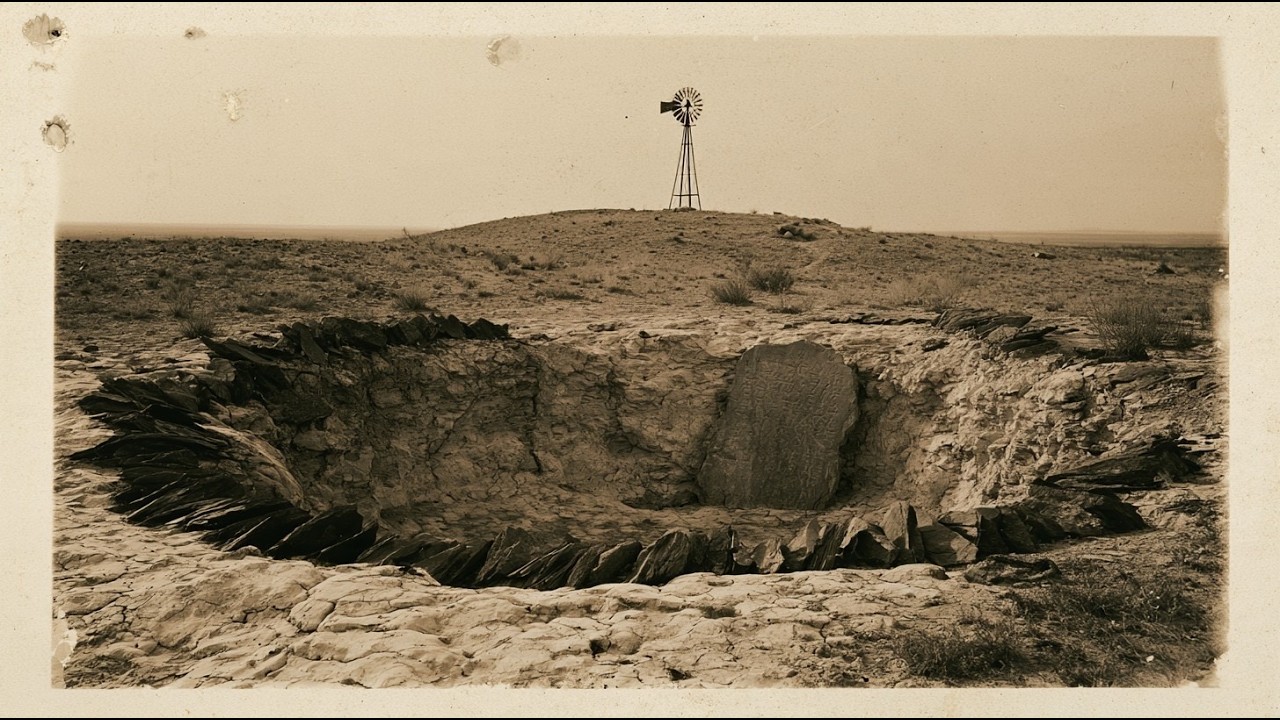
In the gray before sunup, Wllo took him out to the mill, the two of them walking north through the cold, dewless dawn, Puit hanging back and then not coming at all. The seep sat down in a little hollow of pale rock. The three men had dug it out wide and deep, down well past where any living man had ever seen water stand, and the drought had drawn the ground down and dried it back, so that things which had lain hidden a very long time were now sitting near the surface. Around the whole lip of the pit, laid out far too even to be any accident of nature or of water, was a ring of dark flat stones, placed carefully up on their edges and caned inward, leaning in toward the center like a mouthful of teeth, each one worn smooth in a way that running water does not do to stone.
Inside that ring, the men had turned up other things—small worked pieces of shell drilled and shaped by somebody once, a little heap of something that had been metal a long time ago and was now only a green stain lying in the exact shape of a band, a ring of some kind. And down at the very bottom, half in and half out of the wall of the pit where the men had stopped cold, a slab of grayer stone stood upright with marks cut deep into its face. They were not letters and were not any picture Orville could put a name to, but they were made on purpose by a patient hand a long time ago. He found that if he looked at them for more than a moment, the back of his neck went cold and tight, right there in a morning already climbing toward ninety degrees.
Wllo told him, standing well back from the edge, that the men had thrown down their shovels and quit the second they uncovered the ring. Not one of the three would go back down into that hole for any wage he offered. One of them, a steady older hand named Silas who had ridden for him nine years, had simply rolled his blanket that same night and walked off the place on foot in the dark rather than sleep one more night within sight of that rise, and had not been seen or heard from since. Wllo said he had not sent anyone to look for Silas, and that some part of him did not blame the man one bit.
Orville did his job. He climbed the tower to find out why the mill had run backward against its own vane, and he went over that machine bolt by bolt. He found nothing at all. Every bolt true, every bearing sound and greased, the vanes swinging free, the brake holding good.
There was no reason on God’s green earth for what Puit had told him. And standing up there at the top with the whole dead brown country laid out flat to every horizon, Orville had the cold thought that the machine was not the thing that was broken here. Whatever was wrong was wrong with the place, or with the ground, or with the world right there in that one spot. He was still up on the platform when the wind came out of the north, sudden and hard and cold—cold in a way a July wind in West Texas has no business being, cold enough that he saw his own breath.
It should have caught that big wheel and swung it around and set the pump chuffing water. It did not. The wheel stood dead still in a wind he had to lean his weight against to keep his footing. And then slowly, with a long, low groan of iron that he felt in his teeth, the whole wheel began to turn backward against the vane, against the wind, against every single thing that Orville Ashmore had built forty-three years of his life unknowing to be true.
He felt the tower shudder and sway, and he came down that forty-foot ladder faster and worse than he had ever come down anything, tearing the heel of his hand open on a bolt, and when his feet hit the ground he kept walking and did not stop shaking for the better part of an hour. That was only the first day. The nights were the worst, always. That low, patient breathing came every night now, plainly from the direction of the hole, and it got so that not one of the three men on that place would turn and look north after the sun went down.
The dogs left. On the second night they were simply not there, and they came slinking back at dawn with their bellies low and their tails clamped and their eyes rolling white. They would not eat, and they would not go north of the house for anything. On the third night they were gone again, and that time they did not come back at all.
Cattle that drifted up toward the seep in the dark, drawn by the water, came apart out there in the night. Wllo found them scattered in the mornings, found them wrong in ways that made no sense, and after the third such morning he stopped riding up that way to check on them at all and started keeping what stock he could close in around the house at night, packed and lowing and frightened. Deacon Puit was coming apart quietly, a piece at a time. He had gone silent and gray-faced and took to sitting up against the south wall of the house at night with an old rifle across his knees.
Not for any use a rifle would be, Orville thought, but only for the cold weight of it in his hands. Puit would not talk about the night the mill first ran backward, but once, low, near dawn, he said the one thing he ever said about it—that when he had gone up to the seep that first evening to see about the water, the pool had shown him back his own face, plain as a shaving mirror, except that in the water his face had been turned the wrong way, looking off over his own shoulder at something behind him, while he himself was looking straight down. He had not looked in the water since. There was the matter of the time, too.
Orville, who had lived his whole working life by the turning of the light and could tell the hour within ten minutes with his eyes shut, found that out there the days did not sit right. He would climb the tower with the sun just up and come down to find it near noon and his water jug bone dry and no memory of the hours between. He stopped trusting his watch, and then he stopped winding it, because the small sound of it ticking in the dead night had begun to seem like something answering the breathing under the floor. A smell settled over the whole north end of the place, like cold standing water and old green copper, and underneath those, a third thing Orville could never find the word for and did not want to—a thing that got into the back of your throat and stayed, and it did not blow off with the wind, no matter how the wind turned.
A smell that would not move with the wind was not a smell riding on the air. It was coming up out of the ground itself. And then there were the marks. The same marks cut into that buried slab, the ones that were not letters and not pictures, began quietly to appear in other places—in the drying mud around the shrinking pool, then in the fine dust on the hood of his truck overnight, then one gray morning on the inside sill of the bunk house window, drawn small and careful and deliberate in the dust where no living hand had been in the night, because Orville had lain awake most of it and heard the door neither open nor close.
Drawn patient, the way a man draws something when he has all the time in the world and wants only to be sure it will be seen. Orville should have left. He knew right well he should have, and he would tell you so later, an old man shaking his head at his younger self. But there was a thing in him, the same stubborn thing that makes a man climb a tower into a lightning storm on a bet with himself, that would not let him turn his back on a puzzle he had not solved.
And there was Call Wllo, who flatly would not leave his own land and his own beasts. And a man does not drive off and leave another man standing alone in a thing like that. On the fifth evening, a stranger drove up out of the dark in an old truck, unlooked for and unannounced. His name was Hastin Sosi.
He was Navajo—Diné—a silversmith and trader by his living, sixty-one years old, a small man very straight in the back, with a face like a piece of carved cedar and dark eyes that held a settled stillness, the stillness of a man who has spent his life listening more than he speaks. For thirty years he had made a long, slow yearly loop out through the ranch country, trading worked silver and turquoise and good wool blankets for whatever the lonely ranches had to give, and there was not a headquarters in five counties that did not know his word as good. He had heard, in the low sideways way that word travels between far-apart and lonely places, that there was bad trouble at the Wllo place, and something in the particular way the trouble was told to him had turned him clean off his own road and brought him a long way out of it, alone in the dark, to come and see the thing with his own eyes. He told Orville later that when the word first reached him, he had sat by his fire the whole of a night with it, because the description of the ring of leaning stones had put a cold hand on the back of his neck that he had not felt since he was a young man listening to the very old ones talk low around a winter fire.
Every careful thing his grandmother’s grandmother had put into him told him to turn his truck the other way and drive until the red mesas came up over the horizon at home. He had gone the other way in the end, toward it and not away, because if the warning was true—and he was afraid down in his bones that it was—then there were men out there who did not know the first thing about what they had opened, and he could not carry that and still call himself a man his grandmothers would own. Wllo brought him coffee, and Sosi sat and drank it slow and said very little, asking gently only three or four questions all evening, each one landing like a man setting his foot down with great care onto ice he is not sure will hold. He asked where exactly the trouble had begun.
He asked how long the men had been at their digging before it started. He asked what the ground had looked like precisely when they had opened it up. And when Wllo, staring into his cup, described that ring of dark flat stones set up on their edges and caned inward, all of them like teeth, Hastin Sosi went still. Still in a way that Orville Ashmore said he never forgot as long as he lived—still the way the whole country goes, still and yellow and breathless in the last minutes before real weather comes down on it.
He set his coffee cup down on the plank very slowly and did not pick it up again for the rest of that night. He asked to be taken out to it in the morning, only in the full daylight with the sun well up, and he made both of the white men give him their word on that. In the morning the three of them walked out to the hole together in the thin gray light before the sun had cleared the rim of the world, Sosi in the middle, walking slow, his lips moving now and again on words the others could not hear. When the old trader came up over the low rise and looked down into that pit at the ring of caned teeth and the marked slab standing in the wall and the small careful signs drawn all around the rim in the dust, he stopped as if he had walked into a wall in the air.
He stood there a long moment, not moving, barely breathing. Then he said a single word, very quietly, in his own language—a word Orville did not know and could not have spelled and never once forgot the sound of to the end of his days. And after he said it, he took one step back from the edge, and then another, and turned to the two of them and told them in a low, even voice, with no arguing in it anywhere, not to go one step nearer, and to take nothing more out of that ground, and to put back carefully everything that had already been taken out, and to fill the hole, and then to leave this place, all of them, and to let no living soul ever dig here again. Wllo could not leave it be, and asked the old trader straight what it was down there.
Hastin Sosi was quiet for a very long while, long enough that the sun finally broke clean over the eastern rim and threw the three of their shadows out long and thin across the dead ground. Then he answered in his careful, considered English that there were things his people did not speak of to those outside, and that this was one of them, and that he had already said its name once and would not say it a second time out loud in this place. But he told them this much, because he had judged that they needed it to keep their lives. He said his grandmother’s grandmother had carried a warning handed down and handed down across more years than anyone had bothered to count—older than these fences, older than the reservation, older even than the long grief his people carried.
The warning was of certain places far from home, scattered across the land, that were not ever to be camped on, not to be dug into, not to be watered at, and a man would know such a place, if he was unlucky enough to find one, by a ring of stone teeth set carefully into the ground. And the warning was very plain on one point above all others. The stones were not a grave. They were not a marker, and they were not a memory of anyone.
They were a lid. Whatever people it was so far back that they left no other name behind them had gone to the enormous trouble of setting that lid down and cutting those bindings into the stone because they understood something about that particular patch of ground that the rest of us coming after had simply been fortunate enough to forget. The marks cut into the slab were not writing meant to be read. They were a binding meant to hold a thing shut.
And every one of those marks that had been let go weak with time, or worn down, or worse, broken clean through by the edge of a steel shovel, was one more place where the lid no longer sat tight against what it was set to hold. Then Hastin Sosi said the thing Orville carried the rest of his life. Their digging had not woken the thing beneath Ojo Frio, he said; he wanted them to understand that clearly. It had never once been asleep.
All their digging had done, at the very end of it, was finally let it know that they were up there, and that the lid had a crack in it now, and that men careless and thirsty and small were within its reach. He would not say what it was. He held to that, and Orville thought the holding mattered to him more than almost anything. But he said a few things around the edges of it, the way you might describe the shape of a dark room by the sounds that come out of it.
It was older than people. It did not want anything the way a man wants a thing, or even the way a hungry animal wants a thing; it was past all of that, and this was the worst of it, because you can reason with a thing that wants, and you can run from a thing that hungers, but there is nothing at all you can do with a thing that has simply, patiently, always been there under the good ground waiting. The way a stone waits for the lid to fail. The stones had been set facing inward, leaning in, on purpose, because the binding worked one way only—to hold a thing down and in, never to keep a thing out—and the men in their digging had unknowingly begun to turn some of those stones, and a turned stone in that ring was worse than a broken one, because a turned stone did not merely let the thing know they were there.
It invited. Word of the ring and the marked, broken slab did travel in time, never in any newspaper, but the old way, low and slow and sideways, mouth to ear, from a trader to a night camp to an old woman at a loom to a quiet council of old men, until the full description came at last to the far western red land where the Diné live. And when it reached them, it went through the people like cold water poured down the spine, elder to elder, house to house, because they knew it. They had the exact shape of it already waiting in their own oldest and most carefully kept warnings—a place their people had been told of and told to fear and told above all never, ever to disturb, hundreds and hundreds of miles from where any living one of them had ever set his foot.
And out in the Texas dark, a tired rancher and two hired men had pried the lid up out of the ground with a hand shovel, meaning no harm by it at all, not knowing, never once knowing, what it was they were opening. Orville and Deacon Puit filled that hole. They worked the whole of one long, brutal day, hauling and shoveling and tamping the earth down, and they set the dark stones back as near as the two of them could manage to the way they remembered them lying. Hastin Sosi watched the whole time from a good distance off, never once coming within twenty feet of the rim, and told them low and flat that it would not be the same, that it could not be the same, that a lid once lifted never in this world settles back as true as it sat before.
On the last night, the night before Orville had made up his mind to drive out at first light and never come back, the breathing under the ground came close. It came right up at last, under the floor of the bunk house itself, a great slow, patient weight of a sound with the whole cold mass of the earth behind it, in and out, in and out, so near now that Orville felt the boards under his cot move with it. The marks bloomed out across the inside walls of that room in the dark all at once, far faster than any hand alive could have drawn them, pale and certain in the last of the moonlight. The coal-oil lamp guttered down to a bead and would not hold a flame no matter what Puit did to it.
And Call Wllo, who had not left his own land in the face of drought or grief or ruin in fifty-eight hard years, sat straight up in the dark on his cot and said to no one, in a low, strange voice Orville did not recognize as his, that it was calling him by a name he had not been called by since he was a young man, a name that only the dead knew. And he stood up in the black room and walked to the door and out through it into the dark, going north toward the seep, walking steady and unhurried. They found his boots the next morning at the very lip of the filled-in hole, sat down neat and side by side, toes pointed inward toward the center of the ring. The way a man sets his boots at the foot of the bed before he lies down to sleep.
They did not find one single thing more of him—not that morning and not ever. Orville stood over those boots a long time in the early light, and the thing he remembered most was not fear but a terrible quiet. The whole country gone soundless and waiting. And the smell that would not blow off, for the first time in six days, beginning to fade, thinning out on the morning air, going the way a thing goes when it has finished, and is full, and does not need to hunt anymore for a while.
He understood, standing there, that the price had been paid, and that the paying of it had bought the rest of them the chance to leave, and that Call Wllo, in walking out that door, had put himself between the thing and the two younger men. Orville carried that debt every remaining day of his life, and it was heavy, and he never once tried to set it down. The county sent a man out in time. A landholding rancher does not simply walk off into the night and vanish without the law coming out to write something down about it.
The deputy who came was a decent enough young fellow. He took his statements careful, walked the whole north end of that place with his hand resting near his pistol and his face going grayer and stiffer by the hour, and stood a long, long time over those two empty boots at the edge of the hole without saying anything at all. In the end, the report he filed said that Call Wllo had, in his own words, wandered off in the night in a state of confusion brought on by the heat and exhaustion and the long strain of the drought upon an aging man, and was presumed lost somewhere out in the open country. The case was thereby closed.
Missing. That was the word they used on the paper. It is a very tidy word. Hastin Sosi did not stay for the deputy or the questions or the paper.
He had gone before dawn on that last night, quietly, the same way he had come. But before he went, he found Orville alone out by the truck in the dark and gave him one thing and told him one thing. The thing he gave him was a small flat piece of worked silver, cool and heavy in the palm, with a mark beaten carefully into its face—a mark Orville half recognized and did not want to look at too long. The thing he told him was to keep that silver on his own person every day for the rest of his natural life, and never, not once, not for any wage, not for any friend in trouble, and above all not for his own black curiosity—which the old trader seemed to see straight into and understand was the very thing most likely to kill a man built like Orville Ashmore—to go back to that stretch of country again as long as he lived.
Then the old man got into his truck and drove off west into the last of the dark, back toward the high red land. Orville never saw him again, and never once from that day to the end of his long life went back out past the last gate toward Ojo Frio. The Wllo lease was let go. Nobody took it up.
There was talk, the way there is always talk, but no man’s need for grass ever quite got greater than whatever it was he had heard. The country simply took the place back, a board and a season at a time. The cattle were gathered and driven off and sold, the pens rotted and fell, the barn leaned a little further each year and then one winter did not stand back up, the low house went gray and then went to pieces, and inside of a handful of years there was not much left out there to say that any man had ever tried to make a living on that ground at all. But the windmill stood.
For a long time the windmill stood tall and black and alone against the enormous sky on its low rise, long after everything a man’s hands had made around it had gone back down into the dirt. And the very few men who ever after had cause to pass within sight of that rise—and there were fewer and fewer of those as the years went and the road faded—every last one of them came back saying the same one thing. That the great wheel of that dead mill would sometimes, in a dead flat calm with not one breath of air moving anywhere across that whole country, begin slowly to turn, and that it always turned the same way. Backward against the vane.
A cattle buyer who crossed that stretch once years on told it a little different and worse. He said he had stopped his truck on the old track to fix a flat in the middle of a still hot afternoon and had heard the mill before he saw it—that dry iron groan of the wheel coming around—and had looked up expecting a breeze on his face and felt none, the air dead as a closed room, and the wheel turning anyway, slow and patient backward. And while he stood there with the lug wrench forgotten in his hand, he had gotten the sudden and total certainty that if he walked up that rise to look down where the old seep had been, he would not come back down it. He put that tire on half inflated and drove off, and never once in his life took that road again.
The county, for its part, quietly took that road off of its maps. If you go hunting today through the old records of that part of Texas for a place called Ojo Frio, you will not find it written down anywhere. Orville came to believe that was done on purpose, too, the very same as those first old maps that got the country wrong—done by careful men who came along after and understood just enough not to want to be the ones who put the name back on the paper and drew some other poor thirsty soul out there to find it. Orville Ashmore lived to be an old, old man.
He kept climbing his towers well up into his sixties, and his hand stayed good and sure to the end. He told this account only a very few times in all those years, only late in the evening, only to people he had come to trust all the way down. And every man who heard him tell it more than once will tell you he told it the exact same way every single time, in the same words, in the same order. He kept that little piece of silver in his shirt pocket every day of his life, over his heart, and he touched it, people noticed, without seeming to know he was doing it, whenever a north wind came up.
When he died at last, a very old man in his own bed, that silver was buried with him, at his own particular asking. The people who loved him did not understand why, and did not ask, and simply did as he had asked. Late in his life, an old man by the fire, Orville was asked gently by someone who loved him well whether he truly believed there had been some real thing down under that ground all those years ago, or whether it had only been the fear and the terrible heat and the long strain of a killing year working together on the minds of three frightened and exhausted men out alone at the end of the world. Orville did not argue the point.
He only looked into the fire a while, and said he did not need to believe it. Belief, he said, was a thing you kept in reserve for matters you were not sure of. And then he said the one thing that has not been set down again since the first time it was read in the record—that on the quiet nights, even then, an old man safe in his own bed, hundreds of miles and forty long years away from that dry Texas rise, he could still, if he let himself go quiet enough, and still enough, and stopped his own breathing for a moment to listen, hear it down there. Breathing.
The hole is filled in, or it was. The stones are set back, or near enough. The lid is on, or it is not.
And the whole of the account sits in the narrow, dark space between those two—a difference that no living person can ever now go out and check, because there is no road out there anymore, and the maps are blank where the name should be, and the only people who ever truly understood what waits in that ground are far away in the red land, and they will not say its name, and they would tell you only gently to leave it be.
