For generations of British children in the 1960s and 70s, no object defined adolescence quite like a Raleigh bicycle. Whether it was a chopper with its distinctive high back seat, parked in a hallway, or a modest roadster that carried its owner to work for two decades, the gleaming machine was a fixture of daily life. In Nottingham, residents likely knew someone who built it. The bicycle that once cost parents £40 now sells for thousands at specialist auctions, a collectible piece of cultural memory.
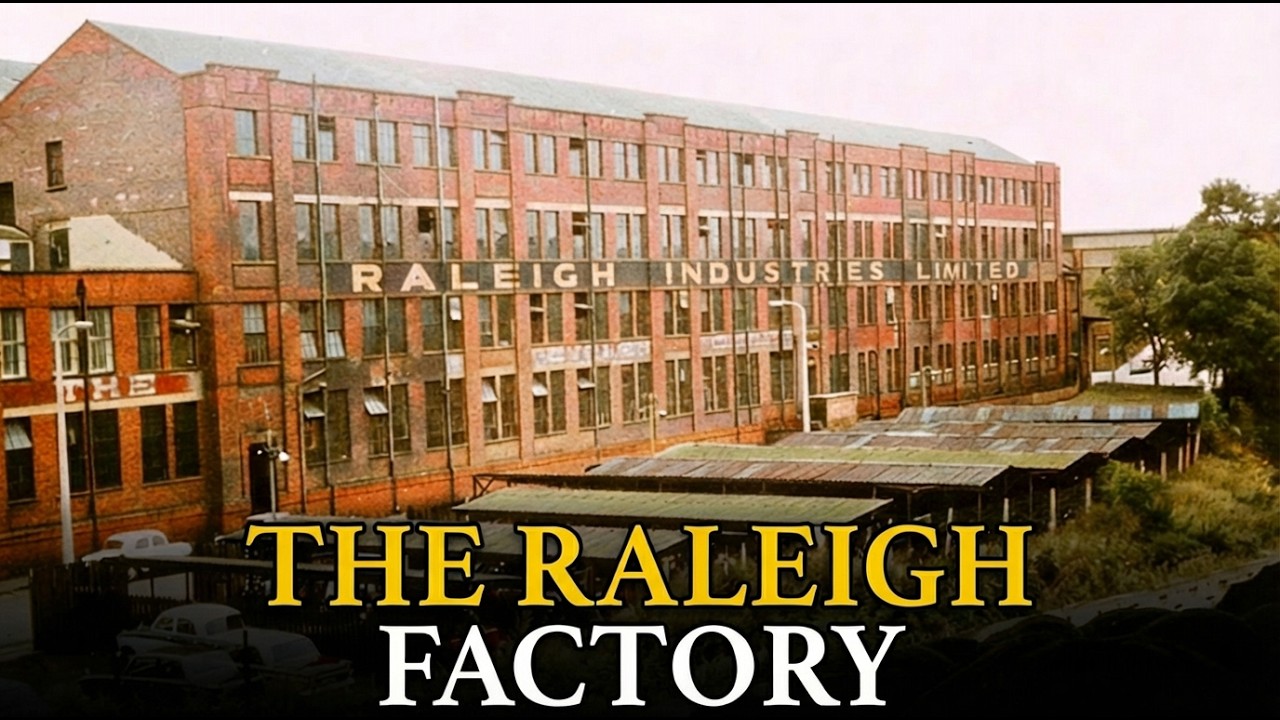
But the vast industrial complex where it was made—a site that employed entire neighborhoods and defined a city for more than a century—has largely vanished. Stand on Triumph Road in Nottingham today, and you face a landscape that requires explanation. Sixty acres of landscaped university campus, modern glass buildings, and students moving between lectures greet the visitor. The street names give a clue to what came before: Triumph Road itself, Rally Street just to the south.
One building remains from the original complex: the art deco headquarters on Lenton Boulevard, constructed in 1931. Three stories of Portland stone and geometric detailing have been preserved and converted into university space. The building was designed as a center of command, projecting confidence and permanence. It stands alone now, surrounded by an entirely different world than the one it was built to oversee.
The factory itself, the acres of production halls and assembly lines that once spread out behind it, was demolished in the early 2000s, replaced by the University of Nottingham’s Jubilee campus. The story began modestly in 1885, in a small workshop on Rally Street operated by three men: Woodhead, Angua, and Ellis. They were producing what was then called the safety bicycle—two wheels of equal size, a chain drive, and a diamond frame—a far more practical design than the earlier penny-farthing. The operation was small, with twelve employees completing perhaps three bicycles each week.
It was a trade, not an industry. What changed was the arrival of Frank Bowden, a lawyer who had made money in Hong Kong but whose health had deteriorated in that climate. His physician suggested cycling as treatment. Bowden purchased one of the Nottingham bicycles, rode regularly, and his health improved.
Recognizing an opportunity, he bought the workshop in December 1888 for £2,000. With capital, ambition, and an understanding that the bicycle was moving from novelty to necessity, Bowden transformed the operation. By 1896, the company had moved to a purpose-built factory on Russell Street. By 1913, Raleigh was the largest bicycle manufacturer on Earth.
The growth was built on technical innovation and market positioning. In 1902, Raleigh acquired Sturmey Archer, the producer of the three-speed hub gear, a mechanical system that allowed riders to change gears without dismounting. For British cyclists facing hills across the North and Midlands, this was transformative. Raleigh established a clear brand identity—the heron badge mounted on every frame, the “all steel” slogan emphasizing durability in an era of poor roads and variable materials.
The early 20th century brought expansion and diversification into motorcycles and three-wheeled vehicles. During both World Wars, Raleigh shifted to military production—munitions, components, fuses—and the facility operated at wartime capacity for years. After 1945, the site on Triumph Road covered roughly sixty acres. Multiple production halls each specialized in a different stage of manufacture: the press shop, where steel tubes were formed; the brazing shop, where frames were joined; the machine shop, where components were finished; and the paint shop, known as the black shop, where workers stood over large vats of boiling enamel with poor ventilation.
It was physically demanding, occasionally dangerous labor. The company provided more than wages: sports facilities, a company band, social clubs, fishing ponds, and a ballroom for employee dances. You were not simply employed by Raleigh; you were part of Raleigh. The architecture reflected the hierarchy—basic facilities on the shop floor, better conditions in administrative offices, and refined wood paneling and heating in the executive headquarters.
Raleigh also became one of Nottingham’s largest employers of Caribbean workers arriving in Britain during the 1950s and 60s as part of the Windrush generation. There was initial resistance within the company and the city, partly challenged by community organizers. By the late 1960s, the workforce was notably diverse, particularly in the brazing and assembly departments. The factory floor was a place where people of different backgrounds worked alongside one another in ways much of British society did not facilitate.
In 1960, Raleigh merged with Tube Investments, a large conglomerate. The new TI Raleigh entity controlled approximately 75 percent of the UK bicycle market. But the merger changed the company’s culture. Engineers who understood bicycle geometry and metallurgy were gradually replaced by financial managers.
Priorities shifted from the product itself to the product as a unit of volume. The brass heron badge, a three-dimensional metal emblem riveted to every frame, was replaced in the 1960s with a stamped metal badge and eventually a decal—a minimal cost saving that signaled to customers that the company was cutting corners. The specialized Carlton workshop in Worksop, which produced high-end hand-brazed racing frames used by competitive cyclists, was deemed inefficient. Production moved to standard assembly lines in Nottingham, and the resulting bicycles were heavier and noticeably inferior.
The reputation was damaged. Sturmey Archer suffered similarly, starved of investment while Japanese manufacturers like Shimano invested heavily in research and development. By the 1980s, Raleigh’s own product managers were sourcing components from overseas because their own subsidiary could not provide what was needed. The 1970s and 80s brought structural changes to the global bicycle market.
Manufacturing shifted to Taiwan and East Asia, where labor costs were lower and facilities newer. British manufacturers operating out of Victorian-era buildings with outdated layouts and high overhead costs struggled to compete. Imports were often lighter and better finished. The traditional British roadster was falling out of favor, and the mountain bike, emerging from California, became hugely popular in the 1980s.
Raleigh was slow to respond. When they released mountain bike designs, they were heavy and poorly specified. The Activator, released in the early 1990s as an affordable full-suspension model, became emblematic of the problem: its suspension system was crude, the bike heavy, dismissed by serious cyclists. Market share fell from above 50 percent in the early 1970s to below 20 percent by the late 1980s.
In 1999, liquidation of equipment began. Multi-torch welding machines installed only three years earlier were auctioned off, as was laser cutting equipment less than a decade old, much of it purchased by overseas competitors. In 2000, the American parent company sold Sturmey Archer for £30—not £30,000, but thirty pounds—an accounting maneuver to offload liabilities. The purchaser collapsed almost immediately.
Three hundred workers lost their jobs. A final attempt to preserve manufacturing in Nottingham, moving assembly operations to a smaller site in Bulwell and saving about 280 jobs, required relocating allotment gardens. Most holders agreed to move; three did not. The American owners, looking at the delay and cost, decided it was not worth pursuing, and the remaining jobs were outsourced to Southeast Asia.
On November 28, 2002, at three in the afternoon, the assembly line at Triumph Road stopped for the last time. The final product was a 20-inch wheel for a children’s bicycle, assembled by a worker named Barry Wheat. He finished the wheel, passed it down the line, and that was the end. The last 280 people left the building that evening.
The site, which had employed thousands, was empty. The factory buildings were demolished in the early 2000s, and the land was sold to the University of Nottingham. The Jubilee campus, with its modern architecture and sustainable design, won awards. But for those who had worked there, the transformation was disorienting.
The headquarters building was preserved, its art deco details intact, but it was designed to oversee a factory; now it overlooks a campus. No single cause explains Raleigh’s decline. There were multiple, documented factors: the shift from engineering leadership to financial management, cost-cutting decisions that signaled declining quality, the failure to invest in research and development, the late and inadequate response to market trends, and the structural disadvantage of an oversized, outdated facility. Broader pressures affected all of British manufacturing—global supply chains were reorganizing, and advantages like early industrialization and skilled labor had become liabilities.
None of this was inevitable, but the pattern was clear. By the 1990s, Raleigh was contracting. Raleigh still exists as a brand, owned by a Dutch conglomerate, with bicycles manufactured in Asia. The vintage market is significant: original choppers, Grifters, and Burners sell for substantial sums.
But these objects have appreciated in value precisely because they are no longer being made. They are artifacts of a lost capability. Walking through the Jubilee campus today, there is little evidence of what came before—a few informational plaques, some photographs in the preserved headquarters. The demolition was thorough, the foundation removed, the site cleared and graded.
What remains is primarily memory, and as time passes, that too fades. The factory was not just a place of production; it held knowledge of metallurgy, brazing, wheelbuilding, and frame geometry that existed in practice, in the accumulated experience of thousands of workers. When the factory closed, much of that collective expertise dispersed. The university campus serves its purpose, and perhaps the change was necessary adaptation to economic reality.
But standing on Triumph Road now, looking at the quiet campus where one of the largest manufacturing sites in British history once stood, the question remains what was lost in that trade—not just in jobs, but in the knowledge of how to make things, the culture formed around making them, and the connection between place and production.
