For close to a century, the Scotch whisky that the world drank—Johnny Walker, Gordon’s Gin, Dewar’s, White Horse, Haig—all of it flowed through a single company whose name appeared on no bottle at all. The Distillers Company Limited, known simply as Distillers, controlled at its height close to half of all the whisky made on Earth, ran more than fifty distilleries, and bottled the world’s best-selling Scotch in the Ayrshire town of Kilmarnock for 190 years. It survived Victorian fraud that ruined its rivals, two world wars, the Depression, and the slow turn of fashion away from Scotch. Then, after 109 years, it was gone—captured in a single year, through a lie told in a London boardroom, financed by fraud and dressed up as a rescue.
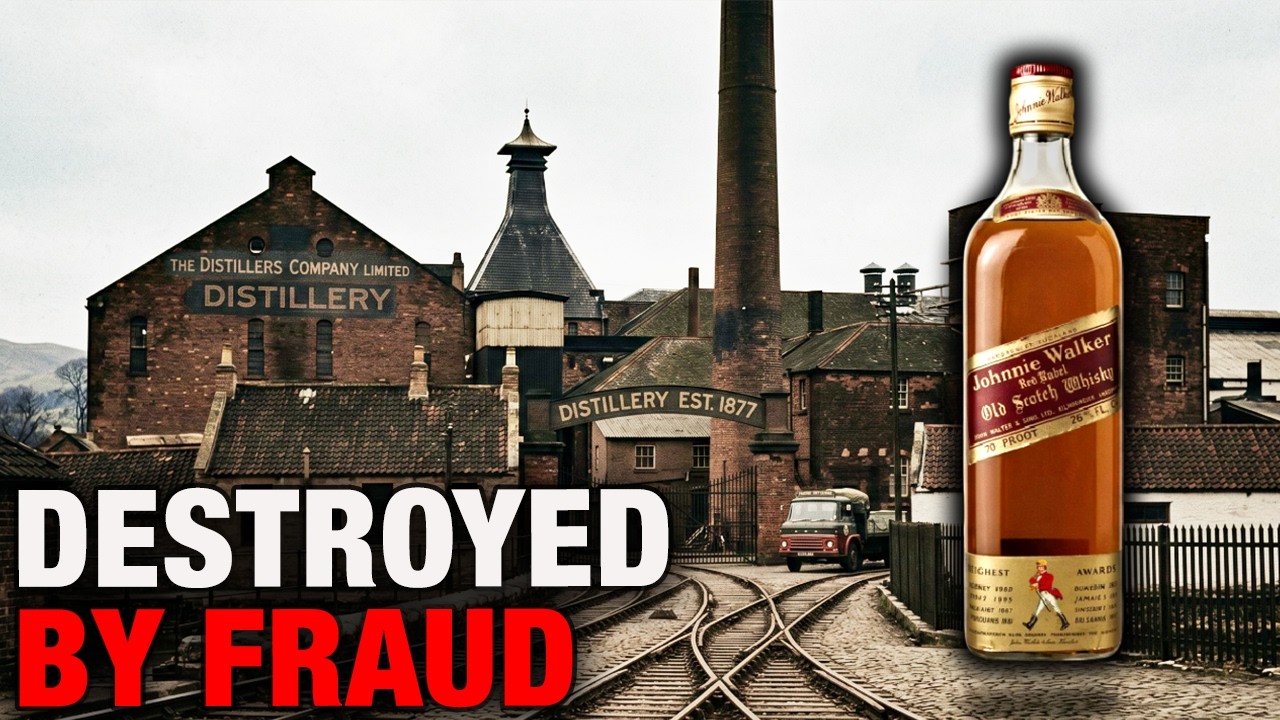
Four of the most celebrated businessmen in Britain ended up in prison. The company was born in 1877, when six Lowland grain distillers, exhausted by cutting one another’s prices to nothing, merged into a single firm. The merger cracked the problem: by carving up production in fixed shares and setting the price of grain spirit by agreement, the new company stopped the bloodletting. Within three years it controlled close to 90 percent of all the grain spirit made in Scotland.
The great blending houses—Buchanan, Walker, Dewar—could not make their famous whiskies without the bulk spirit Distillers supplied, and the company sat at the centre of the trade like a spider in a web. Its first managers were the founding families themselves, suspicious of one another, uneasy around the boardroom table. The man who truly built the empire was William Henry Ross, an accountant from outside the distilling dynasties, who became managing director in 1900 and chairman in 1925. He took an armed truce and turned it, patiently, into an industrial behemoth.
His first great opportunity came from a scandal. In 1898, the Pattison brothers of Leith, who had built a whisky empire on borrowed money and barefaced lies—inflating profits, overvaluing stock, even buying 500 African grey parrots trained to squawk “Buy Pattison’s whiskey”—collapsed spectacularly. Creditors claimed £743,000, half a million pounds in assets had simply vanished, and the brothers were convicted of fraud. Distillers weathered the loss and then went shopping, buying up the warehouses and distilleries of the ruined and frightened at knockdown prices.
Ross was not finished. In 1919 the company bought John Haig outright, and in 1925 came the merger remembered as the big amalgamation: Distillers absorbed the great blending houses themselves—John Walker and Sons, John Dewar and Sons, Buchanan-Dewar—with their proprietors taking seats on the board. White Horse followed in 1929, then the gin houses, including Tanqueray Gordon. The striding man and his rivals gathered at last under one roof.
The world wars revealed another face of the leviathan. In the First World War, Distillers supplied the industrial alcohol, acetone, and solvents that went into explosives. In the Second, it produced barely a year’s normal output of whisky, living off its maturing stocks while its plants turned almost wholly to chemistry. From 1942, a subsidiary ran a Ministry of Supply factory at Speke that became one of the first two penicillin factories in Europe.
The same subsidiary later marketed the sedative thalidomide, sold as Distaval from 1958, with consequences that need no rehearsing here. By mid-century, Distillers was one of the largest manufacturing companies in Britain. At its heart was Kilmarnock. John Walker had opened a grocer’s shop there in 1820, and by the 1960s the town’s Hill Street plant was the largest whisky bottling operation on Earth, its lines clattering without pause.
Around it stood the great grain distilleries—Cameron Bridge, Carsebridge, the Caledonian and, crowning them all, Port Dundas in Glasgow, which for thirty years wore the tallest chimney in the world, 454 feet of brick visible for miles. Beneath them all slept the true wealth: vast dunnage warehouses of maturing spirit, the angel’s share evaporating gently through the oak. In Kilmarnock and Leven and the distilling villages of the glens, the works were not where the town worked; they were why the town existed. Fathers brought sons through the gates, and Friday’s wage packet sat between a life and a hardship.
At its peak, Distillers held five of Scotland’s fourteen grain distilleries, forty-five of its malt distilleries, more than sixty blended brands, and the great gin houses. Johnny Walker Red Label was the single most popular Scotch on the planet, accounting for 15 percent of the entire world market—one bottle in seven. Scotch was Britain’s great ambassador, earning dollars by the shipload. Distillers controlled around three-quarters of the entire UK market for Scotch.
And there the trouble began. The giant grew so dominant, so used to controlling the trade by agreement rather than competition, that it forgot how to fight. By 1984 its share of the British home market had fallen to 16 percent. The young had turned to vodka and white rum; Scotch had become the drink of the past.
While Distillers dozed, one rival, Bell’s, was outselling every Distillers brand in Britain put together. The management made it worse. In 1978, enraged by an EEC ruling that forbade charging British wholesalers more than exporters, the chairman withdrew Johnny Walker Red Label from the British market entirely for six months, handing the ground to rivals who never gave it back. Then came the whisky loch: through the optimism of the 1970s, far more spirit had been laid down than the falling market could drink.
In February 1983, Distillers announced the closure of eleven malt distilleries and a grain plant, cutting 530 Scottish jobs. Between 1983 and 1985 it shut twenty-one distilleries, silencing among them Port Ellen and Brora on Islay and in Sutherland. The company was so cash-strapped it began selling its long-held stake in British Petroleum merely to keep the lights bright. A giant sitting on undervalued assets—lakes of sleeping whisky, world-famous names, property—run by management that had lost its grip, with a share price far below what the parts were worth, is not the pride of Scotland.
It is a target. In December 1985, a Scot named James Gulliver, a grocer’s son from Campbeltown who had built a supermarket empire, launched a hostile bid for Distillers worth £1. 9 billion, the largest takeover bid in British history to that date. The board’s contempt was open, captured in a line that outlived everyone involved: “Mr.
Gulliver dealt in potatoes and tins of beans. We are not selling brown water in bottles. We are selling Scotch. ” Terrified of the grocer, the directors sought a white knight and found one in Guinness, whose chief executive, Ernest Saunders, had just won a bruising hostile takeover of Bell’s itself.
Saunders, born in Vienna in 1935 as Ernest Walter Schlayer, had fled the Nazis as a child, been educated at Cambridge, and built a glittering marketing career before turning Guinness around so completely that the City regarded him as near genius. His finance director was a French Bain consultant named Olivier Roux, who remained on Bain’s payroll throughout—an arrangement that should have troubled someone. Neither bidder had the cash to buy Distillers outright, so both bid largely in their own shares. Guinness’s offer was worth more than Argyll’s only if its own share price climbed high enough.
For most of the battle Gulliver led. Then, in the closing weeks, the Guinness share price rose meteorically, inexplicably, beautifully, and on 18 April 1986 the brewer clinched the prize with an unconditional offer of around £2. 6 billion. The board had been promised that Sir Thomas Risk, governor of the Bank of Scotland, would chair the merged company—a Scottish hand on a Scottish institution.
The moment the battle was won, Saunders dropped him. The share price had been climbing on a lie. Saunders and a small circle had organized a scheme the investigators would call the fan club: rich, discreet men recruited to buy Guinness shares on a massive scale, secretly guaranteed against loss and promised fat fees paid quietly out of the company’s own money—disguised as invoices for advisory services that were largely fictional. This was unlawful: a company may not secretly finance the purchase of its own shares.
The scheme coordinated the purchase of roughly 78 million Guinness shares, about a quarter of the company, for something near £258 million, driving the price to around 278 pence. The buyers included Gerald Ronson, the property tycoon; Sir Jack Lyons, the financier; the American lawyer Thomas Ward; Ivan Boesky, the Wall Street arbitrageur, into whose fund Guinness poured $100 million after the victory; and Bank Leu of Switzerland, chaired by a Guinness director, Arthur Fürer. One buyer took nothing: Lord Rothschild’s firm purchased nearly £29 million worth of shares, asked for no fee, no indemnity, no promise, and was found to have done nothing wrong at all. Then, 4,000 miles away, Boesky pleaded guilty to securities violations and began to talk.
The thread crossed the Atlantic, and on 1 December 1986 the Department of Trade and Industry announced it was investigating Guinness. Inside the company, Olivier Roux understood at once that he was standing on a fault line. In the first days of January 1987 he resigned, then wrote a letter to the company’s solicitors setting out the payments, the arrangements, the names, and took it to the inspectors. The letter implicated Saunders directly.
Saunders read it on 5 January and scrawled across the top two words: “Pure poison. ” Within days he had stepped aside, and on 15 January the board severed every connection with him, removing Ward and Fürer alongside. The genius the City had worshipped was gone in a week. The trial opened in February 1990 at Southwark Crown Court, with four men in the dock: the Guinness four.
The jury did not return until the 112th day. Ernest Saunders was convicted of false accounting, theft, and conspiracy, and sentenced to five years. Gerald Ronson received a year and a £5 million fine. Anthony Parnes, the stockbroker known as The Animal who had recruited the supporters, was sentenced to thirty months.
Sir Jack Lyons, spared prison on health grounds, was fined £4 million and stripped of his knighthood. Then came the detail that turned the affair into a legend. At his appeal, Saunders’ lawyers presented medical evidence that he was suffering from pre-senile dementia, an incurable, irreversible disease of the Alzheimer’s kind. On compassionate grounds he was released after serving about ten months.
He then recovered. The phrase “Saunders syndrome” entered the language as a byword for a miracle nobody quite believed. The official report, published in November 1997 after eleven years of inquiry, was unsparing: without the scheme, it found, Gulliver’s Argyll would most likely have won, and Saunders had shown a cynical disregard for the law, a contempt for truth and common honesty. The report noted, almost in passing, the £3 million that had found its way into his personal Swiss bank account.
The brands suffered nothing at all. In June 1987, Guinness folded Distillers together with Bell’s into United Distillers, which did in short order everything Distillers had failed to do for thirty years: it drove the price and prestige of Scotch upward, launched the Classic Malts range, seized control of its distribution, and saw group profits leap from £408 million in 1987 to £956 million by 1991. United Distillers became part of Diageo in 1997, and Diageo today makes roughly two in every five bottles of Scotch on Earth. Johnny Walker is bigger than ever.
The places that made it were not so lucky. The whisky loch’s ghosts, Port Ellen and Brora, slept for forty years until Diageo spent £35 million bringing them back from the dead in the 2020s. Port Dundas, the great Glasgow distillery that had worn the tallest chimney in the world, was closed in 2010, in its 200th year, and demolished in 2011. And in July 2009, Diageo announced the closure of the Hill Street bottling plant in Kilmarnock—the largest whisky bottling plant the world had ever seen, the beating heart of Johnny Walker in the town where John Walker had opened his shop 189 years before.
The town did not go quietly. The First Minister, Alex Salmond, joined a protest march of some 20,000 people through the streets. They lost anyway. The plant shut in March 2012 and was demolished the following year, taking around 700 jobs with it, and breaking the oldest unbroken bond in the whole story.
The bottling moved away. On the 23 acres where the lines once clattered, where the biscuity smell of grain spirit hung over the town for generations, there is now a college campus. Young people learn trades on the soil where their grandparents bottled the most famous Scotch in the world. In 2021, Diageo opened a gleaming visitor experience on Princes Street in Edinburgh, where tourists can learn the story of the striding man and raise a glass.
The heritage, beautifully preserved. The making, gone. Distillers was not killed by a better company or a finer whiskey. It was killed by a lie—an illegal scheme cooked up in a London boardroom, financed by fraud, dressed in the language of rescue.
The men who did it were caught, tried, and jailed, a justice that the closing of a colliery or a steel works almost never delivered. But the prize they stole never came home. The whiskey still pours, the brands are worth more than their builders ever imagined, and somewhere tonight, in a bar on the far side of the world, someone will ask for a Johnny Walker without ever knowing there was a company called Distillers, or a town called Kilmarnock, or a march of 20,000 people who could not save the works that gave the world its drink. The striding man walks on.
He always did walk alone in the end. We just never noticed until the town behind him fell silent.
