In April 1945, a German sniper walked out of a Bavarian forest alone. He raised his hands. He had spent eleven days in those woods after his unit collapsed around him—eleven days moving alone, trying to survive, refusing to surrender. Now he stood at an American checkpoint, thin, uniform torn, sleep-deprived for nearly two weeks.
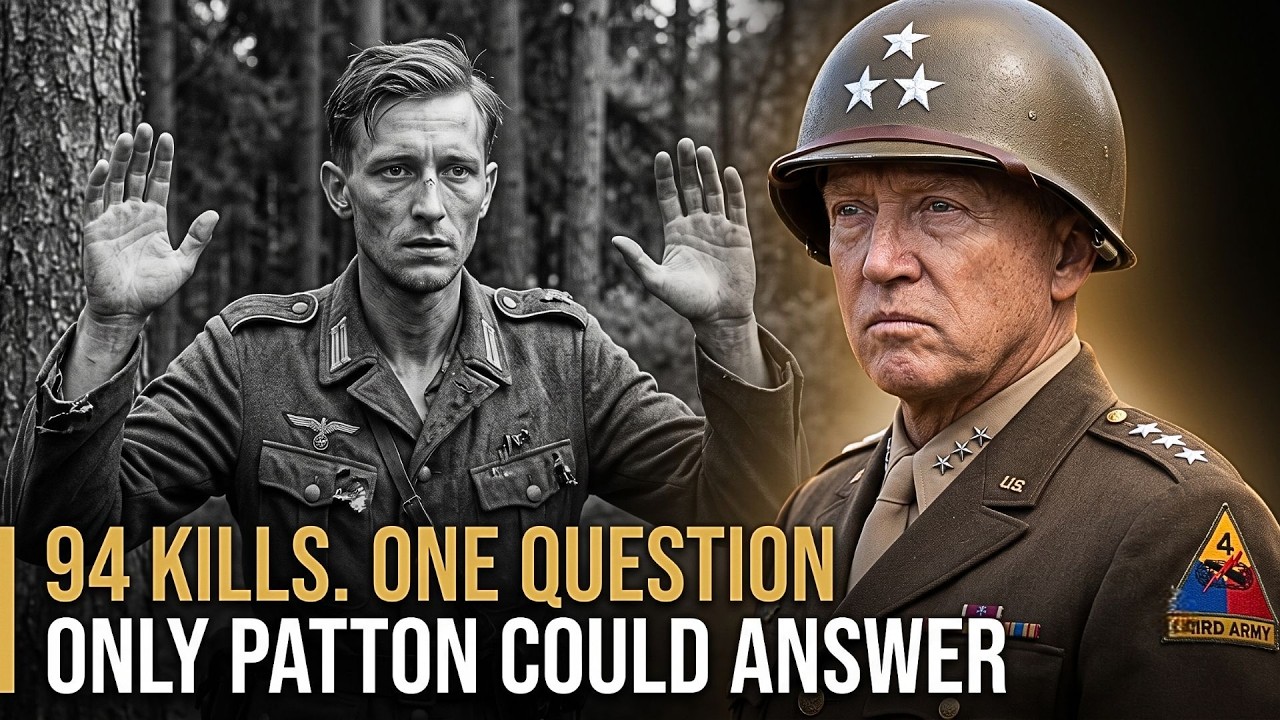
In broken English, he said one sentence: “I want to speak to Patton. ”
The soldiers looked at each other. They processed him. They checked his papers.
What came back stunned everyone in the room: ninety-four confirmed kills. He was twenty-six years old—one of the most efficient snipers the German army had produced in the entire war, and he wanted to talk to Patton. The report reached Patton’s headquarters the next morning. He read it.
He read it twice. He set it aside. Then he said something that surprised everyone in the room: “Bring him to me. ”
Not to an interrogation officer.
Not to intelligence. To Patton personally. They sat across from each other in a small room. The German sniper asked his question, and Patton’s answer silenced everyone who heard it.
—
It was April 16, 1945—three weeks before Germany surrendered. The German army in Bavaria was collapsing the way armies collapse at the end of losing wars. Not all at once, not in one clear final moment, but unit by unit, position by position, man by man, as the structure that held everything together fell apart. Some units surrendered in formation.
Some dissolved overnight. Some men kept fighting because they did not know what else to do. Some men went into the forest and waited. Ernst Vogel was twenty-six years old, from a small town in Saxony.
He had served in the Wehrmacht since 1941 and was classified as a skilled marksman within his first month of training. For three and a half years he held a role that suited his particular combination of patience, calm, and precision. Ninety-four confirmed sniper kills over three years and seven months of service. The number carried no special pride for him, and no special shame.
He had stopped attaching emotion to it somewhere in his second year. It simply became a record of what he had done—the way a carpenter knows how many tables he has built. A plain fact, hard to argue with. When his unit broke apart outside Munich on April 5, Vogel did not surrender with the men who surrendered.
He did not flee with the men who fled. He went into the Bavarian forest with his rifle and his pack, moving slowly and carefully for eleven days, with no destination, just moving, staying out of sight, staying alive, thinking. On the morning of the eleventh day, he made a decision that had been forming in his mind the whole time he walked. It came to him not suddenly, but with the quiet certainty of something that had been there all along.
He stepped out of the forest and raised his hands. The checkpoint was under the command of Sergeant William Cole, twenty-four years old, from Ohio. Cole had been in the army long enough to handle German surrenders without any special drama. He noted the rifle.
He noted the man’s condition—thin, exhausted, showing two weeks of living in the woods. He ran the standard intake procedures. He sent the paperwork to intelligence. Twenty minutes later, the reply came back.
Cole read it. He set it down and stared at the wall for a moment. He read it again. Then he walked back to where Vogel sat on a bench at the edge of the checkpoint and looked at him for a long time.
“You want to talk to Patton? ” Cole said. “Yes,” Vogel said. “Why?
”
Vogel thought about how to say it in English. “I have a question,” he said. “He is the only one who can answer it. ”
Cole recorded the matter exactly as it happened—the request, the reason, the service record—and sent it up the chain of command without comment, because he did not know what the appropriate comment would be.
—
The report reached Patton’s headquarters the next morning. It contained Vogel’s service record, his confirmed kill count, and Cole’s verbatim note about the request. Colonel Thomas Reed brought it in with the morning stack of papers. He had already read it and placed it on top.
Patton read the service record first. Then he read Cole’s note. He was silent for a moment. Major Howard Davis, the intelligence officer on duty, had already filed a formal request to detain Vogel for standard interrogation procedures.
He attached a note: “Important source with operational knowledge of remaining German defensive positions in the Munich sector. Request immediate transfer. ”
Patton looked at Reed. “Tell Davis he will get his turn,” he said.
“Bring Vogel to me first. ”
Reed looked at him. “Sir, intelligence protocol—”
“One hour,” Patton said. “Davis gets him for a week afterwards.
I want one hour. ”
Vogel arrived at Patton’s headquarters that evening. They fed him, and he slept briefly, and he was now cleaner than he had been in eleven days. He was escorted to a small room—a converted office, a table and two chairs.
Patton was already there when he entered. There were no other officers. Reed stood against the wall. An interpreter was present in case the English faltered.
Vogel looked at Patton. Patton looked at him. “Sit down,” Patton said. Vogel sat.
Patton studied the man across the table. Twenty-six years old. Ninety-four confirmed kills over three and a half years. The most solitary, deliberate form of killing the war had produced.
A man who had chosen each target individually, waited for each shot individually, lived with each result individually. A specific kind of record, and a specific kind of weight. “You had a question,” Patton said. Vogel was silent for a moment.
He had been preparing this question for eleven days in the forest. He had repeated it to himself in German dozens of times, then translated it, tested the translation, refined it. He wanted to say it correctly, because he would only have one chance. “I have read about you,” Vogel said.
He spoke carefully, each word weighed. His English was slightly formal, the way a person speaks who learned it from books and reports. “What the German command said about you. You fought in two wars.
You led many men. You made decisions that sent men to places where they would die. ”
He looked directly at Patton across the table. “I want to ask you something,” he said.
“And I want an honest answer. Not a general’s answer. An honest answer. ”
Patton said nothing.
He was listening. “Were we the same kind of men? ” Vogel said. “You and I?
Is there a difference between what you did and what I did? Or did we just have different ranks? ”
The room went very quiet. Reed stopped moving.
The interpreter sat perfectly still. Patton looked at Vogel for a long time. Then he said it. “I will tell you something I have never told anyone before.
Not in this war, not in the last one. Not in forty years of military service. ”
He leaned forward slightly. “I have thought about that question my whole career.
Every commander who has been honest with himself has thought about it. The distance between what I do from a map and what you did from a forest—I was never sure of it. That distance is as large as the military rank structure suggests. ”
He held Vogel’s gaze.
“What I can tell you is this. I gave orders that killed men. I signed papers that sent units into positions where I calculated some of them would not return. I did that because winning the war required it.
You pulled the trigger ninety-four times because your war required it of you. The mechanism is different. I used a pen and a map. You used a rifle and patience and a great deal of time alone.
But the weight of what each of us did with those tools—honestly, I am not sure the gap between them is as wide as it looks because of rank and distance. ”
He stopped speaking for a moment. “But this is what I think really matters. You walked out of that forest.
You did not keep fighting when fighting no longer had a purpose. You stopped, and you asked a question that tells me you have been carrying this honestly. That is the thing I can recognize. Not what we did, but how we carried it.
”
Vogel looked at him. He did not speak for a long moment. “That is not the answer I expected,” he said finally. “It is the honest answer,” Patton said.
The hour ended. Vogel was handed over to Davis and the intelligence team, who spent four days extracting everything he knew about German positions in the Munich area. He was, as Davis had expected, an important asset. He was held as a prisoner of war and processed through the usual official channels.
Major Davis got his four days and got what he needed. Vogel was then transferred to the general prisoner system and held until 1947. He returned to Saxony, which was by then in the Soviet-controlled zone of Germany, and had changed greatly from the town he left in 1941. He became a carpenter.
He worked in carpentry for thirty years. He gave one interview in his life—a single conversation with a German journalist in 1973 who was writing an article about veterans and how they rebuilt their lives in the decades after the war. He spoke briefly about his service and at length about almost nothing else. At the end of the interview, the journalist asked if there was anything specific he remembered from the end of the war.
Vogel thought about it. “I asked a question to an American general,” he said. “He answered it honestly. That was the thing I remembered most.
”
The journalist asked what the question was. Vogel shook his head. “It was a private conversation,” he said. “It will stay that way.
”
—
Colonel Reed was asked about it once. Decades later. “Vogel asked Patton if they were the same kind of men,” Reed said. “And Patton told him he was never sure the distance between them was as large as it seemed.
”
He stopped. “I have thought about that answer for forty years. I do not know if it was the right thing to say to a man with ninety-four kills, who was asking whether there was a difference between himself and the general who had just accepted his surrender. ”
He paused again.
“But it was an honest answer. And real honesty from Patton—the kind that costs something—was not always what you expected when you walked into a room with him. ”
