She stood on the man’s palm, a fully grown woman weighing less than twelve pounds, and the crowd in the exhibition hall could not decide whether to gasp or to laugh. Lucia Zarate, born in Mexico in the 1860s, had been certified by doctors as completely developed, a woman of ordinary proportions reduced to a scale that seemed to belong to a doll. She was not an illusion. She was a medical extreme, and the people who paid to see her left struggling to understand what they had witnessed.
The same year her photograph circulated, another woman posed beside her husband, a man who towered over her. Lavinia Warren stood barely three feet tall; her husband, one of the tallest men of his era, made the difference in their heights look like a trick of perspective. It was not. Their marriage shocked the public precisely because it was real.
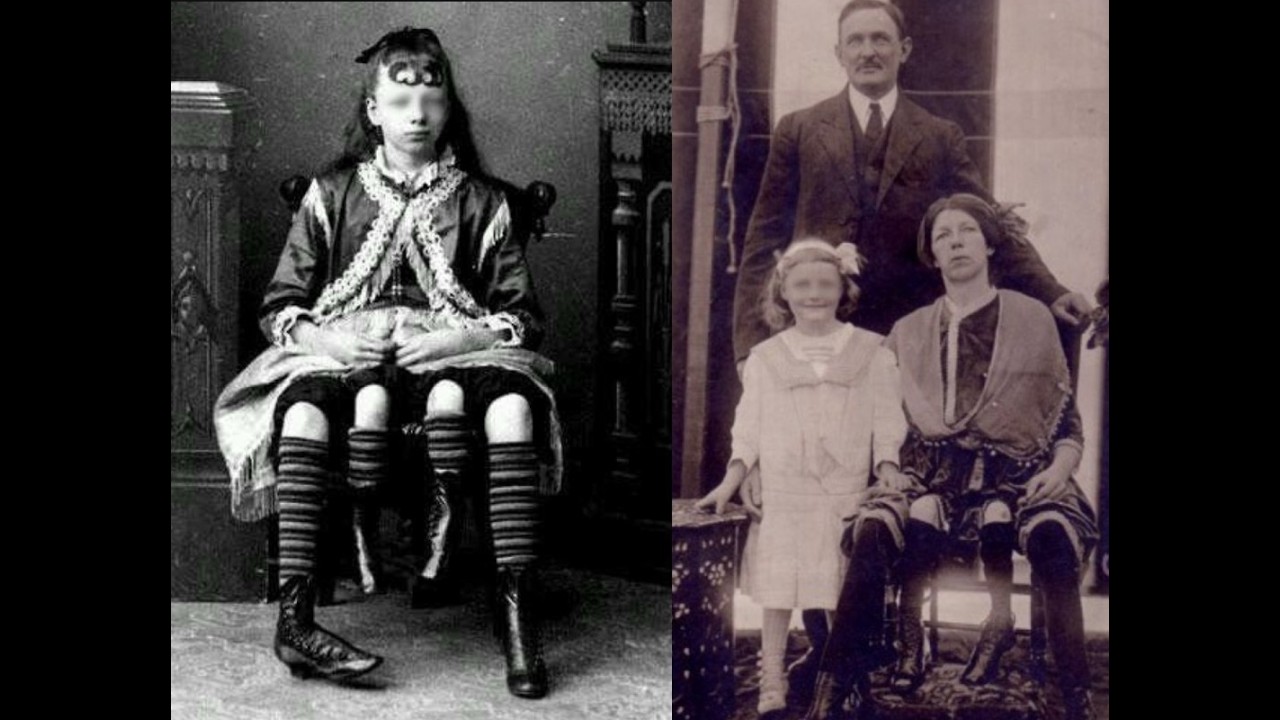
Newspapers treated them as curiosities. They treated each other as equals, and the photograph froze a moment when society did not know where to look first. These images belonged to a strange gallery of human extremes, bodies that defied what medicine believed possible, and the stories behind them refused to stay buried. Myrtle Corbin, born in the United States in 1868, came into the world with four legs.
Two were fully functional; two smaller ones belonged to a partially developed twin. Doctors examined her extensively and confirmed that all four legs were real. They also confirmed something they considered impossible: Myrtle possessed two separate reproductive systems. Pregnancy, they declared, would never happen.
They were wrong. Myrtle married and gave birth multiple times, her divided body defying every medical assumption that had been made about her. The photographs that survive unsettle viewers not because of what is visible, but because of what science said should never occur. A similar defiance marked the life of Isaac Sprague, born in Massachusetts in 1841.
He ate normally, yet his body gradually wasted away until he became skeletal, a living skeleton exhibited before audiences who could not look away. Doctors never identified the cause. Sprague remained physically active and mentally sharp throughout his life, a reminder that the human body can fail without ever explaining why. Edward Mordrake, according to the reports that made him infamous, was born into English nobility in the late nineteenth century with a second face growing on the back of his head.
Doctors confirmed the face could react, smile, and cry. Mordrake claimed it whispered to him at night, mocking him when he tried to sleep. Medical records documented the condition. No doctor could explain the voice he described.
He reportedly begged to have the face removed. It never was. Martin Lorello, born in Germany, became known across Europe and the United States for a different kind of defiance. He could rotate his head nearly one hundred and eighty degrees without pain.
Doctors confirmed it was real, not a trick. Audiences were disturbed not by the movement itself but by how calmly he performed it. He showed no fear, as if his body had simply been built this way. The human body refused, again and again, to follow the rules written for it.
Frank Lentini, born in Sicily in 1889, arrived with three legs, four feet, and duplicated lower anatomy, the result of a partially formed parasitic twin. Doctors documented his condition in detail. Frank did not hide it. He learned to walk, to run, and even to play soccer using all three legs.
What shocked people most was not his body but how completely normal his life appeared to be. Chang and Eng Bunker, the first conjoined twins ever documented in modern medicine, were born in Siam in 1811, sharing part of their chest and internal organs. Doctors debated whether they were one person or two. Chang and Eng settled the question themselves.
They married separate women, built families, and raised children while permanently attached to another human being. Prince Randian, born without arms and without legs, made audiences stop breathing not because of what he lacked but because of what he could do. He rolled cigarettes, lit them, and moved across the stage using only his torso. He was not presented as a miracle.
He was presented as undeniable proof that the human body can adapt far beyond expectation. Joseph Merrick, born in England in 1862, would become known to history as the Elephant Man. His body was slowly deformed by a rare condition that doctors at the time could not explain. Crowds paid to see him as a spectacle.
Those who spoke with him described him as intelligent, gentle, and painfully aware of how others saw him. His appearance shocked the world. His humanity unsettled it even more. Ella Harper, born in the United States in 1870, had a rare orthopedic condition that caused her knees to bend backward.
Walking upright was painful, so she moved on all fours. Audiences called her the Camel Girl. Doctors called her a medical anomaly. Ella later left public exhibitions, choosing education and privacy over spectacle.
Some bodies were defined by what they could do, others by what they could endure. Wim Hof proved the human body could be pushed far beyond what science believed. Through controlled breathing and focus, he endured extreme cold without injury. Doctors measured his response and found something unsettling: he could influence systems once thought automatic.
Hof did not claim magic. He claimed discipline, and the data backed him up. Michelle Lotito, a French man, ate objects no human body should survive: metal, glass, rubber, even parts of a bicycle. Doctors examined his stomach lining and found it unusually thick.
Over his lifetime, Lotito consumed nearly nine tons of metal. He did not perform magic. He performed biology pushed to its limit. Clive Wearing, a British musician, lost the ability to form new memories after a viral infection damaged his brain.
To him, every moment feels like awakening for the first time. Yet one thing remained untouched: his love for music. When Clive sits at a piano, his hands remember what his mind cannot. Ben Underwood lost his eyesight at the age of three.
What shocked doctors was what happened next. Ben learned to navigate the world using echolocation, clicking his tongue and interpreting the sound. He rode bikes, played sports, and walked crowded streets without assistance. He did not see with his eyes.
He saw with sound. Ashlyn Blocker, born in the United States, could not feel pain. Doctors confirmed her nerves simply did not transmit it. It sounded like a gift; her parents knew it was a danger.
Pain protects the body. Without it, Ashlyn had to be constantly watched because injuries could happen without her ever noticing. Other cases offered no clean lesson at all. A girl known only as Genie was discovered in California in 1970 after spending most of her childhood locked in isolation, forbidden to speak or interact.
When authorities found her, she could barely walk and had no language. Scientists rushed in, hoping she would answer questions about human development. They learned something tragic instead: some experiences, once lost, can never be recovered. Genie never fully learned language.
The human brain has a deadline, and when it passes, something essential never arrives. Blanche Monnier, from France, was discovered in 1901 after being locked in a dark room by her own family for over twenty-five years. When police found her, she weighed barely thirty kilograms. Blanche survived, but the damage was irreversible.
She spent the rest of her life in a psychiatric institution, unable to fully return to the world outside. Casper Hauser appeared suddenly in Germany in 1828 with no clear origin. He claimed he had spent his entire life locked in a dark cell, unable to speak or walk properly. As he slowly adapted, rumors spread that he was of noble blood.
Before the mystery could be solved, he was stabbed under unexplained circumstances and died. Phineas Gage, an American railroad worker, survived a metal rod passing straight through his skull. The injury destroyed part of his brain. Yet he lived, talked, and worked.
Friends noticed something unsettling: Gage’s personality had changed completely. Doctors realized for the first time that damage to the brain could alter who a person truly is. The accident did not kill him. It erased the man he used to be.
Daniel Paul Schreber, a respected German judge in the late nineteenth century, watched his mind collapse behind his public image. He believed his body was being transformed by invisible forces and that the world was ending. His detailed writings became one of the most studied cases in psychiatric history, not because they were irrational but because they were terrifyingly coherent. Adolf Wölfli, confined to a psychiatric hospital in Switzerland, spent decades creating an entire imaginary universe.
Thousands of drawings, maps, symbols, and stories filled his cell. Doctors originally saw madness. Later generations realized he had built one of the most complex inner worlds ever recorded. Solomon Shereshevsky, studied in the Soviet Union, could not forget.
Researchers found he could recall long lists of numbers, words, even sounds, years later, perfectly. But the ability did not make life easier. Shereshevsky described memories piling up like noise, drowning out the present. For him, the past was not a place you visit.
It was a room you could never leave. Some stories were hidden for decades before the world learned what had happened. In the 1920s, young factory workers known as the Radium Girls were told radioactive paint was harmless. They shaped their brushes with their lips day after day.
Soon their jaws began to rot. Teeth fell out, bones collapsed. The companies denied responsibility until the women started glowing even in the dark. Clair Patterson, an American scientist, uncovered a threat hiding in plain sight.
While trying to measure the age of the Earth, he kept finding lead contamination everywhere: in tools, in the air, even in his own samples. Patterson proved that lead from gasoline was spreading through the entire population. Powerful industries fought him for years. He did not look like a hero.
He looked like a man who realized the world was being quietly poisoned and refused to stay silent. Henrietta Lacks, an American woman, changed science without her permission. In 1951, cells taken from her body did not die in a lab. They kept dividing, becoming the first widely used immortal human cell line.
Those cells helped develop vaccines, cancer research, and medical breakthroughs. Her family lived for decades without knowing that one ordinary photograph connected to a piece of her that never stopped living. Sutu Yamaguchi, a Japanese engineer, did something almost unthinkable. In 1945, he survived the atomic bombing of Hiroshima.
Days later, he survived Nagasaki as well. He described the same flash, the same shockwave, the same silence afterward, twice. Years later, his case was officially recognized. But the question still hung in the air: what does survival mean when the world ends around you two times?
Violet Jessop, an ocean liner stewardess, became known as the woman who could not sink. She survived the Titanic disaster in 1912. Then she survived the sinking of the Britannic during World War I. Two different ships, two different catastrophes, the same cold water.
Jessop did not talk about luck. She talked about routine, doing the right thing while everyone around her panicked. Roy Sullivan, an American park ranger, was struck by lightning not once but seven times. The strikes occurred over decades in different locations under different conditions.
He survived every single one. Burns healed, scars faded, records were verified. Sullivan never sought fame. He simply kept working under open skies that seemed determined to find him again.
Others chose to walk away from the world entirely. Grigori Perelman, a Russian mathematician, solved one of the greatest problems in history. When offered international fame and a million-dollar prize, he refused everything. He disappeared from public life, living in isolation.
When asked why, Perelman said the recognition was meaningless. To many, that decision was more unsettling than the problem he solved. Howard Hughes, once one of the richest and most powerful men in the world, an aviation pioneer and film producer, withdrew completely. He sealed himself inside hotel rooms for years, controlling empires through notes and intermediaries while his body and mind deteriorated.
When he finally died, many were shocked not by his death but by how long he had already disappeared. Edward Leedskalnin, a Latvian immigrant living in Florida in the early twentieth century, worked alone at night. He built what became known as the Coral Castle, each stone weighing several tons, with no machines and no witnesses. When asked how he did it, Leedskalnin said he understood the secrets of weight and balance and refused to explain further.
Tarraré, a French man born in the eighteenth century, consumed enormous amounts of food in minutes despite his skeletal appearance. Doctors reported he ate live animals, garbage, even objects not meant to be swallowed. No matter how much he consumed, he was never satisfied. When hospital equipment began disappearing, staff started watching him closely.
Albert Fish seemed harmless to those around him: elderly, polite, unremarkable. Behind that appearance was one of the most disturbing criminal minds in American history. Fish committed acts so extreme that investigators struggled to describe them. What terrified people most was not what he did but how easily he blended in.
Stelarc, an Australian performance artist, believed the human body was obsolete. He subjected himself to extreme experiments: suspensions, implants, and mechanical extensions, fully conscious throughout. Doctors monitored him. Audiences watched in silence.
Stelarc did not seek pain. He sought proof that the body could be redesigned. Some photographs carried no explanation at all. One image had no name, no date, and no record of who took it.
It appeared in archives with no identification. Some believed it showed a rare medical case. Others believed it was never meant to be preserved. What unsettled historians most was not what the image showed but the fact that no one remembered the person inside it.
Magali Seron, born in Peru in 2000, had a condition so rare it was called impossible. Parts of her organs were outside her body at birth. Doctors performed a series of risky surgeries to place them correctly. Magali survived when most did not.
Her name means miracle, and for once, it was not an exaggeration. The photographs of these people were taken for different reasons: for medicine, for spectacle, for science, for memory. Some subjects wanted to be seen as records; others wanted to be seen as people. He Pingping, officially recognized as the smallest adult man ever recorded, stood just over seventy centimeters tall.
Despite fragile health, he traveled the world. He did not want to be remembered as a record, but as a person. Joseph Boruwlaski, born in Poland in the 1700s, was extremely short in stature but highly educated, multilingual, and respected in European courts. Unlike many exhibited for their size, Boruwlaski insisted on being seen as a scholar, not a curiosity.
His portrait captured a rare moment when intellect outweighed anatomy. The camera had a way of freezing the imbalance between these people and the world built around them. Anna Swan stood over seven feet tall, her size looking unreal beside ordinary adults, like a trick of perspective. It was not.
Doctors measured her repeatedly. Anna moved through the world knowing every doorway, every chair, every crowd was built for someone else. Robert Wadlow, photographed beside his wife, was one of the tallest men of his era. Their marriage shocked the public not because it was a spectacle but because it was real.
Schlitzie, born in 1901, had a condition that prevented normal brain development. Though an adult, Schlitzie’s mind remained childlike for life. Audiences laughed, waved, and applauded, rarely understanding what they were seeing. Those who knew Schlitzie personally described someone gentle, affectionate, and happiest when performing.
The image blurred the line between innocence and exploitation. Laloo, a man from India, was born with a parasitic twin attached to his chest. The second body had arms, hands, and a face but no independent organs. Doctors confirmed it was alive, reacting to touch and temperature.
Laloo lived his entire life carrying another human form on his body. The question doctors could not answer was simple: which one of them was the anomaly? Wong Fang, born with part of his skull missing, had a brain protected only by skin. Despite this, Wong lived into adulthood, worked, and communicated normally.
Any small impact could have been fatal. Yet for years his body held together. Survival, his case suggested, does not always follow design. Some people tested the limits of how far a body could be bent.
Felix Wehrle’s skin stretched like rubber, the result of a rare connective tissue disorder that allowed extreme elasticity without injury. Audiences watched him pull his face into impossible shapes. What unsettled observers most was how painless it appeared. The body looked broken, yet it functioned.
Maurice Tillet, born in France and later known in the United States as a professional wrestler, had acromegaly, a rare hormonal disorder that altered his bones. Crowds saw something frightening. Friends saw a gentle man who spoke multiple languages and loved poetry. Years later, his face inspired fictional monsters, but Tillet himself was anything but one.
Gua, a chimpanzee raised alongside a human baby in the United States during the 1930s, was part of a psychological experiment. Researchers wanted to see if an animal could learn to behave like a child. Instead, something unexpected happened. The human baby began copying the chimp.
Alarmed by the changes, the experiment was abruptly ended, and the results were quietly buried. Rosa Bates’s weight exceeded one thousand pounds. Doctors documented her condition because it pushed the limits of human survival. Everyday actions, standing, breathing, moving, required assistance.
The image disturbed audiences because it was not exaggerated. It was simply a body taken to an extreme no one knew how to reverse. Chaa, a child performer, stunned audiences in the early twentieth century. Standing on a man’s hand, he appeared unreal, like a doll.
Doctors confirmed he was alive, aware, and fragile. The image forced the viewer to confront how thin the line can be between wonder and vulnerability. And then there was the photograph with no explanation at all. It surfaced in archives with no name, no date, no record of who took it.
Some believed it showed a rare medical case. Others believed it was never meant to be preserved. What unsettled historians most was not what the image showed but the fact that no one remembered the person inside it. The human body, in all its extremes, had been documented, measured, exhibited, and studied.
But some faces were lost completely, and their stories were never told at all.
