On the rain-swept hillside above the village of Berriedale, the silence of a misty August afternoon was shattered by a single loud bang. Residents looked up toward the high grounds, where a Royal Air Force aircraft had just nose-dived into the hillside and exploded on impact. Of the fifteen passengers on board, fourteen were killed instantly. Among the dead was the Duke of Kent, the first British royal to die on active service in 450 years.
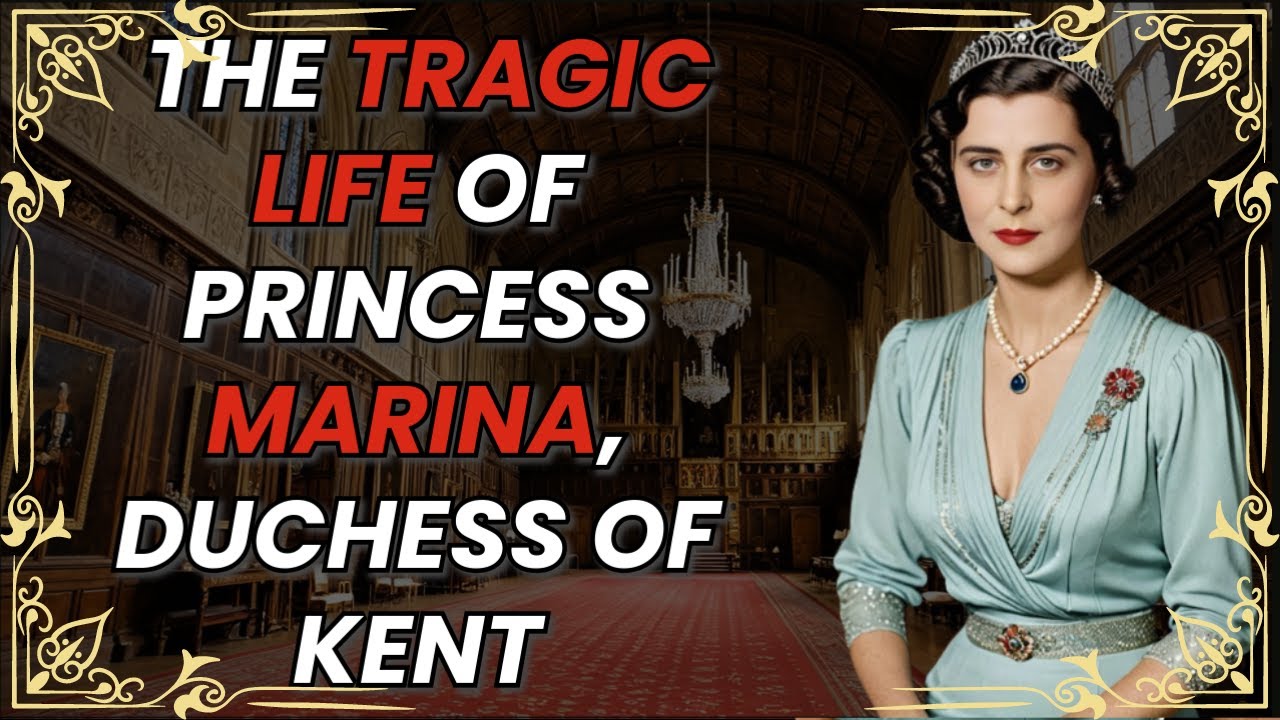
The only survivor, Flight Sergeant Andrew Jack, would carry the weight of the tragedy for the rest of his life, along with questions that have never fully been answered. The Duke who died that day, George, had been born the artistic youngest son of King George V and Queen Mary. But the path that led him to that Scottish hillside began decades earlier, in the life of the woman he married, a princess who had crossed Europe as a refugee before capturing the heart of the British public. Princess Marina of Greece and Denmark was born on the 13th of December 1906 at the Nicholas Palace in Athens, the daughter of Prince Nicholas of Greece and Denmark and Grand Duchess Elena Vladimirovna of Russia, known after her marriage as Helen.
Nicholas was the fourth child of King George I of Greece and the brother of King Constantine I, while Helen was a niece of Emperor Alexander III of Russia and a cousin of Tsar Nicholas II. Marina was the youngest of three children, her sisters Olga and Elizabeth having been born in 1903 and 1904. Unlike her previous pregnancies, Helen found Marina’s birth incredibly difficult, and according to Nicholas, she was so seriously ill and so fragile that she could take little or no part in public life. Marina’s childhood was very much a tale of two cities.
For the first decade of her life, she lived blissfully in Greece, her only ailment being one leg slightly shorter than the other, which she did not allow to infringe on fun with her sisters. She was raised in part by a kind but regimented English nanny called Kate Fox, who instilled in her a precociousness specific to English children. When Marina’s grandmother, Queen Olga of Greece, noticed her saying her prayers in English and asked why she did not say them in Greek, Marina explained that she had arranged it with God: “I told him I like to talk to him in English best, and he said please yourself, Marina, all languages are the same to me. ”
When Marina was eleven, she and her family were forced to flee Greece after the constitutional arrangements collapsed during the First World War.
They traveled first to Switzerland before settling in Paris. Although she enjoyed her years in France and the education she received at Princess Mchéry’s celebrated finishing school, life was not easy. The family struggled to find a permanent home and jumped between hotels and small apartments. Eventually they could no longer rely on charity from friends and relatives and had to find other sources of income.
Prince Nicholas gave private lessons in painting and sold many of his own pieces, while Helen set up a nursery school in the city. At Helen’s insistence, the nursery mixed children of noble families with those whose parents were servants, and Marina threw herself into the work there, playing games with the toddlers and bathing the babies. It was while in France that she began to use clothes, makeup, and hair styling to enhance her already striking features, and she quickly gained a reputation as the most stylish of royal women. Even amongst her equals, Infanta Eulalia of Spain, the daughter of Queen Isabella II, called Marina the most beautiful princess in Europe and said that any man would fall in love with her easily.
This reputation resulted in her catching the eye of many a royal bachelor, and she was at one time spoken of as a potential bride for Tsar Boris III of Bulgaria, though this idea was snuffed out when it was concluded that an adequate dowry could not be provided by her family. One such young prince who saw his head turned was Marina’s second cousin, George. Though Marina and her family had met the Windsors a number of times over the years, most accounts suggest that she and George did not become properly acquainted until 1933. In September of that year, Marina accompanied her sister Olga and her brother-in-law Prince Paul of Yugoslavia on a trip to London.
During this trip they attended a lunch organized by Lady Emerald Cunard, the American-born society hostess who had married the heir to the Cunard shipping line. It was at this lunch that George and Marina first crossed paths, and a friendship was born. Despite spending a lot of time together during this visit, Marina returned home without anything resembling a romance between her and George, who was reported to have found her rather intimidating at times. However, those close to the pair believed that it was Marina’s strong character, unstuffiness, and self-confidence that he eventually became attracted to.
In early 1934, Marina returned to London to spend even more time with George, and Olga and Paul started to notice a growing closeness between the pair, as well as a number of mutual interests such as classical music, dancing, and shooting. By now it was clear to many in royal circles that a fully fledged relationship was on the cards. The King and Queen were supportive of the couple. In their view, Marina was a stabilizing force in George’s life and the right sort of person for him to settle down with after a youth packed with vices.
The American socialite Alice “Kiki” Preston, known as the girl with the silver syringe, had introduced the young prince to cocaine and morphine, and there are rumors to this day that the pair conceived a child together. George eventually recovered from his drug addiction, but only after he was put effectively into house arrest with a team of nurses by his brother David, the then Prince of Wales. Kiki Preston died in 1946 when she jumped out of the window of her fifth-floor apartment at the Stanhope Hotel in New York. Described by Prince Louis Ferdinand of Prussia as effeminate and a user of strong perfume, George had shared his bed with men and women with equal frequency and passion, and is rumored to have had a penchant for cross-dressing.
Lovers were said to have included romantic novelist Dame Barbara Cartland, the film star Jessie Matthews, Jorge Ferrara, the son of the then Argentine Ambassador, and the playwright Noël Coward, who would later become a close friend of Marina’s. His adventurous sex life came to a head in 1932 when Buckingham Palace were said to have paid a large sum of money to retrieve a series of letters George had sent to a male lover living in France. In August 1934, George joined Marina and her family on a holiday to Bled Castle in Yugoslavia, where she had become a popular member of the social circle and was known as an excellent tennis player and skier. During the trip, allegedly while Marina was giving him a manicure, he finally proposed, and she emphatically accepted.
The engagement was kept a closely guarded secret until it had received the King’s blessing, with George telling the Daily Mail just three days before the official announcement that “there is no truth at all in these rumors. ”
In a break from royal tradition, the couple gave a small press conference within days of the engagement being made public, and Marina told the cameras that she was very happy and looking forward to coming to England. Following the announcement, the couple made a short trip to Salzburg, where they showed so much affection for each other that their fellow hotel guests began to speculate that they had already secretly married. After the holiday, to large and excited crowds, Marina returned to her home in Paris as a changed woman.
People took an obsessive interest in her every move, word, and action, and she was more than happy to feed this interest, giving frequent interviews to journalists from around the world. The phones at Balmoral were constantly ringing with messages of congratulations, and the story of the engagement dominated both the British and American newspapers. George returned to Britain to an equally jubilant public and was greeted with thousands of well-wishers when he arrived home. Almost immediately he organized for an engagement ring to be made by Cartier, consisting of an emerald-cut Kashmir sapphire which was said at the time to be Marina’s favorite jewel.
George also bought three eternity rings for the wedding ceremony, which Marina requested be set with rubies, diamonds, and sapphires to represent the Union flag. On the 17th of September, Marina and her parents arrived at Victoria Station in London to the warmest of welcomes. As many as 50,000 people were said to have lined the streets from the station, which newspapers declared the largest greeting a foreign princess had received in Britain since Princess Alexandra of Denmark arrived to marry the future King Edward VII in 1863. The car which was sent to collect the family was bombarded with flowers thrown from the pavements, and at several points the police barricades were overrun by people desperate to get a glimpse of Marina.
She was so overwhelmed by the experience that eyewitnesses recall seeing her wipe away tears. In October, the King gave George the ancient title of Duke of Kent, which had once been held by Queen Victoria’s father. A month later, on the 29th of November, the couple were married at Westminster Abbey. Marina wore a typically stylish silver and white gown with a fifteen-foot train, designed by Edward Molyneux, who had produced outfits for Greta Garbo and Vivien Leigh, and sewn in part by Russian refugees at her request.
Her bridesmaids were her cousins, Princesses Irene, Katherine, and Eugenie of Greece and Denmark, and Grand Duchess Kira Kirillovna of Russia; George’s cousins Lady Mary Cambridge and Lady Iris Mountbatten; his niece Princess Elizabeth of York; and Marina’s friend Princess Juliana of the Netherlands, the heir to the Dutch throne. There were also, at the insistence of the couple, six prime-location seats reserved for a selection of their domestic staff. As of 2023, Marina is the last foreign princess to marry into the British royal family. When Lady Juliet Duff, daughter of the fourth Earl of Lonsdale, remarked to Queen Mary that the public crowds were almost as big, if not bigger, than at the wedding of the Duke of York, later King George VI, the Queen replied: “Oh yes, but then you see, Marina is royalty.
”
There was great public excitement surrounding the wedding, which was the first major royal event since before the First World War. Despite the cold and wet November weather, over one million people flooded the streets of London to see the couple and their guests. Some stories tell of people sleeping in the street, covered only with newspapers, the night before the ceremony, so desperate were they to grab a decent viewing spot. Other reports from the day estimate that paramedics tended to over 700 injuries obtained in the scrum of the crowd, with some spectators being taken away by ambulances with fractured legs.
For those not wanting to risk a trip to the infirmary, seats on a grandstand erected opposite the Abbey sold for the modern equivalent of over £500, with the proceeds being donated to the Westminster Hospital Trust. In a feat of modern technology, the ceremony also became the first royal wedding to be transmitted live on the wireless, made possible by the installation of fourteen tons of broadcasting equipment in the Abbey. The Duke and Duchess settled in an elaborate yet modern townhouse at Number Three Belgrave Square, which was leased to them by Juliet Duff. A year after they married, they inherited Coppins, a mid-nineteenth-century country house less than ten miles away from Windsor Castle that had been left to George by his aunt Princess Victoria, known in the family as Toria.
Within months of George and Marina moving in, Coppins became something of a salon of creatives and society figures, with famous faces such as William Somerset Maugham, Henry “Chips” Channon, Beverly Nichols, and Douglas Fairbanks being regular guests. In a move which surprised their friends, the style-conscious Marina passed the responsibility for the renovation and decoration of the two houses to George, as well as the hosting duties for guests. At one dinner the couple gave early in their marriage, the Dowager Countess of Airlie heaped compliments on Marina for the food and décor of the room, only to be told by the Duchess that it was George who had chosen the menu, furniture, flowers, and the color on the walls, and that she didn’t know what the meal would be until it was put in front of her. Now cemented as a national figure, Marina’s maverick flair was unleashed on Britain in its full glory.
She regularly graced the pages of Vogue, Country Life, and Tatler, and was featured in almost every best-dressed list of the era. Her signature fashion choices, such as pillbox hats and trousers, as well as her public smoking, were considered incredibly progressive for the time and became hugely popular among the moneyed women of Britain. An ostrich-feathered sailor hat was sold by the hundreds within days of Marina being seen wearing it, and some society ladies even attempted to retrain their walk to copy the Duchess’s slight limp, as they had done with her grandmother-in-law Queen Alexandra. Not everyone, however, was entirely approving of Marina’s daring manner.
The King and Queen were known to be an extremely traditional couple for their time, with Queen Mary still wearing floor-length dresses and toques on a daily basis in the 1930s and 1940s, long after they had gone out of fashion. So fond of her son’s new wife was the Queen that she would sometimes subtly try to discourage some of Marina’s style choices, always to no avail. When the King’s disapproval of the Duchess’s colored nail polish was expressed to her by her mother-in-law, it was batted back with a reply: “Your George might not like it, but mine does. ”
Despite enjoying her work in nursing and for the Red Cross, the war placed many strains on Marina’s personal life and put her in the difficult situation of being on a different side to both of her sisters, to whom she had been incredibly close.
In January 1934, eleven months before Marina and George had walked down the aisle, Elizabeth married the Bavarian nobleman Count Carl Theodor of Törring-Jettenbach, who was slightly too close to the German government for the liking of British intelligence services. In 1935, the Törring family moved out of the Munich Palace they had lived in for generations so it could become part of Nazi Party headquarters, and the Count himself was known to have had meetings with Prince Christoph of Hesse, the head of the Research Office of the Reich Aviation Ministry. In Yugoslavia, the usually strongly anglophilic Prince Paul, who had been appointed Prince Regent in place of the infant King Peter II, was backed into a corner by Hitler and forced to sign a treaty that allowed German forces uninterrupted passage through his country to Greece. This resulted in his overthrow, and in 1941 he and Olga were arrested by the British as enemy collaborators.
They were taken to Kenya, at that time still a British colony, and detained in a house near Lake Naivasha, not far from the home of a certain Kiki Preston. Despite incessant pleas from George and Marina to their friend and regular Coppins visitor Winston Churchill, the government would not even consider detaining Paul and Olga in Britain, insisting they were both security risks. Marina’s difficult war peaked in 1942. On the 25th of August, George and a selection of his RAF colleagues embarked on a trip by air from northern Scotland to Iceland to inspect British air bases.
Their plane departed from Invergordon at 1:10 p. m. following the standard pre-flight checks, during which no issues were detected. At around 1:40 p.
m. , residents of the village of Berriedale heard a loud bang from the misty high grounds. The aircraft had nose-dived into the hillside and exploded on impact, killing fourteen of its fifteen passengers. The Duke was among the fourteen, and became the first British royal to die in active service for 450 years.
To this day, there remains a cloud of mystery around the crash. Relatives of the sole survivor, Flight Sergeant Andrew Jack, claimed that he and the other flight crew were unfairly blamed for the accident by the official inquiry, and that George himself was piloting the plane at the time of impact. There are further allegations that the true number of people on board was sixteen, the extra passenger apparently being a male lover of the Duke’s whose identity has never been revealed. Tragically, this all occurred only seven weeks after the Duchess had given birth to another son, Prince Michael.
Upon being told the news, Marina became inconsolable with grief. She stopped talking completely and would alternate between animalistic wailing and staring out of the window for hours in silence, while cries of “Where’s my daddy? ” could often be heard from the young Princess Alexandra. At the funeral, Marina spent almost the entire service on her knees, weeping and silently praying, and King George VI later told confidants that it was the most moving family funeral he’d ever been to.
Marina’s niece, Archduchess Helen of Austria, remembered her aunt feeling alienated in the time following George’s death. This was unsurprising, as she had lived in England for less than a decade at the time of the crash, with most of her birth family and friends scattered across Europe. More importantly, although she was a much-adored figure across Britain, Marina could not help feeling that she was slightly separate from the British royal family, if not above them. She regarded the Windsors as something of a mishmash of low-level aristocracy and outright commoners, while she was a princess by birth.
Indeed, she would often refer to Queen Elizabeth, wife of George VI, and the Duchess of Gloucester as “those common little Scotch girls,” an allusion to both of their fathers being relatively minor Scottish peers. This feeling of alienation would undoubtedly have been exacerbated when she was informed that, as she was now a widow, she no longer had access to the £25,000—about £980,000 in today’s currency—of civil list money her late husband received annually from the government. This led to the humiliating ordeal of Marina having to auction off most of George’s possessions, as well as a number of her own, in order to run her two households and bring up her three young children. There is, however, evidence of the family providing support where they could.
Queen Mary allotted Marina an undisclosed allowance from her personal wealth to help with her day-to-day expenses, and in the weeks following the Duke’s death, the King instructed the government to grant Olga release from her house arrest so she could travel to England to be with her sister. When this decision was challenged in the House of Commons by the Conservative MP Alec Cunningham-Reid, who accused Olga of being an Axis spy, the then Foreign Secretary Anthony Eden explained that no other member of Marina’s birth family was able to come to the UK, and told Cunningham-Reid that he had no apology to make in the matter. Despite her crippling grief, Marina made a quick return to public life and began undertaking engagements just ten weeks after George’s death. However, she struggled to find her real role in the family until her former bridesmaid, Princess Elizabeth, acceded to the British throne in 1952, with Marina’s cousin the Duke of Edinburgh, formerly Prince Philip of Greece and Denmark, at her side.
Marina had been incredibly kind to the young couple, hosting them at Coppins while they were courting and helping to nurture their relationship in its early days. The Queen showed her gratitude by entrusting her aunt with a new role in the new court. She decided to play to Marina’s strengths as a charming and down-to-earth woman and made her a representative for the Crown abroad, as well as granting her a grace-and-favour apartment at Kensington Palace and £5,000 a year from the Civil List. The first overseas visit was a five-week tour of southern Asia in the September before the coronation, which saw Marina and the sixteen-year-old Duke of Kent journey to Sri Lanka, Singapore, Malaya, Sarawak, North Borneo, and Hong Kong.
These visits were more than just handshaking; they involved real business of state. For over a decade she traveled to a string of former British colonies, mostly in Africa, to hand over their instruments of independence and open the first session of their new parliaments on the Queen’s behalf. The first was Ghana in 1957, then came Lesotho and Botswana, the capital city of which is home to the Princess Marina Hospital. She was also the first member of the family to visit postwar Germany and made several successful trips to Commonwealth realms such as Canada and Australia, where she was met with the rapturous crowds she had become accustomed to.
Marina was also often deployed to charm foreign royalty, especially those she was linked to by blood. When her cousin King Paul of Greece and his wife Queen Frederica visited Britain in 1963, it was she who greeted them at the airport. She later represented the British royal family at the wedding of Princess Beatrix of the Netherlands, the eldest daughter of her old friend and former bridesmaid Queen Juliana. In 1961, Edward’s marriage to Lady Katherine Worsley had displaced his mother as the Duchess of Kent.
The new and rather geriatric style of “Dowager Duchess of Kent” was almost immediately rejected by the still relatively young Marina, and with the Queen’s permission she was instead known as Princess Marina, Duchess of Kent. Though she herself never remarried, most likely out of respect for her children and the memory of their father, Marina’s later life was not without romance. In recent years it has been revealed that she had an incredibly close relationship with the American actor and comedian Danny Kaye, whom she had first met just after the war at a showbiz party. As he fitted into her social circle so well, it was not widely known that he and Marina were anything more than friends.
As she approached her sixties, Marina remained a visible and popular member of the royal family and could often be seen accompanying her children and the wider family at events, still displaying the same elegance and vigor she had in her twenties. However, in the summer of 1968, she cancelled an official engagement for the first time since joining the House of Windsor nearly thirty-five years earlier. The reason of a slight knee injury was given, though in reality Marina had been noticing some weakening in her left leg for a while. This weakening worsened as the months went on, soon spreading to Marina’s left arm, and she became prone to stumbles and trips.
Following a more serious fall on the 17th of July, in which she hit her head, she was taken to hospital in Bloomsbury, where she remained for a few days before being sent home to Kensington Palace with strict instructions to rest. However, this relatively minor accident unveiled something far more serious than anyone was expecting. Routine tests undertaken while in hospital revealed that Marina had a brain tumor which had reached the stage of inoperability, and doctors gave her seven months to live at the most. While accounts on whether Marina herself was made aware of the extent of this diagnosis are ambiguous, her children went out of their way to keep their mother’s illness a secret from others, with most of her family and friends kept unaware of the seriousness of her condition.
Despite her prognosis, Princess Marina passed away in her sleep just five weeks after the discovery of the tumor, on the 27th of August 1968, two days after the anniversary of her husband’s death. This was an enormous shock to just about everyone, not least her children, who had expected to have as long as half a year to give their mother a comfortable and enjoyable end to her life. They were, however, grateful that Marina’s end was not drawn out and that she was not forced to go through a complete deterioration of her health. In a letter to Cecil Beaton, Princess Alexandra expressed relief that “my sweet Mama knew no pain, and now she is at peace.
”
Buckingham Palace announced a week of court mourning, and all flags at royal residences were lowered to half mast. Virtually every member of the royal family attended the funeral at St George’s Chapel, led by the Queen, the Duke of Edinburgh, and Queen Elizabeth the Queen Mother. The Duke of Windsor, without the Duchess, made the trip from France in what would be his last appearance at a royal event before his death four years later. A collection of European royals also came to say goodbye.
From Marina’s native Greece, though they now lived in exile in Rome, came King Constantine II, Queen Anne-Marie, and Queen Frederica the Queen Mother. Other royal guests included Helen, the exiled Queen Mother of Romania; a Greek-Danish cousin, Princess Paola of Belgium; and Umberto II, the last king of Italy. As at her wedding, the funeral included contributions from senior figures in the Greek Orthodox Church’s British delegation. Alongside this long list of the great and good, ordinary British people lined the route of the procession in their thousands, as they had done when Marina first arrived in 1934.
This large turnout from the public was seen as a gesture of thanks to the glamorous globe-trotter who had made their country her home and worked tirelessly in its service.
