When Edith Rockefeller McCormick died in room 1801 of the Drake Hotel in Chicago, she had less than nine thousand dollars to her name. She was the daughter of the world’s first billionaire, the wife of the heir to an agricultural empire, and by any measure the wealthiest woman in America. She had also buried two of her children before either reached the age of five. The story of how she ended up alone in a hotel room, estranged from nearly everyone who knew her, begins with a promise she made as a six-year-old girl in Cleveland, Ohio.
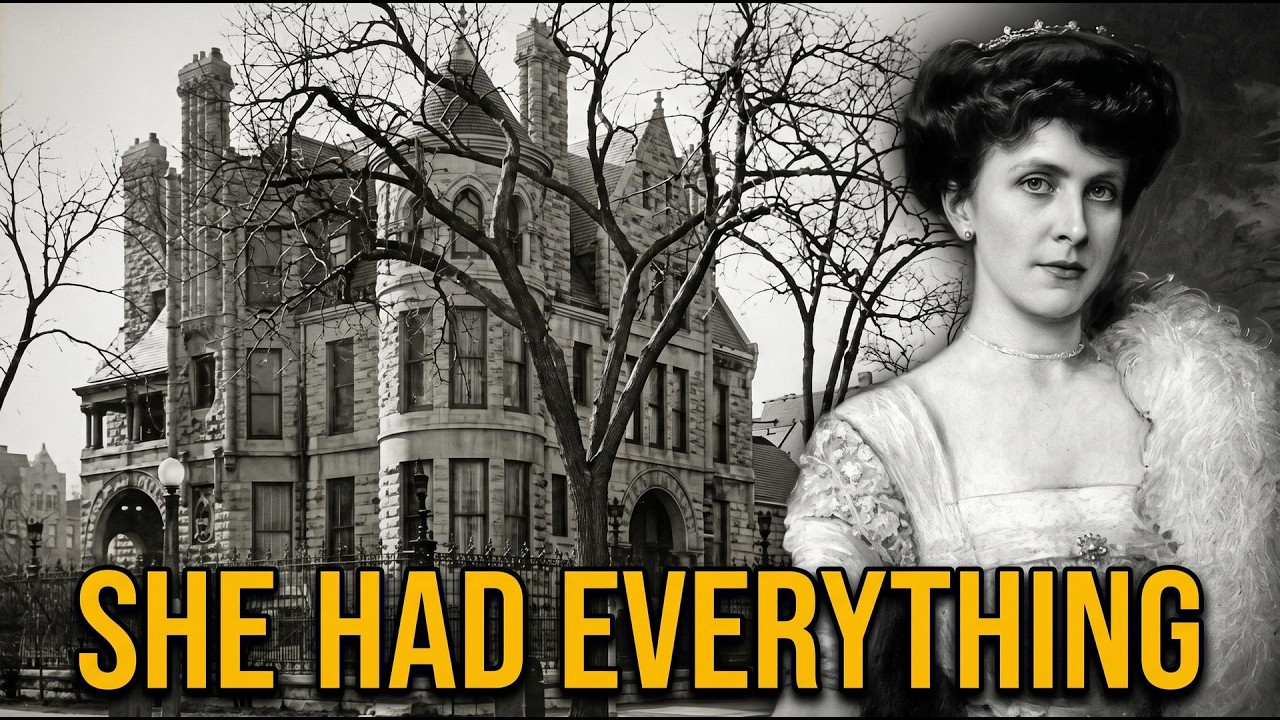
In 1878, John D. Rockefeller was on the verge of building Standard Oil into the most powerful corporation on earth. At the family kitchen table, he taught his daughter Edith to divide a small stack of coins into portions for spending, saving, and charity. When she finished, she looked up and told him she would never count pennies when she grew up.
She would only count what she gave away. Her father said nothing, but he never forgot the moment. Neither did Edith. By the time she was twelve, she was reading Latin, Greek, and German, memorizing the Old Testament, and collecting ancient objects, coins from Egypt, carved jade from China, a small Etruscan figurine she carried in her pocket for the next forty years.
She was already building a private inner world, and she was already convinced that her soul was far older than her body. At twenty-three, Edith married Harold Fowler McCormick, heir to the mechanical reaper fortune that had helped feed nineteenth-century America. Their wedding in November 1895 joined two of the largest fortunes the country had ever produced. The combined wealth of the families exceeded twenty-three billion dollars in today’s money, yet fewer than thirty people attended the ceremony.
The couple settled in Chicago, and by 1905 Edith had given birth to five children. They built Villa Turicum, an Italian Renaissance palace on Lake Michigan with forty-four rooms, marble imported from Tuscany, a private theater, and formal gardens cascading down to the lake. It cost the equivalent of roughly one hundred million dollars today. Edith stood at the top of its marble staircase in the spring of 1905, looked down at her four living children, and wrote in her journal that she had everything a woman could possibly want.
She never wrote that sentence again. The first tragedy came in February 1901. Her eldest son, John Rockefeller McCormick, developed a rash on his neck. Within two days it had spread across his chest and face.
The doctor delivered the diagnosis every mother in that era dreaded: scarlet fever. There was no antibiotic and no vaccine. The combined fortunes of the Rockefeller and McCormick families could buy anything in the world except a cure for streptococcus. For eleven days Edith did not leave the boy’s bedside.
Three specialists arrived from Johns Hopkins by private railcar. A doctor from Boston traveled through a snowstorm. None of them could help. On March 2, 1901, John opened his eyes one final time, said the word mama, and died that afternoon at 3:47.
He was three years and eleven months old. Edith was four months pregnant at the time. When she was told her son was dead, she collapsed onto the floor in the next room. The doctors who attended her that night noted that she kept repeating a phrase in a language she had never studied.
It was the name Khufu, the pharaoh who built the Great Pyramid. She had purchased a small turquoise scarab beetle at an antiquities auction the previous summer. At her son’s funeral, she pressed it firmly into the boy’s mouth, the way ancient Egyptians had placed amulets in the mouths of their dead pharaohs. She believed her son was coming back.
After the funeral she locked herself in her bedroom for nineteen days. When she emerged, she looked thirty years older. She was twenty-eight. She removed every photograph of her son from the walls, wrote his name on the back of each one, and sealed them in a cedar trunk along with her Egyptian carvings.
She would carry that trunk with her for the next thirty-one years. Three years later, in August 1904, her infant daughter Editha died. The child had been healthy, weighed seven pounds four ounces at birth, and had received gifts from the wealthiest families in America. The death certificate filed in Cook County lists the cause as natural causes, infantile.
No physician’s name appears on the document. The line for attending doctor is blank. Editha had been removed from the main house weeks earlier and placed in a small cottage on a country estate that the household staff called the quiet house, built on Edith’s instructions because she believed the child required absolute stillness. The household manager’s memo contained a troubling line written before the move: Mrs.
McCormick had expressed concern that the child did not respond to her presence in the manner of the others. When Editha died, the press printed almost nothing. The Chicago Tribune gave her a single paragraph on page eleven. The New York Times gave her one sentence.
A phone call from John D. Rockefeller to the publishers of every major newspaper east of the Mississippi had silenced the story. No one defied him in 1904. Edith did not weep at the funeral.
She did not visit the grave for thirteen years. That autumn she stopped speaking for almost six weeks and communicated through written notes. Her hair began to turn gray at the temples. A maid later testified that Edith wore the same black dress for forty-one days, refusing to let anyone wash it, because the dress had been near the child.
In the spring of 1905, against the warnings of two physicians, she became pregnant for the fifth time. Mathilde McCormick was born in August 1905, healthy and strong. But Edith had now buried two of her first four children, and something inside her had been broken in a way money could not repair. In October 1913 she boarded a steamship for Switzerland, telling her husband it was for a season of rest.
She brought her three surviving children, six steamer trunks, the cedar trunk, a maid, a governess, a French chef, and forty thousand dollars in gold. She rented suite 308 at the Hotel Baur au Lac in Zurich. She enrolled the children in Swiss boarding schools. She enrolled herself in the analytical psychology seminars of Carl Jung.
She would not return to America for nearly eight years. In 1915 she gave an interview to a Swiss reporter in which she stated that she had recovered clear and detailed memories of three previous incarnations. She claimed she had been an Egyptian queen, the wife of a Babylonian prince, and a Renaissance noblewoman in Florence who died giving birth to twins. The American press exploded.
The Chicago Daily News ran the headline Rockefeller Heiress Claims She Was Queen of Egypt. The New York World called her the most expensive lunatic in modern history. Her father, by then the richest man on earth, refused to comment publicly, but wrote privately to her brother that he was ashamed before God of what his daughter had become. Edith stayed in Switzerland.
In 1917, while she was lecturing visitors in Zurich on Egyptian funerary rites, her husband Harold fell in love with a Polish woman named Ganna Walska. He spent the equivalent of more than one hundred million dollars trying to make her an opera star, buying her costumes, bribing conductors and reviewers, forcing opera companies to cast her in lead roles. Audiences laughed. Critics destroyed her.
Harold married her anyway. Edith filed for divorce on December 29, 1921. The proceedings took less than four hours. Harold married Ganna Walska in Zurich exactly fourteen days later.
Edith attended the wedding. She wore black. She returned to Chicago in August 1921, forty-nine years old, alone for the first time in her adult life. Villa Turicum had stood empty for eight years.
The marble had cracked and the gardens had gone wild. Instead of retreating, she became one of the most aggressive cultural patrons in American history. She founded the Chicago Civic Opera Company, funded an Egyptian wing at the Field Museum, paid for the first English translation of Carl Jung’s Psychological Types, and held weekly salons in her townhouse attended by writers and artists and philosophers. She lectured publicly on reincarnation and the spiritual meaning of money.
The generosity was not generosity. It was grief. She was building a monument, a pyramid, preparing for her own death the way the pharaohs she had studied for thirty years had prepared for theirs. In the summer of 1922, her youngest daughter Mathilde, then sixteen, began taking riding lessons in an Alpine village from a Swiss instructor named Max Oser.
He was forty-eight years old, thirty-two years older than the girl. When their engagement was announced in February 1923, the international press mocked them relentlessly. Edith gave her full public blessing and a wedding gift of one million dollars. She also gave Mathilde a small turquoise scarab beetle, identical to the one she had placed in her dead son’s mouth.
Max Oser was by all accounts a quiet and devoted husband. Their marriage lasted six years until his death from a heart attack in 1929. Mathilde was widowed at twenty-four. She never remarried.
She died in 1947 at forty-two, of complications related to depression and alcoholism. In the spring of 1932 Edith was diagnosed with cancer that had spread from her breast to her bones. She refused morphine, partly because she did not want to dull her mind and partly because she believed pain was a final teacher. She moved into suite 1801 of the Drake Hotel in May.
She did not summon her surviving children. By then she had given away an estimated thirty-five million dollars, and the Depression had destroyed nearly all her remaining investments. She paid her hotel bill week to week. In July, her brother John D.
Rockefeller Jr. , against his doctors’ advice, traveled to Chicago and sat at her bedside for three days. He recorded only one line in his diary: She asked me to forgive her. I told her there was nothing to forgive.
She did not believe me. Neither did I. She died on August 25, 1932, six days short of her sixtieth birthday. The only family member in the room was her son Fowler.
Her last documented words, recorded phonetically by a nurse who did not understand them, were identified three weeks later as a fragment of Middle Egyptian from the Book of the Dead, the spell spoken by the deceased so that the heart will not testify against the soul during final judgment. It translates roughly as: Oh my heart of my mother, do not stand against me as a witness. On the bedside table the maid found three objects: a photograph of John Rockefeller McCormick, age three; a small turquoise scarab beetle; and a handwritten note addressed to her brother, asking that the cedar trunk she had carried for thirty-one years be buried with her, unopened, and that no one be permitted to read its contents. John D.
Rockefeller Jr. honored the request. The trunk is buried with her in Tarrytown, New York, beside the graves of her children. Its contents have never been cataloged.
Decades later, in 1979, the Rockefeller Archive Center received a collection of roughly four hundred letters Edith had written to Carl Jung between 1913 and 1923. Jung’s private case notes described her as one of the three most psychologically gifted patients he had analyzed in his entire career. Her reincarnation claims were not delusions in his framework. They were archetypal symbols, expressions of grief from a woman trying to construct a mythology that would allow her to live with the deaths of two children.
In one letter written eleven years after her son’s death, she wrote that she did not believe her children had died. She believed they had hidden themselves in her, and that if she could become quiet enough, she would hear them again. A servant who accompanied her to Switzerland confirmed that Edith had spoken to her dead children out loud every night for thirty-one years. The question Edith asked her sixteen-year-old daughter Mathilde in the Swiss Alps in 1922 was whether she would choose to be her child again.
Mathilde never answered. Years later, on the night before her own daughter’s engagement, Mathilde finally spoke the answer her mother never heard. She said her mother was not a bad woman. She was a woman who had lost too much too young in a family that did not know how to grieve.
She did not abandon her children. She abandoned the world that had taken them from her. The only thing Mathilde could not forgive her for was that she could not see until the very end that she still had three children left. Edith Rockefeller McCormick died with less than nine thousand dollars in a hotel suite, having inherited the largest private fortune in American history and married into the second largest.
She had kept the promise she made at six years old. She had only counted what she gave away.
