Barbara Castleton was born in 1894 in Little Rock, Arkansas, in the same year that Thomas Edison unveiled the kinetoscope in New York and the Lumière brothers began their experiments in France. She arrived, almost poetically, in the same year as cinema itself, and her life would run parallel to the fragile art she would one day serve. By the second decade of the twentieth century, she had left her quiet southern childhood behind and entered the uncertain world of moving pictures, a field still regarded with suspicion by respectable society. She joined the World Film Corporation, a studio operating not in the grandeur of later Hollywood but in the modest rooms and skylit stages of Fort Lee, New Jersey.
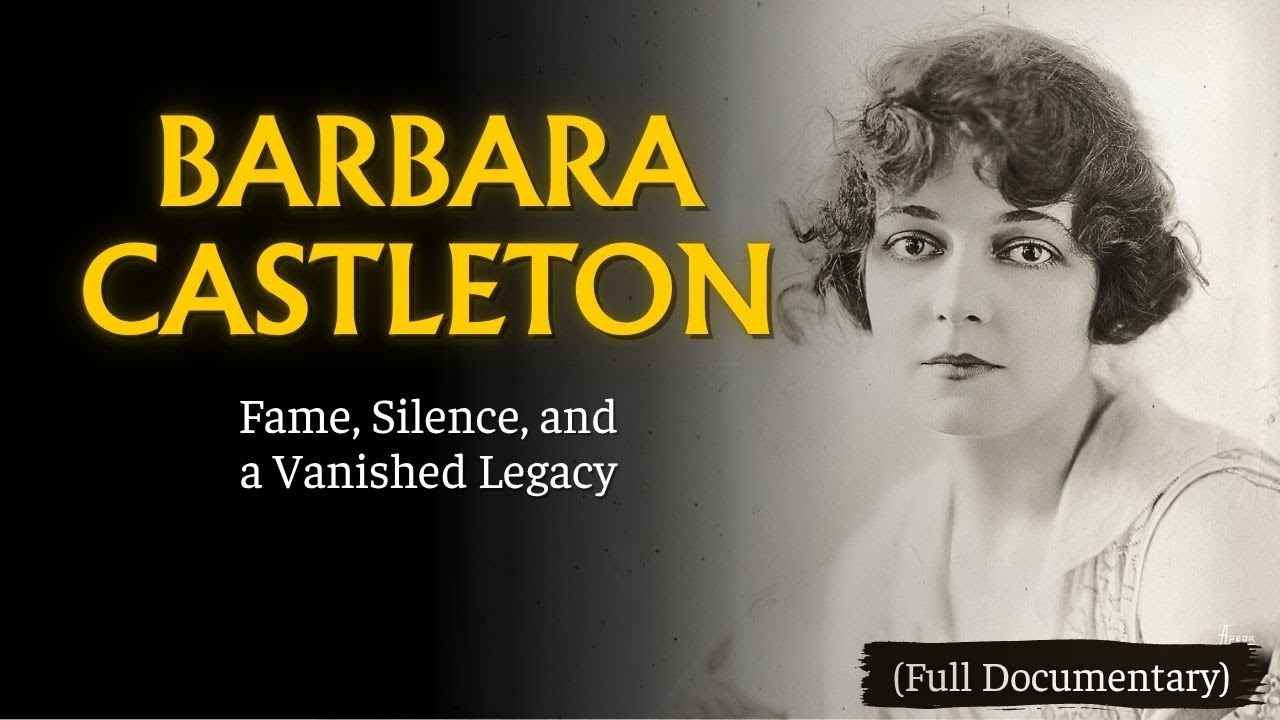
There, in an age when cameras were hand-cranked and directors shouted through megaphones, Barbara built a reputation for restraint. She was praised for her sincerity and her gentle poise, qualities that set her apart in a medium where exaggerated expression was often the rule. Her stillness became her language, and critics noted her ability to suggest an inner life without flailing or distorting her features. She played heroines in dramas and romances, women caught between love and duty, and through these roles she became both a moral figure and a vessel for longing.
She was not as famous as Mary Pickford, nor as scandalous as Theda Bara, but audiences recognized her, and her name appeared in programs and film magazines. Most of her films are now lost, their nitrate reels burned or dissolved into dust, but in her time, her face commanded silence and made strangers hold their breath. Her rise was steady but not meteoric. She remained just beyond the realm of the great icons, and this moderation may have spared her the most intrusive aspects of fame, but it also foreshadowed how quickly she would be forgotten.
Her private life drew its own attention. Her first marriage, entered into in her youth, dissolved without public explanation, leaving behind only gossip that filled the void with whispered tales of incompatibility and discontent. To be a divorced woman in the early twentieth century was not without stigma, and to be a public woman undergoing such a change was to invite scrutiny. She bore it silently, her own voice absent from the record.
Not long afterward, she married again, this time to Willard Mack, a playwright and actor of considerable reputation in theatrical circles. Their union seemed promising, but it was marked by tension, by the strains of two creative lives pulling against one another. Rumors of quarrels and estrangements spread across gossip columns, and the line between truth and invention blurred. The public preferred the fractures, and every whisper was magnified until it echoed across the industry.
The marriage, fragile as glass, did not endure, and Barbara was left alone once more. Through it all, she carried herself with composure, her serenity unbroken before the camera. The 1920s brought a tide of transformation. The war had ended, cities swelled with new life, jazz trembled through dance halls, and audiences grew hungry for novelty.
The cinema itself was changing, building palaces of dreams with velvet curtains and chandeliers. New stars emerged with startling speed, actresses whose daring fashions and bold personalities suited the restless rhythm of the age. Barbara’s calm presence, once admired as sincerity, began to seem like a relic of an earlier time. The very qualities that had set her apart, her quietness, her restraint, no longer shone so brightly in a culture hungry for extravagance.
She continued to appear in films through the early years of the decade, but the spotlight was shifting. Then came the talking picture. The murmur behind the curtain swelled into the unmistakable resonance of a human voice captured by machinery and projected into the air. The silence that had carried Barbara’s career was no longer enough.
The new age demanded that performers speak or vanish. Her voice was never recorded, and no account survives to tell us what it sounded like. Without sound she had been luminous; with sound, she disappeared. The studios moved quickly, and by the late 1920s, silence was already fading.
Barbara’s performances, praised for their subtlety, no longer matched the expectations of a world intoxicated by noise. Slowly, almost without notice, her name slipped from the credits and her image from the magazines. The curtain did not fall with a crash but with a whisper. She did not cling to the spotlight as it turned away.
Unlike some who struggled to reinvent themselves in sound, she faded quietly, accepting the silence not as an art but as the condition of obscurity. She was one among many. Entire generations of silent performers vanished with the coming of sound, their careers collapsing in a single season. Some turned to the stage, others left the industry entirely, and the majority simply faded into the background.
Barbara belonged to the latter, retreating without resistance, her serenity intact even in disappearance. Her quiet years were marked by the peculiar sorrow of being unseen after once being everywhere. We know little of what she did. The records grow thin, dissolving into fragments.
She is believed to have resided in New York, where the metropolis allowed anonymity to be complete. The city, loud and unceasing, was a place where one might vanish into the current of life without trace. She lived there until 1951, her days largely unrecorded, her presence unnoticed by the larger world. When she died, it was without fanfare.
There were no grand obituaries, no headlines, no ceremonies of remembrance. The newspapers that once printed her name in bold made no mention of her passing. She slipped from life as quietly as she had once slipped from the screen. The films that carried her presence now carry nothing, for most of the silent reels were never preserved.
They decayed, crumbled, or burned, and with them vanished the performances that had once stirred audiences. To think of Barbara is to think of this vanishing, for her career is mirrored by the fragility of her medium. She was bound to the silence of film, and when that silence was no longer valued, she was bound also to its disappearance. Yet memory is not entirely erased.
In scattered archives, in collections of silent film enthusiasts, in dusty boxes preserved by accident rather than intention, fragments may survive. The possibility that such fragments endure reminds us that her story is not entirely lost. She was born in the same year as cinema itself, and her life ran parallel to its early decades. When the reels decayed, so too did the memory of her presence, but her story, once spoken again, resists the silence that claimed her.
Her life was not a legend, but it was meaningful. Her presence was not eternal, but it was real. She lived, she acted, she endured both the light of fame and the shadow of obscurity, and in remembering her, we grant her what Hollywood did not. A place within history, however faint.
Her silence remains, inviting us to reflect, to pause, to remember what has been lost and what endures in spite of it.