On the evening of March 31, 1972, twelve-year-old Brad Bolino said goodbye to his best friend and stepped out into the darkening streets of Boardman, Ohio, to walk the three miles home. He never arrived. For fifty-one years, the man responsible lived entirely in the open, just five miles away, driving a delivery truck and raising a family while an entire township searched for answers. The science that finally dragged his killer out of the shadows did not exist when Brad died, and it would take half a century of patient, unglamorous work to bring his name to light.
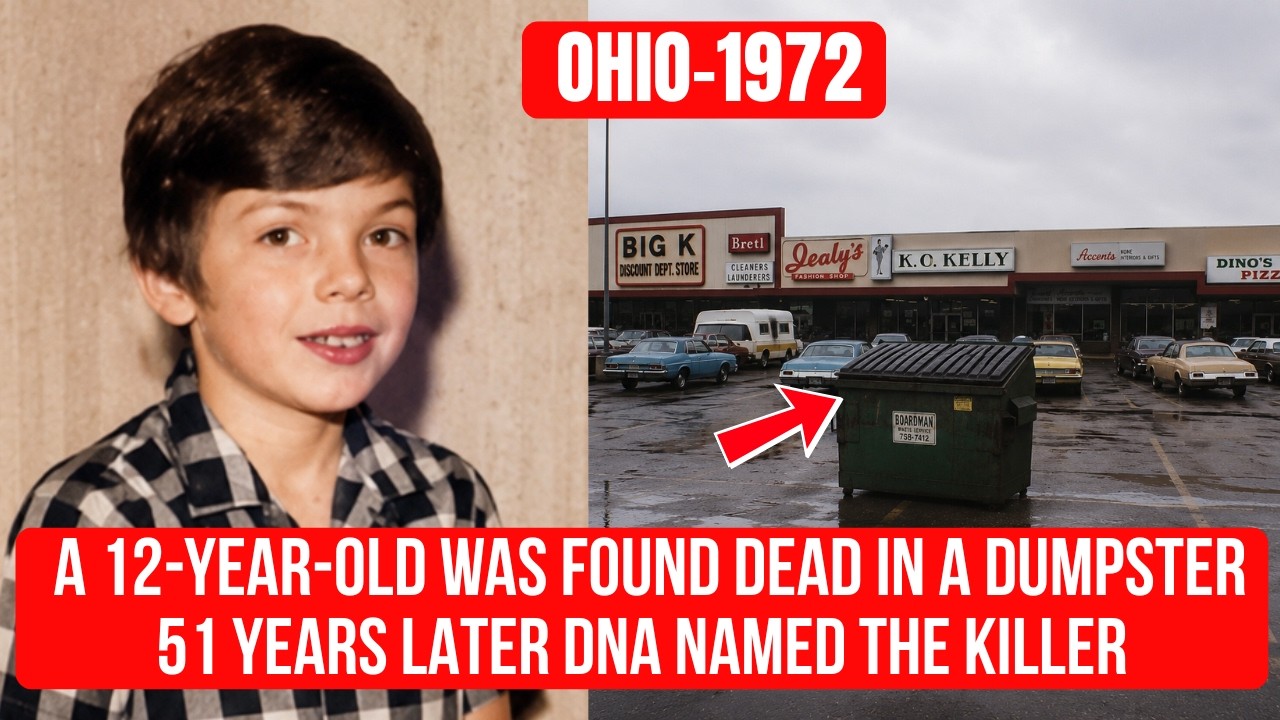
Bradley Lee Bolino was born on April 7, 1959, in Youngstown, Ohio, the youngest of four children. His father worked shifts at Youngstown Sheet and Tube; his mother worked as a buyer for Lane Bryant. Brad was small for his age, about four feet tall and eighty pounds, with a sunny disposition that his best friend Don Templeman remembered more precisely. Brad was the outgoing one, the one who came up with the risks while Don went along with them.
He spent three summers as a catcher while Don pitched and Don’s father coached. He rode his bike everywhere and sometimes hitchhiked, a detail that reads very differently today than it did in 1972, when Boardman was still the kind of place where doors stayed unlocked at night. During Easter break that spring, Brad stayed Thursday night at Don’s house, as the boys often traded nights back and forth between their homes. On Friday, his father allowed him to stay out until nine that evening, and the two boys spent the idle spring day walking around town with no particular destination.
At some point, they noticed a brown van. Then they noticed it again, three or four times in different parts of town. At first they joked about it. Then the joke stopped being funny, and they headed back to Don’s house.
That evening, Brad called his own home and told his older brother he would be staying at Don’s again. About twenty minutes later, his father called the Templeman house directly and told Brad to come home instead. Brad did what he was told. The plan was for Don’s mother to drive him, but she was at the grocery store and Don’s father was sick in bed.
So at 7:30 that evening, with the sun going down, Brad decided to walk. He said goodbye to Don and stepped outside. Around ten that night, Brad’s older brother called the Templeman house asking if Brad had made it home. He had left hours earlier.
Don’s mother woke Don, and the two of them drove the route Brad would have walked, finding nothing. Brad’s father got home late, assumed his son had simply stayed over again, and went to bed around two in the morning without checking. He woke at noon on Saturday, realized Brad was not home, called the Templemans, and learned his son had left the night before. By 3:20 that afternoon, Brad was officially reported missing.
Family, neighbors, and officers searched through the weekend. Easter Sunday came and went, a day this close-knit family would never have missed together, and hope began to curdle into something else. There were scattered unconfirmed sightings at a mall, a basketball court, a Dairy Queen, all almost certainly wrong. Then came Tuesday.
At around eight in the morning on April 4, 1972, a sanitation worker named Paul Smith was collecting trash from a dumpster behind a dairy store at the Boardman Plaza, barely a mile from where Brad was last seen. Underneath layers of garbage and cardboard, he made the discovery. The whole town had been searching outward, imagining some faraway location. The answer had been sitting almost within walking distance of where the search began.
A cousin on the Youngstown vice squad, Tony Deolto, had spent the weekend helping search. It fell to him to identify Brad’s body and then to walk into his aunt and uncle’s house and tell them their youngest child was dead. Decades later, he would say only this: you are never prepared to do something like that. You just do it.
The autopsy showed Brad had suffered fatal asphyxiation from a belt found around his neck, and there were clear indications of severe physical trauma. There were no defensive marks, no bruising consistent with a struggle, a detail that troubled investigators for decades. The coroner’s report placed the time of death at nine on Saturday night, more than twenty-four hours after Brad was last seen. For fifty years, that gap sat unexplained.
But in Brad’s stomach, still only partially digested, was the dinner he had eaten at the Templeman house Friday night: chicken and pineapple. Digestion does not wait twenty-four hours. Decades later, investigators concluded Brad was almost certainly taken within hours of walking out that door, and the timeline that haunted the case had simply been wrong. The investigation produced dozens of leads, all dead ends.
A security guard, eliminated by DNA. A local man known only as Old Bob, investigated and never charged. Whispered rumors about a theater projectionist, a man at a pizza shop, hundreds of vehicles including an orange sports car that led nowhere. The belt itself was sized for a child of five or six, and no one could ever trace a purchase.
The case was reopened in 2001, Brad’s body exhumed, and forensic scientists found DNA on his clothing that did not belong to him. A profile was built and uploaded to CODIS, the FBI’s national DNA database. It came back with no match. For twenty years, the man who killed Brad Bolino was nowhere in the system.
Around 2007 or 2008, the case was reassigned to Detective Robert Rup and retired police chief Jack Nichols, along with two other unsolved Boardman deaths from the same era: fifteen-year-old Thomas Baird, beaten in 1970, and thirteen-year-old David Evans, found dead in 1975. Nichols and Rup narrowed a list of persistent names down to seven men who kept surfacing in old police reports and collected DNA from every one. Every sample came back negative. The break came not from a witness or a confession but from a technology that did not exist in 1972.
In 2018, Boardman Police began working with Parabon Nanolabs, a forensic genetic genealogy company, using the same technique that had just helped identify the Golden State Killer. They uploaded the unknown DNA profile into public genealogy databases, looked for partial matches among distant cousins, and built outward, branch by branch, generation by generation. The case proved one of the more difficult trees Parabon had worked through, precisely because the profile belonged to a man who had done everything right to stay invisible. No criminal record, no prior arrests, nothing but a distant thread of shared DNA.
The genealogy traced back through generations of a family with roots in Wales, then worked forward again toward the present day. Each branch eliminated was a small defeat that narrowed the field a little more. The process took four years and cost the township just over $29,000. Finally, a living relative agreed to give a sample voluntarily, appalled to learn what a member of their own family might have done.
The sample was a match, 98. 2 percent probability according to the Ohio Bureau of Criminal Investigation. The man himself could no longer be tested. He had died in July 2019 and been cremated.
On January 24, 2023, Boardman Police Chief Todd Worth stood at a podium and said the name Joseph Norman Hill. He was not a drifter or a stranger passing through. In 1972, Hill was thirty-two years old, married, and living on Shadyside Drive in Boardman, less than five miles from the Bolino family home. He drove a truck for a bottled water company, delivering bottles to homes and businesses around the very township where Brad lived.
Police found no connection at all between Hill and the Bolino family. Brad was not a target chosen because of who he was. He may simply have been a boy walking alone in the dark on a night when there was no one available to give him a ride. While Boardman searched its streets for four days, questioned neighbors, and chased down hundreds of vehicles that led nowhere, the man responsible was almost certainly still in town, still going to work, still coming home to his own family every night.
Hill moved his family to California in 1978 and lived in fourteen different residences over the following four decades. His only recorded brush with the law came in 1986, a conviction for disorderly conduct and solicitation. He died in an assisted living facility in July 2019 of natural causes, never questioned, never charged, three and a half years before his name was finally spoken in that room in Boardman. Mahoning County Prosecutor Gina DeGenova told reporters that had Hill still been alive, her office was confident there was enough evidence to bring the case before a grand jury.
Instead, there would be no trial, no conviction. What there was, after fifty-one years, was a name. Standing at that same podium, retired detective Robert Rup said he had thought about this case every single day of his life since he stood at that dumpster and watched them pull Brad’s body out. Now, he said, he could finally think about it knowing the boy was at peace.
Brad’s family attended the press conference, sat quietly, and did not speak publicly, present simply to thank the officers who had refused to let the case die. Five months later, in June 2023, Boardman police and Ohio Attorney General Dave Yost held a second press conference about David Evans, the thirteen-year-old boy whose 1975 death had been reassigned alongside Brad’s case. David lived about a mile from where Brad was found. He had been found frozen in the bushes of a parking lot less than half a mile from where Brad’s body was discovered, his death originally ruled a diabetic coma despite a broken wrist and forearm and a small round puncture wound in his lower back.
The Mahoning County coroner later reclassified his death as a homicide. DNA recovered from his clothing matched the profile that had identified Brad’s killer. Joseph Norman Hill had taken two boys in Boardman. Investigators do not believe the third case, Thomas Baird’s, is connected, and Baird’s case remains unsolved to this day.
What investigators in California are still trying to answer is how many other names might still be waiting in the dark. Brad Bolino should be sixty-seven today. He should have grandchildren and a whole life behind him. Instead, he is remembered as a twelve-year-old boy who was walking home the way he had a hundred times before, down a street with the porch lights just starting to come on.
His case sat unsolved not because no one cared, but because for decades, the science the world needed simply had not been invented yet. What finally worked was not a database at all. It was a family tree built out of strangers’ curiosity about their own ancestry, cross-referenced against a killer’s DNA by people patient enough to spend four years and $29,000 chasing a single name.






