In 1976, in a small apartment in Hyde Park on the south side of Chicago, a 23-year-old economics graduate named Casey Cowell sat at a kitchen table pouring liquid resin into mahogany molds. He was building acoustic couplers, the rubber-cradled devices that let a computer whisper to a telephone line. The parts for each unit cost $72. He sold them for $15.
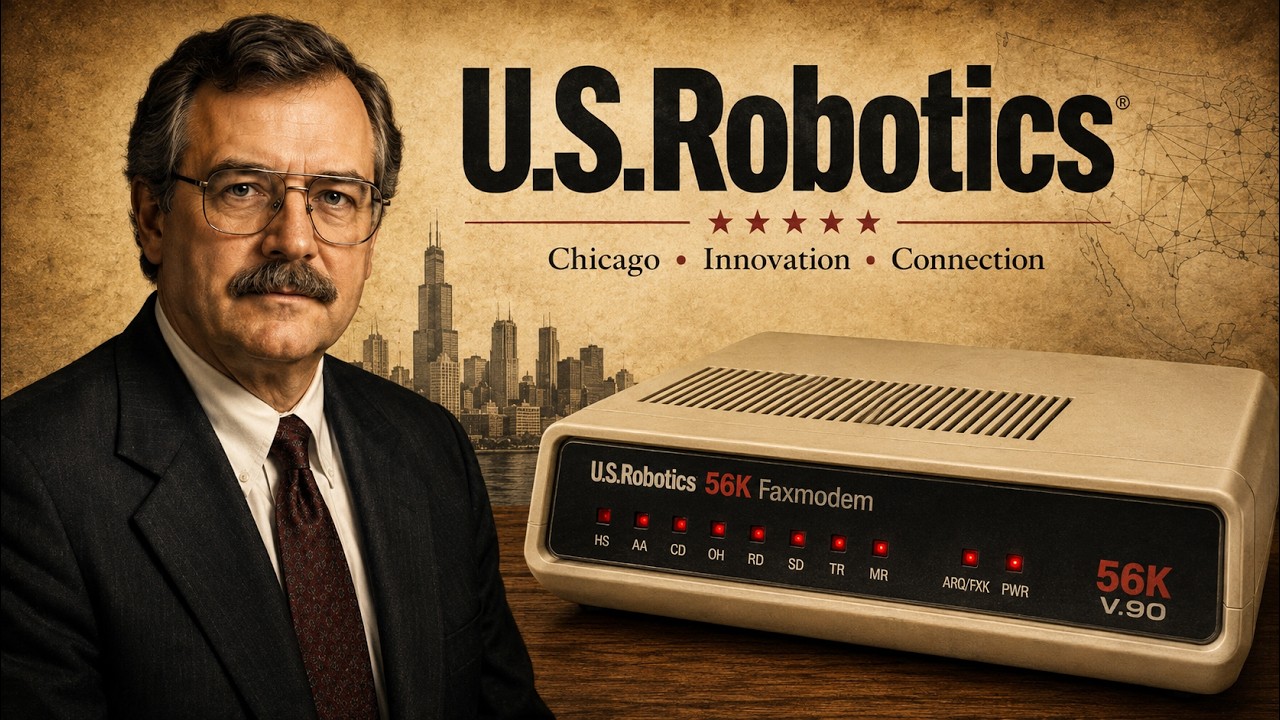
The nearest competitor charged over $700. Cowell and four friends from the University of Chicago had pooled their money to start the company. The total investment was $200. They named it US Robotics after the fictional corporation in Isaac Asimov’s novel I, Robot because they believed it would eventually become the greatest company in the known galaxy.
Within 21 years, a corporation in Santa Clara, California would pay $6. 6 billion to buy what those five graduates had built in that apartment. Within three years of that, the buyer would be trying to give it away. To understand what US Robotics built and why it mattered, you first have to understand the world before the modem existed in any affordable form.
In the mid-1970s, the American telephone network was a monopoly. AT&T controlled every wire, every switch, every handset that connected to its lines. The network had been built for one purpose only: carrying the human voice. If you wanted to send data between two computers, you could not simply plug a cable into a phone jack—that was illegal.
Instead, you placed a telephone handset into a padded rubber cradle called an acoustic coupler, and the device converted digital signals into audible tones that traveled over voice lines built for human conversation. The speeds were agonizing, measured in hundreds of bits per second. A single page of text could take minutes to crawl across the wire. And the equipment was expensive, engineered for universities and government labs, priced well beyond the reach of any individual buyer.
The personal computer barely existed as a concept, let alone a product. The Altair 8800 had appeared in January 1975 as a kit for hobbyists: a metal box with toggle switches and rows of blinking red lights on the front panel. It had no keyboard, no monitor, no storage. The Apple II would not ship until 1977.
The IBM PC was six years away. The idea that millions of ordinary Americans would someday sit in their living rooms, connect a home computer to a telephone line through a small plastic box, and communicate with servers on the other side of the country was not a business plan anyone with money would have funded in 1976. But at the University of Chicago, a small group of young men could see something forming in the distance between what computers could already do and what the telephone network refused to carry. Cowell had graduated with an economics degree in 1975 and briefly enrolled in a doctoral program at the University of Rochester before dropping out and returning to Chicago.
He understood markets and margins but knew nothing about circuit design. Paul Collard filled that gap. He was an Englishman born in Weston-super-Mare in 1952 who had studied applied physics at the University of Sussex and found work at the University of Chicago Computation Center. Collard understood electronics at the component level.
He could design a circuit board, solder a prototype, debug a signal path. Steve Muka was a third classmate. Between them, they had an economics degree, a physics degree, and access to a university machine shop. What they lacked was money, manufacturing capacity, and any reason to believe the world was ready for what they wanted to build.
Cowell’s original vision was ambitious: a keyboard with a built-in acoustic coupler that could connect to a television set, turning any TV into a computer terminal. He could not afford to manufacture it. They pivoted to the simplest thing Collard could design and Cowell could sell. They would build acoustic couplers, the rubber cradles themselves, and price them so far below the competition that the market would come to them.
The first units were cast in mahogany molds in Cowell’s apartment, assembled by hand on the kitchen table. Their first advertisement was a classified listing in Byte magazine. Parts ran $72 per unit, retail price $15. First-year revenue reached roughly $50,000, and about half of that came not from selling their own products but from distributing other companies’ equipment just to keep the operation solvent.
Then the regulatory landscape shifted. The Carterfone decision of 1968 had established the legal principle that non-AT&T devices could connect to the telephone network, but the practical rulemaking took more than a decade to work through the FCC. By 1979, the regulations were clear enough that a small manufacturer could legally sell a modem that plugged directly into the phone jack. No cradle, no handset, no intermediary.
The entire American telephone network was suddenly open territory for anyone with a circuit board and a reason to transmit data. The problem was that someone else had gotten there first. Hayes Microcomputer Products, founded in Atlanta in 1977, had launched the Smartmodem in 1981, a device so influential that its AT command set became the universal standard every modem would speak. Hayes had distribution, brand recognition, and a head start of several years.
US Robotics had moved from the apartment to a small office west of Chicago’s Loop that did not even have a shipping door. Packages had to be carried down a staircase by hand. In 1984, they relocated to a former pharmaceutical building in Skokie, Illinois. The modem became their sole product line.
And at the center of the engineering operation was still Paul Collard. Collard made a technical decision that would define US Robotics for the next 15 years. Instead of building modems around custom application-specific silicon, the way Hayes and most competitors did, he designed them around off-the-shelf digital signal processors, or DSPs. A modem built on a DSP could be upgraded with new firmware, new software loaded onto the same chip without replacing the hardware.
When a faster speed protocol emerged—and in the modem industry, they emerged every two or three years—a US Robotics customer did not need to throw away their modem and buy a new one. They downloaded an update. The hardware outlived its own specifications. In 1986, US Robotics launched the Courier HST.
The three letters stood for high-speed transfer, a proprietary protocol that delivered 9,600 bits per second at a time when the prevailing industry standard was 2,400. The Courier ran trellis encoding on Collard’s firmware-upgradeable DSP platform, which meant it was not simply fast at the moment of purchase. It improved as new speed thresholds appeared: 14,400 bits per second in 1989, 16,800 in 1992. Courier owners upgraded their firmware for free while owners of competing modems threw away their hardware and started over.
The Courier could negotiate speed automatically, reading line quality in real time and downshifting gracefully if conditions degraded rather than dropping the connection. The distribution strategy made it legendary. US Robotics offered steep discounts to BBS operators, the system operators who ran bulletin board systems, the community message boards and file-sharing servers of the pre-internet world. Sysop pricing ran around $264 in the early to mid-1990s.
The logic was elegant and merciless. If the best BBS in your area code ran a Courier, every caller to that board experienced the faster proprietary HST speed. And once you had connected at 9,600 bits per second, dialing into a board running a generic 2,400-baud modem felt like reading a novel through a keyhole. The sysops became evangelists.
Their callers became customers. A network effect built itself, BBS by BBS, area code by area code across the country. By the early 1990s, US Robotics held 43% of the American high-speed modem market. Then the internet arrived, and the country needed a modem all at once.
In 1991, Tim Berners-Lee published the first web page. In 1993, the Mosaic browser gave the World Wide Web a graphical face. AOL began mass-mailing floppy discs and later CDs to every mailbox in America, each one promising a free trial of the online world. Suddenly, connecting to the internet was something your neighbor did after dinner.
And every single one of them needed a modem. In 1993, the company reported $189 million in sales with 866 employees. In 1995, revenue reached $889 million with 5,100 employees. In 1996, revenue hit $1.
98 billion, a 122% increase in a single calendar year. New internet service providers multiplied across the country, and every one of them needed rack-mounted modems to handle thousands of simultaneous incoming dial-up calls. US Robotics answered with the Total Control hub, an enterprise-grade chassis that held dozens of modems in a single rack-mountable unit. In 1993, while the internet was still finding its audience, US Robotics introduced the Sportster.
The Courier had been built for professionals. The Sportster was built for everyone else. It ran on the same motherboard architecture as the Courier but stripped to the essentials, engineered for cost and priced to move. It became the bestselling desktop modem in the world.
The Sportster was the modem under the Christmas tree, its row of green LEDs flashing as the dial-up handshake screamed through the telephone speaker. That sound—the ascending shriek, the burst of tones, the rush of static as two machines negotiated a common language over copper wire built for a grandmother’s voice—became the sound of the American 1990s. But Casey Cowell was already looking past the modem. In September 1995, US Robotics acquired a small company called Palm Computing for $44 million.
Its founder, Jeff Hawkins, had spent years designing handheld computers. In the spring of 1996, US Robotics launched the Palm Pilot at $299 for the base model. It did four things: calendar, address book, to-do list, and memo pad. It shipped over a million units in its first 18 months, a faster consumer launch than the Sony Walkman, the pager, or the mobile phone.
By the end of 1997, the Palm Pilot held two-thirds of the American handheld market. Casey Cowell now ran a company that manufactured both the way into the internet and the first truly successful pocket computer. In early 1997, US Robotics made its bet on the next speed barrier. They developed a proprietary technology called X2, capable of transmitting data at 56 kilobits per second over ordinary phone lines.
Rockwell Semiconductor and Lucent Technologies backed a competing standard called K56Flex. The two camps split the industry. Neither faction won. The International Telecommunication Union stepped in and imposed V.
90, a unified standard that rendered both proprietary protocols obsolete. But in February 1997, the X2 gamble had not yet played out, and US Robotics looked like the most valuable modem company on Earth. On February 27, 1997, 3Com, a networking equipment manufacturer in Santa Clara, California, announced it would acquire US Robotics for $6. 6 billion.
The deal would create a combined company with over $5 billion in annual revenue and 12,900 employees, the second largest networking equipment firm in the world behind only Cisco Systems. The merger closed on June 12, 1997. And almost immediately, the logic behind it began to unravel. The theory was sound on paper: 3Com built the networking equipment that formed the backbone of corporate infrastructure; US Robotics built the modems that connected end users to those networks.
But the theory depended on one assumption that was already crumbling. It assumed dial-up modems would remain the primary way Americans connected to the internet. They would not. Cable modems and DSL lines were arriving, and they were faster than anything a telephone line could carry.
A 56K modem topped out at 56 kilobits per second under ideal conditions. A cable modem could deliver several megabits per second. The difference was not incremental. It was generational.
Neither 3Com nor US Robotics had built a competitive broadband product. The dismantling happened in stages. In March 2000, 3Com spun off Palm as an independent company. The Palm IPO was the most successful technology offering of the year.
The $44 million acquisition Casey Cowell had made in 1995 turned out to be the single most valuable asset in the entire merger, and 3Com gave it away. Three months later, in June 2000, 3Com spun off US Robotics itself, folding it into a joint venture with Accton Technology of Taiwan and NatSteel Electronics of Singapore. Then the layoffs came. By May 2001, 3Com had cut 4,200 workers across two rounds of reductions, a 30% reduction in total headcount.
In 2009, Hewlett-Packard acquired 3Com itself for $2. 7 billion—less than half of what 3Com had paid for US Robotics alone 12 years earlier. The brand kept falling. In 2005, Platinum Equity acquired US Robotics for an estimated $30 to $50 million.
In 2013, Unicom Global bought US Robotics and folded it into its portfolio of legacy technology businesses. Paul Collard did not live to see any of it. He had left the modem industry in 1987, after attending a lecture on concentrated solar power and becoming convinced that photovoltaic energy mattered more than data transmission. He founded a company called Midway Labs to build concentrator solar electric panels.
He died on December 28, 2005 at his home in Chicago. He was 53 years old. The machines he designed had connected millions of Americans to the internet. His name appeared in no headline.
Today, US Robotics still exists. It operates as a division of Unicom Global with roughly 125 employees and annual sales of approximately $144 million. It still manufactures 56K dial-up modems along with cellular gateways and network monitoring equipment. The Courier is still manufactured for corporate security applications and remote management.
On eBay, old models endure, changing hands among collectors who remember what it felt like to hear that handshake negotiate for the first time on a clear phone line. $200. That is what it cost to start US Robotics. Five friends from the University of Chicago pulling their money on a kitchen table in Hyde Park in 1976, casting acoustic couplers in mahogany molds, selling them for $15 when the competition charged $700.
That $200 built a company that employed nearly 6,000 people, generated $2 billion a year in revenue, put modems in millions of American homes, and launched the Palm Pilot. It was acquired for $6. 6 billion, dismantled within three years, and sold for scrap twice over. US Robotics did not miss the future.
They built the on-ramp to it. The future just did not need an on-ramp anymore.
