On the morning of December 9th, 1889, Sheriff William Tate climbed down a wooden ladder into the darkness beneath the altar of the Ezekiel Chapel and stopped counting the men at fourteen. They lay chained along the north and south walls of a limestone chamber, iron collars around their necks, each man secured to the rock by a bolt driven deep into the stone. The air was thick with the smell of human waste and unwashed bodies and infected tissue. The men watched him with blank eyes, neither hopeful nor despairing.
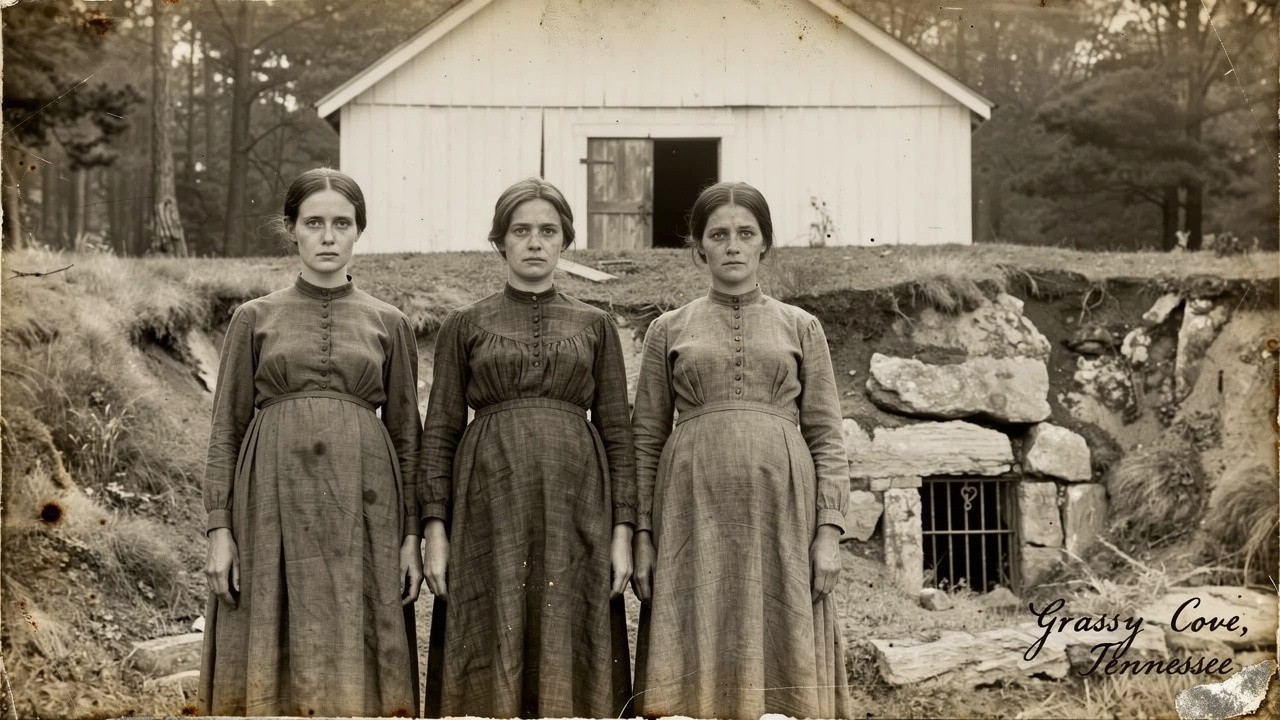
One of them, a lumber mill worker named Samuel Dockery, would later say he had been down there for more than four years. How the chapel became a prison, and how a congregation of faithful worshippers could gather above it every Sunday for years without knowing what lay beneath their feet, is a story that begins with an old preacher’s theology and ends with nine unmarked graves in a clearing the sisters called the garden of correction. The Ezekiel Chapel stood at the end of a dirt track three miles from the nearest road, in the limestone hollows of southeastern Tennessee, hemmed in on three sides by second-growth oak forest so dense that sunlight reached the forest floor only for the two hours around noon. The nearest occupied homestead was a mile and a quarter to the south, separated from the chapel by a steep ravine cut by a creek that ran only during the wettest months.
The settlement of Grassy Cove itself consisted of nineteen families scattered across eleven square miles of forested ridgeline. It was country where the unwritten law of non-interference in family matters held authority that surpassed any statute written in Nashville. Mountain code dictated that what happened on a man’s land or within a family’s walls remained their concern alone, unless it spilled into the community in a way that could not be ignored. Isolation created its own moral physics.
Distance became permission. The inability to see became the decision not to know. The Grimshaw family had occupied the land since 1878, when Reverend Josiah Grimshaw, a Methodist circuit rider from North Carolina, purchased 87 acres of forested slope and established both his homestead and his ministry. He built the chapel with his own hands over the course of fourteen months, felling the timber, milling the boards, raising the walls and roof while his three daughters, Mercy, Temperance, and Silence, carried water and drove nails under his instruction.
The community remembered him as a man of fierce conviction and limited warmth, a preacher whose sermons dwelt frequently on themes of submission, obedience, and the wages of defiance against divine order. The daughters were known in Grassy Cove as competent, quiet, and unnaturally devoted to their father’s work. Mercy, the eldest at 31 in 1889, kept the chapel’s attendance records and led the women’s prayer circle. Temperance, 29, served as organist and taught scripture to children on Sunday afternoons.
Silence, 26, maintained the building itself and prepared the simple meals served after services. All three had remained unmarried, a fact that occasioned some quiet speculation among the settlement’s women but nothing approaching scandal. Their father had taught them to read using only the Bible. They owned four dresses among them.
They spoke when spoken to and otherwise kept their peace. In the final two years of his life, Josiah Grimshaw’s preaching grew increasingly consumed with what he described in letters as the feminization of modern worship and the erosion of biblical patriarchy. His wife Ruth had died in 1883 after a fall from a ladder while repairing the cabin roof, a task Josiah had assigned her while he prepared his Sunday sermon. Her death, rather than producing grief or self-examination, appeared to calcify his belief that suffering and submission were the tools by which God refined the soul.
He began preaching a doctrine he called dominion theology, which held that men were not merely leaders of households and congregations but physical embodiments of divine authority, and that any man who failed to occupy that role fully was in rebellion against God’s design. He preached that women, having been created second and having introduced sin into the world, bore a permanent debt to male authority. He preached that discomfort, hunger, and confinement were spiritual disciplines that burned away pride. His daughters absorbed these teachings with a completeness that would have troubled him had he lived to see it applied.
Josiah Grimshaw died in February of 1885 at the age of 61, after a stroke that left him paralyzed on his left side. For the final eleven days of his life, he was bedridden in the cabin, unable to speak, dependent on his daughters for food, water, and the management of his bodily functions. Mercy would later state in testimony that those eleven days had been revelatory: watching their father experience utter helplessness had clarified for them the central truth of his own theology in a way his sermons never had. They buried him behind the chapel on February 19th, 1885.
On April 2nd of that same year, they brought the first man into the cellar. The mechanism of capture was simple. The chapel remained open to travelers. The sisters continued to offer water, food, and a place to rest to any man who walked the three miles up the track and knocked on the door.
The men who accepted this hospitality were men without companions, men traveling alone, men whose absence would not be immediately noted. Once inside, the sisters would offer them a cup of water mixed with a tincture of laudanum purchased in bulk from a pharmacy in Chattanooga under the pretense of treating chronic pain. The dosage was sufficient to produce deep sleep within twenty minutes. The sisters would then drag the unconscious man to the hatch, lower him into the cellar, and collar him before he woke.
The cellar itself had been excavated from the limestone bedrock beneath the chapel floor, measuring approximately 38 feet in length, 18 feet in width, and 7 feet in height at its center point. A cast-iron stove stood in the northwestern corner, vented through a pipe that protruded from the chapel’s rear wall at ground level. Four oil lamps hung from iron hooks driven into the rock overhead. A journal kept by Temperance Grimshaw described the process in language that was both precise and devoid of any recognition that what was being documented was criminal.
She wrote that the selection of men was guided by prayer and by their father’s teachings. They sought men who displayed arrogance, entitlement, or an assumption that service from women was owed rather than offered. The goal was never to destroy these men, but to humble them, to let them live for a season as their father had lived in his final days, dependent and powerless, so that they might emerge with a proper understanding of what authority truly cost. The journal also noted that the sisters rotated responsibility for feeding the men, cleaning the cellar, and tending to injuries or illness.
They held a weekly meeting in which they discussed each man’s progress toward humility and decided whether additional time in confinement was warranted. They prayed over the men each Sunday before ascending to conduct the regular worship service with the congregation that gathered above, unaware of what lay beneath their feet. In the cellar, each man was secured to the wall by an iron collar fastened around his neck and connected to a chain bolted into the rock. The chains were of varying lengths, the shortest permitting a range of movement of approximately four feet, the longest extending nearly eight.
Each man was provided with a straw pallet, a wool blanket, and a wooden bucket. In a wooden cabinet against the western wall, the sisters kept a leather-bound ledger in which they recorded the name, approximate age, date of capture, and physical condition of each man brought into the space. The entries were written in a meticulous hand, in black ink, with no corrections or cross-outs. Each man was assigned a number.
Each man’s daily condition was noted in a single sentence. The language was clinical. There was no expression of emotion. There was no commentary on whether the men deserved what was being done to them.
There was only documentation. A wooden crate held fourteen sets of clothing, folded and stacked, labeled with the numbers corresponding to the men in the ledger. The clothing had been taken from the men at the time of their capture and preserved. The condition of the garments suggested that the sisters had intended at some point to return them.
On the final page of the ledger was a list of nine additional names, each marked with a small cross. These were men who had been held in the cellar and had died there. The ledger noted the date of death for each. The causes were recorded as fever, infection, pneumonia, and in two cases, refusal to eat.
The ledger also noted the location where each body had been buried. All nine graves were located in the forest behind the chapel, in a clearing the sisters referred to in their notes as the garden of correction. The discovery might have come sooner had anyone followed the small incongruities. Thomas Brennan, a widower who operated a gristmill two miles west of the chapel, delivered fifty pounds of cornmeal to the Grimshaw sisters on the first Saturday of every month for more than three years.
He had noticed on at least four occasions that the chapel’s cellar door stood open despite the temperature being well below freezing, and had observed what appeared to be steam rising from the entrance, suggesting the presence of warm bodies below ground. He assumed the sisters were storing livestock in the space to protect them from the cold. He never asked for clarification. Silas Tutwiler, the proprietor of the settlement’s general store, sold the Grimshaws an estimated eleven cords of hardwood per year, enough to heat a structure far larger than their cabin, and flour, salt pork, and dried beans in amounts that suggested they were feeding more than three people.
He never questioned them about their purchases. The Grimshaws paid in cash and caused no trouble. Constance Merritt, a midwife, heard men’s voices coming from beneath the chapel during a Sunday service in 1887, but assumed she was hearing the acoustics of wind moving through the limestone hollow below the building. Elijah Croft, a traveling preacher, visited the chapel in 1888 and noticed the altar seemed unusually warm to the touch, as though heat were rising through the floorboards.
He did not pursue the observation. When pressed by the prosecution, each of these witnesses acknowledged that they had chosen not to investigate further, not to ask questions, not to involve the sheriff. Each cited mountain code. Each cited the respect owed to a preacher’s daughters.
Each admitted that they had suspected something was wrong, but had preferred the comfort of uncertainty to the burden of knowledge. It took a traveling physician named Dr. Marcus Holcomb to break the pattern. On the morning of December 3rd, 1889, beneath skies so heavy with coming snow that the light at eight in the morning resembled twilight, Holcomb arrived at the Ezekiel Chapel with the intention of treating a congregant’s daughter for scarlet fever.
Mercy Grimshaw met him at the entrance and informed him that the sick child was resting in the small cabin the family maintained a hundred yards behind the chapel. She offered to walk him there. Her manner, as Holcomb would later describe in his affidavit, was calm and correct, her gaze steady, her voice devoid of anything that might suggest deception or distress. They had walked perhaps thirty yards from the chapel when Holcomb heard a sound like iron dragging across stone, muffled but unmistakable, emanating from beneath the ground where they just stood.
He stopped. He asked Mercy what the sound had been. She informed him, with the same untroubled composure she had shown at the door, that the chapel had been built over a natural limestone hollow and that shifting rock sometimes produced unusual acoustics. Holcomb accepted this explanation and continued walking.
It was only when he returned to the chapel from the doorway of the cabin some minutes later that he noticed the chimney. The structure had no visible stove or fireplace that would require a chimney. Yet a thin column of smoke rose from a metal pipe that protruded from the chapel’s rear wall at ground level, exactly where a basement or cellar would exhaust heat if such a space were being warmed in winter. Holcomb treated the child.
He accepted the sister’s payment. He returned to his horse. But the detail of the chimney remained with him, an incongruity he could not reconcile with the explanation he had been given. Three days later, Holcomb returned to Grassy Cove and made inquiries at the general store.
Tutwiler confirmed that the Grimshaw sisters purchased firewood in quantities that seemed excessive for a household of three women and a single small cabin. He also noted that the sisters purchased flour, salt pork, and dried beans in amounts that suggested they were feeding more than three people. When Holcomb asked whether Tutwiler had ever questioned the sisters about their purchases, Tutwiler replied that he had not, that it was not his place to audit a customer’s household, and that the Grimshaws paid in cash and caused no trouble. Holcomb rode nine miles to the Cumberland County seat in Crossville and presented his observations to Sheriff William Tate, a man who had held his position for fourteen years and who was known for his reluctance to intervene in matters involving churches or clergy.
Tate listened to Holcomb’s account, acknowledged that the details were irregular, but stated that irregularity alone did not constitute grounds for a search. Holcomb pressed. He invoked the sound he had heard. He invoked the chimney.
He invoked the quantities of food. Tate agreed, with visible reluctance, to accompany Holcomb back to Grassy Cove and to speak with the Grimshaw sisters himself. They arrived at the chapel on the afternoon of December 9th. The temperature had dropped to nineteen degrees.
The ground was frozen. Smoke rose from the inexplicable chimney. Mercy Grimshaw met them at the door and invited them inside with the same steady courtesy she had shown Dr. Holcomb three times before.
The interior of the chapel measured forty feet by twenty-two feet, with ten rows of rough-hewn pews arranged in two columns and a small raised platform at the eastern end where the pulpit stood. Sheriff Tate asked Mercy whether the chapel contained a cellar. She informed him that it did, that the space had been dug by her father to store hymnals and communion supplies in a cool dry environment. Tate asked to see it.
Mercy informed him that the entrance was located behind the altar and that she would be pleased to show him. She walked to the eastern end of the chapel, stepped onto the raised platform, and lifted a section of the altar cloth to reveal a wooden hatch set flush with the floor. The hatch measured three feet square. It was secured with a padlock.
Mercy produced a key from the pocket of her dress and unlocked it. She lifted the hatch. The smell that rose from the opening was immediate and overwhelming: a combination of human waste, unwashed bodies, wood smoke, and something else that Holcomb would describe in his affidavit as the scent of infected tissue. When Sheriff Tate climbed back up the ladder and confronted Mercy Grimshaw with what he had found, she did not deny it.
She did not attempt to flee. She stood in the chapel, her hands folded at her waist, and informed him that what she and her sisters had done had been done in obedience to a principle their father had taught them before his death. A principle rooted in scripture and in the natural order established by God. Tate asked her to explain the principle.
Mercy stated that her father had preached that men were created to lead and women to serve, that this hierarchy was divine and immutable, and that any man who wandered alone without family or church was a man who had abandoned his God-given role and had made himself subject to correction. She stated that the men in the cellar had been wanderers, drifters, men without wives or congregations, men who had forfeited their authority by refusing to exercise it properly. She and her sisters had placed these men under their own authority as an act of scriptural correction, to teach them through confinement and dependency what it meant to exist without power, without choice, without the ability to command or decide. She stated that they had fed the men.
They had kept them warm. They had committed no cruelty. They had simply inverted the order for a season so that these men might understand what submission felt like and emerge humbled. Tate asked her whether she understood that what she described was imprisonment.
Mercy replied that imprisonment was a legal term, and that legal terms applied to the lawless, not to those acting under divine instruction. Tate placed her under arrest. He placed Temperance and Silence under arrest. He sent for a deputy and a wagon to transport the sisters to Crossville.
He sent for Dr. Holcomb to examine each of the fourteen men and document their injuries. Holcomb’s examination, documented in a twelve-page report submitted to the court on December 20th, 1889, found evidence of healed fractures, poorly set and likely sustained during the initial struggle or fall into the cellar. He found chronic malnutrition in three of the men despite the sisters’ insistence that they had been fed adequately.
He found infections that had been treated with poultices but no formal medical intervention. He found psychological damage that he described as profound, noting that several of the men exhibited symptoms consistent with extreme learned helplessness, including inability to make decisions, lack of affect, and resistance to the idea of leaving the cellar even after being told they were free to do so. The trial of Mercy, Temperance, and Silence Grimshaw commenced on March 4th, 1890, in the Cumberland County Courthouse in Crossville, before Judge Amos Whitfield, a jurist who had presided over the circuit court for twenty-three years. The prosecutor, a Nashville attorney named Gerald Aston, built his case on the ledger, the journal, the medical testimony, and the sworn statements of the fourteen survivors.
The evidence was presented in chronological order, beginning with the first entry in the ledger and ending with the testimony of the last man freed from the cellar. The most devastating moment of the trial occurred on March 9th, when the prosecution entered into evidence a letter written by one of the nine men who died in captivity. The letter had been found folded inside the ledger. It was addressed to no one.
It was written in pencil on a torn scrap of paper. The man, identified through handwriting analysis as Jacob Turley, 42 years old, a former school teacher from McMinnville, had written that he no longer understood why he was being kept, that he had apologized for whatever offense the sisters believed he had committed, that he had begged for release, and that he had received no answer except the daily portion of cornmeal and the weekly assurance that his humbling was not yet complete. The letter ended mid-sentence. The final line read: “I think I will not see summer.
” Jacob Turley had died on May 12th, 1887, of pneumonia, according to the ledger. He had been held for twenty-six months. The defense, led by an attorney named Orville Preston, argued that the sisters had acted not out of malice but out of sincere religious conviction, that they had been taught by their father to view submission and suffering as instruments of spiritual correction, and that they genuinely believed they were performing an act of ministry. Preston called no witnesses.
He entered no evidence. He asked the jury to consider whether the sisters’ isolation, their lack of education outside of scripture, and their father’s theological extremism had rendered them incapable of understanding that what they were doing was criminal. When asked by the judge whether the sisters wished to make a statement before the verdict, Mercy Grimshaw rose and addressed the court. She informed the court that she and her sisters had acted in obedience to principles they believed to be sacred.
She stated that they had not sought to harm the men but to instruct them. She stated that suffering, when endured for the purpose of correction, was not cruelty but love. She stated that she did not expect the court to understand that the law of men and the law of God were not the same, and that she and her sisters would accept whatever judgment was rendered with the same submission they had sought to teach. The jury deliberated for four hours.
They returned a verdict of guilty on all counts. The charges included kidnapping, false imprisonment, and in the case of the nine men who died, manslaughter. Judge Whitfield sentenced each of the three sisters to twenty-five years of hard labor at the Tennessee State Penitentiary in Nashville. At sentencing, the judge stated that the crime before him was made more terrible not by its violence but by its patience, that the sisters had operated with a level of care and record keeping that suggested they believed their actions to be not only justified but righteous, and that the corruption of faith into a tool for control was among the darkest perversions the court could imagine.
Of the fourteen men freed from the cellar, eleven survived the first year after their release. Three died within six months, two from pneumonia and one from what Dr. Holcomb described as a wasting condition brought on by prolonged despair. The survivors scattered.
Samuel Dockery returned to Pikeville and resumed work at the lumber mill, though co-workers would later report that he no longer spoke unless directly addressed. A man named Thomas Pine, 23 years old, relocated to Knoxville and found work as a night watchman, a position that allowed him to avoid enclosed spaces during daylight. Another named Garrett Hollis, 41 years old, was committed to the state asylum in 1893 after attempting to chain himself to a tree behind his sister’s home, stating that he felt safer restrained than free. The Ezekiel Chapel was burned to the ground on January 6th, 1891, by parties unknown.
The county sheriff’s office investigated but made no arrests. The foundation stones and the cellar remained. Over the following decade, the forest reclaimed the site. By 1900, only those who had lived in Grassy Cove during the trial years remembered exactly where the chapel had stood.
No procedural changes resulted from the case. No law was written to prevent similar acts. The state of Tennessee made no formal review of isolated churches or religious communities operating without denominational oversight. The case was documented, archived, and largely forgotten outside the county where it occurred.
Mercy Grimshaw died in prison in 1902 at the age of 44, of tuberculosis. Temperance Grimshaw died in 1907 at the age of 47, of the same disease. Silence Grimshaw, the youngest, served her full sentence and was released in 1915. She returned to Grassy Cove, lived in a one-room cabin two miles from where the chapel had stood, and died in 1921 without having spoken, according to those who encountered her in her final years, more than a handful of words to anyone.
The forest that surrounded the chapel site remains today. Second-growth oak and hickory, dense and quiet. The limestone hollow still collects fog on winter mornings. The ridges still isolate the families who live there from one another and from the mechanisms of oversight that function more easily in open country.
The land does not remember what happened beneath it. The land does not judge. It only permits, through distance and silence, the kinds of conviction that require darkness to sustain themselves.
